# Eternity Async Tutoring

**URL:** https://discuss.criticalfallibilism.com/t/eternity-async-tutoring/1932
**Category:** Tutoring
**Created:** [April 17, 2024, 11:22pm UTC](https://discuss.criticalfallibilism.com/t/eternity-async-tutoring/1932 "2024-04-17T23:22:52Z")
**Posts on this page:** 20
**Page:** 26

<div class="post-metadata">

### Author: ![Elliot](https://discuss.criticalfallibilism.com/user_avatar/discuss.criticalfallibilism.com/elliot/32/14_2.png) [@Elliot](https://discuss.criticalfallibilism.com/u/Elliot)
#### Post date: [August 13, 2024, 11:10pm UTC](https://discuss.criticalfallibilism.com/t/eternity-async-tutoring/1932/502 "2024-08-13T23:10:15Z")

</div>

> After you throw a small, red ball, while you sing, you should stamp your feet loudly, and you should clap your hands energetically, if it’s still daytime.

> [@Eternity](#):
>
> - 1.) after a small red ball is thrown while singing at the same time

no

> [@Eternity](#):
>
> 2.) then you should stamp your feet loudly and clap your hands energetically while singing

yes, the singing goes with the stamping and clapping

can you tell which it is with intuition? like if someone said it to you, do you know what you’d think they meant? i don’t think you should worry about figuring this detail out with grammar rules right now.

---

<div class="post-metadata">

### Author: ![Eternity](https://discuss.criticalfallibilism.com/user_avatar/discuss.criticalfallibilism.com/eternity/32/5930_2.png) [@Eternity](https://discuss.criticalfallibilism.com/u/Eternity)
#### Post date: [August 13, 2024, 11:37pm UTC](https://discuss.criticalfallibilism.com/t/eternity-async-tutoring/1932/503 "2024-08-13T23:37:32Z")

</div>

> [@Elliot](#):
>
> can you tell which it is with intuition? like if someone said it to you, do you know what you’d think they meant?

If someone _said_ it to me I think I would but probably due to stuff like putting emphasis on certain parts when they talk and what not. Intuitively, I thought singing goes with the red ball being thrown.

> [@Elliot](#):
>
> i don’t think you should worry about figuring this detail out with grammar rules right now.

Ok. I’ll move onto part three then and look at those articles on infinitives you shared earlier.

---

<div class="post-metadata">

### Author: ![Eternity](https://discuss.criticalfallibilism.com/user_avatar/discuss.criticalfallibilism.com/eternity/32/5930_2.png) [@Eternity](https://discuss.criticalfallibilism.com/u/Eternity)
#### Post date: [August 15, 2024, 12:22am UTC](https://discuss.criticalfallibilism.com/t/eternity-async-tutoring/1932/504 "2024-08-15T00:22:35Z")

</div>

> [@Elliot](#):
>
> Cool. What are some adjustments you’ve made as you got further along? Patterns you’ve noticed or strategies you’ve been using?

Uhh. I don’t know. If desired, I could probably write down my thought processes as I do a level.

I just glanced at a level I haven’t beat yet (and still haven’t as I write this) and I would roughly say my process playing through the game has been:  
1.) Do random stuff, read text, figure out what’s going on in the level  
2.) After getting a feel for the level, really read the text blocks and where they are  
3.) Levels imply what they want you to do. Trust it. Most of the time they hint at what they want done. The puzzle is figuring out what they want done. So step 3 is figure out what the level is implying to beat it.  
4.) Try and solve the puzzle.  
5.) If you still haven’t solved it, give it a little more time and then re-judge if there is another way this puzzle can be approached. Keep repeating until beaten.

That’s it really. I would add to it that while I do break the level into parts. I’m usually breaking the whole idea I feel the level is implying into parts. I think the level wants me to do X for a solution. Ok so what are all the steps to get X to work? Well I need “rock is push” for example, ok. The blocks “rock” “is” and “push” are in terrible spots, so I’ll focus on getting those things together before thinking of the rest of the puzzle.

EDIT:  
So to answer your question: I could probably note down some stuff I’ve noticed, but strategy is the same as from when I started I feel. No real conscious adjustments to how I approach the game. I’ve just played a good bit every day, so I feel more comfortable with the game and with how things work.

---

<div class="post-metadata">

### Author: ![Elliot](https://discuss.criticalfallibilism.com/user_avatar/discuss.criticalfallibilism.com/elliot/32/14_2.png) [@Elliot](https://discuss.criticalfallibilism.com/u/Elliot)
#### Post date: [August 17, 2024, 3:25pm UTC](https://discuss.criticalfallibilism.com/t/eternity-async-tutoring/1932/505 "2024-08-17T15:25:27Z")

</div>

Any problems or just busier recently?

---

<div class="post-metadata">

### Author: ![Eternity](https://discuss.criticalfallibilism.com/user_avatar/discuss.criticalfallibilism.com/eternity/32/5930_2.png) [@Eternity](https://discuss.criticalfallibilism.com/u/Eternity)
#### Post date: [August 17, 2024, 10:18pm UTC](https://discuss.criticalfallibilism.com/t/eternity-async-tutoring/1932/506 "2024-08-17T22:18:00Z")

</div>

Mmm. A bit of both. I was very busy near the end of last week and then this week I just got sick near the start of it. Getting sick made it hard to do the sentence analysis and stuff. I didn’t know how hard it actually was for me versus how much of it was difficulty focusing because I was sick. I think I had covid? Tested negative but I had it before and it felt the same. Idk.

I did finish reading the article yesterday. I started feeling better today. I spent most of my time in bed just playing more Baba. I beat 211 levels at 75 hours.

I’m going to work on the sentence analysis for part 3 and 4 now. I’ll try and not spend too much time on any sentence and note down any confusions I have.

---

<div class="post-metadata">

### Author: ![Eternity](https://discuss.criticalfallibilism.com/user_avatar/discuss.criticalfallibilism.com/eternity/32/5930_2.png) [@Eternity](https://discuss.criticalfallibilism.com/u/Eternity)
#### Post date: [August 18, 2024, 12:02am UTC](https://discuss.criticalfallibilism.com/t/eternity-async-tutoring/1932/507 "2024-08-18T00:02:02Z")

</div>

Part 3 Sentence Analysis, ~55 minutes:

> Running fast isn’t fun

- isn’t = is not, so “Running fast is not fun.”
- is - linking verb
- running - subject, gerund
- fun - complement
- modifiers:
  - fast is an adjective modifying running
  - not is an adverb modifying is

- Running in a manner that is considered fast is not enjoyable.

> I don’t want to stand on my porch when it’s wet.

- don’t = do not, it’s = it is, so " I do not want to stand on my porch when it is wet."
- do - action verb, is - linking verb
- “I do not want to stand on my porch” is joined together with " it is wet" with the conjunction “when”.
  - “I do not want to stand on my porch”
    - do - action verb
    - I - subject
    - want - object?, infinitive?
    - modifiers:
      - not is an adverb modifying want
      - to stand on my porch is a prepositional phrase modifying want
        - to is the preposition
        - porch is the noun governed by to
        - my is modifying porch
          - stand on is a prepositional phrase modifying porch modifying? Idk. This one confuses me

  - “It is wet”
    - is - linking verb
    - It - subject, refers to my porch
    - wet - complement
    - no modifiers

  - When my porch is wet, I do not do the action of wanting to stand on my porch.

> Swimming after work is too tiring.

- is - linking verb
- swimming - subject, gerund
- tiring - complement
- modifiers:
  - after work is a prepositional phrase modifying swimming
    - after is the preposition
    - work is the noun governed by after

  - too is an adverb modifying tiring

- Swimming after work is very tiring.

> John gets sweaty when he does his exercise routine.

- gets - action verb, does - action verb
- “John gets sweaty” is joined together with “he does his exercise routine” with the conjunction “when”.
  - “John gets sweaty”
    - gets - action verb
    - John - subject
    - sweaty - object, gerund?
    - no modifiers

  - “he does his exercise routine”
    - does - action verb
    - he - subject, he refers to John
    - routine - object
    - modifiers:
      - his is a reference adjective modifying routine
      - exercise is a participle? modifying routine

  - John has a routine. That routine is for exercise. It is his routine. When John does that routine, he gets sweaty.

> I gave him gifts.

- gave - action verb
- I - subject
- gifts - object
- modifiers:
  - him is a reference adjective modifying gave?

- I gave gifts. I gave gifts specifically to a him.

> I love to throw boomerangs to myself.

- love - action verb
- I - subject
- no object
- modifiers:
  - to throw boomerangs is a prepositional phrase modifying love
    - to is the preposition
    - boomerangs is the noun governed by to
    - throw is a participle modifying boomerangs

  - to myself modifies throw
    - to is the preposition
    - myself is the noun governed by the preposition

- I love to throw boomerangs if the person I’m throwing them to is myself.

> When a movie is boring, I stop watching.

- is - linking verb, stop - action verb
- “I stop watching” is joined together with “a movie is boring” with the conjunction when.
  - “I stop watching”
    - stop - action verb
    - I - subject
    - watching - object, gerund

  - “a movie is boring”
    - is - linking verb
    - movie - subject
    - boring - gerund, complement or is it a participle?
    - modifier:
      - a modifies movie

  - If any movie I am watching is boring, then I will stop watching it.

> I like reading non-fiction books out of order.

- like - action verb
- I - subject
- reading non-fiction books - object, gerund
  - non-fiction books is the object of reading

- modifiers:
  - out of order is a prepositional phrase modifying reading
    - out of is the preposition
    - order is the noun governed by out of

  - non-fiction modifies books

- If I’m reading books that are of the non-fiction variety, I like to read them out of their specified order.

> My broken speakers don’t work for making sound.

- don’t = do not, so “My broken speakers do not work for making sound.”
- do - action verb
- speakers - subject
- work - object
- modifiers:
  - my modifies speaker
  - broken modifies speaker
  - not modifies work
  - for making sound is a prepositional phrase modifying do
    - for is the preposition
    - making sound is a gerund governed by for
      - sound is the object of making

- For the purpose of making sounds, my speakers, which are broken, do not work.

> FYI, working at the CIA is cooler than the FBI.

- FYI = For your information, CIA = Central Intelligence Agency, FBI = Federal Bureau of Investigations, so “For your information, working at the Central Intelligence Agency is cooler than the Federal Bureau of Investigation.”
- is - linking verb
- working - subject, gerund
- cooler - complement
- modifiers:
  - for your information is a prepositional phrase modifying? Idk
  - at the CIA is a prepositional phrase modifying working
    - at is the preposition
    - the modifies CIA
    - CIA is the noun governed by at

  - than the FBI is a prepositional phrase modifying cooler?
    - than is the preposition
    - the modifies FBI
    - FBI is the noun governed by than

---

<div class="post-metadata">

### Author: ![Eternity](https://discuss.criticalfallibilism.com/user_avatar/discuss.criticalfallibilism.com/eternity/32/5930_2.png) [@Eternity](https://discuss.criticalfallibilism.com/u/Eternity)
#### Post date: [August 18, 2024, 2:10am UTC](https://discuss.criticalfallibilism.com/t/eternity-async-tutoring/1932/508 "2024-08-18T02:10:46Z")

</div>

Hmm. It could be because I’m tired and I’m still recovering, but the practice for part 4 is confusing me. Here’s the first sentence:

> John pet his dog and cat with vigor.

- Marking  
`	- {<John> <pet> <his dog>} and {<cat> <with vigor>}`
- Outline
  - {John pet his dog} and {cat}.

- Questions
  - What action happened? Pet
  - Who pet? John
  - What was pet? Johns dog and cat
  - How was the petting performed? With vigor

Its mainly the outlining stuff. Is that outline fine? Is their necessarily a “correct” outline? I assume not. Its just a way to organize the important parts of the sentence right? I think since its kind of open ended I’m unsure as to what should be in an outline of a sentence.

---

<div class="post-metadata">

### Author: ![Elliot](https://discuss.criticalfallibilism.com/user_avatar/discuss.criticalfallibilism.com/elliot/32/14_2.png) [@Elliot](https://discuss.criticalfallibilism.com/u/Elliot)
#### Post date: [August 18, 2024, 2:45pm UTC](https://discuss.criticalfallibilism.com/t/eternity-async-tutoring/1932/509 "2024-08-18T14:45:13Z")

</div>

> [@Eternity](#):
>
> to throw boomerangs is a prepositional phrase modifying love
> 
> - to is the preposition
> - boomerangs is the noun governed by to
> - throw is a participle modifying boomerangs

“to throw” is an infinitive.

> [@Eternity](#):
>
> him is a reference adjective modifying gave?

where did you get the term “reference adjective”?

> [@Eternity](#):
>
> > My broken speakers don’t work for making sound.

Can you list all non-finite verbs in this sentence and their types? (The article’s term “verbal” means “non-finite verb” but I don’t usually use “verbal” anymore.)

> [@Eternity](#):
>
> > FYI, working at the CIA is cooler than the FBI.

This sentence needs an implied word.

Check other people’s solutions and see if that helps with anything.

> [@Eternity](#):
>
> Marking  
> `	- {<John> <pet> <his dog>} and {<cat> <with vigor>}`

This isn’t correct. You’re saying there are two clauses. But is there a verb in the second clause?

---

<div class="post-metadata">

### Author: ![Eternity](https://discuss.criticalfallibilism.com/user_avatar/discuss.criticalfallibilism.com/eternity/32/5930_2.png) [@Eternity](https://discuss.criticalfallibilism.com/u/Eternity)
#### Post date: [August 18, 2024, 4:43pm UTC](https://discuss.criticalfallibilism.com/t/eternity-async-tutoring/1932/510 "2024-08-18T16:43:35Z")

</div>

> [@Elliot](#):
>
> where did you get the term “reference adjective”?

From your article. From [Fallible Ideas - Grammar](https://fallibleideas.com/grammar):

> **Reference adjectives** are similar to pronouns, but they’re adjectives like “my”. In “John liked his job.”, the adjective “his” refers to “John” and means “John’s”. (These adjectives are also possessive.)

Its in part 3, under the section _References_.

---

<div class="post-metadata">

### Author: ![Elliot](https://discuss.criticalfallibilism.com/user_avatar/discuss.criticalfallibilism.com/elliot/32/14_2.png) [@Elliot](https://discuss.criticalfallibilism.com/u/Elliot)
#### Post date: [August 18, 2024, 5:04pm UTC](https://discuss.criticalfallibilism.com/t/eternity-async-tutoring/1932/511 "2024-08-18T17:04:57Z")

</div>

Oh OK. It’s not a standard term and I forgot about it. It’s not very important/necessary but it makes sense. For words like “his” and “my” the dictionary says “possessive determiner” which is fine but neither of those terms specifies that it _refers_ to something else like a pronoun does. FYI, “determiner” is a sub-category of adjective – a type of adjective. Some people may claim otherwise but ignore them.

Proadjective is another made-up term that would make reasonable sense (meaning “like a pronoun but an adjective”. the “pro” part means “in place of”).

However, “him” isn’t any type of adjective. The dictionary just says “pronoun”.

---

<div class="post-metadata">

### Author: ![Eternity](https://discuss.criticalfallibilism.com/user_avatar/discuss.criticalfallibilism.com/eternity/32/5930_2.png) [@Eternity](https://discuss.criticalfallibilism.com/u/Eternity)
#### Post date: [August 20, 2024, 8:55pm UTC](https://discuss.criticalfallibilism.com/t/eternity-async-tutoring/1932/512 "2024-08-20T20:55:54Z")

</div>

> [@Elliot](#):
>
> “to throw” is an infinitive.

From [Purdue Owl - Infinitives](https://owl.purdue.edu/owl/general_writing/mechanics/gerunds_participles_and_infinitives/infinitives.html) :

> Be sure not to confuse an infinitive—a verbal consisting of to plus a verb—with a prepositional phrase beginning with to, which consists of to plus a noun or pronoun and any modifiers.

I did read this initially but I didn’t take it too seriously, I guess? I don’t know. So going forward to + a verb should _always_ be treated as an infinitive (with possible rare exceptions I assume)?

To fix that one then:

> I love to throw boomerangs to myself.

- love - action verb
- I - subject
- boomerangs - object
- modifiers -
  - to throw is an infinitive acting as an adjective modifying boomerangs
  - to myself is a prepositional phrase modifying love
    - to is the preposition
    - myself is the noun governed by to

- I throw boomerangs. When the person the boomerang is being thrown at is myself, I love it.

> [@Elliot](#):
>
> However, “him” isn’t any type of adjective. The dictionary just says “pronoun”.

Ok. For that one I think I just got confused. I think that sentence needs an implied word? Here’s my second attempt:

> I gave him gifts.

- gave - verb
- I - subject
- gifts - object
- modifiers:
  - (to) him is a prepositional phrase modifying gave

> [@Elliot](#):
>
> Can you list all non-finite verbs in this sentence and their types? (The article’s term “verbal” means “non-finite verb” but I don’t usually use “verbal” anymore.)

> My broken speakers don’t work for making sound.

- My broken speakers do not work for making sound.
- uh _verbs_? do is a verb but if I’m understand correctly so far it’s the finite verb in the sentence. so that leaves potentially work, making, and sound. I treated work and sound as nouns. They have noun definitions in merriam-webster. Are either(or both) of those two supposed to be a nonfinite verb? Hmm so does making though. I don’t know.
- The only one I think of as a non-finite verb is making. Making is a gerund?

> [@Elliot](#):
>
> This sentence needs an implied word.

> FYI, working at the CIA is cooler than the FBI.

Ok. I initially thought that, but I felt like it made sense without implied words and I didn’t want to do more than necessary.

- Implied words " working at"
- For your information, working at the CIA is cooler than working at the FBI.
  - is - linking verb
  - working - subject, gerund
  - cooler - complement
  - modifiers:
    - for your information is a prepositional phrase modifying idk?
    - at the CIA is a prepositional phrase modifying working
    - than working at the FBI is a prepositional phrase modifying cooler?

> [@Elliot](#):
>
> This isn’t correct. You’re saying there are two clauses. But is there a verb in the second clause?

There isn’t a verb in the second “clause”. I think because the time I’ve spent on this has been kind of sporadic I forgot that and can also join together things other then clauses. So:

> John pet his dog and cat with vigor.

` {<John> <pet> <his dog and cat> <with vigor>}.`  
pet - verb phrase  
John - subject phrase  
his dog and cat - object phrase  
with vigor - prepositional phrase modifying pet

---

<div class="post-metadata">

### Author: ![Elliot](https://discuss.criticalfallibilism.com/user_avatar/discuss.criticalfallibilism.com/elliot/32/14_2.png) [@Elliot](https://discuss.criticalfallibilism.com/u/Elliot)
#### Post date: [August 20, 2024, 10:21pm UTC](https://discuss.criticalfallibilism.com/t/eternity-async-tutoring/1932/513 "2024-08-20T22:21:47Z")

</div>

> [@Eternity](#):
>
> > I love to throw boomerangs to myself.
> 
> - love - action verb
> - I - subject
> - boomerangs - object
> - modifiers -
> - to throw is an infinitive acting as an adjective modifying boomerangs
> - to myself is a prepositional phrase modifying love
> - to is the preposition
> - myself is the noun governed by to
> 
> - I throw boomerangs. When the person the boomerang is being thrown at is myself, I love it.

This is incorrect in terms of grammar and meaning. For meaning, what is the thing the person loves? Is it the action of throwing (with some modifiers like it’s not just throwing anything) or is it an object (boomerangs)? For “to myself”, if it modifies “love” then it is _not_ modifying the throw, so the boomerang could be thrown to anyone or anywhere.

> [@Eternity](#):
>
> > [@Elliot](#):
> >
> > Can you list all non-finite verbs in this sentence and their types? (The article’s term “verbal” means “non-finite verb” but I don’t usually use “verbal” anymore.)
> 
> > My broken speakers don’t work for making sound.
> 
> - My broken speakers do not work for making sound.
> - uh _verbs_? do is a verb but if I’m understand correctly so far it’s the finite verb in the sentence. so that leaves potentially work, making, and sound. I treated work and sound as nouns. They have noun definitions in merriam-webster. Are either(or both) of those two supposed to be a nonfinite verb? Hmm so does making though. I don’t know.
> - The only one I think of as a non-finite verb is making. Making is a gerund?

Look up “broken”. And [DO, DOES, DID + bare infinitive | Grammaring](https://www.grammaring.com/do-does-did-bare-infinitive)

> [@Eternity](#):
>
> Implied words " working at"

Yes.

> [@Eternity](#):
>
> - for your information is a prepositional phrase modifying idk?

“FYI” modifies the whole clause. the clause is led by the verb, “is”, so more or less equivalently “FYI” modifies “is”.

> [@Eternity](#):
>
> - 
> - 
> - than working at the FBI is a prepositional phrase modifying cooler?

yes and it contains another prepositional phrase, “at the FBI”, which modifies “working”.

> [@Eternity](#):
>
> > John pet his dog and cat with vigor.
> 
> ` {<John> <pet> <his dog and cat> <with vigor>}.`  
> pet - verb phrase  
> John - subject phrase  
> his dog and cat - object phrase  
> with vigor - prepositional phrase modifying pet

OK much better. I’d also do this:

`<his <dog and cat>>`

The “his” applies to the whole group “dog and cat”.

---

<div class="post-metadata">

### Author: ![Eternity](https://discuss.criticalfallibilism.com/user_avatar/discuss.criticalfallibilism.com/eternity/32/5930_2.png) [@Eternity](https://discuss.criticalfallibilism.com/u/Eternity)
#### Post date: [August 22, 2024, 3:19am UTC](https://discuss.criticalfallibilism.com/t/eternity-async-tutoring/1932/514 "2024-08-22T03:19:47Z")

</div>

> [@Elliot](#):
>
> This is incorrect in terms of grammar and meaning. For meaning, what is the thing the person loves? Is it the action of throwing (with some modifiers like it’s not just throwing anything) or is it an object (boomerangs)? For “to myself”, if it modifies “love” then it is _not_ modifying the throw, so the boomerang could be thrown to anyone or anywhere.

Hmm. Is it something like this?:

- love - action verb
- I - subject
- to throw boomerangs - object, noun infinitive, and it has the object boomerang?
- modifiers:
  - to myself is a prepositional phrase modifying to throw boomerangs

The only other thing I can think of is from your comment is that its just to throw thats a noun and boomerang is a sort of modifier? I don’t know how that works though.

> [@Elliot](#):
>
> Look up “broken”. And [DO, DOES, DID + bare infinitive | Grammaring](https://www.grammaring.com/do-does-did-bare-infinitive)

Broken - From merriam-webster:  
broken - adjective

> violently separated into parts **:** [shattered](https://www.merriam-webster.com/dictionary/shattered)

> **:** damaged or altered by or as if by breaking (see [break entry 1](https://www.merriam-webster.com/dictionary/break#h1)): such as

Maybe this second definition?  
break - verb, break entry 1 from merriam-webster:

> 1
> 
> a
> 
> **:** to separate into parts with suddenness or violence
> 
> _broke_ a plate
> 
> _Break_ the chocolate bar in half.
> 
> b(1)
> 
> **:** to cause (a bone) to separate into two or more pieces **:** [fracture](https://www.merriam-webster.com/dictionary/fracture)
> 
> broke her femur
> 
> (2)
> 
> **:** to fracture a bone of (a bodily part)
> 
> the blow broke her arm
> 
> (3)
> 
> **:** to dislocate or dislocate and fracture a bone of (the neck or back)
> 
> c
> 
> **:** to cause an open wound in **:** [rupture](https://www.merriam-webster.com/dictionary/rupture)
> 
> break the skin
> 
> d
> 
> **:** to cut into and turn over the surface of
> 
> break the soil
> 
> e
> 
> **:** to render inoperable
> 
> _broke_ his watch

So broken is a form of the verb break?

> [@Elliot](#):
>
> And [DO, DOES, DID + bare infinitive | Grammaring](https://www.grammaring.com/do-does-did-bare-infinitive)

Ok. So, looking up, a bare infinitive is an infinitive without to. So in the sentence work would be an infinitive there.

---

<div class="post-metadata">

### Author: ![Elliot](https://discuss.criticalfallibilism.com/user_avatar/discuss.criticalfallibilism.com/elliot/32/14_2.png) [@Elliot](https://discuss.criticalfallibilism.com/u/Elliot)
#### Post date: [August 22, 2024, 3:13pm UTC](https://discuss.criticalfallibilism.com/t/eternity-async-tutoring/1932/515 "2024-08-22T15:13:28Z")

</div>

> [@Eternity](#):
>
> to throw boomerangs - object, noun infinitive, and it has the object boomerang?

Yes!

> [@Eternity](#):
>
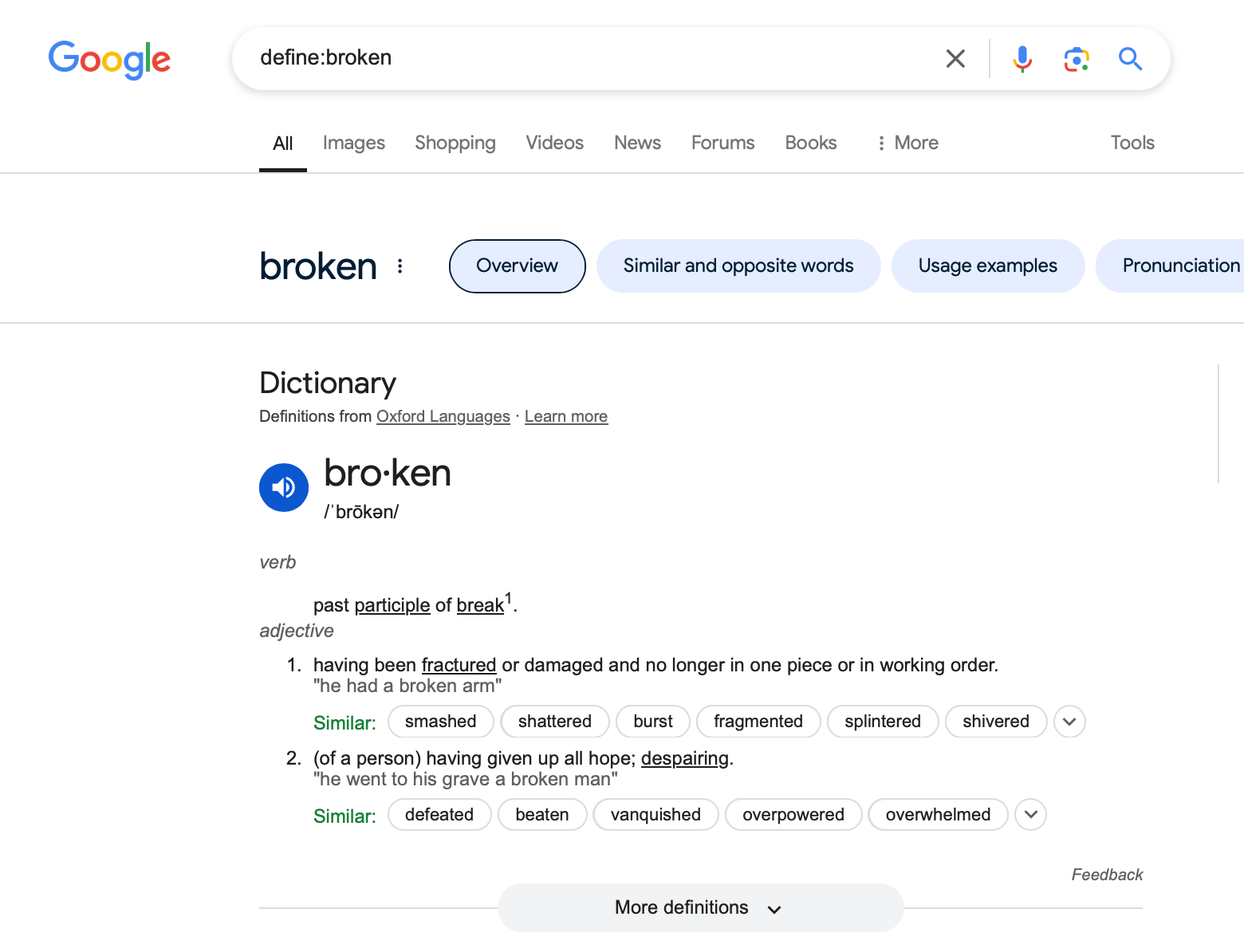
> Broken - From merriam-webster:  
> broken - adjective

Interesting. I’d recommend New Oxford dictionary as the first one you check for grammar. I think it’s better at parts of speech. It’s in Apple’s Dictionary app or on Google:
 ![image](https://discuss.criticalfallibilism.com/uploads/default/original/2X/7/7b098e848b54369b2a26ca06cc1b47a2d341054b.png)

---

<div class="post-metadata">

### Author: ![Elliot](https://discuss.criticalfallibilism.com/user_avatar/discuss.criticalfallibilism.com/elliot/32/14_2.png) [@Elliot](https://discuss.criticalfallibilism.com/u/Elliot)
#### Post date: [August 22, 2024, 3:16pm UTC](https://discuss.criticalfallibilism.com/t/eternity-async-tutoring/1932/516 "2024-08-22T15:16:13Z")

</div>

It’s common to have non-finite verbs after verbs as objects. It comes up a lot. You’ll also sometimes see them after each other, also as objects, in a chain.

Try this sentence:

> Tomorrow I will have been waiting for a month!

---

<div class="post-metadata">

### Author: ![Eternity](https://discuss.criticalfallibilism.com/user_avatar/discuss.criticalfallibilism.com/eternity/32/5930_2.png) [@Eternity](https://discuss.criticalfallibilism.com/u/Eternity)
#### Post date: [August 26, 2024, 3:36pm UTC](https://discuss.criticalfallibilism.com/t/eternity-async-tutoring/1932/517 "2024-08-26T15:36:06Z")

</div>

> [@Elliot](#):
>
> It’s common to have non-finite verbs after verbs as objects. It comes up a lot. You’ll also sometimes see them after each other, also as objects, in a chain.

Non-finite verbs are verbals. Verbals consist of gerunds, participles, and infinitives.

- From [Cambridge Dictionary](https://dictionary.cambridge.org/us/grammar/british-grammar/finite-and-non-finite-verbs):
  - Finite verb forms show tense, person and number (_I go, she goes, we went_, etc.)"
  - “Non-finite verb forms do not show tense, person or number. Typically they are infinitive forms with and without _to_ (e.g. _to go, go_), -_ing_ forms and -_ed_ forms (e.g. _going, gone_):”

- Along with other stuff previously mentioned finite verbs seem to be the typical conception of verbs. They’re the verbs doing stuff in a sentence. Non-finite verbs are words based on verbs but they don’t play the same role. They can act as nouns (gerunds), adjectives (participles), or play a variety of roles (infinitive).
- It is common to have a non-finite verb (a verbal) after a verb as an object. So it is common to have a non-finite verb acting as an object (not a verb) after the finite verb. The non-finite verbs acting as objects can also be sometimes seen in a chain, one after each other.

> Tomorrow I will have been waiting for a month!

- will - action verb
- I - subject
- waiting - gerund, object
- modifiers:
  - tomorrow - adverb modifying will, it’s giving information about when the willing object will happen
  - for a month - prepositional phrase modifying waiting
    - for is the preposition
    - a is a determiner modifying month
    - month is the noun governed by four

So looking up on google I got this for have:

> used with a past [participle](https://www.google.com/search?sca_esv=b3631baa3837d75b&sca_upv=1&sxsrf=ADLYWIKFy0BwOSPinjQsbdL_LUadRMmZVA:1724685890797&q=participle&si=ACC90nz-2feRzoY4yuySkO-aQE81Lksb7lK0c1MvZJxUBfj8Ip6oR1QiYjKMzcBlRvsygb7EO_dxJUBt3xmeeVGGXC0-k0nkGroK93h1e8Nl94rKQiOixII%3D&expnd=1&sa=X&ved=2ahUKEwiyxfrO-5KIAxWRF1kFHSMWDw4QyecJegUITxCkAw&cshid=1724685992219452) to form the perfect, [pluperfect](https://www.google.com/search?sca_esv=b3631baa3837d75b&sca_upv=1&sxsrf=ADLYWIKFy0BwOSPinjQsbdL_LUadRMmZVA:1724685890797&q=pluperfect&si=ACC90nz-2feRzoY4yuySkO-aQE81X0jf9KHgfACQLK_XqiRBOBlMT7CFjN5mNCEFleuRTLB4vef2XQalKvOl692UaoeSQA_VudH_V4YSvojHYLUO20NlYvA%3D&expnd=1&sa=X&ved=2ahUKEwiyxfrO-5KIAxWRF1kFHSMWDw4QyecJegUITxClAw&cshid=1724685992219452), and future perfect [tenses](https://www.google.com/search?sca_esv=b3631baa3837d75b&sca_upv=1&sxsrf=ADLYWIKFy0BwOSPinjQsbdL_LUadRMmZVA:1724685890797&q=tenses&si=ACC90nwdkA2npcVVmNPViiSe8FMK2o2U6ErFVliIL6Ks3aOhTDEgGV54bl_XmtjnikMwSQFx98Er6fYXyeJjFMK4yNyfqNrX1Q%3D%3D&expnd=1&sa=X&ved=2ahUKEwiyxfrO-5KIAxWRF1kFHSMWDw4QyecJegUITxCmAw&cshid=1724685992219452), and the conditional mood.

been:

> past [participle](https://www.google.com/search?sca_esv=b3631baa3837d75b&sca_upv=1&sxsrf=ADLYWIIqDDz2E9VP0wup6s2ulbz20SQ2Gg:1724686014733&q=participle&si=ACC90nz-2feRzoY4yuySkO-aQE81Lksb7lK0c1MvZJxUBfj8Ip6oR1QiYjKMzcBlRvsygb7EO_dxJUBt3xmeeVGGXC0-k0nkGroK93h1e8Nl94rKQiOixII%3D&expnd=1&sa=X&ved=2ahUKEwiqi4eK_JKIAxXAF1kFHZLnGIgQyecJegQITxAO&cshid=1724686067981401) of [be](https://www.google.com/search?sca_esv=b3631baa3837d75b&sca_upv=1&sxsrf=ADLYWIIqDDz2E9VP0wup6s2ulbz20SQ2Gg:1724686014733&q=be&si=ACC90nxD6AVXi6SZ15TdDpREBk7Xl_9ZAcU_9pgqkiat8JqEr_DiFo6AaC1IF9v4vB6B1SpoLnAziy8QN1AO7X7euEbokRFC0w%3D%3D&expnd=1&sa=X&ved=2ahUKEwiqi4eK_JKIAxXAF1kFHZLnGIgQgCt6BAhPEA8&cshid=1724686067981401).

So should “have been” be treated as one word here?

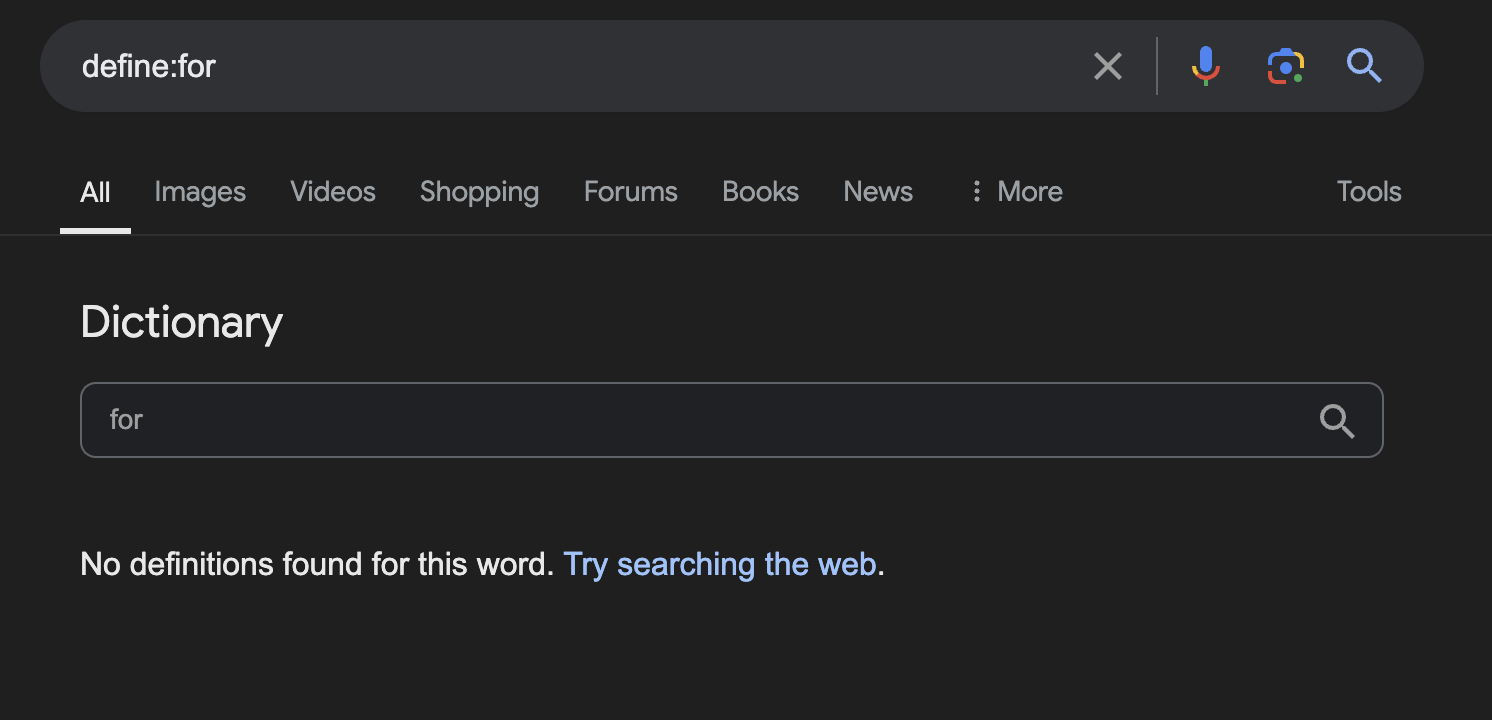
Also I guess New Oxfords dictionary (googles dictionary) doesn’t have a definition for “for”?
 ![image](https://discuss.criticalfallibilism.com/uploads/default/original/2X/2/20ac785bb0fc2d66bac596250e3df28e3ed8df93.png)

---

<div class="post-metadata">

### Author: ![Elliot](https://discuss.criticalfallibilism.com/user_avatar/discuss.criticalfallibilism.com/elliot/32/14_2.png) [@Elliot](https://discuss.criticalfallibilism.com/u/Elliot)
#### Post date: [August 26, 2024, 3:56pm UTC](https://discuss.criticalfallibilism.com/t/eternity-async-tutoring/1932/518 "2024-08-26T15:56:44Z")

</div>

> [@Eternity](#):
>
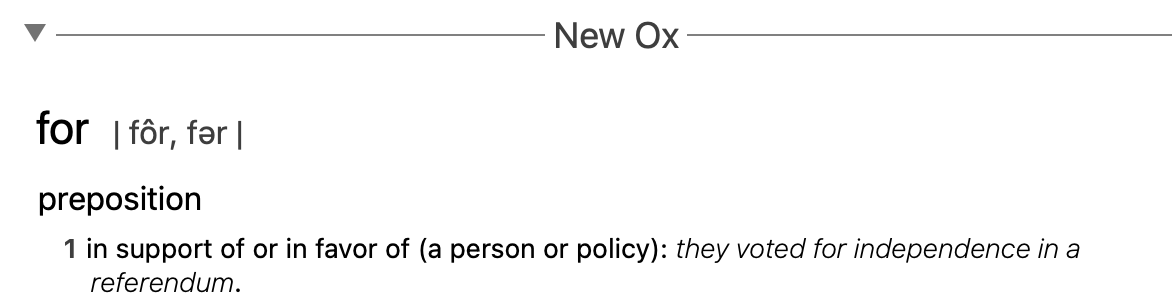
> Also I guess New Oxfords dictionary (googles dictionary) doesn’t have a definition for “for”?

Looks like a bug. Apple’s dictionary has it:
 ![image](https://discuss.criticalfallibilism.com/uploads/default/original/2X/0/046bdb241d05ec34be03e5238965d3bea3405d77.png)

> [@Eternity](#):
>
> So should “have been” be treated as one word here?

No. You never need to do that with verbs. It’s most useful for proper nouns like “Elliot Temple”.

> [@Eternity](#):
>
> - waiting - gerund, object

You didn’t say what “waiting” is the object of. I think you mean it’s the object of “will”? But the thing I will is not waiting.

> Tomorrow I will have been waiting for a month!

have is the object of will. been is the object of have. waiting is the object of been.

The thing I will is have. The thing I have is been. The thing I’ve been is waiting.

Or put another way, the thing I will is “have been waiting”. The lead of that group is “have”. The thing I will have is “been waiting”. The lead of that group is “been”, and the thing I will have been is “waiting”.

“will” is a finite verb. “have” is an infinitive. “been” is a past participle. “waiting” is a gerund.

Does that make any sense to you?

Also try looking at this and see if it helps but don’t try to read everything and just give up if it’s not working. [Nonfinite verb - Wikipedia](https://en.wikipedia.org/wiki/Nonfinite_verb) including a bunch of the links in the first paragraph.

* * *

@LMD I think you understand this right? You could share how you understand it if you know how to explain that.

---

<div class="post-metadata">

### Author: ![Eternity](https://discuss.criticalfallibilism.com/user_avatar/discuss.criticalfallibilism.com/eternity/32/5930_2.png) [@Eternity](https://discuss.criticalfallibilism.com/u/Eternity)
#### Post date: [August 30, 2024, 3:14pm UTC](https://discuss.criticalfallibilism.com/t/eternity-async-tutoring/1932/519 "2024-08-30T15:14:11Z")

</div>

> [@Elliot](#):
>
> “will” is a finite verb. “have” is an infinitive. “been” is a past participle. “waiting” is a gerund.
> 
> Does that make any sense to you?

Mhm. Well. It makes sense to me when you point it out and like reading about this stuff. Maybe it’s because I’ve been doing this with lots of days apart (though I should be good to do it consistently again) but I’m having issues making sense of that while looking at sentence. Or, another way to put it, my issue is identifying those things in a sentence.

> [@Elliot](#):
>
> Also try looking at this and see if it helps but don’t try to read everything and just give up if it’s not working. [Nonfinite verb - Wikipedia](https://en.wikipedia.org/wiki/Nonfinite_verb) including a bunch of the links in the first paragraph.

Non-finite verbs don’t conjugate for number and person (pov). They don’t function as the main verb in a clause.

~yeah, I looked at the examples and they make sense when pointed out to me, but when you ask me to go and figure it out I get confused.

---

<div class="post-metadata">

### Author: ![Elliot](https://discuss.criticalfallibilism.com/user_avatar/discuss.criticalfallibilism.com/elliot/32/14_2.png) [@Elliot](https://discuss.criticalfallibilism.com/u/Elliot)
#### Post date: [August 30, 2024, 3:42pm UTC](https://discuss.criticalfallibilism.com/t/eternity-async-tutoring/1932/520 "2024-08-30T15:42:14Z")

</div>

You need more practice over time.

---

<div class="post-metadata">

### Author: ![Eternity](https://discuss.criticalfallibilism.com/user_avatar/discuss.criticalfallibilism.com/eternity/32/5930_2.png) [@Eternity](https://discuss.criticalfallibilism.com/u/Eternity)
#### Post date: [August 30, 2024, 6:24pm UTC](https://discuss.criticalfallibilism.com/t/eternity-async-tutoring/1932/521 "2024-08-30T18:24:00Z")

</div>

Yeah that makes sense. Should I go ahead and finish the part 4 sentence practice with the marking of phrases and clauses and the question based analysis?

[Previous page](https://discuss.criticalfallibilism.com/t/eternity-async-tutoring/1932.md?page=25)

[Next page](https://discuss.criticalfallibilism.com/t/eternity-async-tutoring/1932.md?page=27)
