The analysis works fine with individual words. Try reviewing your tree.
so maybe “so much” is one adjective phrase modifying hurts?
Can an adjective phrase modify “hurts” (which you said was a verb)?
The analysis works fine with individual words. Try reviewing your tree.
so maybe “so much” is one adjective phrase modifying hurts?
Can an adjective phrase modify “hurts” (which you said was a verb)?
Oh. No.
Adjectives modify just nouns. Adverbs modify everything else.
I’ve been playing through Expedition 33 recently. Its been very fun. One thing I wanted to share was a story I heard about the composer.
The story thats been going around is that he was someone found on Soundcloud, didn’t produce much music, and wasn’t a well known figure or anything. Yet they found him and made a really fun game with amazing music.
Reason I bring this up is because it kinda reminds of the stuff in The Fountainhead. I’m assuming some stuff here but this made me think of someone looking for a composer and trying to actually find a good one and not caring about all their fancy credentials and stuff. Kinda reminded of some of the stuff related to Mallory and judging people for their work.
Or who knows I think the company is a small game company. Maybe they just found the cheapest work they could fine that seemed decent and it ended up being amazing. Idk.
Hmm. So I think “It” and “hurts” is fine in my tree. When I originally made the tree I intended “so” as an adverb for “hurts”. “so” was then modified by “much” as an adverb.
Is that fine? Merriam-webster does give an adverb definition of “so much” I’m just confused on how to understand it:
by the amount indicated or suggested
One way to look at modifiers and sub-modifiers is what you can remove and still have a sentence make sense.
E.g. “I like big cars.”
big is a child of cars. you can remove the child, “big”, and the sentence still makes sense.
If you remove “cars” the sentence breaks. “cars” is an object not a modifier.
What about modifiers modifying modifiers?
E.g. “I like very big cars.”
Is very a child of big or vice versa?
If you remove “very” the sentence still works. If you remove “big” the sentence breaks. Very is more removable which suggests it’s the child.
The sentence being broken when it says “very cars” suggests that “very” cannot and does not modify “cars”.
Try “It hurts so much” again and see if this helps.
I really like the YouTube channel Technology Connections. I’m having trouble finding link but I remember finding it on the forum. I think it was Elliot who posted the video. It was his video on awnings:

I rewatched it again recently to comment on it and I really liked it. I think its interesting how we had a pretty good “low-tech” solution to keeping your house cool. I forget if he covered it (i watched it a few days ago) but I wonder why we stopped using it. I think probably because: people took it for granted and thought they looked granted. Also, at least nowadays, people (including me) are biased towards new tech. So they probably would rather deal with it in new tech ways then using old stuff.
I’ve watched a lot of his videos. Would it be worth making a discussion topic for them?
Another issue that is sometimes dealt with better in old construction than new is managing where water will go.
Feel free to make forum topics.
I recently changed my pc set-up. I now have my macbook hooked up to a bigger monitor, use a full size mac keyboard, and a bluetooth trackpad (I prefer mouse but I really really like the zoom in thing you can do with trackpad, idk how to replicate that with a mouse on mac). The only real issue has been my keyboard.
I think because I’ve practiced typing on my macbook keyboard the most it feels odd typing on this full size keyboard. I notice I type more accurately in the macbook itself. I really like this set-up, however, and I want to keep my macbook to the side for now.
Because of that I’m going to repractice typing for the next two weeks. I’m going to 15mins a day like before.
Did a 1 minute typing test on monkeytype (regular settings) and got 109 wpm with 98% accuracy.
Go to System Settings and search for “zoom” or Google it or ask AI. There are options like keyboard shortcuts or holding a modifier key while using scroll wheel to zoom.
Thanks! I got something working. It zooms a bit slower than the mac trackpad but it works well. I’ll how I like it. I think because I can do ctrl + mouse scroll by default on windows to zoom I assumed it wasn’t a thing on mac because it didn’t work like that initially. I guess I would have to set-it up.
Been busy/stressed over some stuff the past few days. Its all been happily resolved. Starting this week (and going forward) my hours are lower. So I should have some more time to put into philosophy. I’ll see how it goes and see if time really was the roadblock.
I’m going to post on my Pre-Algebra textbook today. I will work on the counting assignment tomorrow.
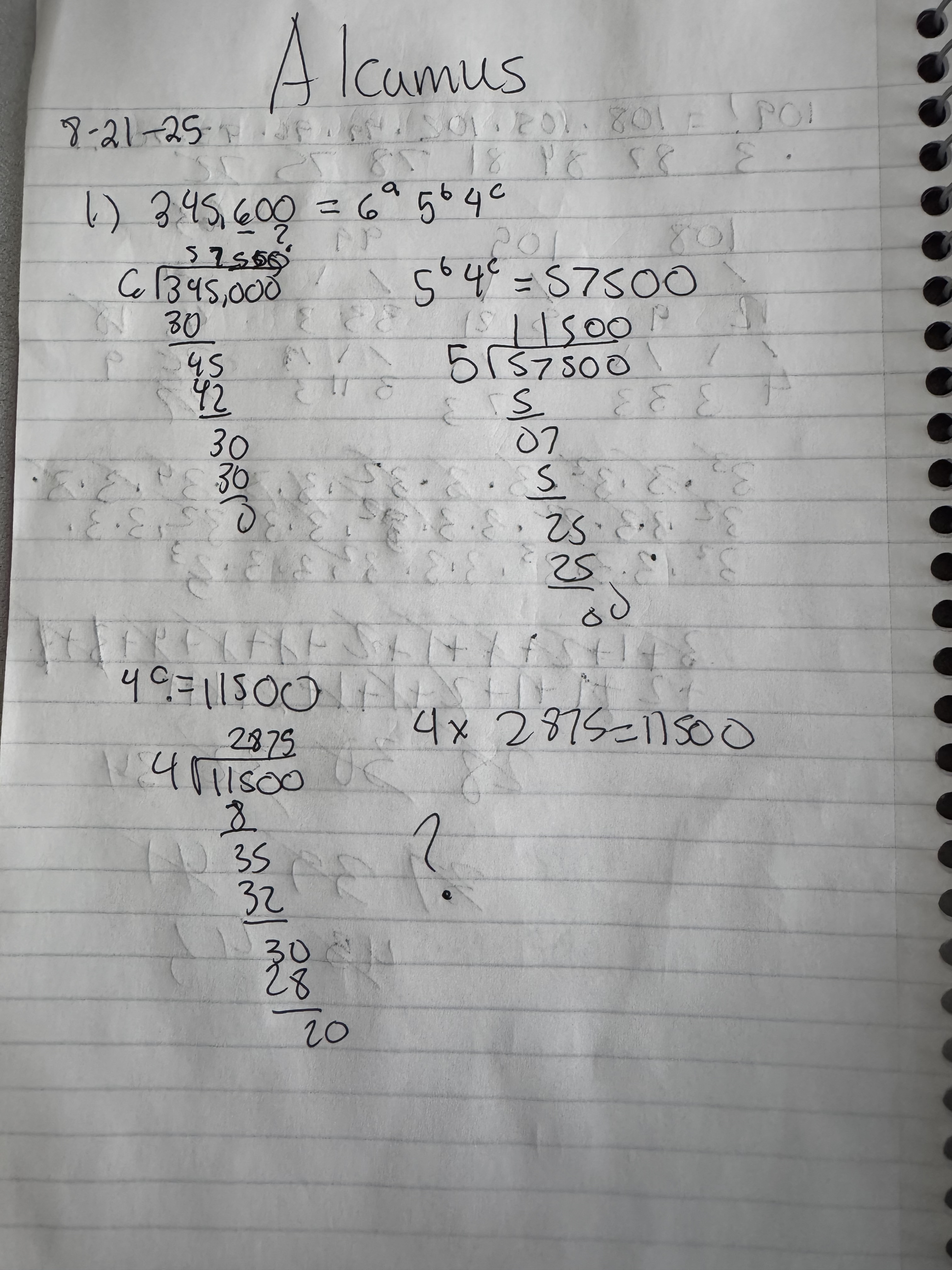
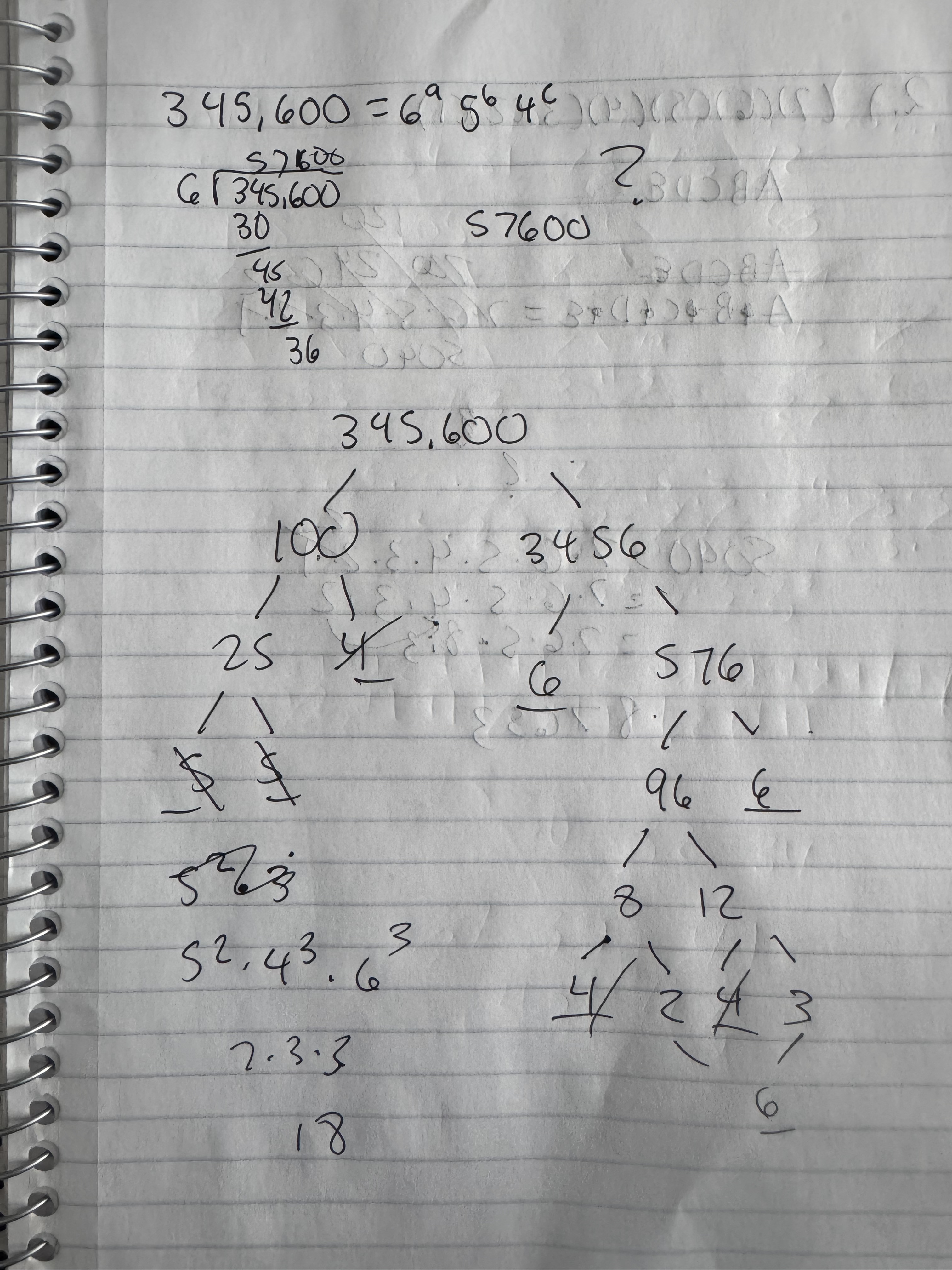
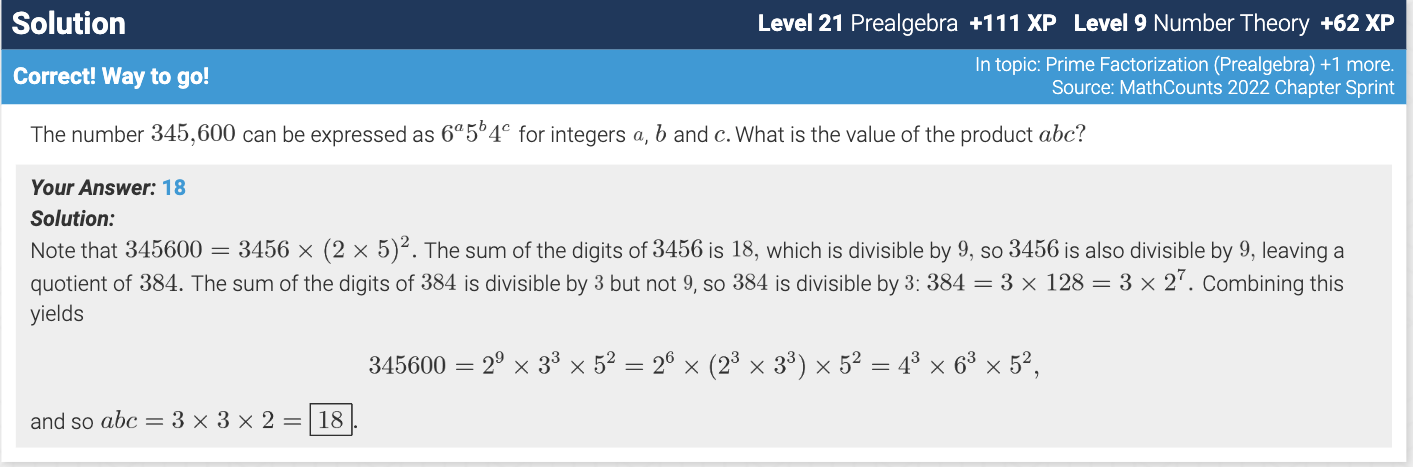
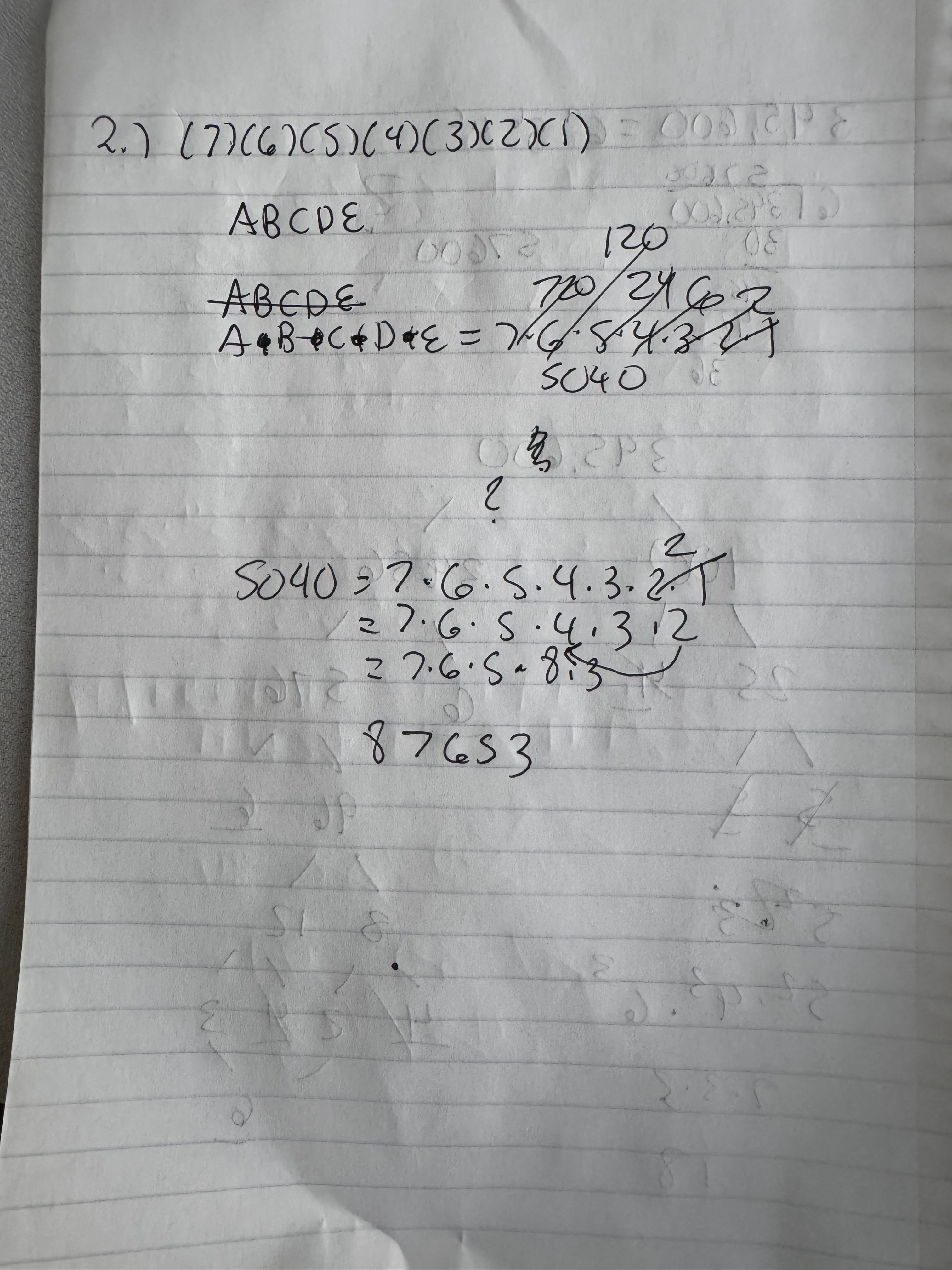
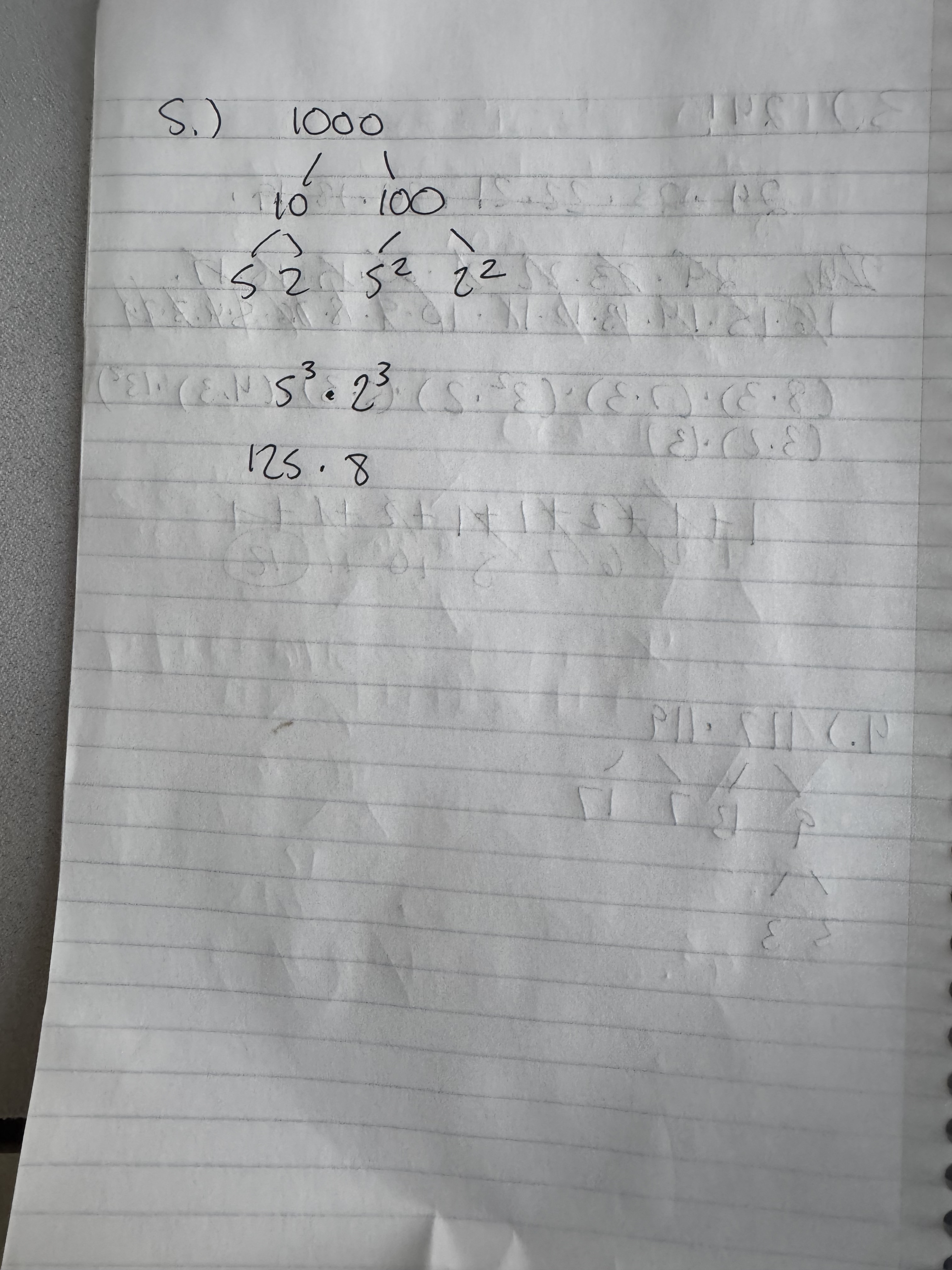
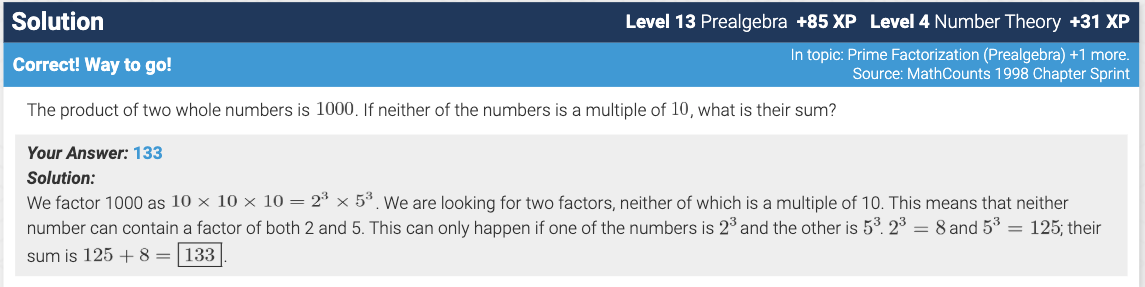
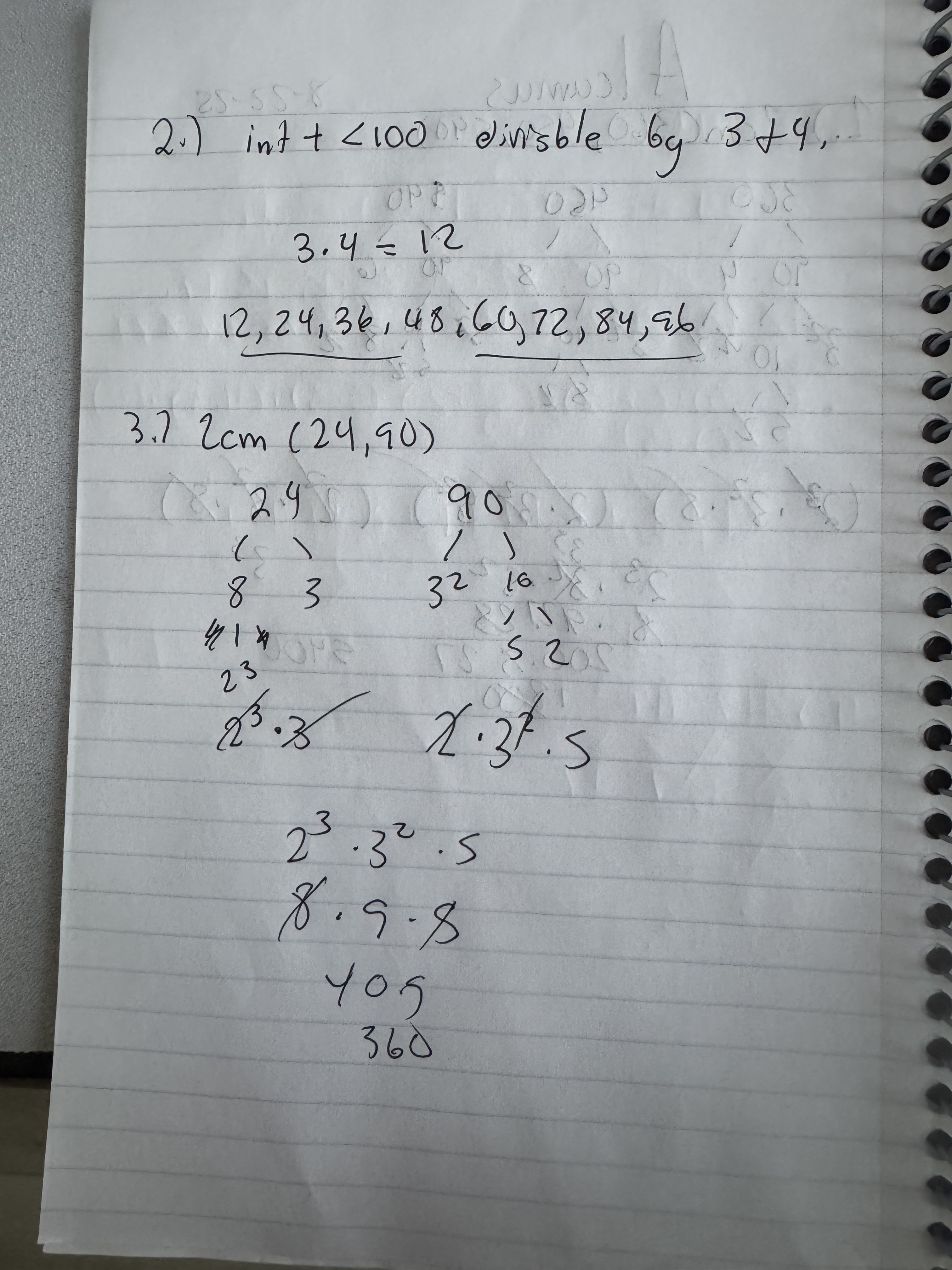
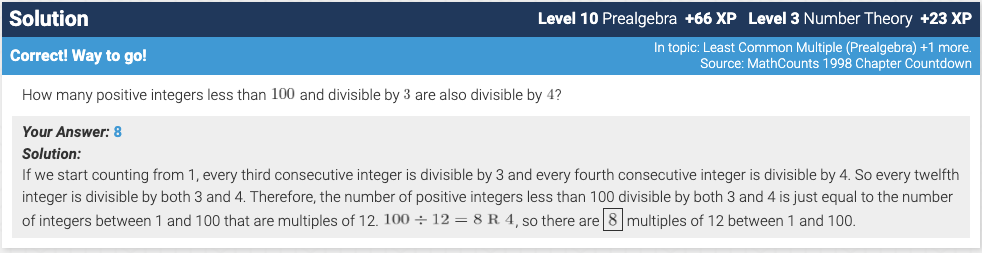
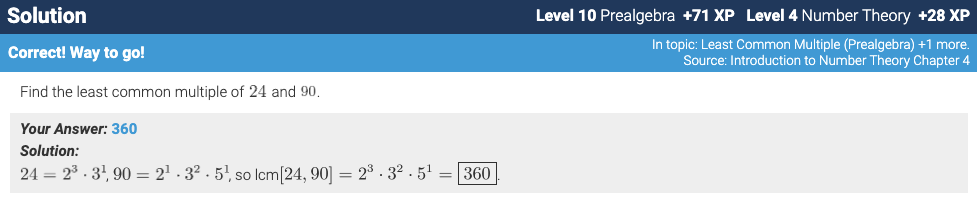
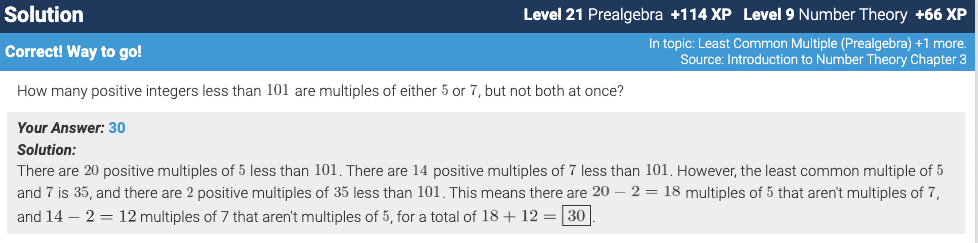
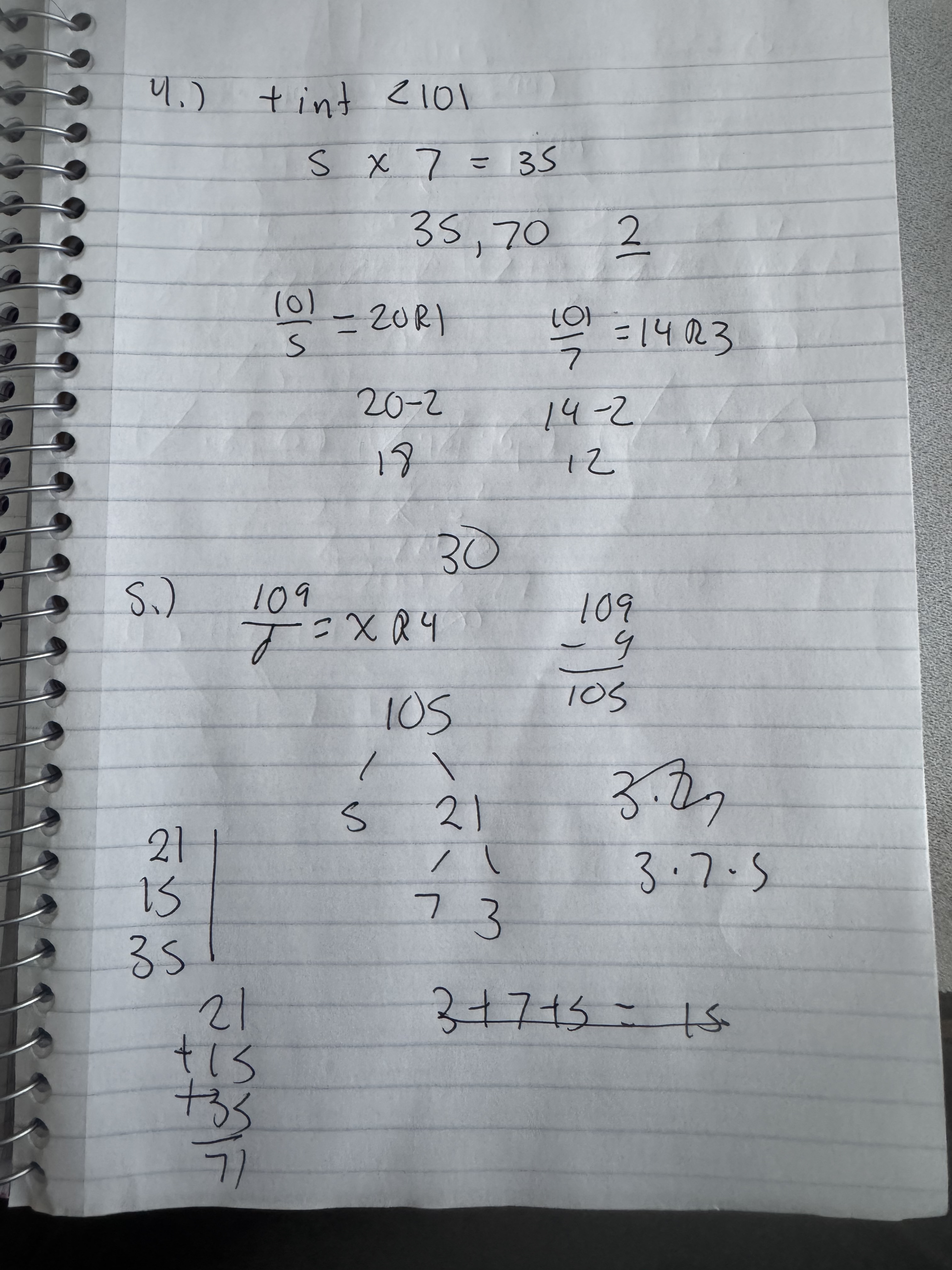
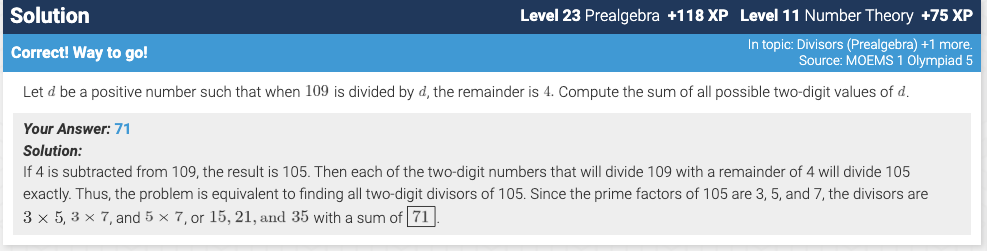
I’ve been doing Alcumus practice problems fairly consistently (4/5 out of 7 days). Figured I’d start sharing the problems I’ve been doing.
For today 8 - 21 - 25:
1.) Got this correct 1st try.

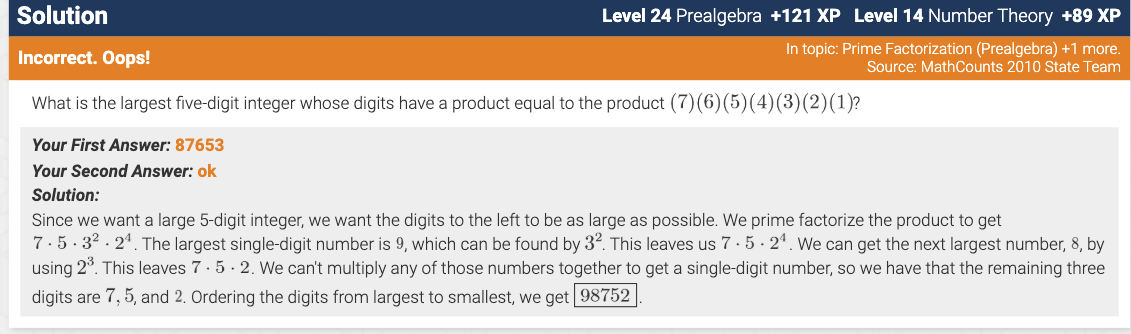
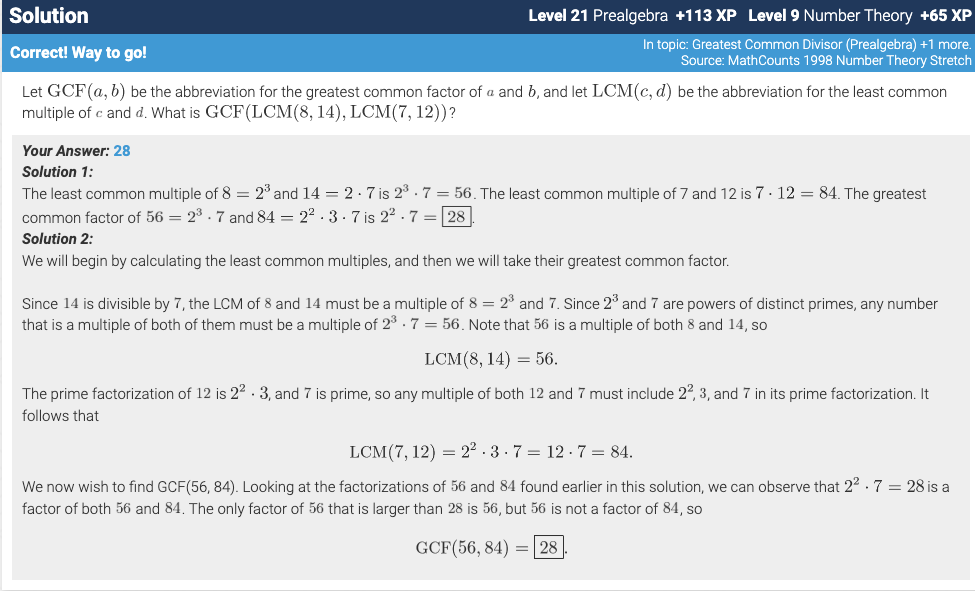
2.) Got this wrong. Didn’t really try the second time. I didn’t think to prime factor the given “product”. I think I subconsciously assumed it was prime factored already or something.

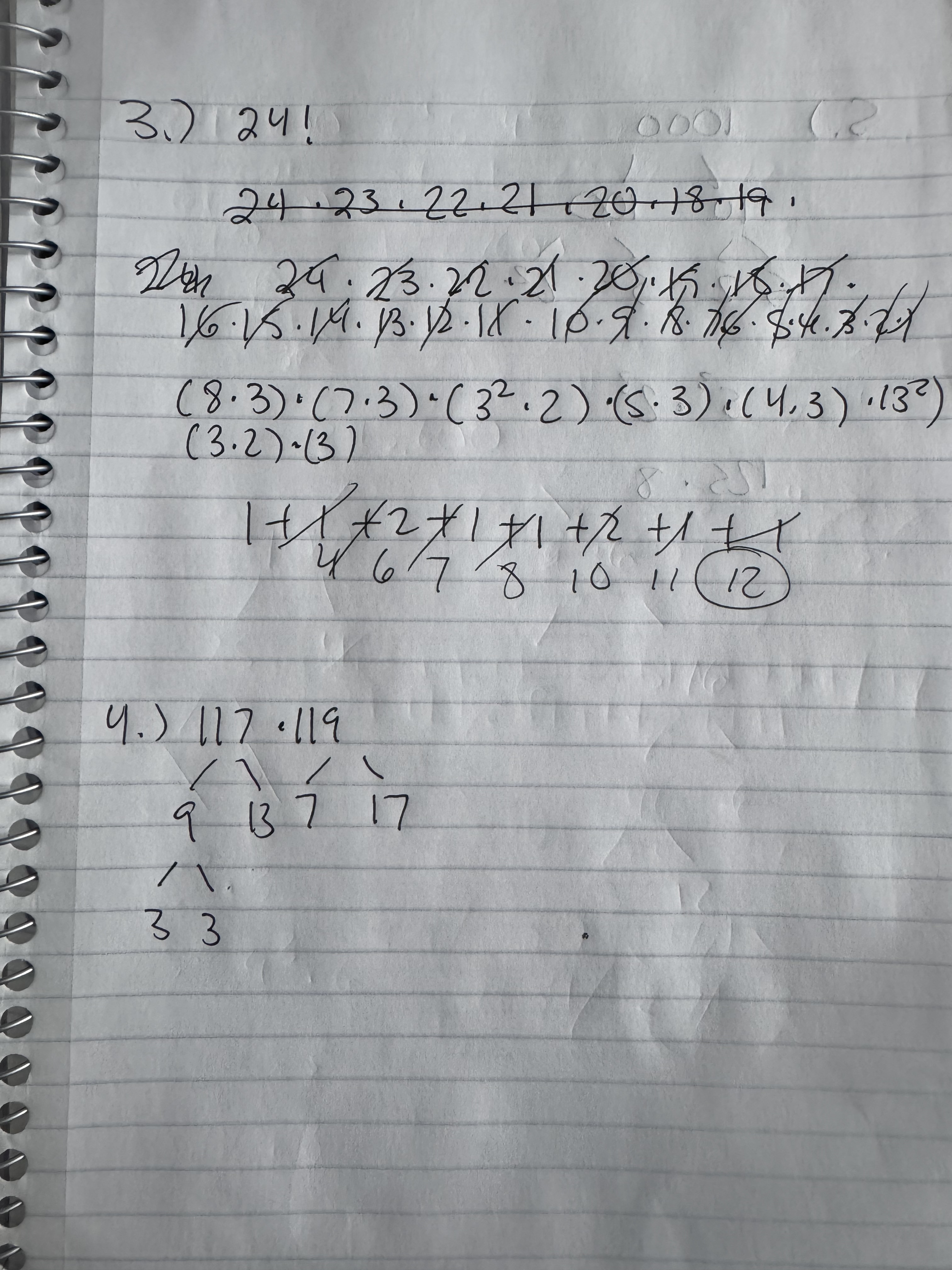
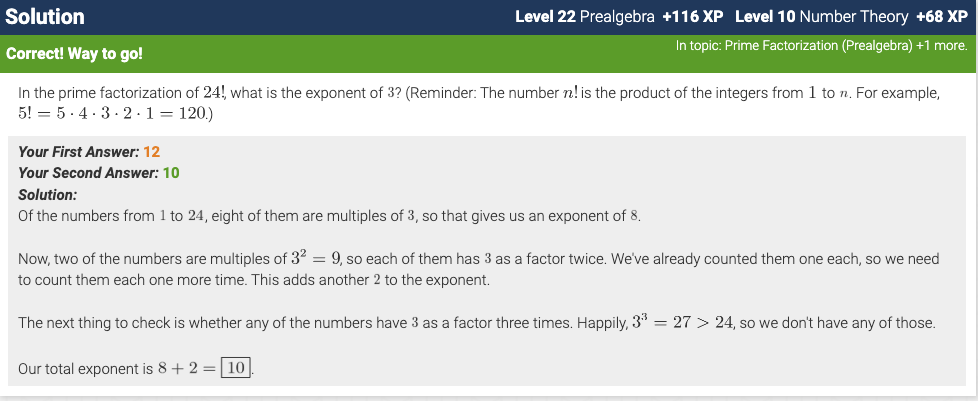
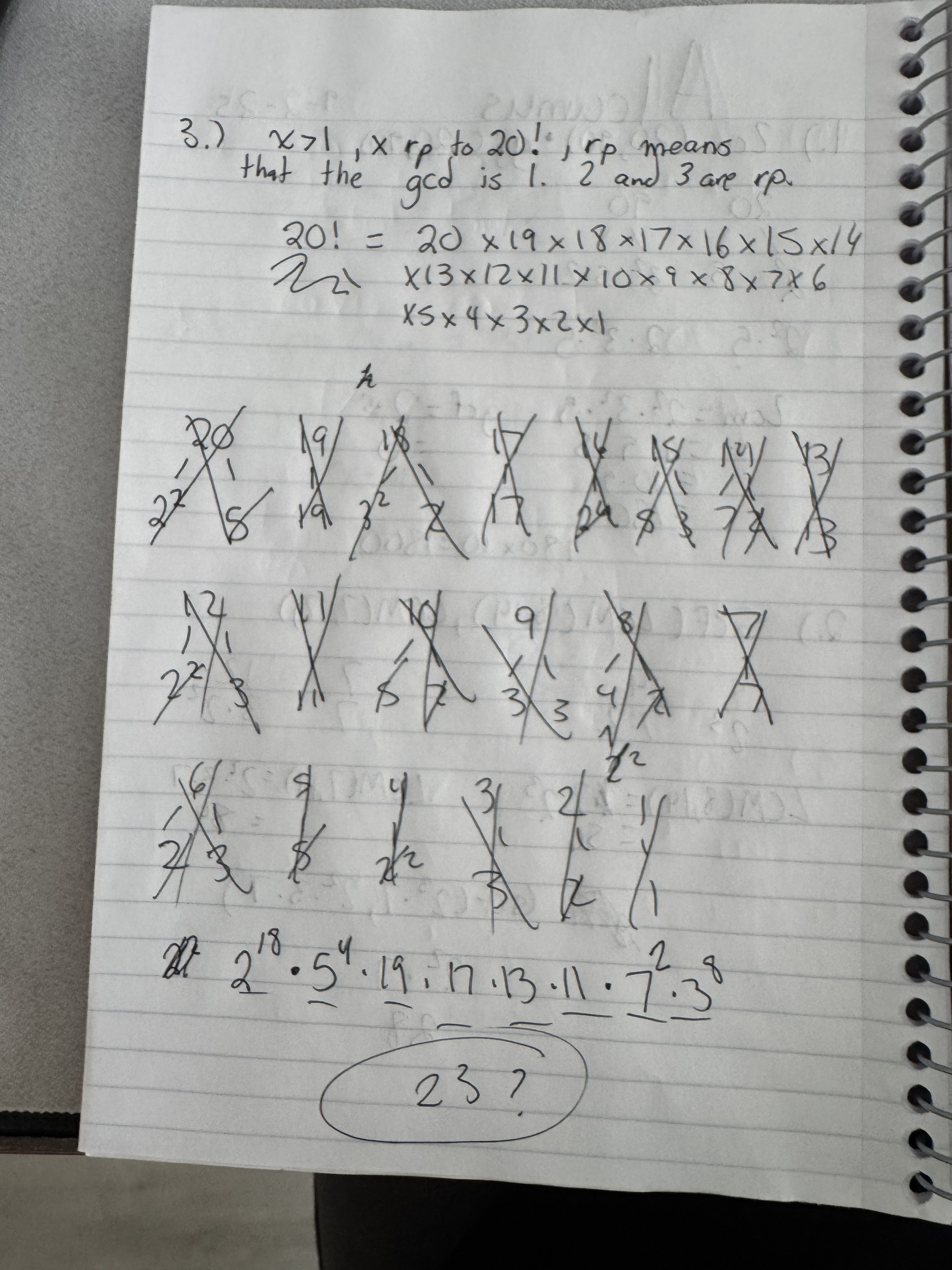
3.) Got this wrong the first time because when I counted up the three’s I added the first part (1+1) in my head and then started adding from the numbers I wrote down. This led me to start from 4. I didn’t think to do it the way they described. If I understand it correctly you would do something like this:
Find the exponent 5 in the prime factorization of 40! 5, 10, 15, 20, 25, 30, 35, 40. 8 numbers that contain 5. Then you do 52 so 25, 50. And 53 is 125 so nothing to check from that. So in the prime factorization of 40! 5 should have the exponent of 9.

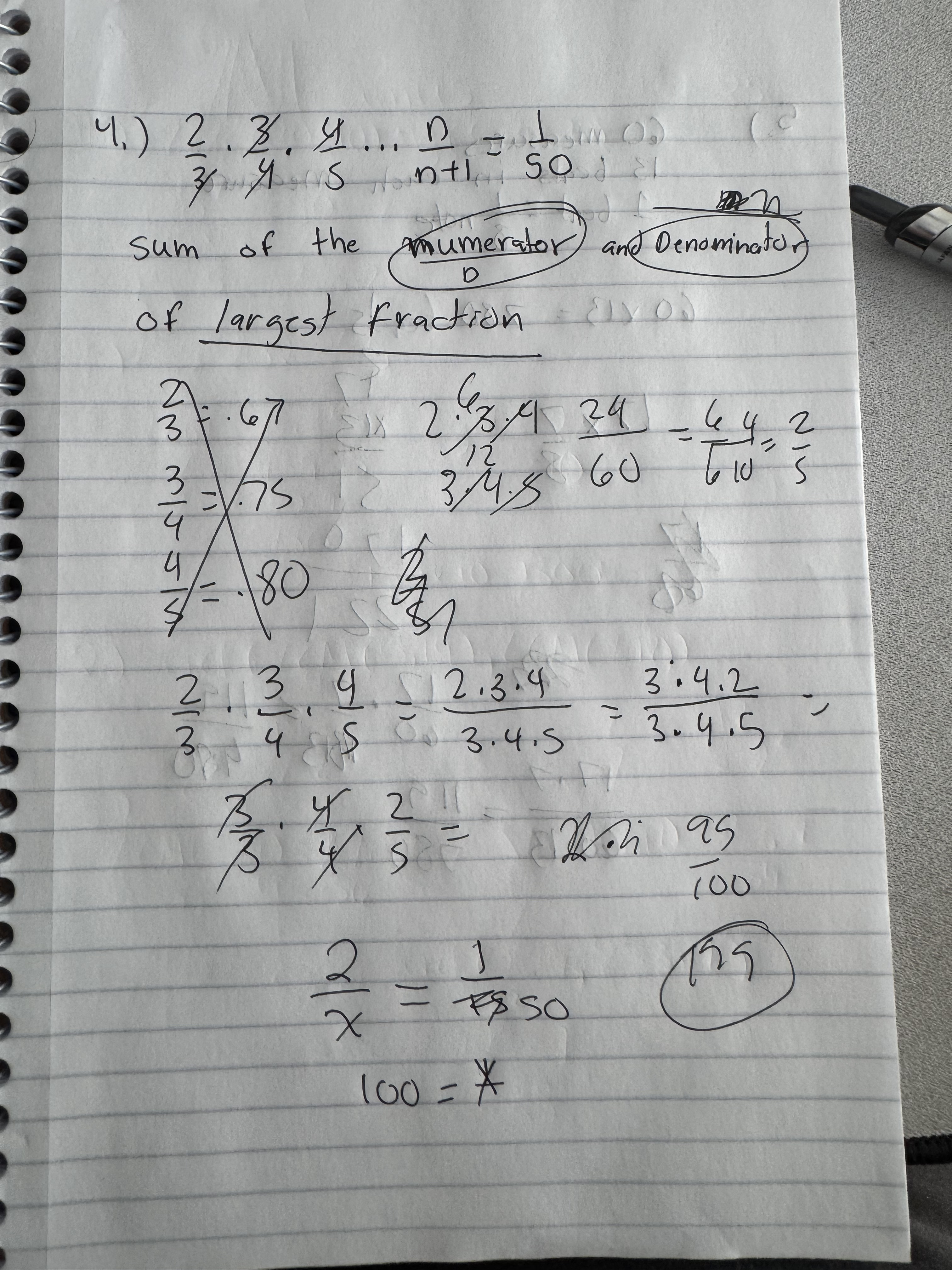
4.) Got this right.

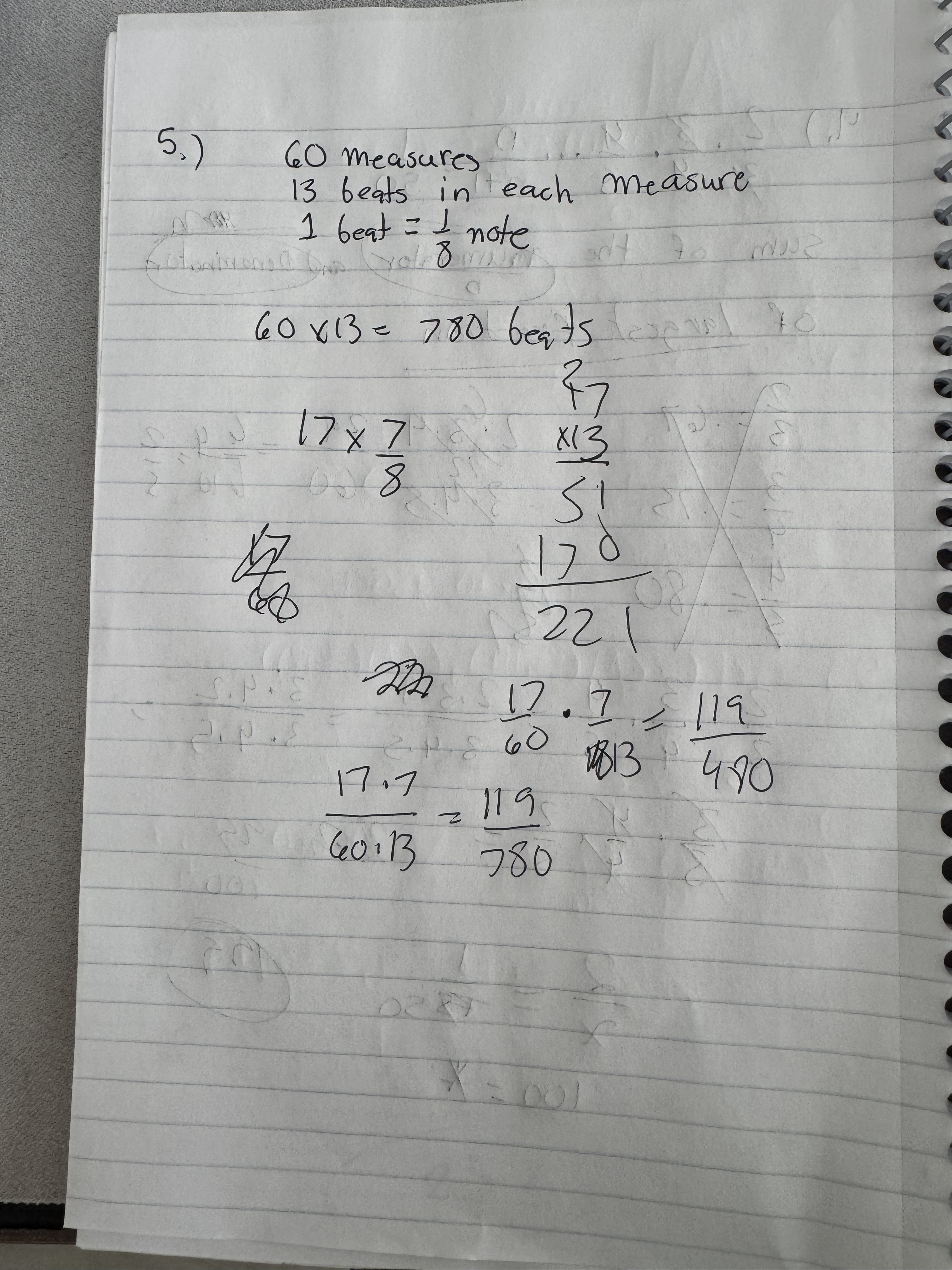
5.)

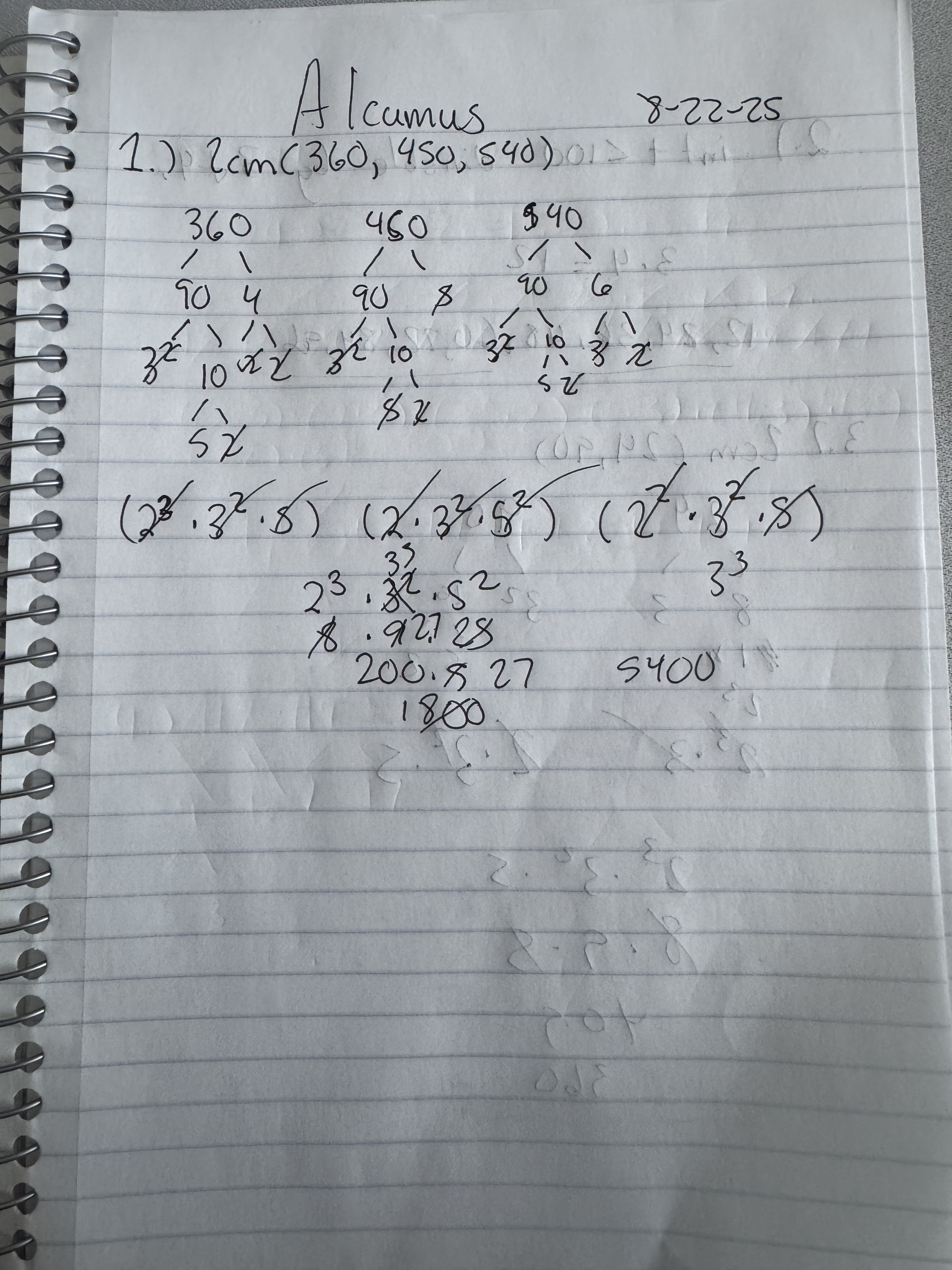
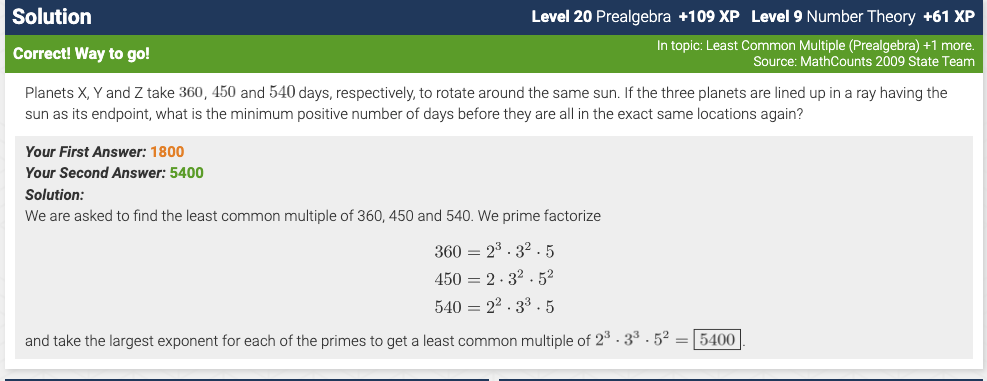
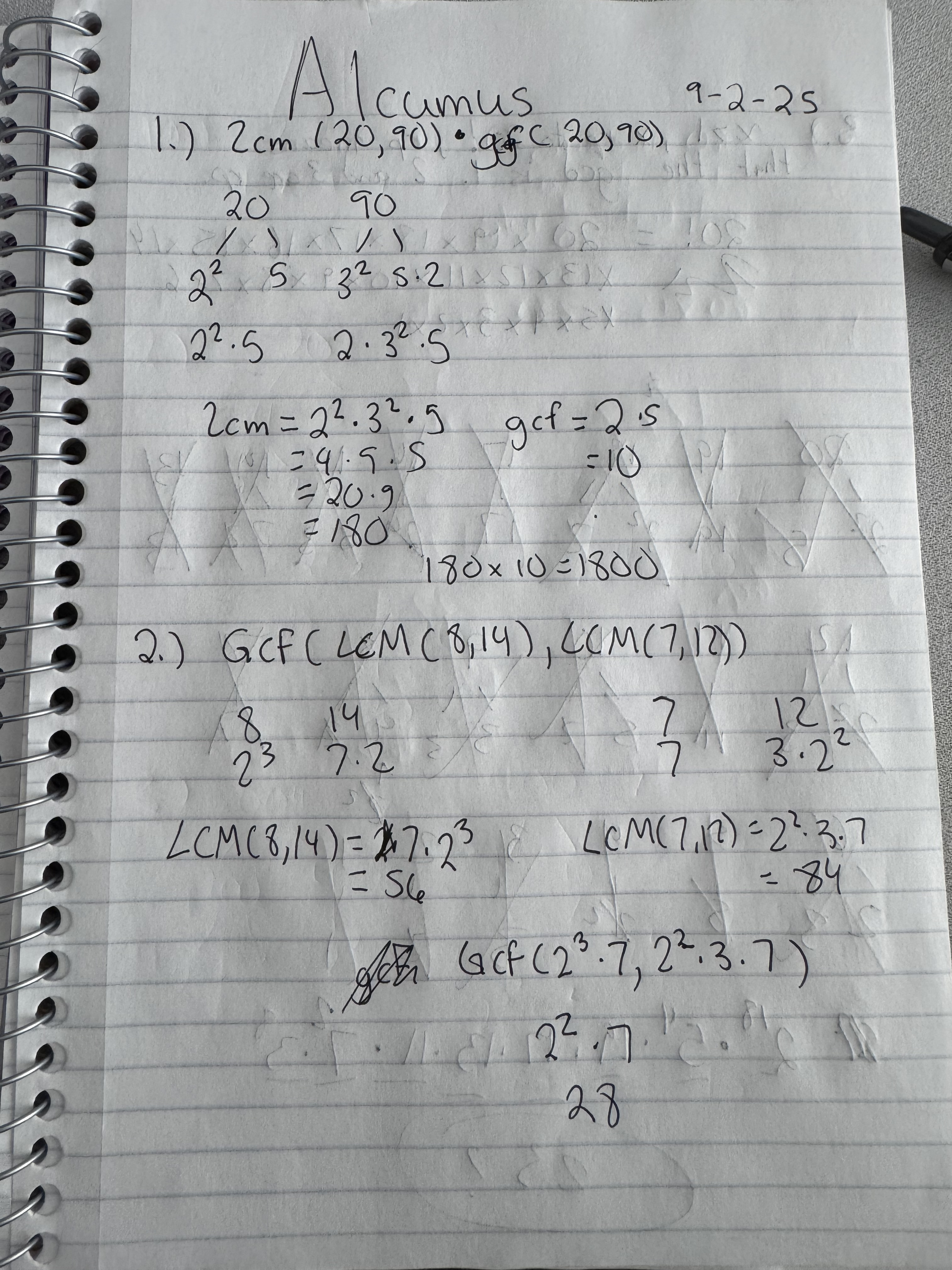
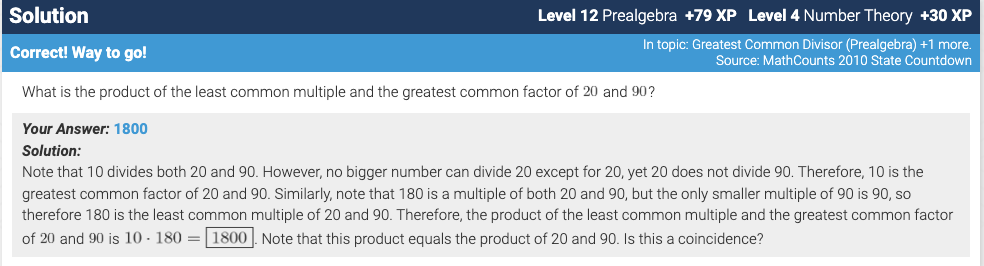
I meant to post that yesterday but ended up not posting it. So here are some problems from today too:
1.) Got it right on the second try. I messed up accounting for an extra 3 in the prime factorization of 540.

2.) Got it right.

3.) Got it right.
4.) Got it right.

5.) Got it right.

Problem numbers are all for the first set of 5.
For 1, FYI, instead of dividing 3456 by 6, it’d probably be easier to divide it by 2. In general, after taking 10s out of a big number, it’s easiest to take 2s (if even) or 5s (if it ends with 5), then 3s.
For 2 I tried this mentally. I just rearranged the factors and tried to get big digits to put first. So 4x2 combines for an 8. I also wanted a 9 so I split the 6 into 3 and 2, then used the other 3 to get a 9, leaving a 2 left over. That left: 98752.
Prime factoring makes sense in general but in this case only a small number of changes were needed from the starting numbers (I only factored a single number) so I didn’t need to do it.
For 3, this should be easy. You just need to take your time and pay attention and you should be able to do it. You can write out all the numbers from 1 to 24 and then write the number of 3’s in each then add them up.
If you do that you can notice patterns. Basically you’re counting by 3’s and also counting by 9’s (that’s where the 3^2 are). So you can solve it as 24/3 + 24/9 (round down) = 8+2 = 10. The multiples of 9 are already counted when counting by 3, so we only need to add +1 for each of them, not +2, even though they contain 3^2.
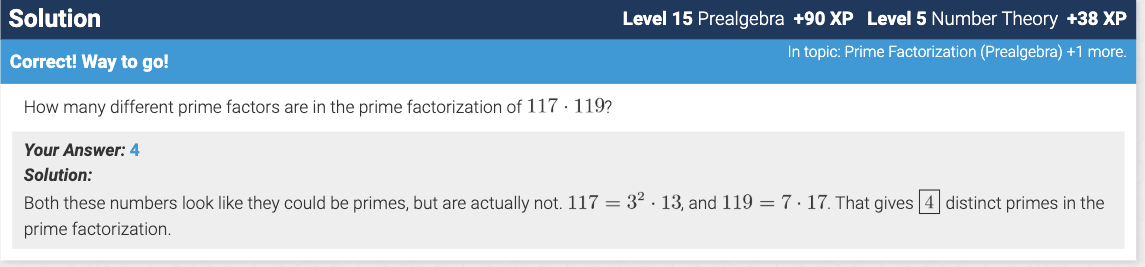
For 4, how did you know 117 was divisible by 9? Did you do more work that you didn’t write down? How did you know what factors to use? I would have divided 117 by 3 first because I can immediately see it’s not divisible by 2 or 5 and is divisible by 3. I check 2, 3 and 5 divisibility first because they’re common and easy. Do you know the shortcuts to check them? How do you find factors?
Yeah. Thats the only problem where I didn’t necessarily show all my work I think. I did that division by calculator and just knew 6 would work because the problem said it would. I was a bit tired and got annoyed that I was approaching the problem wrong at the start, so when I approached it correctly I just used a calculator for some of the math.
The textbook I’m working on I believe had me go through division tests for 2, 3, 4, 5, 7, 8 and 9 (maybe not 7 idk, i dont remember it if it did). 1 + 1+ 7 = 9. The division test for 9 was if the digits added up to something divisible by 9. I didn’t more work than written down.
The shortcuts to check certain divisibilities? uhh 2 if it ends in an even number. 5 if it ends in 0 or 5. 3 if the digits add up to something divisible by 3 same with 9. you can check for divisibility by 4 i think if the last two digits are divisible by 4. you can do something similar with 8 if the last 3 digits are divisible by 8.
How do I find prime factors? I don’t have a set method. I just try to dividing numbers into the thing starting from a smaller number. I’m fairly good at mental math I think.
If you’re approaching something wrong at first, that’s a sign you should spend more time thinking about it, and take your time. It’s not a good time to rush.
Also these problems don’t require calculators and I think you should learn to do them without calculators.
Also the problem didn’t say division by 6 would work. You made a bad assumption or logical error. Review that and see if you can figure it out.
Oh that makes sense that you used that. I don’t use that one much (nor 4 nor 8) because dividing by 3 (or 2) is generally easier. The divisibility tests for primes are more important. The 2, 3 and 5 tests are easy and very useful. I don’t know 7, 11 or 13 divisibility rules offhand. I just looked them up and they seem useful for dealing with really big numbers without a calculator but not very useful for small numbers (too complicated and you can just do division instead).
To figure out if X is prime, what numbers do you need to check divisibility for, and what is the standard order to check them? If they all fail, when can you stop and conclude that X is prime?
To prime factorize X, you do the same thing to start with and either you find out it’s prime or you find a factor. Say you find a factor so now you have 2*Y=X. What do you do next to keep prime factorizing? What’s the full method?
Daily Math Problems:
1.) Got it right.

2.) Got it right.

3.) Got it right.

4.) Got it right.

5.) Got it right second try. Bit confused on what this was asking initially.
~yeah. When I did this problems I was very tired. Its hard trying to stay focused and be methodical when tired. Its easier to go fast.
I agree this problems don’t require calculators. I make it a habit to not use them. I sometimes do (maybe 1 out of like 50 problems? its rare) when I’m tired and make a mistake to get through the math faster like I did that day. Generally, though even if the math is a bit tedious I will hand do it all.
It can be expressed as 6 times some number. I guess yes the power on 6 could be 0. It doesn’t directly say it can divided by 6. This was just me trusting the question writer to not write a trick question. Is this the error you’re referring to?
I remember learning this in the textbook, but I forgot the rule and my understanding of it. I’ve been doing what I think is a vague approximation of the rule. Let’s say you want to check if 31 is prime. You check the divisibility using prime numbers. You check the prime numbers up until half of that number i think. So using 31 you would try 2,3,5,7,11,13,17. You’d stop at 17 because after that any second number for the terms after 17 would be greater than 31. 17, 34. 19, 38.
I remember the rule involving squares I think so idk.
I was busy the past week on starting off my classes. I should be good now. I didn’t feel like making topics for these because I don’t see much value in it.
One’s essentially an excel class and the other is a basic psychology class.
The excel class is very very easy. A lot of people seem to be struggling and I don’t know how. The stuff is very step-by-step (as in they tell you what to do, its literally like click the cell and put in this equation). Its open notes. Only thing not allowed, that is considered cheating, is asking peers for helps on tests. Thats it.
I think maybe my familiarity with computers helps? And my familiarity with very very basic coding? idk. I do think my prior stuff working on truth tables and stuff helped with boolean logic section.
I’m ~3 weeks ahead. At my current pace I should be done by next Thursday. A whole month before the course officially ends. So that’ll be nice.
Psychology is a bit tedious but still easy. My only things being graded on are an occasional discussion assignment (I think posting here has made that much easier), one 10 question quiz a week (which is open notes, just not asking peers), and a project coming up soon. The only things thats been hard is doing the assigned reading. It’s not technically necessary but I feel weird just going into a quiz without doing the reading (even if it is open notes).
Not ahead in Psychology because the professor hasn’t structured in a way where that’s allowed but I’m at a comfortable pace for it.
Yes. I don’t think a 0 exponent would be a trick question. There’s nothing wrong with a 0 exponent.
The rule is fairly simple and logical. See if you can figure it out.
I did this one in my head quickly and used shortcuts. I don’t think you should do that but I thought it was worth mentioning that that’s possible. A potential future goal could be to get good enough at arithmetic to do more of it mentally and use more shortcuts (while having higher accuracy than you currently do with paper). I think that level of mastery of math basics is important to being able to make philosophical progress like Multi-Factor Decision Making Math
I did these in my head too. I think reading the problems took longer than solving them.
Well where it feels like a trick to me is that it would be giving me information that could confuse me.
It says the number can be expressed 6a 5b 4c . The issue I have with one of them being able to take on 0 is that any number can take on 0 for it to still work. Then you could have a question like 345,600 can be expressed as 6 5 4 7 11. Seven and eleven will have zeros but its confusing to include them there.
Ok. I’ll try this soon
I can do them in my head (though I’d struggle on the last one, too wordy). I was doing that a lot when we first started because, tbh, I was too lazy/too tired to write the stuff on paper. I can do a fair amount of simple arithmetic in my head but I’m trying to get in a habit of writing as much as I can on paper and showing my work. Also, yeah, I did make a lot of mistakes.
Would the process of working on this be like: get a very low error rate on paper and then try to do some stuff in your head slowly?