# Following Along Async Tutoring \[Dface\]
**URL:** https://discuss.criticalfallibilism.com/t/following-along-async-tutoring-dface/1948
**Category:** Other
**Created:** [August 13, 2024, 9:12pm UTC](https://discuss.criticalfallibilism.com/t/following-along-async-tutoring-dface/1948 "2024-08-13T21:12:54Z")
**Posts on this page:** 20
**Page:** 1
### Author:  [@Dface](https://discuss.criticalfallibilism.com/u/Dface)
#### Post date: [August 13, 2024, 9:12pm UTC](https://discuss.criticalfallibilism.com/t/following-along-async-tutoring-dface/1948/1 "2024-08-13T21:12:54Z")
I want to follow along with some of the Async activities here.
---
### Author:  [@Dface](https://discuss.criticalfallibilism.com/u/Dface)
#### Post date: [August 13, 2024, 9:35pm UTC](https://discuss.criticalfallibilism.com/t/following-along-async-tutoring-dface/1948/2 "2024-08-13T21:35:25Z")
I was wondering if I can quote from the students’ Async thread for assignments. Is that gonna blow up their notification feed? Like if I wanna try the first typing activity on @Eternity’s Async thread. Am I supposed to quote the activity first?
---
### Author:  [@Eternity](https://discuss.criticalfallibilism.com/u/Eternity)
#### Post date: [August 13, 2024, 9:48pm UTC](https://discuss.criticalfallibilism.com/t/following-along-async-tutoring-dface/1948/3 "2024-08-13T21:48:01Z")
I don’t think there would be any issues with accurately quoting what assignments you’re doing. Are you talking about something like this?:
From [Eternity Async Tutoring](https://discuss.criticalfallibilism.com/t/eternity-async-tutoring/1932) :
> [@Eternity Async Tutoring](https://discuss.criticalfallibilism.com/t/eternity-async-tutoring/1932/2):
>
> First assignments:
>
> Read [Student Information](https://discuss.criticalfallibilism.com/t/student-information/1930/1) and [Tutoring Category Rules](https://discuss.criticalfallibilism.com/t/tutoring-category-rules/1926)
>
> Take an online typing test. Let me know your words per minute and accuracy.
or this:
> [@Eternity Async Tutoring](https://discuss.criticalfallibilism.com/t/eternity-async-tutoring/1932/2):
>
> First assignments: Read [Student Information](https://discuss.criticalfallibilism.com/t/student-information/1930/1) and [Tutoring Category Rules](https://discuss.criticalfallibilism.com/t/tutoring-category-rules/1926) Take an online typing test. Let me know your words per minute and accuracy.
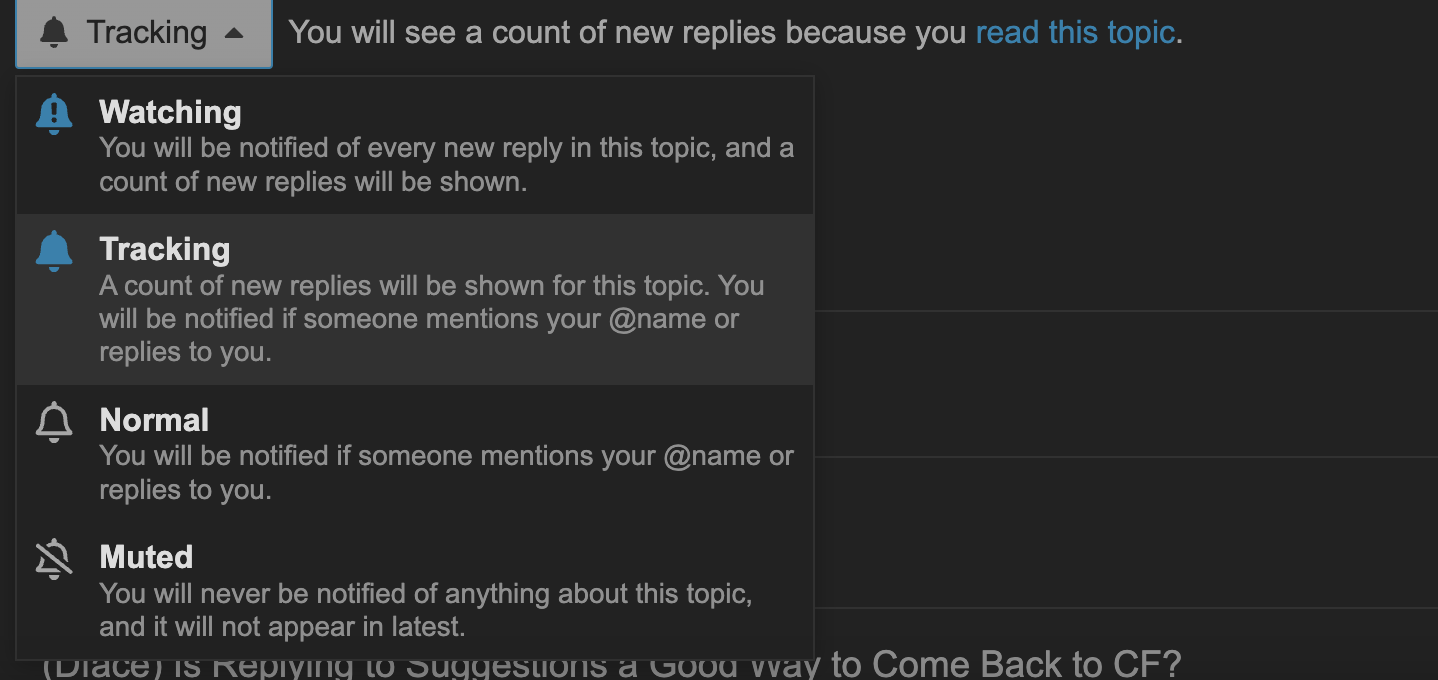
Are you asking if doing either would notify me and blow up my feed? I don’t think so. Also when you say blow up you would have to posting a lot and a lot fast too. No? I think it’d be fine. I do think I would get notified for mentioning the tutoring thread. I think I can just block that though:
---
### Author:  [@Dface](https://discuss.criticalfallibilism.com/u/Dface)
#### Post date: [August 13, 2024, 9:54pm UTC](https://discuss.criticalfallibilism.com/t/following-along-async-tutoring-dface/1948/4 "2024-08-13T21:54:34Z")
> [@Eternity](#):
>
> Are you asking if doing either would notify me and blow up my feed?
Yeah
> [@Eternity](#):
>
> I don’t think so. Also when you say blow up you would have to posting a lot and a lot fast too. No? I think it’d be fine.
Yeah, that makes sense. I don’t think I’m going to post more than once a day in this thread.
> [@Eternity](#):
>
> I do think I would get notified for mentioning the tutoring thread. I think I can just block that though:
Oh, that’s a good feature. I didn’t know much about it before.
---
### Author:  [@Dface](https://discuss.criticalfallibilism.com/u/Dface)
#### Post date: [August 13, 2024, 10:03pm UTC](https://discuss.criticalfallibilism.com/t/following-along-async-tutoring-dface/1948/5 "2024-08-13T22:03:07Z")
> [@Eternity Async Tutoring](https://discuss.criticalfallibilism.com/t/eternity-async-tutoring/1932/2):
>
> Take an online typing test. Let me know your words per minute and accuracy.
I did two practice tests and three real tests on [https://monkeytype.com/](https://monkeytype.com/)
I saw @Eternity’s post talking about the website:
> [@Eternity Async Tutoring](https://discuss.criticalfallibilism.com/t/eternity-async-tutoring/1932/74):
>
> Re-took typing test. I got 118 wpm and 100% accuracy. However, I did change from [typing.com](http://typing.com) to [monkeytype.com](http://monkeytype.com) as I felt it had better tools for practicing. I did do a test on [typing.com](http://typing.com) and got 93wpm with 100% accuracy.
I liked the idea cuz in the website you can type 200 of the most common words in the English Language.
1st real attempt: 73 wpm 100 % accuracy
2nd attempt: 57 wpm 91% accuracy
3rd attempt: 76 wpm 100% accuracy
---
### Author:  [@LMD](https://discuss.criticalfallibilism.com/u/LMD)
#### Post date: [August 14, 2024, 1:38am UTC](https://discuss.criticalfallibilism.com/t/following-along-async-tutoring-dface/1948/6 "2024-08-14T01:38:30Z")
I don’t think getting notifications would bother me and, like Eternity mentioned, I could always change the notifications settings for the thread.
---
### Author:  [@Dface](https://discuss.criticalfallibilism.com/u/Dface)
#### Post date: [August 14, 2024, 2:55am UTC](https://discuss.criticalfallibilism.com/t/following-along-async-tutoring-dface/1948/7 "2024-08-14T02:55:37Z")
Ok, that sounds good.
---
### Author:  [@Dface](https://discuss.criticalfallibilism.com/u/Dface)
#### Post date: [August 15, 2024, 10:37pm UTC](https://discuss.criticalfallibilism.com/t/following-along-async-tutoring-dface/1948/8 "2024-08-15T22:37:08Z")
Spent ~25 mins reading the article and making the post.
I want to try this activity:
> [@Eternity Async Tutoring](https://discuss.criticalfallibilism.com/t/eternity-async-tutoring/1932/452):
>
> What do you know about grammar? What have you done before?
>
> Assignment: Read my grammar article. Speak up if you find stuff hard or confusing. Consider sharing some thoughts as you go along but don’t get stuck on that (not mandatory). Do the practice exercises.
I’ve read [Fallible Ideas – Grammar](https://fallibleideas.com/grammar) like 4 years ago. I practiced making trees for the grammar article, and I’ve posted some grammar trees on a chapter book on FI group. I don’t remember much about grammar and I think I could only do the simple sentences well.
# English Language, Analysis & Grammar
> It doesn’t cover some typical details like verb tenses or commas.
I forgot when to use commas. I’ll look it up for a refresh.
### Step 2 – Subject
> The subject is always a noun, and it’s the noun that does the verb.
That makes it easier to figure out the parts of speech of the sentence.
> _What’s the difference between an object and a complement?_ Objects go with action verbs, they’re always nouns, and they’re sometimes optional. Complements go with linking verbs, they’re nouns or adjectives, and they’re always required.
So objects are optional and will go with an action verb. A complement is not optional and go with a linking verb.
I stopped reading on Step 3 – Object or Complement. I think it’s a lot of reading for me and there’s a lot of stuff remember.
---
### Author:  [@Dface](https://discuss.criticalfallibilism.com/u/Dface)
#### Post date: [August 17, 2024, 10:38pm UTC](https://discuss.criticalfallibilism.com/t/following-along-async-tutoring-dface/1948/9 "2024-08-17T22:38:48Z")
> [@Eternity Async Tutoring](https://discuss.criticalfallibilism.com/t/eternity-async-tutoring/1932/452):
>
> What do you know about grammar? What have you done before?
>
> Assignment: Read my grammar article. Speak up if you find stuff hard or confusing. Consider sharing some thoughts as you go along but don’t get stuck on that (not mandatory). Do the practice exercises.
I went back to part one cuz I think I read a little too fast. I spent about five minutes reading the article and ~10 more making the post.
### Step 1 – Verb
> The verb is the most important part of a simple sentence because it tells us what’s happening in the sentence.
Ok, that’s different than in school where we look at the subject first.
> There are two types: _action verbs_ and _linking verbs_ . The verb determines which of the two sentence types you’re dealing with (action sentence or linking sentence).
That makes sense and makes it already easy to categorize sentences. Like there’s only two kinds to remember.
> _Tip:_ If you’re not sure if a verb is action or linking, don’t get stuck worrying about it. It doesn’t make a big difference.
Ok, I think I get that the verb could be an action or it can link things. And I get that find the verb is the first step to analyze a sentence.
---
### Author:  [@Dface](https://discuss.criticalfallibilism.com/u/Dface)
#### Post date: [August 18, 2024, 9:30pm UTC](https://discuss.criticalfallibilism.com/t/following-along-async-tutoring-dface/1948/10 "2024-08-18T21:30:05Z")
> [@Eternity Async Tutoring](https://discuss.criticalfallibilism.com/t/eternity-async-tutoring/1932/452):
>
> What do you know about grammar? What have you done before?
>
> Assignment: Read my grammar article. Speak up if you find stuff hard or confusing. Consider sharing some thoughts as you go along but don’t get stuck on that (not mandatory). Do the practice exercises.
I read the article for 5 mins and spent 10 minutes making this post.
### Step 2 – Subject
> _Nouns are things_ . They include objects, people, places and abstract things like a thought or an emotion.
I like this explanation cuz it specifies what the “things” part of a noun are. In school I didn’t know what “things” meant like if it was something abstract or physical.
> Step two is **finding the subject**.
That’s easy to remember. So first find the verb and then the subject which is to the left of the verb.
> _Note:_ Some people teach finding the subject before the verb, mostly because it comes first (to the left) in the sentence. But it makes more sense to look for an actor after you know what the action is. And sentences tend to have more nouns than verbs, so starting with verbs gives you fewer things to deal with.
Yeah, I remember in school finding the subject came first. I like finding the verb first cuz yeah there are less verbs than nouns in a sentence so they’re easier to spot.
---
### Author:  [@Dface](https://discuss.criticalfallibilism.com/u/Dface)
#### Post date: [August 20, 2024, 8:03pm UTC](https://discuss.criticalfallibilism.com/t/following-along-async-tutoring-dface/1948/11 "2024-08-20T20:03:51Z")
> [@Eternity Async Tutoring](https://discuss.criticalfallibilism.com/t/eternity-async-tutoring/1932/452):
>
> Assignment: Read my grammar article. Speak up if you find stuff hard or confusing. Consider sharing some thoughts as you go along but don’t get stuck on that (not mandatory). Do the practice exercises.
I read Step 3 – Object or Complement for 6 mins and took 15 minutes to write this post.
### Step 3 – Object or Complement
> In action sentences, the subject does an action to the object.
Ok, I see how the verb, subject, and object are related. Like the subject does the action on the object.
> _I threw a red ball._
_I_ in the sentence does the action _threw_ and the _ball_ is what receives the throwing action. I think I get it intuitively, but if I think too much about it I can’t think it through.
> The _complement_ is a _noun or adjective_ which is linked to.
Good to know that the complement can be a noun or adjective. It makes sense that it can be an adjective cuz it’s linked to a noun.
> The word “complement” is related to the word “complete”. It’s a completer. If you said “The house is”, that would be an incomplete thought.
I looked up the word complement and it helped to get the quote above better. I know that complement is related to the word complete, but seeing the word used in a sentence in a dictionary helped me understand it more.
> **Finding the object or complement** is step three. Look to the _right_ of the verb. Finding that there is no object is fine too.
Ok, step three is find the object or complement. Sometimes there are no objects but there is always a complement if it’s a linking sentence.
---
### Author:  [@Dface](https://discuss.criticalfallibilism.com/u/Dface)
#### Post date: [August 22, 2024, 9:23pm UTC](https://discuss.criticalfallibilism.com/t/following-along-async-tutoring-dface/1948/12 "2024-08-22T21:23:36Z")
> [@Eternity Async Tutoring](https://discuss.criticalfallibilism.com/t/eternity-async-tutoring/1932/452):
>
> Assignment: Read my grammar article. Speak up if you find stuff hard or confusing. Consider sharing some thoughts as you go along but don’t get stuck on that (not mandatory). Do the practice exercises.
I read Step 4 – Modifiers for 9 mins and worked on this post for ~20 minutes.
> To understand a modifier, you must figure out what it modifies. In “John throws red balls.” you need to understand that “red” applies to “balls” not to “John”.
Yeah, it looks like it’s gonna take skill and practice to know what the modifier is modifying.
> The difference isn’t very important conceptually (they’re both modifiers, similar to how action verbs and linking verbs are both verbs).
Good to know. I think I get the difference between the two, but overall I get that modifiers change the word that they modify. Like they give more information about the word that’s being modified.
> In “dark red ball”, “dark” is an adverb that tells you the shade of red.
I see how asking questions like “what kind of red is it?” helps to figure out what word modifiers belong to.
> **Finding modifiers** , and figuring out what they modify, is step four for understanding a sentence.
Ok, step four for analyzing a sentence is find modifiers and find the word they’re modifying. Maybe modifiers can modify not just a word but a phrase too. I don’t remember that well about that.
> A tricky one is that “cute” answers “How does it look and/or act?”. A reasonable person could write the question differently for “cute”.
I’ve seen some more complicated writing like Popper and Rand how it doesn’t look easy to find what’s being modified.
> If I say “cat”, people won’t know which cat I mean. If I say “a cat” then I mean an indefinite, unspecified cat, “the cat” means a definite, particular cat, and “this cat” means the cat near me.
Yeah, I think I need more practice on when to use “a” and “the”. I think I mix those up sometimes. I’ll look it up
> _Detail:_ Verbs can be modified by other verbs. Modifier verbs are called “helper” or “auxiliary” verbs, not adverbs. In “I will practice grammar.”, the verb “practice” is modified by the helper verb “will” which changes it from present tense to future tense.
I remember using auxiliary verbs as secondary verbs in the sentence, but recently I’ve been reading @Eternity’s [Async Tutoring thread](https://discuss.criticalfallibilism.com/t/eternity-async-tutoring/1932/481) where auxiliary verbs seem more to act as main verbs of the sentence.
Quote below about auxiliary verbs in the Async thread:
> [@Eternity Async Tutoring](https://discuss.criticalfallibilism.com/t/eternity-async-tutoring/1932/483):
>
> > [@Eternity Async Tutoring](https://discuss.criticalfallibilism.com/t/eternity-async-tutoring/1932/481):
> >
> > So in “I will eat later” you’re saying that “will” is the main verb and it is modified by eat?
>
> “eat” is an infinitive functioning as a noun which is the object of “will”.
>
> Infinitives, gerunds and participles are words based on verbs which function as nouns or modifiers. They are called “nonfinite verbs” but they can’t do the job of a regular (“finite”) verb. Nonfinite verbs are one of the harder grammar topics.
To my understanding auxiliary verbs like _will_ and _have_ are main verbs of the sentence, and the other verb “main” verb in the sentence is the infinitive that modifies the auxiliary verb. I think I get that. I just don’t remember much about infinitives yet.
---
### Author:  [@Dface](https://discuss.criticalfallibilism.com/u/Dface)
#### Post date: [August 23, 2024, 10:35pm UTC](https://discuss.criticalfallibilism.com/t/following-along-async-tutoring-dface/1948/13 "2024-08-23T22:35:42Z")
> [@Eternity Async Tutoring](https://discuss.criticalfallibilism.com/t/eternity-async-tutoring/1932/452):
>
> Assignment: Read my grammar article. Speak up if you find stuff hard or confusing. Consider sharing some thoughts as you go along but don’t get stuck on that (not mandatory). Do the practice exercises.
I read from **Prepositional Phrases** to the end of **Simple Sentence Patterns** for about ~23 minutes. I was looking how to practice Prepositional Phrase Examples and Simple Sentence Analysis Example. I was looking on how to use bullet points in CF.
It took me about ~25 mins to finish this post.
I saw @Eternity’s [post](https://discuss.criticalfallibilism.com/t/eternity-async-tutoring/1932/462) on practicing examples from this article and I like how it’s formatted. I wanna try to use something similar.
### Simple Sentence Analysis Example
> The man with dark brown hair excitedly threw a little rock at the target.
- Step 1 Find Verb
- threw
- Step 2 Find Subject
- man
- Step 3 Find Object
- rock
- Step 4 Find Modifiers
- excitedly - modifies threw
- The - modifies man
- with dark brown hair modifies man
- brown - modifies hair
- dark - modifies brown
- a - modifies rock
- little - modifies rock
- at the target - modifies threw
- the - modifies target
> This analysis demonstrates everything covered so far.
>
> The man with dark brown hair excitedly threw a little rock at the target.
>
> Action verb: threw.
>
> Subject: man.
>
> Object: rock.
>
> “Excitedly” modifies “threw”.
I see how the analyzing was done in the article. I wasn’t sure if I should practice the sentence in my post or not. It took me a while to do and it was kind of a big project. I think maybe I should take it on in small steps next time so it doesn’t take me so long.
---
### Author:  [@Dface](https://discuss.criticalfallibilism.com/u/Dface)
#### Post date: [August 24, 2024, 11:09pm UTC](https://discuss.criticalfallibilism.com/t/following-along-async-tutoring-dface/1948/14 "2024-08-24T23:09:27Z")
> [@Eternity Async Tutoring](https://discuss.criticalfallibilism.com/t/eternity-async-tutoring/1932/452):
>
> Assignment: Read my grammar article. Speak up if you find stuff hard or confusing. Consider sharing some thoughts as you go along but don’t get stuck on that (not mandatory). Do the practice exercises.
I read **Prepositional Phrases** and **Prepositional Phrase Examples** for 10 minutes. I wanted to go back and read piece by piece. It took me 16 mins to write this post.
#### Prepositional Phrases
> Prepositions are words like “with”, “to”, “in”, “about” and “of” which _relate_ a noun to something else in the sentence.
I think I was having trouble with the relate part of the sentence. It helped to look up what relate meant so I just don’t rely on my intuition.
> A prepositional phrase is a type of _modifier_ .
Ok, I see how a preposition and its noun makes up a prepositional phrase and it counts as one modifier.
> A noun used with a preposition is never the subject, object or complement of the sentence. Each noun has one job in the sentence.
Ok that sounds good. It makes it easier to find what role each word has.
> Prepositions express a relationship between a part of the sentence and some additional information.
That makes sense. The preposition relates its noun and its modifiers to whatever its modifying.
#### Prepositional Phrase Examples
> The prepositional phrase “at stamps” is an adverb modifying “looks”. It tells us what John is looking at.
Just like any modifier you gotta find what the prepositional phrase is modifying.
> In “John sat in his chair.”, the preposition is “in” and its noun is “chair”. The prepositional phrase “in his chair” is an adverb modifying “sat”. It tells us what John sat in.
I see in the end of every paragraph in the section it’s making sense of what the prepositional phrase is doing in the sentence. Like prepositional phrases literally give us more information about what the sentence means.
---
### Author:  [@Dface](https://discuss.criticalfallibilism.com/u/Dface)
#### Post date: [August 25, 2024, 11:53pm UTC](https://discuss.criticalfallibilism.com/t/following-along-async-tutoring-dface/1948/15 "2024-08-25T23:53:56Z")
> [@Eternity Async Tutoring](https://discuss.criticalfallibilism.com/t/eternity-async-tutoring/1932/452):
>
> Assignment: Read my grammar article. Speak up if you find stuff hard or confusing. Consider sharing some thoughts as you go along but don’t get stuck on that (not mandatory). Do the practice exercises.
I read **Simple Sentence Analysis Example** and **Simple Sentence Patterns** for 12 mins and made this post in 17 minutes.
### Simple Sentence Analysis Example
> This analysis demonstrates everything covered so far.
>
> The man with dark brown hair excitedly threw a little rock at the target.
>
> Action verb: threw.
>
> Subject: man.
>
> Object: rock.
>
> “Excitedly” modifies “threw”.
>
> The first “the” modifies “man”.
>
> “A” modifies “rock”.
>
> “Little” modifies “rock”.
The analysis looked pretty straightforward. First the verb was found, then the subject, then the object, and at the end the modifiers.
> Prepositional phrase: “with dark brown hair”. This functions as an adjective which modifies “man”. The preposition is “with” and it governs the noun “hair”. It relates hair and man by telling us that the man has hair. It also tells us the type of hair (dark brown).
More detail seems to be given for analyzing the prepositional phrase. That makes sense cuz there’s more going on with prepositional phrases. Like the preposition relates two things and it tells us more about what the sentence is about.
> Conclusions: The sentence is about a man throwing a little rock. The throwing was excited. The man had dark brown hair. He threw the rock at the target.
I see that analyzing the sentence lets us split what’s happening into smaller pieces.
### Simple Sentence Patterns
> I now present the two simple sentence patterns:
>
> - Subject + Action Verb + Object (noun or nothing)
> - Subject + Linking Verb + Complement (noun or adjective)
I was reading this part out loud cuz I think it helps me remember the two patterns. It was hard reading it in my head.
> (“there” is called an expletive)
I looked up expletive, and I didn’t know there were literal filler words in english. I wonder why I use them a lot like they feel more natural to me in a conversation.
> In the question, “Are you a philosopher?”, the subject (you) is to the right of the verb (are), but the pattern of verb, subject and object (or complement) is still used.
That makes sense. You could even find the two simple sentence patterns even in questions.
---
### Author:  [@Dface](https://discuss.criticalfallibilism.com/u/Dface)
#### Post date: [August 26, 2024, 11:42pm UTC](https://discuss.criticalfallibilism.com/t/following-along-async-tutoring-dface/1948/16 "2024-08-26T23:42:23Z")
> [@Eternity Async Tutoring](https://discuss.criticalfallibilism.com/t/eternity-async-tutoring/1932/452):
>
> Assignment: Read my grammar article. Speak up if you find stuff hard or confusing. Consider sharing some thoughts as you go along but don’t get stuck on that (not mandatory). Do the practice exercises.
I finished reading **Conclusion of Part 1** for 8 minutes before starting the practice sentences. It took me 23 minutes to write this post.
### Conclusion of Part 1
> Practicing will let you _test_ whether you understood the steps correctly (can you actually do them?).
I think I have a good approximation of all the steps. I wanna see if I can practice them.
> A good place to get sentences to practice on is a _young adult novel_. Books aimed at young people use simpler writing.
That sounds good I wanna try that sometime.
> Practicing the steps will make them fast and intuitive.
I think I see what this means more now. Like, I don’t have to take so long find the main verb of the sentence. I think I get the intuitive part, like I won’t have to think so much about what step is next in the analysis.
> That means your attention will be free to focus on the topic instead of the grammar.
It took me a few times reading this to get it. I couldn’t connect exactly that being good at grammar means more time focusing on the writing like the topic or points.
> You can also use analysis to explain sentences better when someone else is confused or when there’s a disagreement about what a sentence means.
That’s like doing math work and showing your work. Sometimes showing your work to someone helps them see how you got to your answer.
> For each sentence you practice, follow the steps. Find the action or linking verb, then the subject, then the object or complement. Then find the modifiers and figure out what each one modifies. For prepositions, find their noun and figure out what the whole prepositional phrase modifies. Finally, after you understand the individual parts of the sentence, consider what the whole thing means.
Ok, first find the action or linking verb, then find the subject, then find the object or complement, and find the modifiers and what they modify.
For prepositional phrases find the preposition, then its noun, and then say what the prepositional phrase is modifying.
After all those steps make conclusions about what the sentence is about.
> John is wise.
Linking verb: is
Subject: John
Complement: wise
Conclusions: I don’t know how to conclude this exactly. I think John is being linked to being wise.
> John quickly drank milk.
Action verb: drank
Subject: John
Object: milk
adverb: quickly, it modifies drank
Conclusions: John drank milk. He drank quickly.
> John likes big, fast cars.
Action verb: likes
Subject: John
Object: cars
“Big” modifies “cars”.
“Fast” modifies “cars”.
Conclusions: John likes cars that are big and fast.
---
### Author:  [@Dface](https://discuss.criticalfallibilism.com/u/Dface)
#### Post date: [August 27, 2024, 11:36pm UTC](https://discuss.criticalfallibilism.com/t/following-along-async-tutoring-dface/1948/17 "2024-08-27T23:36:45Z")
> [@Eternity Async Tutoring](https://discuss.criticalfallibilism.com/t/eternity-async-tutoring/1932/452):
>
> Assignment: Read my grammar article. Speak up if you find stuff hard or confusing. Consider sharing some thoughts as you go along but don’t get stuck on that (not mandatory). Do the practice exercises.
This post and its practice problems took me 24 mins to make.
### Conclusion of Part 1 Practice Sentences
> John went to the new store.
Action verb: went
Subject: John
Object: I don’t think there is an object. I’ll check with somebody else’s work.
“To the new store” is a Prepositional Phrase that modifies “went”. “To” is the preposition. Its noun is “store”. “To” relates “went” and “store” to say what place John went.
“The” modifies “store”.
“New” modifies “store”.
Conclusions: John went somewhere. He went to the store.
> The ferocious dog chased three cats over the chair.
Action verb: chased
Subject: dog
Object: cats
The first “The” modifies “dog”.
“Ferocious” modifies “dog”
“Three” modifies “cats”.
Prepositional Phrase: “over the chair”. This is an adverb that modifies “chased”. “Over” is the preposition and its noun is “chair”. “Over” relates “chased” and “chair” to say where the chasing happened.
The second “the” modifies “chair”.
Conclusions: There was dog and he chased cats. The dog was ferocious. There were three cats. And the chasing action was happening on top of the chair.
I’m not too sure about my conclusion for the chasing happening on the chair. My conclusion makes it sound like the chasing happened exclusively on the chair.
I saw @Eternity’s [post](https://discuss.criticalfallibilism.com/t/eternity-async-tutoring/1932/465) on this practice sentence and it made more sense to me:
> [@Eternity Async Tutoring](https://discuss.criticalfallibilism.com/t/eternity-async-tutoring/1932/465):
>
> 5 - There is a ferocious dog. The dog chased three cats. The dog chased the cats while going over the chair.
The chasing was happening while going over a chair. I think I’ll look up what over means as a preposition
---
### Author:  [@LMD](https://discuss.criticalfallibilism.com/u/LMD)
#### Post date: [August 29, 2024, 11:05am UTC](https://discuss.criticalfallibilism.com/t/following-along-async-tutoring-dface/1948/18 "2024-08-29T11:05:23Z")
> [@Dface](#):
>
> I’m not too sure about my conclusion for the chasing happening on the chair.
I think you’re right that the prepositional phrase ‘over the chair’ modifies ‘chased’, so I’m not sure why you use a different preposition ‘on’ in your conclusion. To me ‘chased _on_ the chair’ means something like: all the chasing happened on the chair. But ‘chased _over_ the chair’ I think means something like: they were chased and one of the places they were chased was over the chair (as opposed to around or under the chair).
---
### Author:  [@Dface](https://discuss.criticalfallibilism.com/u/Dface)
#### Post date: [August 29, 2024, 10:22pm UTC](https://discuss.criticalfallibilism.com/t/following-along-async-tutoring-dface/1948/19 "2024-08-29T22:22:56Z")
> [@LMD](#):
>
> I think you’re right that the prepositional phrase ‘over the chair’ modifies ‘chased’, so I’m not sure why you use a different preposition ‘on’ in your conclusion.
I used a different preposition cuz I thought I could explain what’s going on in other words. I don’t think it came out right.
> [@LMD](#):
>
> To me ‘chased _on_ the chair’ means something like: all the chasing happened on the chair.
Yeah, using “on” also makes it sound like it modifies “cats” and saying their position is on the chair.
> [@LMD](#):
>
> But ‘chased _over_ the chair’ I think means something like: they were chased and one of the places they were chased was over the chair (as opposed to around or under the chair).
I see, one of the places the cats were chased was over the chair. Not around the chair or under the chair. I think I get your explanation intuitively. I was wondering when the cats were chased over the chair instead of around it or under it are we referring to the position of the movement? Like are we referring to the shape of a curve?
I think I have trouble visualizing function words like prepositions in a sentence. I wonder if talking about this stuff is too complicated for me.
---
### Author:  [@LMD](https://discuss.criticalfallibilism.com/u/LMD)
#### Post date: [August 29, 2024, 11:23pm UTC](https://discuss.criticalfallibilism.com/t/following-along-async-tutoring-dface/1948/20 "2024-08-29T23:23:12Z")
> [@Dface](#):
>
> I was wondering when the cats were chased over the chair instead of around it or under it are we referring to the position of the movement? Like are we referring to the shape of a curve?
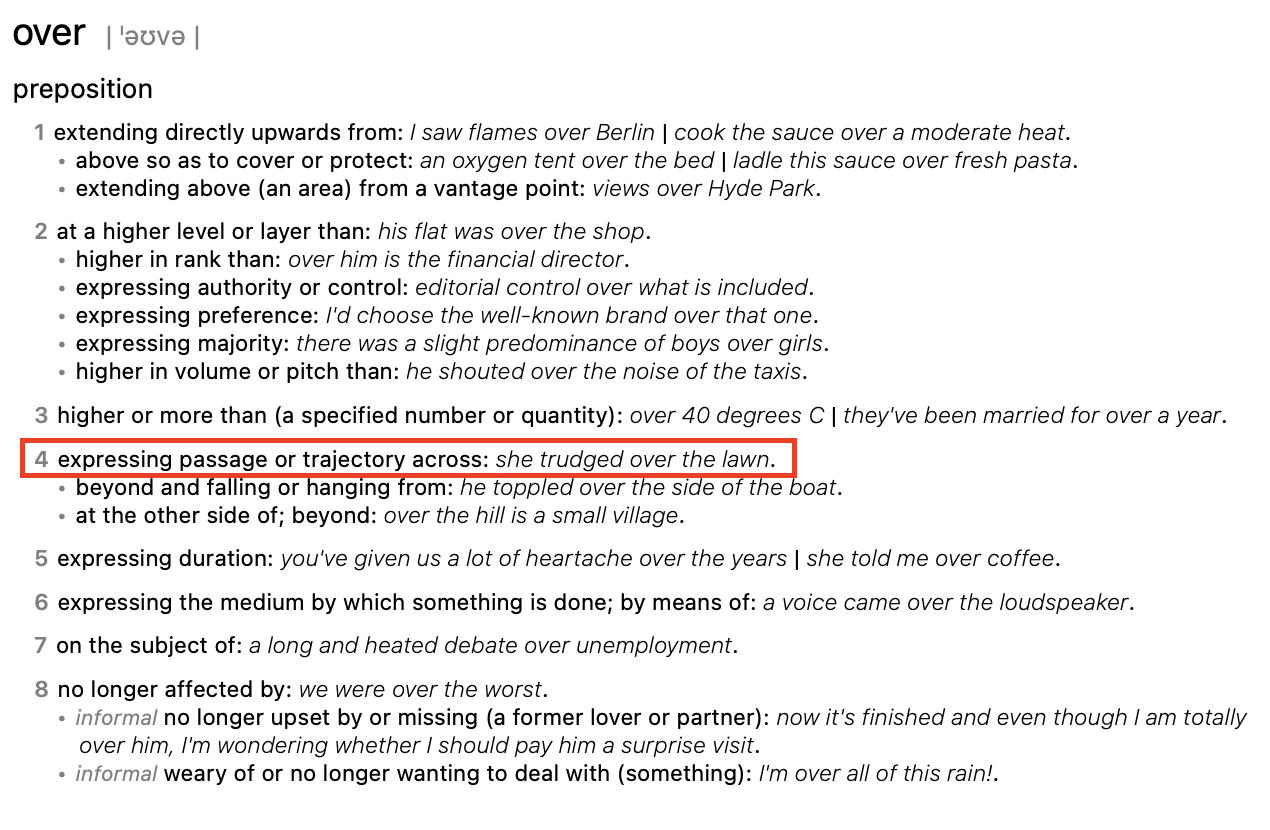
I’m not sure exactly what you mean about position of the movement. I think it’s giving a detail about the path of the chase. I think this highlighted meaning in the dictionary is the right one for this sentence. From the Oxford Dictionary on my mac:
[Next page](https://discuss.criticalfallibilism.com/t/following-along-async-tutoring-dface/1948.md?page=2)