# I Changed My Mind about Error-Correcting Debate, Misogyny and More
**URL:** https://discuss.criticalfallibilism.com/t/i-changed-my-mind-about-error-correcting-debate-misogyny-and-more/2160
**Category:** Elliot Temple
**Tags:** bot, curiosity-blog
**Created:** [March 30, 2026, 6:06am UTC](https://discuss.criticalfallibilism.com/t/i-changed-my-mind-about-error-correcting-debate-misogyny-and-more/2160 "2026-03-30T06:06:43Z")
**Posts on this page:** 20
**Page:** 1
### Author:  [@Elliot](https://discuss.criticalfallibilism.com/u/Elliot)
#### Post date: [March 30, 2026, 6:06am UTC](https://discuss.criticalfallibilism.com/t/i-changed-my-mind-about-error-correcting-debate-misogyny-and-more/2160/1 "2026-03-30T06:06:43Z")
I changed my mind about some things. These examples are illustrative of potential weaknesses of focusing on error correction and critical discussion like Karl Popper advised. I don't think the weaknesses are inherent or unavoidable. They're practical issues that don't require different epistemology principles to address. They're just ways you can go wrong if you don't know enough.
* * *
This is a companion discussion topic for the original entry at [https://curi.us/2611-i-changed-my-mind-about-error-correcting-debate-misogyny-and-more](https://curi.us/2611-i-changed-my-mind-about-error-correcting-debate-misogyny-and-more)
---
### Author:  [@ActiveMind](https://discuss.criticalfallibilism.com/u/ActiveMind)
#### Post date: [March 30, 2026, 7:44am UTC](https://discuss.criticalfallibilism.com/t/i-changed-my-mind-about-error-correcting-debate-misogyny-and-more/2160/2 "2026-03-30T07:44:18Z")
Great post! Your willingness to change your mind and share your past mistakes is a big part of why I respect you.
---
### Author:  [@Dface](https://discuss.criticalfallibilism.com/u/Dface)
#### Post date: [March 30, 2026, 9:22am UTC](https://discuss.criticalfallibilism.com/t/i-changed-my-mind-about-error-correcting-debate-misogyny-and-more/2160/3 "2026-03-30T09:22:03Z")
> [@Elliot](#):
>
> I used to think if I said something to people, and they had evidence that I was wrong, they would tell me. I took a lack of any negative responses as indicating they didn’t have key evidence that I was missing. That has implications.
An implication is tht u may be right, correct? Like, ure idea wasnt refuted and tht it’s reasonable? Not too sure there.
From my experience, this attitude(??) u had, i thot it was cool cus it looks logic based and idk it’s talking from a place with a lot of in depth knowledge. When i first noticed tht attitude/idea i always noticed tht i tried to make sense of it on my own and tht it was hard to. But i would usually think like, “no this is how real intellectuals can think of things when they’ve become top in their expertise.” I think i never really tried being super curious about the attitude or try to use it or understand it for my learning. I thought it was a thing tht would come later when ure really good at things no? In a way i feel like im talking about something else in this reply so far. So mb if yea n i wanna know how if yea
In a way, I think ive dealt with something similar tht changed my mind. Like, I now think jus cuz i don hear any good arguments( i think) doesnt mean tht the other side doesnt have any good criticisms or things to consider. Wat made me realize tht is when i talked to my brother. We would disagree so much about a lot of things often, and in one convo i told him it was very difficult to talk to him cuz i try so hard to understand his side n account for it, but he jus keeps disagreeing with me on a lot of points anyways.
On a side note, I think im probably making many mistakes taking to him like how well am i actually understanding his side?
But it all made me think like maybe he does have some good points to bring up but hasnt said it yet or cuz of how conversation works im not gonna hear it. Like, it might be difficult to get the good point from him and i may never hear it without a lot of effort. Maybe u changing ur mind parallels me changing my mind?
---
### Author:  [@Max](https://discuss.criticalfallibilism.com/u/Max)
#### Post date: [March 30, 2026, 2:07pm UTC](https://discuss.criticalfallibilism.com/t/i-changed-my-mind-about-error-correcting-debate-misogyny-and-more/2160/4 "2026-03-30T14:07:36Z")
I enjoyed reading this, thanks. Some thoughts and reflections I had along the way:
> People, including authors, pundits and academics, will use bad examples and bad evidence despite much better stuff being available.
How do we judge what is best? Is it possible that people use what _they found_ persuasive and their sense of that is badly calibrated?
I have some thoughts but I’m not confident that I know an answer. Good arguments/evidence means it’s persuasive or resistant to criticism or something like that. Part of the problem is that, while I have a decent idea of what I think my keystone claims are (which I think are resilient and/or persuasive), I don’t know what other people (whom I disagree with) think are their keystone claims.
If cooperation is an option (so I can ask what their keystone claims are) then debate trees could solve this. The problem there is the requirement for near synchronicity. Large time gaps would be less of an issue if we publicly maintained debate trees, kind of like how academic journals can have debates that run for decades, but more organized and focused.
Failing that, my intuition says to read and listen and try and figure out what their keystones are, but that’s what you’ve done and found that it’s not very effective.
Do we have a term for ‘keystone claims’ yet? I feel like we should and I’m just not remembering it.
> [@Elliot](#):
>
> I’m trying to be more humble and recognize that it’s complicated and I don’t know enough about it.
This resonates with me. It’s something I had no skill in or appreciation of prior to CF; I think I started really appreciating the idea in the 2020 tutoring.
I can’t remember if BoI encourages this much at all, but I think it’s notable that after reading BoI, I was convinced of fallibilism but I didn’t really have an appreciation of epistemic humility or know how to practice it, or even know that I should be practicing it. (I still have a lot of room left for improvement, of course.)
Also, thinking about how you changed your mind in the essay and the lengths you went to, I don’t think that I would have done that. Which is kind of exciting in that it’s a bit of a glimpse of stuff on the horizon. I don’t exactly have the words – it’s like the feeling of an amateur seeing an artisan and knowing that there’s a whole lot of progress to make if I want it.
---
### Author:  [@Elliot](https://discuss.criticalfallibilism.com/u/Elliot)
#### Post date: [March 30, 2026, 5:00pm UTC](https://discuss.criticalfallibilism.com/t/i-changed-my-mind-about-error-correcting-debate-misogyny-and-more/2160/5 "2026-03-30T17:00:10Z")
> [@Max](#):
>
> How do we judge what is best? Is it possible that people use what _they found_ persuasive and their sense of that is badly calibrated?
Yes. People go by a variety of things. What persuaded them, what they think will persuade or manipulate others, what’s popular, what’s socially acceptable, what their abstract logical analysis says is good, what their biases say is good, what is convenient, what they think sounds clever.
> [@Max](#):
>
> I can’t remember if BoI encourages this much at all, but I think it’s notable that after reading BoI, I was convinced of fallibilism but I didn’t really have an appreciation of epistemic humility or know how to practice it, or even know that I should be practicing it. (I still have a lot of room left for improvement, of course.)
I don’t think BoI is effective at encouraging intellectual modesty/humility, partly because Deutsch isn’t actually good at it, and partly because he tries to pander to readers more than he tries to change them. Deutsch’s fan community is generally rather irrational even when they aren’t harassing me. They’re silly and arrogant on Twitter, and they also do things like form an Institute and publish books on topics they know little about: [Curiosity – The Sovereign Child Contradicts Taking Children Seriously](https://curi.us/2600--the-sovereign-child-contradicts-taking-children-seriously) And they may be even less open to debate than Less Wrong or Effective Altruism.
Deutsch also talks about grand stuff like theories of everything and he broadly thinks his ideas are super important and high quality on many topics (not just for one or two specialities).
---
### Author:  [@Elliot](https://discuss.criticalfallibilism.com/u/Elliot)
#### Post date: [March 30, 2026, 6:25pm UTC](https://discuss.criticalfallibilism.com/t/i-changed-my-mind-about-error-correcting-debate-misogyny-and-more/2160/6 "2026-03-30T18:25:46Z")
I fear what too many people did with me (and with Deutsch and many others) is _try to agree_ instead of giving critical feedback. I think a lot of responses are polarized between trying to agree or being broadly argumentative, and more mixed or nuanced responses are less common.
So I shared some stuff _trying to get critical feedback_ and thought it had been exposed to people’s critical thinking when it hadn’t and they were just trying to learn it and agree with it even though it was tentative stuff I wanted to explore not teach. This came up with repeating things Deutsch told me (which, even if he believed them for many years with confidence, I still wanted to expose to critical scrutiny) and with some early-stages ideas of my own.
The argumentative people often don’t give good criticism either even when there are better arguments available on their side, which they don’t know about, don’t like, or don’t use for other reasons. So winning arguments with some people and getting praise from others doesn’t mean the ideas have been exposed to very good critical thinking even if everyone says they’re Popperians who did critical thinking.
Lots of people withhold intuitive, practical, or experience-based criticisms/disagreements/counter-examples when they are trying to be clever intellectuals and use logical philosophical arguments.
---
### Author:  [@Neo](https://discuss.criticalfallibilism.com/u/Neo)
#### Post date: [March 31, 2026, 6:29am UTC](https://discuss.criticalfallibilism.com/t/i-changed-my-mind-about-error-correcting-debate-misogyny-and-more/2160/7 "2026-03-31T06:29:55Z")
Great article! It reminds me of this video about being intellectually humble.
[ ](https://www.youtube.com/watch?v=-3SA6G5rZrg)
---
### Author:  [@Dface](https://discuss.criticalfallibilism.com/u/Dface)
#### Post date: [March 31, 2026, 7:21am UTC](https://discuss.criticalfallibilism.com/t/i-changed-my-mind-about-error-correcting-debate-misogyny-and-more/2160/8 "2026-03-31T07:21:34Z")
> [@Elliot](#):
>
> I fear what too many people did with me (and with Deutsch and many others) is _try to agree_ instead of giving critical feedback.
Was this over time? Did this happen when CF was up? Did I do this? Later on in ur reply(first sentence of second paragraph), I think u say u wrote exploratory things and that people tried to learn instead of being critical. I wonder if I I tried to learn instead of being curious or trying to understand more of what u say.
> [@Elliot](#):
>
> I think a lot of responses are polarized between trying to agree or being broadly argumentative, and more mixed or nuanced responses are less common.
Idk what polarized means well so ill look it up
Ok, after looking it up, I think it means that the responses are like the oppossite of each other. Like, they try to agree a lot or disagree a lot.
I think ure looking for the more mixed or nuanced responses cuz they are at least being more fair I think. Like, they don’t just shut down the part of themselves that disagree I think.
> [@Elliot](#):
>
> So I shared some stuff _trying to get critical feedback_ and thought it had been exposed to people’s critical thinking when it hadn’t and they were just trying to learn it and agree with it even though it was tentative stuff I wanted to explore not teach.
Yeah, I wish this intellectual stuff was easier cuz I think there’s so much one could miss or overlook and it could get in the way of understanding what u say.
How does one know they’re giving critical feedback? What does critical feedback mean? Giving critical feedback sounds like a goal that’s hard to be successful in if one doesn’t it practice enough.
> [@Elliot](#):
>
> This came up with repeating things Deutsch told me (which, even if he believed them for many years with confidence, I still wanted to expose to critical scrutiny) and with some early-stages ideas of my own.
The problem is that Deutsch could be very wrong about some of the things he showed u or taught u, but u’re not getting the critical feedback that would help to know.
Does the quote above show that there may be deficiency in I guess the community’s rational skills?
> [@Elliot](#):
>
> The argumentative people often don’t give good criticism either even when there are better arguments available on their side, which they don’t know about, don’t like, or don’t use for other reasons.
I think I’ve noticed this offhand over the years. Makes me think it’s hard to be an intellectual idk. Like, it seems hard for people to be rational idk.
> [@Elliot](#):
>
> So winning arguments with some people and getting praise from others doesn’t mean the ideas have been exposed to very good critical thinking even if everyone says they’re Popperians who did critical thinking.
I wonder how it looks like when ideas are being exposed to very good critical thinking. Like, what do u see members do? What do you see them employ? I think they would use stuff like post mortems or maybe debate trees. Like it would be automatic for them and they would be cool with using those. Maybe they could make up their own rationality tool that’s not problematic to use idk.
> [@Elliot](#):
>
> Lots of people withhold intuitive, practical, or experience-based criticisms/disagreements/counter-examples when they are trying to be clever intellectuals and use logical philosophical arguments.
I wonder why but it seems that the quote explains some.
---
### Author:  [@Max](https://discuss.criticalfallibilism.com/u/Max)
#### Post date: [March 31, 2026, 1:28pm UTC](https://discuss.criticalfallibilism.com/t/i-changed-my-mind-about-error-correcting-debate-misogyny-and-more/2160/9 "2026-03-31T13:28:14Z")
Have you tried using AI to identify or find the good arguments / resources for different positions? If so, how’d it go?
This feels like a problem that AI could help with, particularly identifying candidates and finding new/unique arguments. It might take a deep research kind of harness.
---
### Author:  [@Elliot](https://discuss.criticalfallibilism.com/u/Elliot)
#### Post date: [March 31, 2026, 3:11pm UTC](https://discuss.criticalfallibilism.com/t/i-changed-my-mind-about-error-correcting-debate-misogyny-and-more/2160/10 "2026-03-31T15:11:58Z")
it helps some. it typically works better for finding leads than web search or google scholar search. you can’t trust its summaries, so it’s a lot of reading to check stuff well.
it didn’t work for finding inductivist responses that actually engage with key Popperian points. i’m not sure those exist. but it worked better on other topics like MCDM.
---
### Author:  [@Max](https://discuss.criticalfallibilism.com/u/Max)
#### Post date: [March 31, 2026, 5:32pm UTC](https://discuss.criticalfallibilism.com/t/i-changed-my-mind-about-error-correcting-debate-misogyny-and-more/2160/11 "2026-03-31T17:32:37Z")
Okay yeah. I tried it earlier on some UBI stuff and it worked pretty well. I have a draft post about it I’m finishing (which I started beofre this post so I might have to finish the UBI one later).
I thought I’d try with the inductivist stuff and see what I could get:
> **Prompt**
>
> note: i find the AskUserQuestion tool mention helpful with claude.
>
> > [@](#):
> >
> > We are researching historical arguments from epistemology (20th and 21st c). Our goal is to find inductivist responses that actually engage with key Popperian points. Your job is to thoroughly research the literature looking for cases. Since these are hard to find, you will need to go down many tangents and side paths. You are free to use any publicly accessible resource to find relevant works (eg web search, google scholar, scihub, libgen, etc). In modern parlance, our goal is to find inductivist works that faithfully steelman key popperian ideas. You may use the AskUserQuestion tool to ask me questions whenever you need to.
>
> and then some questions and answers:
>
> > [@](#):
> >
> > Q: Which Popperian points are you most interested in seeing engaged with? (Select all that apply)
> > A: Problem of induction (no justification for universal claims from finite observations), Falsificationism / conjectures & refutations as the engine of knowledge growth, Demarcation problem (science vs pseudoscience), Critique of confirmationism / verificationism
> >
> > Q: What counts as ‘inductivist’ for your purposes? (Select all that apply)
> > A: Classical inductivism (Mill, early logical positivists), Bayesian / probabilistic confirmation theory, Any non-Popperian epistemology that defends some role for induction
> >
> > Q: Are you primarily after published academic works (journal articles, monographs), or are informal sources (blog posts, lecture notes, interviews) also valuable?
> > A: Both formal and informal sources
> **Main Response**
>
> [https://claude.ai/public/artifacts/b07595ea-9067-4c5d-b7c6-51d8e04cd6fc](https://claude.ai/public/artifacts/b07595ea-9067-4c5d-b7c6-51d8e04cd6fc)
>
> [compass\_artifact\_wf-13afd578-1840-4054-9e8b-0a7f9d123741\_text\_markdown.md](https://discuss.criticalfallibilism.com/uploads/short-url/2rh9kO9bBMvfGN2fq2qaRlwoJJG.md) (20.7 KB)
After that I asked a follow up and while reading the first criticism of Popper, I felt like I could address it, so I’m going to (and maybe more).
_Insert during editing: I reason through the top two arguments with some annotations of thoughts. Even if these arguments it found aren’t new or interesting, I think some of my thoughts are (interesting at least, some were new to me). It felt like good practice._
> [Max:] summarize the strongest arguments assuming the reader has a familiarity with popper but not with the specific arguments in question (so you need to state poppers position and the criticism).
> **Full Response**
>
> model was claude opus 4.6 extended.
>
> > [@](#):
> >
> > Here’s a summary of the strongest arguments, structured so each one states the Popperian position being challenged and then the criticism.
> >
> > * * *
> >
> > ## 1. Salmon’s Corroboration Dilemma
> >
> > **Popper’s position.** Science proceeds by conjecture and refutation. We propose bold theories, attempt to falsify them, and when they survive severe tests, we say they are “corroborated.” Crucially, corroboration is _not_ confirmation — it does not raise the probability that the theory is true or that it will succeed in future applications. Corroboration is merely a backward-looking report card: this theory has survived these tests so far. Popper insists this is purely deductive — no inductive inference is involved at any stage.
> >
> > **Salmon’s critique.** Wesley Salmon (_The Foundations of Scientific Inference_, 1967; “Rational Prediction,” 1981) pressed a simple but devastating question: _why should we prefer well-corroborated theories for practical decisions?_
> >
> > Suppose you need to build a bridge. Two theories of materials science are available. Theory A has been severely tested and survived — it is highly corroborated. Theory B was proposed yesterday and has never been tested. Popper says corroboration confers no expectation of future success. If that’s true, you have no rational basis for choosing Theory A over Theory B for your bridge. You might as well consult an astrologer.
> >
> > Salmon formulated this as a dilemma:
> >
> > - **Horn 1:** If corroboration really confers no rational expectation about future performance, then Popper’s methodology gives scientists no reason to rely on well-tested theories. _Modus tollens_ without corroboration is empty — you can eliminate falsified theories but have no basis for preferring among the survivors.
> >
> > - **Horn 2:** If corroboration _does_ provide rational grounds for preferring well-tested theories for future application, then corroboration is functioning as inductive support under a different name. _Modus tollens_ with corroboration is just induction.
> >
> > Either way, Popper’s program fails on its own terms. Salmon’s formulation — “modus tollens without corroboration is empty; modus tollens with corroboration is induction” — has not been satisfactorily answered by Popperians in the nearly six decades since it was published. Popper’s own responses tended to reassert that corroboration is backward-looking, but this doesn’t resolve why a rational agent should use backward-looking assessments to guide forward-looking decisions unless some inductive principle is operating.
> >
> > **Strength of engagement:** Salmon represented Popper’s position accurately and even sympathetically. He acknowledged the genuine insight in falsificationism before showing the gap. This is considered by many philosophers of science to be the single strongest challenge to Popper’s anti-inductivism.
> >
> > * * *
> >
> > ## 2. Putnam’s “Inductivist Quaver”
> >
> > **Popper’s position.** Scientific theories gain credibility through bold, risky predictions that could have falsified them but didn’t. A theory that predicts something surprising and turns out to be right has been severely tested. This is what distinguishes science from pseudoscience — genuine scientific theories stick their necks out.
> >
> > **Putnam’s critique.** Hilary Putnam (“The ‘Corroboration’ of Theories,” 1974) pointed out a historical counterexample that strikes at the heart of this picture. Newton’s theory of universal gravitation — one of the greatest achievements in the history of science — was _not_ accepted because it made bold novel predictions that were then tested. It was accepted because it _explained things people already knew_: planetary orbits (Kepler’s laws), the tides, the behavior of falling objects. These weren’t risky predictions — they were established phenomena that Newton’s framework unified.
> >
> > On a strict Popperian account, the fact that Newton’s theory accommodated already-known data shouldn’t count for much. After all, any clever theorist can construct a theory to fit existing data. Popper emphasized _novel_ predictions — predictions made before the data was in. But historically, the most important evidence for Newton was old evidence, not new predictions.
> >
> > Putnam then examined how Popper actually discussed theory preference and detected what he called “an inductivist quaver” — moments where Popper’s reasoning about why we should prefer well-corroborated theories implicitly relied on the very inductive logic he officially rejected. The logical structure of “this theory has passed severe tests, therefore it is more worthy of tentative acceptance” is, Putnam argued, indistinguishable from inductive reasoning regardless of what label you attach to it.
> >
> > **Strength of engagement:** Putnam opened with genuine respect for Popper’s influence and worked from a concrete historical case rather than abstract logic, making the argument difficult to deflect with technical maneuvers. The Newton example is particularly effective because Popper himself held Newton in high regard.
> >
> > * * *
> >
> > ## 3. Carnap’s Mixed-Quantifier Argument Against the Falsification/Verification Asymmetry
> >
> > **Popper’s position.** There is a fundamental logical asymmetry between falsification and verification. A universal statement like “all swans are white” can never be verified (you’d have to check every swan that ever exists) but can be conclusively falsified by a single black swan. This asymmetry is the foundation of Popper’s entire methodology — it’s why he favored falsification over confirmation as the engine of science.
> >
> > **Carnap’s critique.** Rudolf Carnap (in the Schilpp volume _The Philosophy of Rudolf Carnap_, 1963) identified a technical but profound problem: Popper’s asymmetry only holds for sentences of a simple universal form (“for all x, Fx”). But most actual laws of physics aren’t of this form. They involve _mixed quantifiers_ — sentences of the form “for all x, there exists a y, such that…”
> >
> > Consider the law “every material has a melting point.” This says: for every substance x, there exists a temperature y such that x melts at y. To _falsify_ this, you’d need to show that some substance has no melting point at any temperature — which requires testing every possible temperature, an infinite task. To _verify_ it for a specific substance, you just need to find one temperature where it melts.
> >
> > For sentences with this mixed-quantifier structure, **falsification is as difficult as verification**. The clean asymmetry that Popper’s entire methodology depends on simply vanishes. And since real physical laws routinely involve existential quantifiers (limits, equilibrium points, conservation quantities), this isn’t an exotic edge case — it’s the norm in actual science.
> >
> > According to historian A.W. Carus, neither Popper nor any of his followers ever directly addressed this argument. It remains one of the most technically precise and under-discussed challenges to Popper’s foundations.
> >
> > **Strength of engagement:** This is a formal logical argument that attacks Popper on his own preferred terrain — the logical structure of scientific statements. It doesn’t require any controversial philosophical premises, just careful attention to quantifier structure.
> >
> > * * *
> >
> > ## 4. Mayo’s Error-Statistical Completion of Severe Testing
> >
> > **Popper’s position.** Science progresses through severe testing. A good test is one that a theory would be likely to fail if it were false. The more severe the tests a theory survives, the more corroborated it is. Popper explicitly required that tests be severe — a sycophantic “test” designed to confirm a theory doesn’t count. He even proposed that we can measure a theory’s testability by its degree of falsifiability.
> >
> > However, Popper insisted this entire framework could operate without any notion of probability or inductive inference. Corroboration is not confirmation. Severe testing does not raise the probability that a theory is true.
> >
> > **Mayo’s critique.** Deborah Mayo (_Error and the Growth of Experimental Knowledge_, 1996; _Statistical Inference as Severe Testing_, 2018) argued that Popper’s insight about severity was exactly right — but that he was unable to _cash it out_ formally because he refused to use the mathematical tools required.
> >
> > The problem: how do you determine whether a test is actually severe? Popper’s answer was essentially qualitative — a theory is more severely testable if it makes more precise predictions, prohibits more possible observations, etc. But this leaves crucial questions unanswered. Suppose a theory predicts a measurement of 5.0 ± 0.1 and you observe 5.05. Has the theory passed a severe test? That depends on things like: how precise is your instrument? What’s the probability you’d see 5.05 even if the theory were false? How much experimental noise is there?
> >
> > Answering these questions requires _error probabilities_ — the probability that your test procedure would produce a given result under various hypotheses. This is precisely the statistical machinery of Neyman-Pearson testing, which involves reasoning about how often a procedure would err. And this, Mayo argued, is inductive reasoning — reasoning from the performance characteristics of a procedure to a conclusion about the case at hand.
> >
> > Mayo’s claim is that Popper saw the right destination (severe testing as the key to scientific method) but refused to take the only road that leads there (error-probabilistic reasoning). She characterized this as Popper making a “bait and switch” — getting assent to the intuitive idea that severity matters, then delivering a framework that cannot formally distinguish severe tests from non-severe ones. Her own error-statistical framework fills the gap by defining severity precisely: a claim passes a severe test when the test had a high probability of detecting the specific flaw being probed, and the claim survived anyway.
> >
> > **Strength of engagement:** Mayo is arguably the fairest critic in this literature because she explicitly positions herself as completing Popper’s project rather than demolishing it. She carefully distinguishes “naive” Popper (the textbook straw figure) from the more sophisticated philosopher, credits his insights about severity as foundational, and presents her alternative as what Popper should have said rather than what he’s wrong about.
> >
> > * * *
> >
> > ## 5. Howson’s Bayesian Solution That Partly Vindicates Popper
> >
> > **Popper’s position.** The problem of induction (Hume’s problem) is insoluble. There is no way to justify inductive inference — no way to show that observing regularities in the past gives rational grounds for expecting them to continue. Popper accepted Hume’s negative conclusion completely and proposed that science doesn’t need induction because it can proceed purely through conjecture and refutation.
> >
> > **Howson’s critique.** Colin Howson (_Hume’s Problem: Induction and the Justification of Belief_, 2000) developed the remarkable position that **Popper was right about Hume but wrong about Bayesianism.**
> >
> > Howson agreed with Popper that there is no non-circular justification for induction. He then argued that Bayesian probabilistic reasoning doesn’t require such a justification. Bayesianism provides a _logic_ for updating beliefs in light of evidence — Bayes’ theorem is a deductive consequence of the probability axioms — without making any claim that this logic is “justified” in the foundational sense Hume demanded. Just as deductive logic tells you what follows from your premises without justifying the premises themselves, Bayesian inference tells you how to update your credences without justifying your starting credences (priors).
> >
> > This dissolves Popper’s main motivation for rejecting probabilistic reasoning. Popper rejected Bayesianism because he thought it required solving the problem of induction — that you’d need some inductive warrant to show that updating on evidence is rational. Howson argued this conflates two different things: the problem of justifying induction as a general principle (which Howson agrees is insoluble) and the problem of whether probabilistic inference is internally coherent and useful (which Howson argues it is).
> >
> > Additionally, Howson and Urbach (_Scientific Reasoning: The Bayesian Approach_, 1989/2006) showed through detailed analysis that Popper’s concept of corroboration — when you work out its formal properties — is essentially a monotonic transformation of Bayesian posterior probability. Corroboration tracks the same evidential relationships that Bayesian confirmation does. The two programs agree on which evidence supports which theories; they disagree only on what to call it.
> >
> > **Strength of engagement:** Howson was at the LSE (Popper’s department) and knew Popper’s work intimately. His strategy of partly agreeing with Popper — yes, Hume’s problem is insoluble — before showing this doesn’t lead where Popper thought it led, is a sophisticated form of engagement. He even defended Popper against weak attacks (notably defending the Popper-Miller theorem against a bad objection by Dunn and Hellman) before offering his own independent critique.
> >
> > * * *
> >
> > ## 6. Zamora Bonilla: Popper’s Own Measures Are Inductivist
> >
> > **Popper’s position.** Popper spent considerable effort developing formal measures of corroboration, testability, and verisimilitude (truthlikeness). These measures were designed to capture, in logical and mathematical terms, his anti-inductivist methodology. A theory’s corroboration is a function of its logical content, the severity of the tests it has passed, and related factors — but crucially, it is _not_ a probability and does not involve inductive reasoning.
> >
> > **Zamora Bonilla’s critique.** Jesús Zamora Bonilla (“On Popper’s Strong Inductivism (or Strongly Inconsistent Anti-Inductivism),” _Studies in History and Philosophy of Science_, 2010) performed a careful formal analysis of Popper’s own mathematical desiderata for what a good measure of evidential support should look like. He showed that once you strip away the ad hoc elements and take Popper’s formal requirements at face value, the resulting measures are _qualitatively indistinguishable_ from standard inductivist confirmation measures.
> >
> > In other words, Popper’s own criteria for what makes evidence support a theory — when you work them out rigorously — produce the same orderings as the Bayesian confirmation measures he rejected. The formal properties Popper demanded of corroboration are the formal properties that confirmation theorists had independently identified. The difference between “corroboration” and “confirmation” turns out to be terminological rather than structural.
> >
> > **Strength of engagement:** This is a particularly elegant critique because it uses Popper’s own formal machinery against him. It doesn’t require accepting any philosophical premises Popper would reject — it just requires taking his mathematics seriously and following where it leads.
> >
> > * * *
> >
> > ## What These Arguments Share
> >
> > The strongest critiques all converge on a common theme: **Popper’s framework implicitly relies on the inductive reasoning it officially rejects.** Whether the argument focuses on the practical role of corroboration (Salmon), the historical practice of science (Putnam), the formal structure of physical laws (Carnap), the requirements of severe testing (Mayo), the logic of belief updating (Howson), or the mathematics of evidential support (Zamora Bonilla), the conclusion is structurally similar — that anti-inductivism is unstable, collapsing into either a covert inductivism or an empty formalism that can’t guide actual scientific practice.
> >
> > What distinguishes these from weaker critiques is that each author takes Popper’s actual position seriously, represents it accurately, and identifies a specific gap in the logic rather than dismissing the project wholesale.
> [@](#):
>
> ## 1. Salmon’s Corroboration Dilemma
>
> **Popper’s position.** Science proceeds by conjecture and refutation. We propose bold theories, attempt to falsify them, and when they survive severe tests, we say they are “corroborated.” Crucially, corroboration is _not_ confirmation — it does not raise the probability that the theory is true or that it will succeed in future applications. Corroboration is merely a backward-looking report card: this theory has survived these tests so far. Popper insists this is purely deductive — no inductive inference is involved at any stage.
>
> **Salmon’s critique.** Wesley Salmon (_The Foundations of Scientific Inference_, 1967; “Rational Prediction,” 1981) pressed a simple but devastating question: _why should we prefer well-corroborated theories for practical decisions?_
>
> Suppose you need to build a bridge. Two theories of materials science are available. Theory A has been severely tested and survived — it is highly corroborated. Theory B was proposed yesterday and has never been tested. Popper says corroboration confers no expectation of future success. If that’s true, you have no rational basis for choosing Theory A over Theory B for your bridge. You might as well consult an astrologer.
I note that CF instructs us on what to do without saying whether we should expect A or B to work. I am not sure if CR does or not, though. I think CF’s instruction is via _yes/no_ and thus original to CF.
It’s implied that A and B disagree, so the bridge that theory A suggests will work is predicted to fail by theory B and vice versa.
If theory B has not passed the same tests as theory A (because they haven’t been performed), then this seems like a non-inductivist way to favor A over B. Thus, I’ll assume B has passed all the tests that A has.
If B has passed all the same tests as A, then there is no reason to favor A over B.
> [@](#):
>
> Salmon formulated this as a dilemma:
>
> - **Horn 1:** If corroboration really confers no rational expectation about future performance, then Popper’s methodology gives scientists no reason to rely on well-tested theories. _Modus tollens_ without corroboration is empty — you can eliminate falsified theories but have no basis for preferring among the survivors.
> - **Horn 2:** If corroboration _does_ provide rational grounds for preferring well-tested theories for future application, then corroboration is functioning as inductive support under a different name. _Modus tollens_ with corroboration is just induction.
>
> Either way, Popper’s program fails on its own terms. Salmon’s formulation — “modus tollens without corroboration is empty; modus tollens with corroboration is induction” — has not been satisfactorily answered by Popperians in the nearly six decades since it was published. Popper’s own responses tended to reassert that corroboration is backward-looking, but this doesn’t resolve why a rational agent should use backward-looking assessments to guide forward-looking decisions unless some inductive principle is operating.
>
> **Strength of engagement:** Salmon represented Popper’s position accurately and even sympathetically. He acknowledged the genuine insight in falsificationism before showing the gap. This is considered by many philosophers of science to be the single strongest challenge to Popper’s anti-inductivism.
Response to Horn 1: “well-tested” is suspicious to me here. If we are comparing A and B and B is not well-tested, and that means it has **not** been tested against important cases that A has been. The motivation to choose A is not from its well testedness, rather it’s to avoid B’s lack of testing. _(Note: inductivism trap here: B’s lack of testedness is not a prediction that B will fail.)_ We criticize B: “it fails test X”. In reality we don’t know if this criticism is true, but disproving it should be easy (pass test X). We should treat B as tentatively refuted if we are forced to choose A or B. If B has passed test X (for all X), then A and B are both well tested and the argument breaks.
So Horn 1 is wrong. Either we have a reason to reject B in favor of A, or the argument is broken.
(Note: I looked up [modus tollens](https://simple.wikipedia.org/wiki/Modus_tollens) and it doesn’t seem like I need to respond to that directly.)
Response to Horn 2: seems right.
Okay I feel like this is an adequate response to the argument as put here. Maybe the original argument was better or more precise in a way I glossed over.
I think I used CF knowledge in answering it, so I’m not sure if Popper would have possibly given this response.
A more direct CF response is that it’s okay to have two options because either they agree or we can figure out which is correct. In the extreme case, the bridge we’re building _is the experiment_ because theory A and B must disagree on whether the bridge designed under theory A works or not.
I’m not sure I’ve realized this before as a property of CF’s approach: _For all practical real world decisions, if we have a plan under either theory, then: either there is no conflict in this case or that plan is an experiment which **will** criticize one or both theories._
That’s really elegant. It also sets an upper bound on the cost of figuring out the truth when there’s a conflict: just build both options (at least one will fail).
> [@](#):
>
> ## 2. Putnam’s “Inductivist Quaver”
>
> **Popper’s position.** Scientific theories gain credibility through bold, risky predictions that could have falsified them but didn’t. A theory that predicts something surprising and turns out to be right has been severely tested. This is what distinguishes science from pseudoscience — genuine scientific theories stick their necks out.
Hmm, by what standard is something _surprising_? It wasn’t a surprise to the theory that predicted it. I’m not sure Popper would have put it like that. My intuition is that it’s surprising because _it disagrees with the dominant theory_, in which case the prediction being true is a criticism of the dominant theory.
> [@](#):
>
> **Putnam’s critique.** Hilary Putnam (“The ‘Corroboration’ of Theories,” 1974) pointed out a historical counterexample that strikes at the heart of this picture. Newton’s theory of universal gravitation — one of the greatest achievements in the history of science — was _not_ accepted because it made bold novel predictions that were then tested. It was accepted because it _explained things people already knew_: planetary orbits (Kepler’s laws), the tides, the behavior of falling objects. These weren’t risky predictions — they were established phenomena that Newton’s framework unified.
>
> On a strict Popperian account, the fact that Newton’s theory accommodated already-known data shouldn’t count for much. After all, any clever theorist can construct a theory to fit existing data. Popper emphasized _novel_ predictions — predictions made before the data was in. But historically, the most important evidence for Newton was old evidence, not new predictions.
_Hard to vary_ comes to mind as the CR response. I’m using BoI phrasing, was this one of Popper’s ideas that DD didn’t credit in BoI? If so, that seems like a Popperian criticism of the argument.
Also I think the predictions-before-data thing is kind of overblown. In part because new theories tell us where to look (disagreements in predictions). The important part of predictions-before-data is that the data is not the motivation for the theory. Also, if we have a theory with prediction X and then discover some old archived data that can be used to test prediction X (and the theory passes), intuitively the fact the data predates the theory/prediction should not be a criticism of the theory.
> [@](#):
>
> Putnam then examined how Popper actually discussed theory preference and detected what he called “an inductivist quaver” — moments where Popper’s reasoning about why we should prefer well-corroborated theories implicitly relied on the very inductive logic he officially rejected. The logical structure of “this theory has passed severe tests, therefore it is more worthy of tentative acceptance” is, Putnam argued, indistinguishable from inductive reasoning regardless of what label you attach to it.
I don’t think the quaver is a very good argument unless it was something Popper never resolved. Assuming this is accurate, I admire Popper’s willingness to discuss it. _Hmm, time to google it I think_
_[Research here partially informed by LLM] Okay, so Putnam used the phrase “inductivist quaver” and Popper quoted it in Replies to my Critics. Popper claims Putnam didn’t understand Popper’s ideas and that he was using ‘induction’ in a broad loose way that wasn’t philosophically meaningful._
_[My thoughts] In hindsight, I think Popper was wrong to dismiss this and concede to a lesser point (that the argument is true only when ‘induction’ is used too broadly). I say ‘in hindsight’ because I think my responses were better and are more consistent with CR. I’m not sure if CF has more to offer in this case that I didn’t spot._
_Hmm, I don’t want to accidentally get the wrong idea about Popper because I was lazy and used an LLM instead of sourcing the original text._
_Can’t find it ☹_ edit: [found it](https://archive.org/details/philosophyofkarl0014unse)
> [@](#):
>
> **Strength of engagement:** Putnam opened with genuine respect for Popper’s influence and worked from a concrete historical case rather than abstract logic, making the argument difficult to deflect with technical maneuvers. The Newton example is particularly effective because Popper himself held Newton in high regard.
I feel like Popper would cringe at that last part – his regard for Newton shouldn’t have any bearing on which explanation (of why UG was good) is correct, or how effective an argument is. I think there’s some social dynamics stuff going on. It’s a bit weird to think about because this is claude output (though it did learn it from human text).
* * *
---
### Author:  [@Elliot](https://discuss.criticalfallibilism.com/u/Elliot)
#### Post date: [March 31, 2026, 5:36pm UTC](https://discuss.criticalfallibilism.com/t/i-changed-my-mind-about-error-correcting-debate-misogyny-and-more/2160/12 "2026-03-31T17:36:23Z")
Haven’t read most of your post but:
> [@Max](#):
>
> > **Salmon’s critique.** Wesley Salmon (_The Foundations of Scientific Inference_, 1967; “Rational Prediction,” 1981) pressed a simple but devastating question: _why should we prefer well-corroborated theories for practical decisions?_
This has no relevance to a steelmanned Popper that focuses on his key critiques of induction and a stripped down solution (conjectures and refutations and error correction and evolution) that omits corroboration which isn’t central or really necessary. Corroboration is an attempt to add more detail and solve additional problems, but it’s not required to decide induction is wrong and have a general framework for an alternative.
Also the question isn’t devastating at all. The more effort we put into error correcting ideas, the better those ideas are on average. Everything else being equal, they’re lower risk than new ideas or ideas that got less critical review. Even if abstract epistemology theory ought to go in some other direction, there’s a straightforward and fairly reasonable and practical answer to this question.
---
### Author:  [@Max](https://discuss.criticalfallibilism.com/u/Max)
#### Post date: [March 31, 2026, 5:38pm UTC](https://discuss.criticalfallibilism.com/t/i-changed-my-mind-about-error-correcting-debate-misogyny-and-more/2160/13 "2026-03-31T17:38:58Z")
Ahh, I think I misunderstood what you initially meant, then. In my prompt I have the “in modern parlance” part which steered it away from looking for inductivist _responses_ to _Popper’s criticisms of inductivism_ (which is now what I think you originally had in mind).
---
### Author:  [@Elliot](https://discuss.criticalfallibilism.com/u/Elliot)
#### Post date: [March 31, 2026, 5:40pm UTC](https://discuss.criticalfallibilism.com/t/i-changed-my-mind-about-error-correcting-debate-misogyny-and-more/2160/14 "2026-03-31T17:40:28Z")
yeah the primary thing i meant was some kinda coherent statement of induction + defense against some critiques. so e.g. an account of induction which addresses the _ **which** patterns/correlations are important and likely to continue in the future?_ question instead of just saying it as if there are only a few and they’re all good (no, there are [infinitely many or at least a very very large amount](https://xkcd.com/1122/)). (that isn’t Popper’s wording but I think it’s in line with Popperian thinking.)
---
### Author:  [@Max](https://discuss.criticalfallibilism.com/u/Max)
#### Post date: [March 31, 2026, 6:13pm UTC](https://discuss.criticalfallibilism.com/t/i-changed-my-mind-about-error-correcting-debate-misogyny-and-more/2160/15 "2026-03-31T18:13:46Z")
This reminds me of an old scam about stock market predictions: week 1 you mail out stock predictions advertising your psychic investing service to 64 zip codes, half the zip codes say XYZ will go up, and half say down. Week 2: you forget about the 32 zip codes where you were wrong. For the remaining 32, 1/2 get a letter predicting up and vice versa. Repeat till you have like 6 correct predictions for 1 zip code, then ask for them to subscribe or send you cash or whatever.
I wonder how an inductivist would respond to something like this, actually. If they’ve never observed the scam before, on what basis should they refuse? (I feel like this kind of case should be obvious enough that _some_ inductivist has addressed it)
---
### Author:  [@Elliot](https://discuss.criticalfallibilism.com/u/Elliot)
#### Post date: [March 31, 2026, 6:15pm UTC](https://discuss.criticalfallibilism.com/t/i-changed-my-mind-about-error-correcting-debate-misogyny-and-more/2160/16 "2026-03-31T18:15:44Z")
yeah I know that scam. it’s kinda funny but also I think it’s really hurt people :(
> [@Max](#):
>
> (I feel like this kind of case should be obvious enough that _some_ inductivist has addressed it)
I wouldn’t expect that. Feel free to ask AI to search for someone addressing it.
---
### Author:  [@Max](https://discuss.criticalfallibilism.com/u/Max)
#### Post date: [March 31, 2026, 7:33pm UTC](https://discuss.criticalfallibilism.com/t/i-changed-my-mind-about-error-correcting-debate-misogyny-and-more/2160/17 "2026-03-31T19:33:40Z")
Claude didn’t find anything.
I asked lesswrong:
> **[Is Bayesianism Susceptible to the Mail-Order Prophet Scam? — LessWrong](https://www.lesswrong.com/posts/FpEfERKZzGwapvnaH/is-bayesianism-susceptible-to-the-mail-order-prophet-scam)**
>
> Can Bayesianism deal with the mail-order prophet scam? If so, how? …
---
### Author:  [@Max](https://discuss.criticalfallibilism.com/u/Max)
#### Post date: [March 31, 2026, 7:36pm UTC](https://discuss.criticalfallibilism.com/t/i-changed-my-mind-about-error-correcting-debate-misogyny-and-more/2160/18 "2026-03-31T19:36:49Z")
uh okay, apparently it’s front page material. I added the Bayesianism tag but the others including frontpage were automatic.
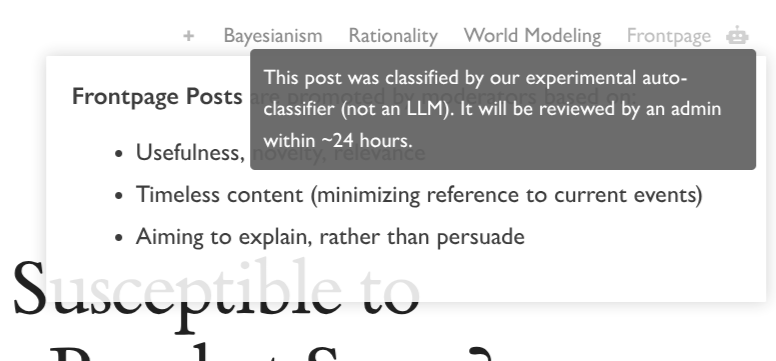
edit: I think maybe all posts get that, and then they can be removed if problematic.
---
### Author:  [@Elliot](https://discuss.criticalfallibilism.com/u/Elliot)
#### Post date: [April 1, 2026, 5:04pm UTC](https://discuss.criticalfallibilism.com/t/i-changed-my-mind-about-error-correcting-debate-misogyny-and-more/2160/19 "2026-04-01T17:04:06Z")
ChristianKl on LW [wrote](https://www.lesswrong.com/posts/FpEfERKZzGwapvnaH/is-bayesianism-susceptible-to-the-mail-order-prophet-scam?commentId=r38sbfmYjfAnrZrTp):
> Bayesianism has no rules for what someone priors should be. It has rules about how to progress from a state of having priors.
FYI this is problematic because whenever decisive arguments are used (e.g. a piece of evidence that contradicts some things and doesn’t contradict others), the probabilities/credences for all non-refuted ideas stay in the same ratios. In other words, you observe a black cat and you rule out some things like “there are no cats” and “all cats are white” and the probability from those refuted ideas is distributed to all non-refuted ideas in proportion to the probability they already have.
In other words, if you only use decisive arguments, all your non-refuted ideas are evaluated entirely based on your priors. The priors fully determine what wins.
It’s only indecisive arguments which can favor some non-refuted ideas over others. Decisive arguments can’t do that. In Bayesianism. As far as I know.
And IMO your priors should be essentially random because otherwise you’re presupposing some other ideas and intelligence before Bayesianism in order to guide you to have intelligent priors, but priors are supposed to come prior to intelligent thinking. In practice they always seem to use priors in line with common sense and science, not random priors.
I think their answer is that most or all arguments are indecisive, e.g. if you see a cat it doesn’t decisively refute “there are no cats” it just lowers the probability a lot.
To actually get useful updates that significantly change the ratios between ideas established by your priors, and let you move away from your priors making much difference, I think you need not only indecisive arguments but indecisive theories which make probabilistic claims. If one theory says “there is an 80% chance I’ll observe a cat today” and another says “there is a 20% chance I’ll observe a cat today” then observing or not observing a cat today can favor one theory over the other and that can influence your conclusions more than your priors do.
My take is most of our ideas in most fields aren’t like that, aren’t that statistical, so Bayesianism does a poor job of learning its way to the point that bad priors have a small impact. Also, stronger claims like “There is a 100% chance I’ll observe a cat today” tend to dominate over the hedged claims – some of the stronger claims lose but the ones that match all the evidence dominate, so the focus ends up being on the really strong claims which are the ones where probabilities are affected most by priors.
If I’m missing something, I haven’t been able to find out what it is over the years.
I haven’t seen any essays/analyses about _effective updates_ (that cause theories with lower prior probability to pass theories with higher probability while neither theory goes near 0% or 100%) vs _ineffective updates_ (where the probability ratios of the non-refuted theories stay about the same as they were in your priors).
“ineffective” updates are always effective in some sense or for something. If you rule out theory C, then the update is effective re C. but if A and B are both non-refuted, it may be ineffective relative to A and B. and the thing I’m interested in is updates which are effective re theories that both start (before the update) and end (after the update) at probabilities that are not approximately 0 or 1. so e.g. A is at 0.2 and B at 0.3, but after the update, A is at 0.4 and B is at 0.35. That would be an effective update because the probability ratios of A and B changed and neither one is at approximately 0 or 1. A doesn’t have to pass B for it to be effective. If A went to 0.25 while B went to 0.31 that’d be effective too. Or if one goes up and the other goes down, that’s effective.
---
### Author:  [@Elliot](https://discuss.criticalfallibilism.com/u/Elliot)
#### Post date: [April 1, 2026, 5:17pm UTC](https://discuss.criticalfallibilism.com/t/i-changed-my-mind-about-error-correcting-debate-misogyny-and-more/2160/20 "2026-04-01T17:17:19Z")
I asked Claude Opus 4.6 about this but was unable to get useful answers about something I’m missing.
[https://claude.ai/share/01834cda-013d-4277-b834-7b0594fa1792](https://claude.ai/share/01834cda-013d-4277-b834-7b0594fa1792)
[Next page](https://discuss.criticalfallibilism.com/t/i-changed-my-mind-about-error-correcting-debate-misogyny-and-more/2160.md?page=2)