# Learning Grammar - Parts of Speech Analysis and Trees
**URL:** https://discuss.criticalfallibilism.com/t/learning-grammar-parts-of-speech-analysis-and-trees/541
**Category:** Projects
**Created:** [March 25, 2022, 2:34am UTC](https://discuss.criticalfallibilism.com/t/learning-grammar-parts-of-speech-analysis-and-trees/541 "2022-03-25T02:34:33Z")
**Posts on this page:** 20
**Page:** 1
### Author:  [@Fire](https://discuss.criticalfallibilism.com/u/Fire)
#### Post date: [March 25, 2022, 2:34am UTC](https://discuss.criticalfallibilism.com/t/learning-grammar-parts-of-speech-analysis-and-trees/541/1 "2022-03-25T02:34:33Z")
## Project Summary
\*\*Summary:\*\*This project is for me to post my attempts to learn grammar. I am starting with the practice sentences from Elliot’s grammar article.
## Goal
\*\*Goal:\*\*To post 20 grammatical sentence analyses.
\*\*Metrics:\*\*20 parts of speech analyses and 20 grammar trees.
\*\*Broader goal:\*\*To get better at reading analysis and power up. I want to become a better learner so that I can learn philosophy, among other things.
\*\*Values:\*\*This is part of my higher level goal to learn philosophy and learn about having a great life.
\*\*CF relevance:\*\*Grammar is a prerequisite to philosophy.
## Plan
\*\*Plan:\*\*I have already done 9 sentences from the grammar article. I plan to do 11 more over the next week or two.
\*\*Project size:\*\*Medium
\*\*Resource budget:\*\*It took me about four hours to do the first 9 sentences. That includes re-reading the grammar article, googling grammar, and watching Max Tutoring videos. I think I will need about another 4 hours to complete.
\*\*Asks:\*\*Corrections on my analysis and trees.
\*\*Offers:\*\*The value I can see someone else getting from this is from teaching and analyzing my mistakes to see where beginners go wrong.
\*\*Independence:\*\*I will complete this project even if I don’t get any replies.
\*\*Confidence:\*\*I am 90% confident that I will succeed at the project.
\*\*Follow through:\*\*I believe that I will finish the project within the next two weeks. I have succeed at similar sized projects on other occasion.
## Context
\*\*Context:\*\*I am a native English speaker with a about an average intuition for the language.
\*\*Background:\*\*I have not done any formal grammar learning outside of school, which didn’t do much for me.
\*\*Track Record:\*\*I fairly regularly complete 2-4 hour long of weekly learning projects.
\*\*Priorities:\*\*I have become convinced that learning grammar is important to learning many other topics well.
\*\*Progress:\*\*The first 9 sentences are already done.
\*\*Problems:\*\*I could see getting stuck on a harder sentence but in that case I will post a question or try an easier sentence.
---
### Author:  [@Fire](https://discuss.criticalfallibilism.com/u/Fire)
#### Post date: [March 25, 2022, 2:38am UTC](https://discuss.criticalfallibilism.com/t/learning-grammar-parts-of-speech-analysis-and-trees/541/2 "2022-03-25T02:38:17Z")
Grammar Practice:
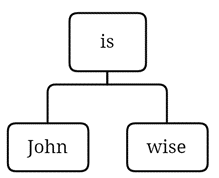
1. John is wise.
Linking verb: is.
Subject: John.
Subject complement: wise.
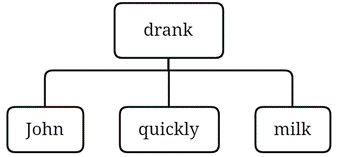
2. John quickly drank milk.
Action verb: drank.
Subject: John.
Object: milk.
“Quickly” modifies “drank” (adverb).
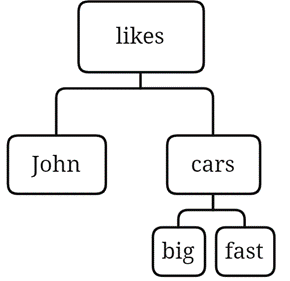
3. John likes big, fast cars.
Action verb: likes.
Subject: John.
Object: cars.
“Big” modifies “cars” (adjective).
“Fast” modifies “cars” (adjective).
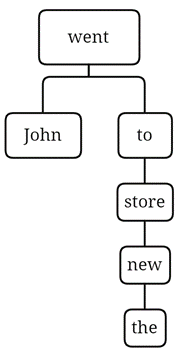
1. John went to the new store.
Action verb: went.
Subject: John.
Prepositional phrase: to the new store. The phrase is an adverb modifying “went”. The preposition is “to” and it governs the noun “store”. “The” is an adverb modifying “new”. “New” is an adjective modifying “store”.
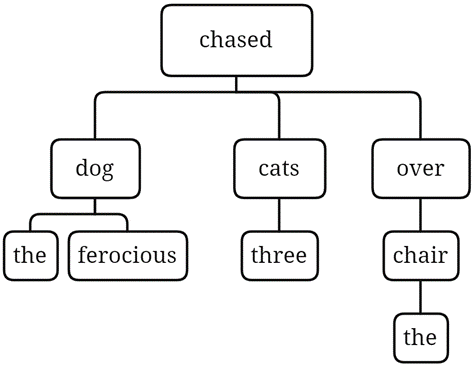
2. The ferocious dog chased three cats over the chair.
Action verb: chased.
Subject: dog.
Object: cats.
“The” modifies “dog” (adjective).
“Ferocious” modifies “dog” (adjective).
“Three” modifies “cats” (adjective).
Prepositional phrase: over the chair. The phrase functions as an adverb modifying “chased”. The preposition is “over” and it governs the noun “chair”.
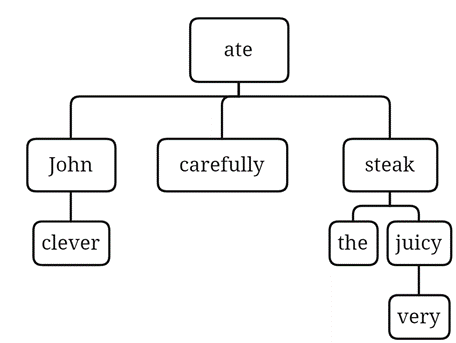
1. Clever John carefully ate the very juicy steak.
Action verb: ate.
Subject: John.
Object: streak.
“Clever” modifies “John” (adjective).
“Carefully” modifies “ate” (adverb).
“The” modifies “steak” (determiner/adjective).
“Very” modifies “juicy” (adverb).
“Juicy” modifies “steak” (adjective).
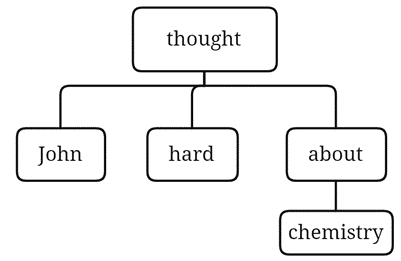
2. John thought hard about chemistry.
Action verb: thought.
Subject: John.
“Hard” modifies “thought” (adverb).
Prepositional phrase: about chemistry. The phrase functions as an adverb modifying “thought”. The preposition is “about” and it governs the noun “chemistry”.
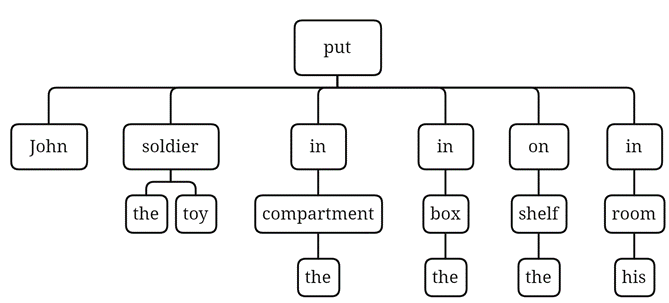
3. John put the toy soldier in the compartment in the box on the shelf in his room.
Action verb: put.
Subject: John.
Object: soldier.
“Toy” modifies “soldier” (adjective).
The first “the” modifies “soldier” (adjective).
Prepositional phrase: in the compartment. The phrase functions as an adverb modifying “put”. The preposition is “in” and it governs the noun “compartment”. “The” is an adjective modifying “compartment”.
Prepositional phrase: in the box. The phrase functions as an adverb modifying “put”. The preposition is “in” and it governs the noun “box”. “The” is an adjective modifying “box”.
Prepositional phrase: on the shelf. The phrase functions as an adverb modifying “put”. The preposition is “on” and it governs the noun “shelf”. “The” is an adjective modifying “shelf”.
Prepositional phrase: in his room. The phrase functions as an adverb modifying “put”. The preposition is “in” and it governs the noun “room”. “His” is an adjective modifying “room”.
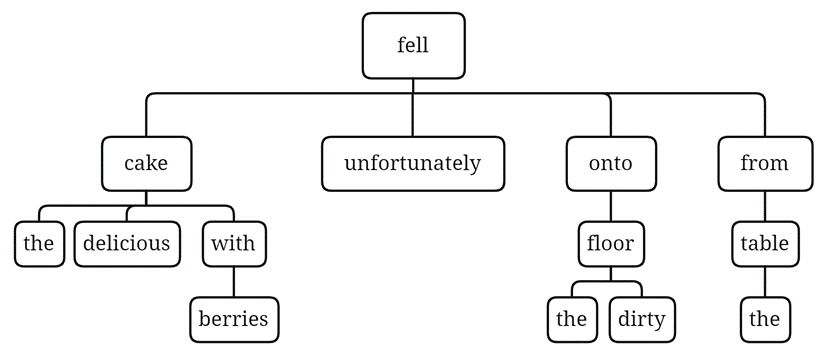
4. The delicious cake with berries unfortunately fell onto the dirty floor from the table.
Action verb: fell.
Subject: cake.
“Unfortunately” modifies “fell” (adverb).
The first “the” modifies “cake” (adjective).
“Delicious” modifies “cake” (adjective).
Prepositional phrase: with berries. The phrase functions as an adjective modifying “cake”. The preposition is “with” and it governs the noun “berries”.
Prepositional phrase: onto the dirty floor. The phrase functions as an adverb modifying “fell”. The preposition is “onto” and it governs the noun “floor”. “The” is an adjective modifying “floor”. “Dirty” is an adjective modifying “floor”.
Prepositional phrase: from the table. The phrase functions as an adverb modifying “fell”. The preposition is “from” and it governs the noun “table”.
---
### Author:  [@Elliot](https://discuss.criticalfallibilism.com/u/Elliot)
#### Post date: [March 25, 2022, 4:03am UTC](https://discuss.criticalfallibilism.com/t/learning-grammar-parts-of-speech-analysis-and-trees/541/3 "2022-03-25T04:03:48Z")
What app did you make the tree diagrams with?
---
### Author:  [@Max](https://discuss.criticalfallibilism.com/u/Max)
#### Post date: [March 25, 2022, 5:41am UTC](https://discuss.criticalfallibilism.com/t/learning-grammar-parts-of-speech-analysis-and-trees/541/4 "2022-03-25T05:41:48Z")
> [@Fire](#):
>
> John went to the new store.
For this one, you say that “the” is an adverb modifying “new”, but later (in subsequent exercises) you say it’s an adjective. Any reason you don’t treat it like the other cases of “the” in the other exercises?
> [@Fire](#):
>
> John put the toy soldier in the compartment in the box on the shelf in his room.
I got a different tree to you here. (image below with section+spoiler tag)
> **my answer to 'John put the toy soldier in the compartment in the box on the shelf in his room'**
>
> 
>
> `[put [john] [soldier [the] [toy]] [in [compartment [the] [in [box [the] [on [shelf [the] [in [room [his]]]]]]]]]]`
Note: I generated these trees via a \LaTeX package called `forest` that I found recently. The code to generate that tree is included below the image. It made it super fast to do the exercises (but setting up a latex environment might be a PITA; I have all the packages and things installed already so was pretty easy)
[01.pdf](https://discuss.criticalfallibilism.com/uploads/short-url/mr76FHFtgUcKL3T1MtifnCp3LZp.pdf) (61.3 KB)
---
### Author:  [@Fire](https://discuss.criticalfallibilism.com/u/Fire)
#### Post date: [March 25, 2022, 5:43am UTC](https://discuss.criticalfallibilism.com/t/learning-grammar-parts-of-speech-analysis-and-trees/541/5 "2022-03-25T05:43:41Z")
XMind; [https://www.xmind.net/](https://www.xmind.net/)
---
### Author:  [@Elliot](https://discuss.criticalfallibilism.com/u/Elliot)
#### Post date: [March 25, 2022, 6:02am UTC](https://discuss.criticalfallibilism.com/t/learning-grammar-parts-of-speech-analysis-and-trees/541/6 "2022-03-25T06:02:26Z")
[https://www.ironcreek.net/syntaxtree/?[can%20you%20[write%20[in%20[strings%20query]]]]](https://www.ironcreek.net/syntaxtree/?%5Bcan%20you%20%5Bwrite%20%5Bin%20%5Bstrings%20query%5D%5D%5D%5D)
and [toy soldier sentence](https://www.ironcreek.net/syntaxtree/?%5Bput%20%5Bjohn%5D%20%5Bsoldier%20%5Bthe%5D%20%5Btoy%5D%5D%20%5Bin%20%5Bcompartment%20%5Bthe%5D%20%5Bin%20%5Bbox%20%5Bthe%5D%20%5Bon%20%5Bshelf%20%5Bthe%5D%20%5Bin%20%5Broom%20%5Bhis%5D%5D%5D%5D%5D%5D%5D%5D%5D%5D)
---
### Author:  [@Max](https://discuss.criticalfallibilism.com/u/Max)
#### Post date: [March 25, 2022, 6:20am UTC](https://discuss.criticalfallibilism.com/t/learning-grammar-parts-of-speech-analysis-and-trees/541/7 "2022-03-25T06:20:04Z")
Do you mean can I generate those via query strings or do they work in query strings?
The syntax works with that tool but has little subscripts. There’s a box to turn those subscripts off though (but that checkbox doesn’t seem to be in the query string anywhere).
[toy soldier sentence with forest syntax](https://www.ironcreek.net/syntaxtree/?%5Bput%20%5Bjohn%5D%20%5Bsoldier%20%5Bthe%5D%20%5Btoy%5D%5D%20%5Bin%20%5Bcompartment%20%5Bthe%5D%20%5Bin%20%5Bbox%20%5Bthe%5D%20%5Bon%20%5Bshelf%20%5Bthe%5D%20%5Bin%20%5Broom%20%5Bhis%5D%5D%5D%5D%5D%5D%5D%5D%5D%5D)
`forest` makes you use `[]` for each new node (causing the subscripts) – that’s the main difference I think (besides customizability and stuff that forest provides). This means you can write more than one word without quotes and add arguments to each node to customize the look or exactly where the lines get drawn to, etc.
e.g.:
`[is [cat, rectangle, outline=red [my] [pet]] [hungry]]`
(commas can be escaped with a backslash if needed)
---
### Author:  [@Max](https://discuss.criticalfallibilism.com/u/Max)
#### Post date: [March 25, 2022, 6:33am UTC](https://discuss.criticalfallibilism.com/t/learning-grammar-parts-of-speech-analysis-and-trees/541/8 "2022-03-25T06:33:59Z")
Actually, I think the subscripts are b/c the node is repeated.
I made a new version of that PDF that automatically makes links to `ironcreek.net/syntaxtree`
[01-with-links.pdf](https://discuss.criticalfallibilism.com/uploads/short-url/qGiTQbZqY8REc59RexwdOIoB1gF.pdf) (64.4 KB)
---
### Author:  [@Elliot](https://discuss.criticalfallibilism.com/u/Elliot)
#### Post date: [March 25, 2022, 5:25pm UTC](https://discuss.criticalfallibilism.com/t/learning-grammar-parts-of-speech-analysis-and-trees/541/9 "2022-03-25T17:25:41Z")
I skimmed through them and they looked generally right to me (besides two things Max mentioned: the toy soldier sentence and “the” being an adjective vs. adverb).
---
### Author:  [@Fire](https://discuss.criticalfallibilism.com/u/Fire)
#### Post date: [March 30, 2022, 11:25am UTC](https://discuss.criticalfallibilism.com/t/learning-grammar-parts-of-speech-analysis-and-trees/541/10 "2022-03-30T11:25:26Z")
Thank you for helping me on this project. Your post was good for directing me research. I was confused about when ‘the’ is an adverb. I looked up some resources on the topic and I think I get it now. It looks like ‘the’ is an adverb when it is used with a comparative, like more or best. I almost did call ‘the’ an adverb in the last sentence, in the phrase 'the dirty floor" and I thought about it with ‘the very juicy steak’. I think with those two I just had an intuition that ‘the’ was referring to the nouns in the phrase. So I didn’t have much reasoning to go with that, or not good thinking there.
I also looked up a few resources explaining how prepositional phrases can be nested and function as modifiers of objects of other prepositional phrases. This basically makes sense to me now. At the time of making the diagrams, I was not considering the possibility that the prepositional phrases could modify aspects of each other. It just didn’t occur to me. After looking up these additional sources, I found (or re-found) the explanation in Elliot’s grammar article. I missed this section before, or forgot, or I just didn’t understand it. Here it is:
> In “John wanted to learn about the science of orbits.”, there are two prepositions. The first is “about” and its noun is “science”. The second is “of” and its noun is “orbits”. The prepositional phrase “about the science of orbits” is an adverb modifying “learn”. It tells us what the learning is about. The second prepositional phrase, “of orbits”, is an adjective modifying “science”. It tells us what type of science. The second prepositional phrase is a modifier inside of the first prepositional phrase.
Additional sources I used:
> **[What are nested prepositional phrases? - Answers](https://www.answers.com/Q/What_are_nested_prepositional_phrases)**
>
> A second prepositional phrase in a sentence that modifies part
> of the first prepositional phrase. There can also be a third nested
> prepositional phrase that modifies part of the second prepositional
> phrase, and so on.
> For example:
> Mary ran (to the...
[The Grammar Exchange Unavailable](https://thegrammarexchange.infopop.cc/topic/commas-between-multiple-prepositional-adverbial-phrases-at-the-end-of-the-sentence#:~:text=Two%20or%20More%20Phrases,on%20time%22%20tells%20when.))
> **[Prepositional Phrase: Explanation and Examples](https://www.grammar-monster.com/glossary/prepositional_phrase.htm)**
>
> A prepositional phrase is a group of words that consists of a preposition, its object, and any modifiers (e.g., 'in time,' 'from her,' 'with much passion').
> **[Daily Grammar - Lessons 181 - Parts of the Sentence - Prepositional Phrases](https://www.dailygrammar.com/Lesson-181-Prepositional-Phrases.htm)**
>
> A prepositional phrase may be used as an adjective telling which or what kind and modifying a noun or pronoun. A prepositional phrase may be used as an adverb telling how, when, where, how much, and why and modifying the verb and sometimes an...
I looked into the use of ‘the’ as an adverb and it looks like that applies in the case of a comparative (e.g. most, best, or highest). I read something that I thought said ‘the’ is an adverb when followed by an adjective. Although, maybe the thing I saw just said that [‘the’ + adjective] is a hint that it’s an adverb.
Use of ‘the’ as an adverb:
> **[\[Grammar\] - "The" as an Adverb](https://www.usingenglish.com/forum/threads/the-as-an-adverb.166881/)**
>
> Wow, I have brought a very shocking grammar issue about "the". When I heard that "the " can be used and function as an adverb, I was almost dead. What an English!!, so I looked it up in the dictionary(longman) and it says
>
> "Used before an adjective...
>
---
### Author:  [@Max](https://discuss.criticalfallibilism.com/u/Max)
#### Post date: [March 30, 2022, 12:33pm UTC](https://discuss.criticalfallibilism.com/t/learning-grammar-parts-of-speech-analysis-and-trees/541/11 "2022-03-30T12:33:06Z")
> [@Fire](#):
>
> Thank you for helping me on this project.
yw. I like the idea of doing the exercises along with you as revision. If I get different answers then giving you feedback is a way for me to check my own knowledge, too.
If you keep posting grammar exercises I intend to do them too and compare results. (Future grammar exercises might have results posted on my [Max Learning FI](https://xertrov.github.io/fi/ex-parsing/index/) site, but I don’t intend to look at those before doing them again, here. Note: there _are_ errors in some of my answers on that page.)
---
### Author:  [@Elliot](https://discuss.criticalfallibilism.com/u/Elliot)
#### Post date: [March 30, 2022, 3:59pm UTC](https://discuss.criticalfallibilism.com/t/learning-grammar-parts-of-speech-analysis-and-trees/541/12 "2022-03-30T15:59:00Z")
“the” as an adverb is enough of an uncommon edge case that i wasn’t familiar with it.
---
### Author:  [@Fire](https://discuss.criticalfallibilism.com/u/Fire)
#### Post date: [March 31, 2022, 2:48am UTC](https://discuss.criticalfallibilism.com/t/learning-grammar-parts-of-speech-analysis-and-trees/541/13 "2022-03-31T02:48:40Z")
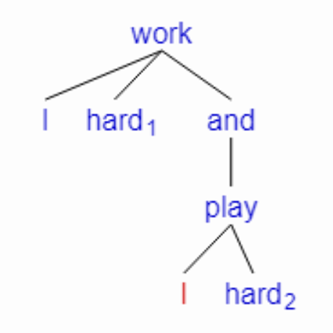
1. I work hard and I play hard.
Main clause: I work hard.
Action Verb: work.
Subject: I.
‘Hard’ modifies ‘work’ (adverb).
Coordinating conjunction: and.
Coordinate clause: I play hard.
Action verb: play.
Subject: I.
‘Hard’ modifies ‘play’ (adverb).
S-Expression: [work [I] [hard] [and [play I [hard]]]]
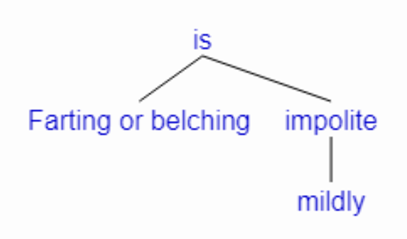
1. Farting or belching is mildly impolite.
Linking verb: is
Subject: farting or belching.
Subject complement: impolite.
‘Mildly’ modifies ‘impolite’.
S-Expression: [is [“Farting or belching”] [impolite [mildly]]]
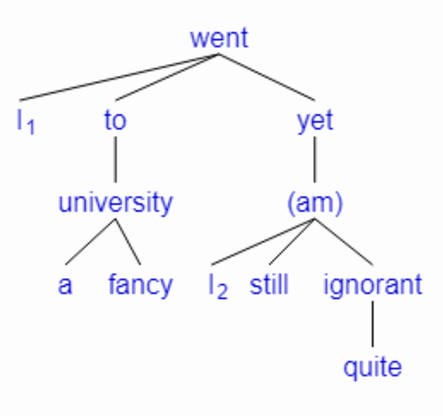
1. I went to a fancy university, yet I’m still quite ignorant.
Main clause: I went to a fancy university.
Action verb: went.
Subject: I.
Prepositional phrase: to a fancy university. The phrase functions as an adverb, modifying ‘went’. The preposition is ‘to’ and it governs the noun ‘university’. ‘A’ is an adjective, modifying ‘university’. ‘Fancy’ is an adjective, modifying ‘university’.
Coordinating conjunction: yet.
Coordinate clause: I’m still quite ignorant.
Linking verb: am.
Subject: I.
Subject complement: ignorant.
‘Still’ modifies ‘am’ (adverb).
‘Quite’ modifies ‘ignorant’ (adjective).
S-Expression: [went [I] [to [university [a] [fancy]]] [yet [(am) [I] [still] [ignorant [quite]]]]]
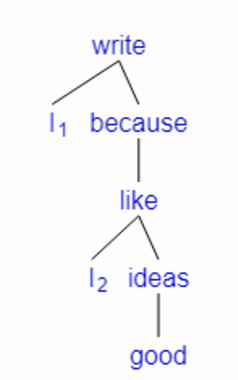
1. I write because I like good ideas.
Main clause: I write.
Action verb: write.
Subject: I.
Subordinating conjunction: because.
Subordinate clause: I like good ideas.
Action verb: like.
Subject: I.
Object: ideas.
‘Good’ modifies ‘ideas’ (adjective).
S-Expression: [write [I] [because [like [I] [ideas [good]]]]]
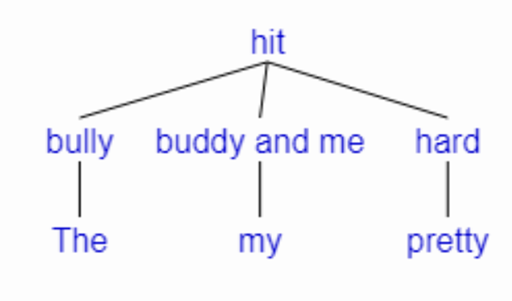
1. The bully hit my buddy and me pretty hard.
Action verb: hit.
Subject: bully.
Object: buddy and me.
‘The’ modifies ‘bully’ (adjective).
‘My’ modifies ‘buddy’ (adjective).
‘Pretty’ modifies ‘hard’ (adverb).
‘Hard’ modifies ‘hit’ (adverb).
S-Expression: [hit [bully [The]] [“buddy and me” [my]] [hard [pretty]]]
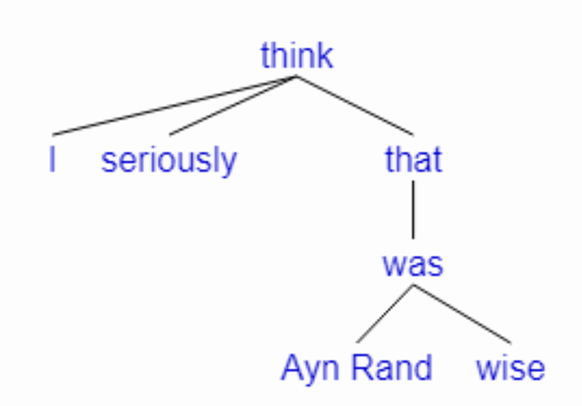
1. I seriously think that Ayn Rand was wise.
Main clause: I seriously think.
Action verb: think.
Subject: I.
‘Seriously’ modifies ‘think’ (adverb).
Subordinating conjunction: that.
Subordinate clause: Ayn Rand was wise.
Linking verb: was.
Subject: Ayn Rand.
Subject complement: wise.
S-Expression: [think [I] [seriously] [that [was [“Ayn Rand”] [wise]]]]
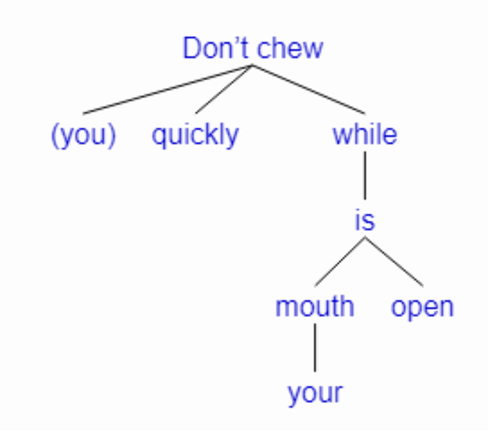
1. Don’t chew quickly while your mouth is open.
Main clause: Don’t chew quickly.
Action verb: don’t chew (imperative).
Subject: (implied) You.
‘Quickly’ modifies ‘chew’ (adverb).
Subordinating conjunction: while.
Subordinate clause: your mouth is open.
Linking verb: is
Subject: mouth.
Subject complement: open.
‘Your’ modifies ‘mouth’ (adjective).
S-Expression: [“Don’t chew” [(you)] [quickly] [while [is [mouth [your]] [open]]]]
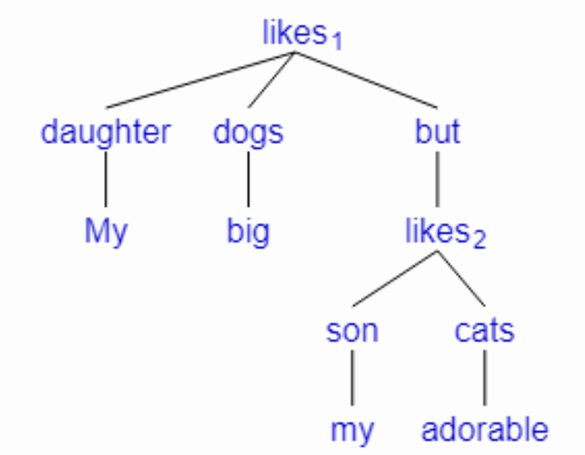
1. My daughter likes big dogs, but my son likes adorable cats.
Main clause: my daughter likes big dogs.
Action verb: likes.
Subject: daughter.
Object: dogs.
‘My’ modifies ‘daughter’ (adjective).
‘Big’ modifies ‘dogs’ (adjective).
Coordinating conjunction: but
Coordinate clause: my son likes adorable cats.
Action verb: likes.
Subject: son.
Object: cats.
‘My’ modifies ‘son’ (adjective).
‘Adorable’ modifies ‘cats’ (adjective).
S-Expression: [likes [daughter [My]] [dogs [big]] [but [likes [son [my]] [cats [adorable]]]]]
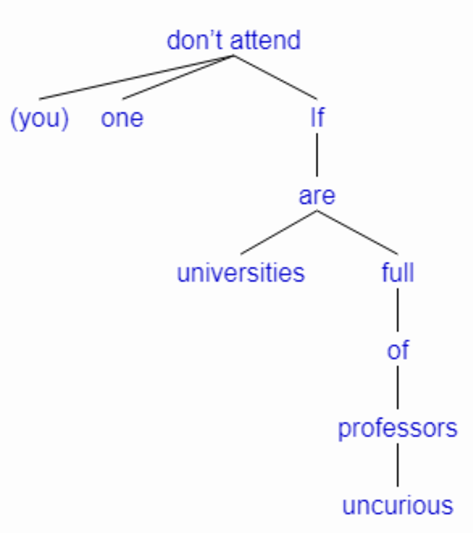
1. If universities are full of uncurious professors, don’t attend one.
Main clause: don’t attend one.
Action verb: don’t attend (imperative).
Subject: You (implied).
Object: one.
Subordinating conjunction: if.
Subordinate clause: universities are full of uncurious professors.
Linking verb: are.
Subject: universities.
Subject complement: full.
Prepositional phrase: of uncurious professors. The phrase functions as an adverb, modifying ‘full’. The preposition is ‘of’ and it governs the noun ‘professors’. ‘Uncurious’ is an adjective, modifying ‘professors’.
S-Expression: [“don’t attend” [(you)] [one] [If [are [universities] [full [of [professors [uncurious]]]]]]]
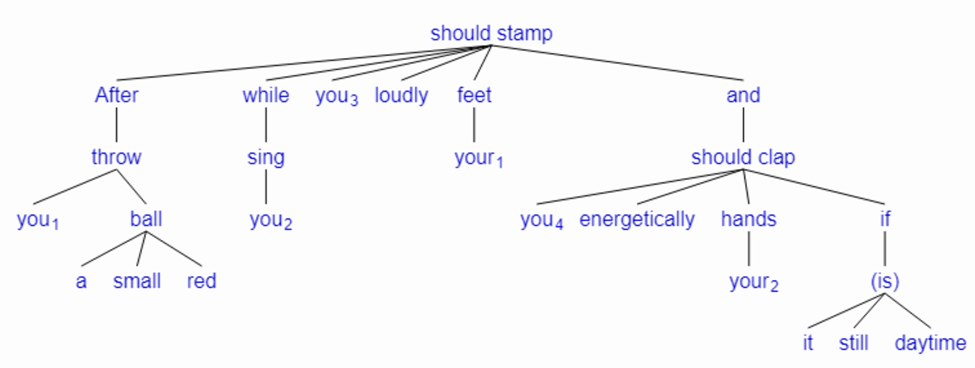
1. After you throw a small, red ball, while you sing, you should stamp your feet loudly, and you should clap your hands energetically, if it’s still daytime.
Main clause: you should stamp your feet loudly.
Action verb: should stamp.
Subject: you.
Object: feet.
‘Your’ modifies ‘feet’ (adjective).
‘Loudly’ modifies ‘stamp’ (adverb).
Subordinating conjunction: after.
Subordinate clause: you throw a small, red ball
Action verb: throw.
Subject: you.
Object: ball.
‘A’ modifies ‘ball’ (adjective).
‘Small’ modifies ‘ball’ (adjective).
‘Red’ modifies ‘ball’ (adjective).
Subordinating conjunction: while.
Subordinate clause: you sing.
Action verb: sing.
Subject: you.
Coordinating conjunction: and.
Coordinate clause: you should clap your hands energetically.
Action verb: should clap.
Subject: you.
Object: hands.
‘Your’ modifies ‘hands’ (adjective).
‘Energetically’ modifies ‘clap’ (adverb).
Subordinating conjunction: if.
Subordinate clause: it’s still daytime
Linking verb: is.
Subject: it.
Subject complement: daytime.
‘Still’ modifies ‘is’ (adverb).
S-Expression: [“should stamp” [After [throw [you] [ball [a] [small] [red]]]] [while [sing [you]]] [you] [loudly] [feet [your]][and [“should clap” [you] [energetically][hands [your] ] [if [(is) [it] [still] [daytime]]]]]]
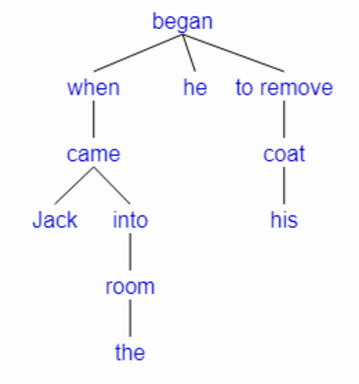
From Peikoff Grammar Homework:
1. When Jack came into the room, he began to remove his coat.
Main clause: he began to remove his coat.
Action verb: began.
Subject: he.
Object: to remove his coat. This is an infinitive phrase functioning as an object. The infinitive is ‘to remove’. ‘His’ is an adjective, modifying ‘coat’. ‘Coat’ is the object of the infinitive phrase.
Subordinating conjunction: when.
Subordinate clause: Jack came into the room.
Action verb: came.
Subject: Jack.
Prepositional phrase: into the room. The phrase functions as an adverb, modifying ‘came’. The preposition is ‘into’ and it governs the noun ‘room’. ‘The’ is an adjective, modifying ‘room’.
S-Expression: [began [when [came[Jack][into [room [the]]]]] [he][“to remove” [coat [his]]]]
---
### Author:  [@Fire](https://discuss.criticalfallibilism.com/u/Fire)
#### Post date: [March 31, 2022, 2:49am UTC](https://discuss.criticalfallibilism.com/t/learning-grammar-parts-of-speech-analysis-and-trees/541/14 "2022-03-31T02:49:44Z")
This took longer than I expected (about 6-7 hours).
---
### Author:  [@Fire](https://discuss.criticalfallibilism.com/u/Fire)
#### Post date: [March 31, 2022, 2:52am UTC](https://discuss.criticalfallibilism.com/t/learning-grammar-parts-of-speech-analysis-and-trees/541/15 "2022-03-31T02:52:47Z")
It’s good to know that because I can’t tell what are the more well understood aspects of grammar, or well known (among grammarians), and what are the edge cases or controversies.
---
### Author:  [@Elliot](https://discuss.criticalfallibilism.com/u/Elliot)
#### Post date: [March 31, 2022, 3:01am UTC](https://discuss.criticalfallibilism.com/t/learning-grammar-parts-of-speech-analysis-and-trees/541/16 "2022-03-31T03:01:06Z")
> I went to a fancy university, yet I’m still quite ignorant.
Sometimes it’s hard to tell exactly what an adverb modifies. The reason it’s hard to tell is there’s little change to the meaning of the sentence either way. So it also doesn’t matter much. This is a pretty typical example. Does “still” modify “am” or “ignorant”? Why?
---
### Author:  [@Fire](https://discuss.criticalfallibilism.com/u/Fire)
#### Post date: [March 31, 2022, 10:32am UTC](https://discuss.criticalfallibilism.com/t/learning-grammar-parts-of-speech-analysis-and-trees/541/17 "2022-03-31T10:32:39Z")
What word does ‘still’ modify?
My guess:
‘Still’ is modifying ‘am’ by saying that you are a certain way and that condition is ongoing. It was the case in the past and it is ‘still’ the case.
I just looked up the definition of ‘still’ and it appears that, as an adverb, it is defined as “up to and including the present or the time mentioned; even now (or then) as formerly.” I think that definition goes with ‘still’ modifying ‘am’.
So how could ‘still’ modify ‘ignorant’? My first thought for modifiers of ‘ignorant’ is that they would be a degree type word, as is used in the sentence with the adverb ‘quite’, or else something like ‘most’, ‘more’, or ‘less’. I tried to think of time-related modifiers for ‘ignorant’ and came up with words like ‘ongoing’, ‘lasting’, and ‘continuing’. ‘Ignorant’ wouldn’t go with those words though, instead I would use ‘ignorance’.
I tried to think of a sentence in which ‘still’ could modify ‘ignorant’ and I have come up with the following:
‘I am running away from the still ignorant people.’ I think, in this sentence, ‘still’ does modify ‘ignorant’. In this case, my thinking is like this:
1. What are the people? ‘ignorant’ 2) In what way are the people ‘ignorant’? ‘still’ (as in, that is their current condition).
In my example sentence, ‘still’ and ‘ignorant’ are packaged together as parts of a prepositional phrase. It also seems like ‘still ignorant’ implies a question such as the following: ‘Still ignorant’ of what? What is ‘still ignorant’? As part of the prepositional phrase the answer is that the ‘people’ are what is ‘still ignorant’.
As a phrase, ‘am still’, implies a question like: what are you continuing to be? My guess is that what ‘still’ modifies is best ascertained by asking whether ‘still’ is describing the condition of something, or indicating the continuation of something.
Another example: ‘I am still tired of work.’ ‘Still’ looks a bit ambiguous in this sentence but I think that it is a modifier of ‘am’.
---
### Author:  [@Max](https://discuss.criticalfallibilism.com/u/Max)
#### Post date: [March 31, 2022, 10:58pm UTC](https://discuss.criticalfallibilism.com/t/learning-grammar-parts-of-speech-analysis-and-trees/541/18 "2022-03-31T22:58:01Z")
my answers including part 2. total time was ~20 min, largest chunk was the “after you throw” sentence (still not sure about my answer and pretty sure it’s different to what I wrote ~21 months ago). a few min spent on LaTeX stuff.
@Fire haven’t compared to yours yet (will do that later probs)
[grammar-ex-parts12.pdf](https://discuss.criticalfallibilism.com/uploads/short-url/64FfU05Q85OEYDx7O7UAB9GHFPa.pdf) (105.4 KB) (includes links to jssyntaxtree)
[link to my answer for the ‘after you throw’ q – note there’s two minor rendering errors but should be fine to read still](https://www.ironcreek.net/syntaxtree/?%20%5Bif%20%5Bis%20%5Bit%5D%20%5Bstill%5D%20%5Bdaytime%5D%5D%20%5B%7B%5Bthen%5D%7D%20%5Bafter%20%5Bwhile%20%5Bthrow%20%5Byou%5D%20%5Bball%20%5Ba%5D%20%5Bsmall%5D%20%5Bred%5D%5D%5D%20%5Bsing%20%5Byou%5D%5D%20%5D%20%5B%7B%5Bthen%5D%7D%20%5Band%20%5Bshould%20%5Byou%5D%20%5Bstamp%20%5Bloudly%5D%5D%20%5Bfeet%20%5Byour%5D%5D%5D%20%5Bshould%20%5Byou%5D%20%5Bclap%20%5Bhands%20%5Byour%5D%5D%20%5Benergetically%5D%5D%5D%20%5D%20%5D%20%5D%20%5D%20%5D)
---
### Author:  [@Max](https://discuss.criticalfallibilism.com/u/Max)
#### Post date: [March 31, 2022, 11:01pm UTC](https://discuss.criticalfallibilism.com/t/learning-grammar-parts-of-speech-analysis-and-trees/541/19 "2022-03-31T23:01:19Z")
> [@Fire](#):
>
> This took longer than I expected (about 6-7 hours).
> [@Max](#):
>
> total time was ~20 min
For the record, this stuff took me hours at first too (lots of googling definitions and stuff). I’ve done a lot of writing since then, too.
---
### Author:  [@Max](https://discuss.criticalfallibilism.com/u/Max)
#### Post date: [March 31, 2022, 11:32pm UTC](https://discuss.criticalfallibilism.com/t/learning-grammar-parts-of-speech-analysis-and-trees/541/20 "2022-03-31T23:32:09Z")
It seems like mb conjunctions are a thing we disagree about atm – particularly precedence of them.
if you have two clauses, `A` and `B`, how would you make a tree of “[A] and [B]”?
(Note: this isn’t a list, like: I want a car that’s _big and red_; it’s more like “I want to lead a good life and I don’t like apricots”)
differences:
- multiple examples differ by conjunction precedence (how high in tree it is)
- bully hit my buddy and me (what does ‘my’ modify?); how would you do the subtree just for “my buddy and me”?
- 16 – multiple differences. try writing out the full form of “don’t chew”
- 18
- 19 multiple differences, but b/c it’s complex I’d suggest leaving this till you can resolve issues with the other ones
> [@Fire](#):
>
> Main clause: I work hard.
Where did you get the idea for a _main_ clause from?
I haven’t reviewed your notes particularly closely yet, but did look at some focusing on conjunction stuff.
[Next page](https://discuss.criticalfallibilism.com/t/learning-grammar-parts-of-speech-analysis-and-trees/541.md?page=2)