# Notes on Elliot's Grammar Article
**URL:** https://discuss.criticalfallibilism.com/t/notes-on-elliots-grammar-article/1388
**Category:** Unbounded
**Tags:** grammar
**Created:** [June 21, 2022, 11:26am UTC](https://discuss.criticalfallibilism.com/t/notes-on-elliots-grammar-article/1388 "2022-06-21T11:26:46Z")
**Posts on this page:** 6
**Page:** 1
### Author:  [@adamg](https://discuss.criticalfallibilism.com/u/adamg)
#### Post date: [June 21, 2022, 11:26am UTC](https://discuss.criticalfallibilism.com/t/notes-on-elliots-grammar-article/1388/1 "2022-06-21T11:26:46Z")
**Topic Summary:**
Some notes on Elliot’s grammar article. Can be found [here](https://fallibleideas.com/grammar).
**Goals:**
- _Object-level goals_:
- I am going to read and analyse Elliot’s grammar article; decompose it line-by-line; put stuff into my own words; give my own examples; make sure I understand thoroughly.
- _Meta-goals:_
- To learn grammar better. To stop encountering grammar obstacles with no recourse to an explicit system for analysis.
**CF relevance:**
Become a more organised thinker. Don’t just rely on intuitions whose origin you don’t understand.
**Measures for success:**
I don’t want to be too precise/demanding about this because I think it will lead to rebellion. For now:
1. CF is a hobby and I have other stuff going on (I realise that this implies a system for priority); and
2. I don’t think that learning grammar better is a bottleneck for that other stuff; and
3. My skill level, as well as my level of discipline, and organisation, is just a bit above ordinary. That is actually quite bad and means that consistent, self-directed learning projects are more difficult.
So: The project is a success if I achieve the object-level goals before going back to uni (mid-sempter-ish). That might sound silly but avoiding rebellion is important.
**A good response would:**
elaborate on or criticise something I said.
Examples of elaboration:
- “I agree. Here’s another example …”’
- “This comes from a more fundamental principle about …”
- “Here is a link to an article which further discusses…”
Examples of criticism:
- “Here you misinterpreted Elliot because…”
- “That is not a valid example because…”
- “Your assumption here is wrong because …”
**Do you want unbounded criticism? (A criticism is a reason that an idea decisively fails at a goal. Criticism can be about anything relevant to goal success, including methods, meta, context or tangents. If you think a line of discussion isn’t worth focusing attention on, that is a disagreement with the person who posted it, which can be discussed.)** Yes.
---
### Author:  [@adamg](https://discuss.criticalfallibilism.com/u/adamg)
#### Post date: [June 21, 2022, 11:31am UTC](https://discuss.criticalfallibilism.com/t/notes-on-elliots-grammar-article/1388/2 "2022-06-21T11:31:45Z")
**Analysing the intro:**
> Grammar is about how to _talk, listen, read, write and think_.
Grammar defines well-formed shapes for explicit thought (which talking, listening, etc. are about). Grammar is useful because I don’t want to worry about whether my errors are coming from ambiguities about the right shapes for thought. Also, I don’t want to worry about struggling to communicate with others because we have a lack of common ideas about the right shapes for thought (and no direct means to rectify that).
> Language has two main purposes, _communication_ and _organizing ideas_.
There are many different and different types of language, so you can think about how each is adapted to communication and organising ideas.
English is a spoken and written language. There are forms of language like signing that I don’t know much about. There are art forms which arguably have a language, although that is more limited. Telling stories is a kind of language when you are being metaphorical. Literal elements of the story (people, objects, animals, locations, etc.) are used as symbols to represent (communicate) and organise ideas. Those literal elements don’t make much sense otherwise. Jordan Peterson talks about this. Here is where he talked about [Sleeping Beauty](https://youtu.be/dUhzBvYfoOk). But stories typically depend a lot on other languages like English to deliver their message. That implies that languages can mix with each other.
Written language has a lot of modularity which makes it well-adapted to its purpose. You can organise ideas by grouping and separating them (into words, phrases, sentences, paragraphs, sections, etc.). Which is useful. For example, it means that you can prescribe what kinds of interactions are _not_ possible between two instances of a group. Words in different sentences cannot interact in certain ways. Those prescriptions are good because they can stop your thinking from being too chaotic and making spurious or irrelevant connections.
Another example of how modularity is useful is that it can help you think about an idea’s ‘resolution’. An idea’s resolution, relative to a goal, is the number of sub-ideas that are relevant to express in order to achieve that goal. (This is not well-defined if there are multiple ways to achieve a goal based on different (and a different number) of sub-ideas.) For instance, I might think: _This idea X should fit into a chapter_. If I had no clue about what a chapter was, I wouldn’t know as much about what was relevant to accomplish with expressing idea X.
> Putting your ideas into sentences helps you understand them better and think more clearly, even if you never share those sentences with other people.
Sentences are special because they have a lot of explicit rules. There are less rules about e.g. how to structure a paragraph, or a whole book for that matter.
> English is _simpler than people think_. Once you know what the patterns are, you can understand most writing while using only a small set of grammar concepts.
I have heard people complain because there are a lot of exceptions to how bits of words are pronounced in English, like “-ough”. That is an issue about spoken English not being simple. I have heard people complain about other stuff but I didn’t understand/wasn’t interested in it well-enough to remember. Elliot could be saying that English is simpler than what those people think.
> This article focuses on major concepts and makes English simple. It doesn’t cover some typical details like verb tenses or commas.
Sounds good. I trust Elliot’s judgment about what the major concepts are.
> Knowing how sentences work lets you be a better thinker and learner. People fluent in English _intuitively_ know grammar. Usually their intuition works, but when something confuses them, then they get stuck. They don’t know how to consciously _analyze_ sentences, step by step, to get unstuck.
This is my situation. It makes me feel weak and ineffectual that I can’t do conscious analysis. My default means of progress has been: Pay attention to how authors-I’d-expect-to-know-grammar write, and look for things they do that are different from what I’ve been doing. Then I might skim a webpage to see if it talks about the difference. Then I might make a small update.
But I don’t have a coherent system for understanding. I don’t have a robust framework, built from fundamentals, within which to explain things. That limits my progress. See my points earlier “Grammar is useful because […]”
> Analysis is also easier to communicate to other people than intuition is. Clear, precise, conscious understanding, in words, gives you a powerful tool for thinking (in addition to intuition, which is also valuable).
People see grammar analysis as snotty, useless, ivory tower, and weird. People are content with a lot of ambiguity about grammar if resolving it wouldn’t change a general social dynamic. I am not satisfied with this.
> _Talking_ came first. Grammar rules (and writing) were developed based on how people talk. So grammar has _many exceptions_.
Why does developing grammar based on how people talk mean that the rules you develop will have many exceptions? People don’t learn to talk in a very systematic way. It is very free-form and intuitive. It is loose, and it would be hard to try to box it in with a clear set of grammar rules. Also, there are a lot of differences in how different groups of people talk. Putting those ways of talking together into an acceptable common standard is hard too. It would be a bit mix and match.
> English has a bunch of special cases that don’t fit the rules nicely. So remember that there are exceptions to most of what I say about grammar. But the main concepts of grammar are usually correct and still really useful.
OK. I will be able to recognise and study the exceptions if I understand the main rules.
> Because grammar imperfectly describes how people talk, experts _disagree_ with each other about some grammar rules. Sometimes I’ll teach something different than what your teacher (or a book) said. I’ve looked at many different viewpoints and, using my philosophical expertise, made judgment calls about the most useful way to think about grammar.
I trust Elliot’s process. I don’t think that it is that important for me to study the experts’ disagreements right now.
> Part 1 covers simple sentences. Part 2 covers complex sentences. Part 3 covers a few more concepts for understanding sentences. Part 4 covers outlining and question-based analysis. Part 5 discusses organizing ideas in English and how English influences your thinking.
OK, so it seems like each part will build upon the next.
---
### Author:  [@adamg](https://discuss.criticalfallibilism.com/u/adamg)
#### Post date: [July 3, 2022, 1:02pm UTC](https://discuss.criticalfallibilism.com/t/notes-on-elliots-grammar-article/1388/3 "2022-07-03T13:02:55Z")
### **Analysing Part 1:**
#### **The first couple of sentences:**
> There are _four main steps_ for understanding simple sentences, and _one more step_ for understanding complex sentences. Complex sentences involve multiple simple sentences joined together.
You can put simple sentences together with conjunctions (e.g. ‘and’, ‘but’, ‘when’), with punctuation (e.g. ‘;’, ‘—‘, ‘,’), and with both a conjunction and some punctuation at the same time (e.g. ‘; although’, ‘— while’, ‘, because’)). Is there another way? I don’t think there is.
> There are only _two types_ of simple sentences in English. And they’re similar enough to share the _same analysis steps_.
I am beginning to understand what Elliot means by English being simple. Now we are going into step 1 which is about verbs.
#### **Step 1:**
> The verb is the most important part of a simple sentence because it tells us what’s happening in the sentence. There are two types: _action verbs_ and _linking verbs_. The verb determines which of the two sentence types you’re dealing with (action sentence or linking sentence).
I remember being told (e.g. at school) that a verb is a doing word. But that sounds specifically like an action verb. Maybe the teachers/curriculum-writers thought that I (or a sufficiently unmanageable number of classmates) wouldn’t be able to understand the difference between action verbs and linking verbs. Which could mean a lack of confidence on their part about explaining the distinction. Maybe I am remembering incorrectly.
> Example actions: write, feel, sew, run, throw, eat, talk, play, think, love, hate, sit.
>
> Linking verbs link or relate two things. They describe or rename the first thing with the second thing. They’re sort of similar to an equals sign. The most common linking verb is “be”. (“Is” is present tense of “be” and “was” is past tense.)
More example actions: act, touch, type, read, lie, speak, breathe.
**Linking verbs** :
Renaming one thing with another thing would be like:
- ‘X is Y’
- ‘X equals Y’
- ‘X defines Y’
So I think those are linking verbs.
That makes me think of a close kind of verb like in:
- ‘X denotes Y’
- ‘X represents Y’
- ‘X symbolises Y’
and I wonder if those examples are linking verbs. You are not exactly renaming X in terms of Y, because you could have a sentence like ‘X denotes Y and X is not Y because X is the map and Y is the territory’; and if you were renaming then that sentence (which is reasonable) would imply that X could both be renamed and not be renamed in terms of Y.
However, that second set of verbs don’t seem like action verbs. So it follows that they are linking verbs. So it follows that they are describing one thing with another thing.
What does that mean? I guess that it is like a property of X that it (say) denotes Y, and so Y is describing X, and so ‘denotes’ is a linking verb. However, you could also say that it is a property of X that it acts in a certain way, e.g. it is a property of X that it touches Y, and so by that logic ‘denotes’ could still be an action verb.
Ok, I skipped forward a bit and found out about complements. So action verbs complete thoughts, like ‘X acts’ is a complete thought, whereas linking verbs don’t, like ‘X equals’ is not a complete thought. That would resolve things: a linking verb lays the stage for a property of X, but requires a Y to assign the property, whereas action verbs can prescribe properties of X on their own. Please may somebody correct me if this is incorrect. Also it may be that this is the rule except for a list of exceptions.
> A _simple sentence_ only has one verb. In part 1, I use the word “sentence” to mean “simple sentence”.
>
> Example action sentence: _I threw a red ball._
>
> Example linking sentence: _The house is very big._
**Consolidation:**
There are two types of simple sentences: action sentences and linking sentences. These are distinguished based on whether the sentence’s verb is an action verb or a linking verb. The two types of sentences are similar enough to share the same analysis steps.
**More examples:**
Action:
- ‘I played the drums’
- ‘Harry flew the Nimbus 2000’
- ‘Harry flew’
- ‘Hermione studies Divination’
Linking:
- ‘The narrative conveys the message’
- ‘The velocity depends on the frame’
- ‘Ron seems upset’ (This is a different one as I have used an adjective as the complement.)
> The first step for analyzing a sentence is **finding the verb**. The verbs in the examples are “threw” and “is”.
>
> An action verb answers the **question** , “What action happens?”. A linking verb answers “What type of linking is this?”.
The verbs in my examples immediately above are “played”, “flew”, “flew”, “studies”, “conveys”, “depends”, and “seems”.
> Tip: If you’re not sure if a verb is action or linking, don’t get stuck worrying about it. It doesn’t make a big difference.
I don’t think I got stuck worrying about it, although I did want to think about it a bit more. I am happy with my understanding until being corrected.
---
### Author:  [@Elliot](https://discuss.criticalfallibilism.com/u/Elliot)
#### Post date: [July 3, 2022, 4:47pm UTC](https://discuss.criticalfallibilism.com/t/notes-on-elliots-grammar-article/1388/4 "2022-07-03T16:47:29Z")
Linking verbs besides “be” are uncommon. Now that you know the terminology, if you want details, you can do a web search, e.g. “list of linking verbs”.
---
### Author:  [@Fire](https://discuss.criticalfallibilism.com/u/Fire)
#### Post date: [July 4, 2022, 6:16am UTC](https://discuss.criticalfallibilism.com/t/notes-on-elliots-grammar-article/1388/5 "2022-07-04T06:16:22Z")
> **[Linking Verbs: Complete List and How to Identify Them – INK Blog](https://blog.inkforall.com/linking-verbs)**
>
> Instead of showing action like other verbs, linking verbs connect a subject to the rest of the sentence. Find a quick linking verb pdf with examples here.
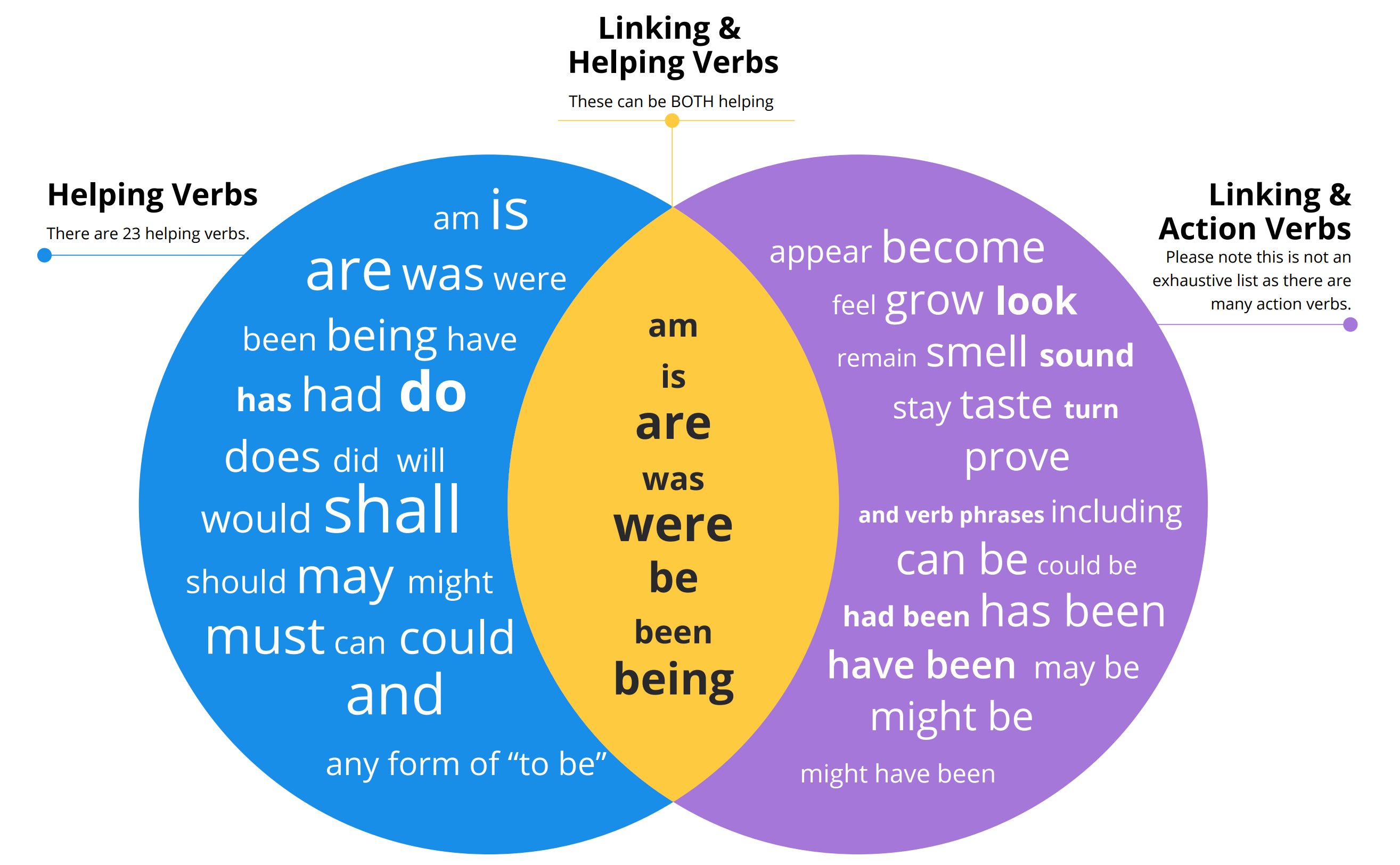
This article talks about many of the linking verbs, while referring to them in their infinitive form, as shown below. It seems likes it would be better to just refer to the linking verbs in their finite form. Is there some good reason for talking about the verbs in this way?
> There are several [verbs](https://inkforall.com/verb-finder/) that are always linking. These are:
>
> - to seem
> - to become
> - any form of the verb _to be_
I do like this graphic from the article.
---
### Author:  [@adamg](https://discuss.criticalfallibilism.com/u/adamg)
#### Post date: [December 6, 2022, 9:31pm UTC](https://discuss.criticalfallibilism.com/t/notes-on-elliots-grammar-article/1388/6 "2022-12-06T21:31:15Z")
I put a deadline on this project:
> [@adamg](#):
>
> The project is a success if I achieve the object-level goals before going back to uni (mid-sempter-ish).
and didn’t meet it. Why? The project was IMO low value and forced while also taking lots of time and slowing down my learning. I abandoned it and just read the article normally instead.
I don’t think that the sentence-by-sentence text analysis style is a great way of approaching learning. You should be more patient and should allow connections to form up in the larger scope of the learning material. Text analysis is better adapted for when you already have a bunch of knowledge about something and you are picking apart, as reflected in fine details, someone else’s ideas related to that thing. For example, like Elliot does in the [Pinker](https://www.youtube.com/watch?v=uliSJwkcPkc&ab_channel=CriticalFallibilismPhilosophy) video. And that’s my full commentary on the Pinker video so now I can be prioritised again! (Joke. I’ve been reading The Stormlight Archive from Elliot’s [book recommendations](https://www.elliottemple.com/essays/reading) and I think that I had that thought by Shallan’s influence.)
I might have continued the project anyway if I felt that I was adding big amounts of value as supplementary material to the article. But I really wasn’t.
I could have probably anticipated those things in the project planning. And one lesson I take is that maybe I should do a bit of the beginning/middle/something of a project before I start doing planning about how it’s going to run to completion. I basically take a low-commitment test sample to feel around for basic obstacles and stuff.