Critical Fallibilism (CF) is a philosophy I developed which deals with rationality, knowledge, and critical thinking and discussion. It builds most on Karl Popper's Critical Rationalism, which says we learn (create knowledge, solve problems) by an evolutionary process of conjectures and refutations. Popper rejected positive arguments (justifications) and induction. He advocated fallibilism and error correction.
Decisive positive arguments are either rare or entirely inaccessible.
By “entirely inaccessible” do you mean that in general they are impossible? Because they would require infinite time and resources to demonstrate?
Decisive positive arguments require 100% proof; otherwise you could accept the argument, and accept that its conclusion is false, without contradiction.
Are these positive arguments you can’t convert to negative ones?
Decisive positive arguments are either rare or entirely inaccessible.
most or all of our decisive arguments are negative.
What is unknown to prevent you from exclusively saying “entirely inaccessible” and “all” respectively for these two quotes? Knowing that would let you decide on this hypothesis?:
I hypothesize that arguments which can’t be converted to decisive, negative form are wrong.
I think fallibilism excludes 100% guarantees against error in math, logic and every field.
Why hedge with “I think” here?
Skipping the conversion step is often reasonable in low-stakes, low-precision, friendly contexts.
If one thinks automatically in CF terms, would using convertible indecisive positive arguments still be reasonable and time/resource saving, or would one always go immediately for decisive negative ones? You could imagine having been brought up in a culture fully based on a long tradition of CF premises and philosophy. I expect this is speculative.
I assume the answer to the above is “yes” given negative arguments are often indirect:
Focusing on negative arguments can take some getting used to because it’s more indirect. Instead of arguing in favor of an idea, you criticize alternatives to that idea. You also try to criticize the idea. The conclusion you reach is the idea you can’t find any decisive error in, despite trying.
i think the key distinction is between using positive wording and relying on a positive argument.
positive wording can be shorthand. mcdonald’s because it’s close can mean something like: given my goal is quick lunch, options outside the walking-distance constraint fail. if the goal and criterion are already understood, spelling out the negative form every time may be unnecessary.
but the shortcut is only safe when the conversion is recoverable. if there is disagreement, higher stakes, or ambiguity about the goal/criterion, then the positive wording can hide the important part. in that case converting it matters because it exposes what would actually rule alternatives out.
so my current read is: explicit negative form isn’t always required in ordinary conversation. what matters is being able to recover it when the argument needs to do serious work.
I was talking about using the positive indecisive wording version of one you could convert into a negative decisive version, not about relying on a non-convertible, fundamentally positive argument. Not sure if that was unclear. Perhaps you just brought it up to make your own point, not to address me.
By “recoverable” do you mean being able to do the conversion feasibly within in your means? Because “recoverable” I would take to imply that you at some point had the negative version, which I don’t think is necessary for it be safe to use in low-stakes situations.
It there is disagreement then it’s risky to execute on the idea, but it’s not necessarily unsafe to bring it up in a discussion, even if you can’t convert it right away. The idea would be rejected for not being decisive but it can be worth to archive and look at later, or the discussion partner could be inspired by it and be the one to convert it into negative form.
by recoverable i didn’t mean that you already had the negative version written out earlier. i meant something weaker: if the argument needs to carry weight, you can feasibly expose what would rule alternatives out.
i also agree that unsafe was too broad. it’s fine to bring up a positive/indecisive version as a conjecture, prompt, or thing to archive. the problem is treating it as doing decisive work when the negative form isn’t available.
so maybe:
positive wording as a prompt or conjecture: fine
positive shorthand where the negative version could be recovered if needed: fine
positive argument treated as settling the issue when the conversion isn’t available: problem
It’s a standard “most or all” hedge. I did it for the typical reason: to avoid taking a position on which one is correct and avoid going into those details.
Lots of positive arguments fail to convert. “I should go to McDonald’s because I like burgers” fails to convert to “I should not go to Burger King because I like burgers”. If your alternative was Burger King, it was a bad argument since that trait doesn’t actually favor McDonald’s over Burger King. Whether the argument is good is more obvious in negative form. In isolation considering only one restaurant, the positive argument about McDonald’s could seem reasonable, but the negative argument about Burger King is clearly broken in isolation.
I expressed it as my opinion because some other people don’t think it and my main points don’t depend on it.
Yeah speculative. I’d assume people would mostly use negative arguments in that case but I don’t know about always.
positive arguments = reasons why we should do x, induction = we’ve seen x in many instances so its true
ideas have to be evaluated in a context, hmm
newtons laws of physics are good in a certain context (from what I understand they still have certain actual uses), but are bad in other contexts. idk good examples, but for certain physical phenomena they work just fine for our goals, and for other physical phenomenon we need better more precise equations (or whatever the improvement needs to be).
“I want to be hydrated” is a purpose and “I want $1500 dollars” is a purpose and “I want to be hydrated and I want $1500 dollars” is one purpose
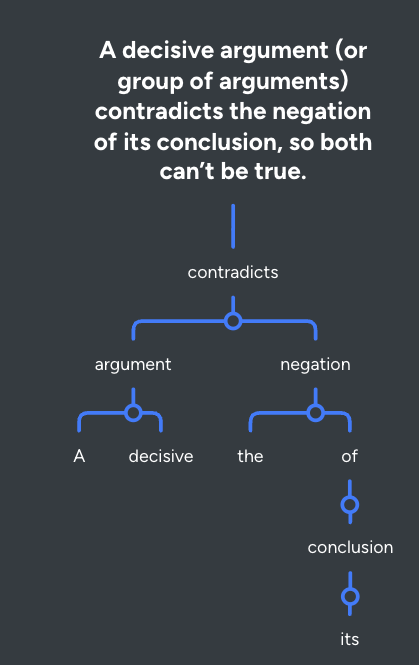
a decisive argument is contradicting here. what does it contradict? a negation. a negation of what? of the decisive arguments conclusion? what does that mean? maybe i’m just a bit tired.
Maybe thinking of an example helps, cause I don’t think my issue here is the grammar. You have $1000 dollars. You want to buy a car. What is a decisive argument? the car costs $2000. you can’t buy it. its decisive. i think my example makes sense. but still lost on the sentence.
i read the stuff after and it still kinda confuses me.
or no matter how good a fit(?) a car is for someone (mileage, maintenance costs, look, size) if they can’t afford it, they can’t get it.
I was thinking, “What if you studied the biology of ravens and what not and concluded that they must be black.”, but you could have gaps in your knowledge. You may not understand the biology behind ravens being black well enough. The biology could still allow one to be white.
I like McDonalds because it tastes good → I don’t like Burger King because it tastes bed.
idea: go to McDonalds, purpose: get breakfast, context: where you are for example? going to mcdonalds for breakfast works but it can’t work if theres none nearby
well first of all, studying biology is a totally different thing thatn observing a lot of black ravens.
biology study is fallible but could potentially (fallibly) reach conclusions that merely observing 50000 ravens couldn’t. biology study involves critical thinking, not just positive example data.
decisive argument: I shouldn’t buy that $2000 phone because my budget is $500.
conclusion: don’t buy phone
negation of conclusion: buy phone
the argument contradicts “buy phone”.
compare with:
indecisive argument: “I should buy this phone because it’s pretty”
conclusion: should buy phone
negation of conclusion: shouldn’t buy phone
Does the argument (phone is pretty) contradict “shouldn’t buy phone”? No. Both things could be true. It could be true that the phone is pretty and you shouldn’t buy the phone. (it could cost $2000 and be out of budget, while also being pretty, for example).