Also look for any other conditions. Like look for counter-examples where you could plug in specific numbers but not be satisfied by the result.
Are you busy or is this too hard or did you lose interest?
Busy (at work rn). I do have an interest in doing this still. Idk if its too hard. I think it’s doable.
I haven’t been doing the math stuff since it is a bit more work to do then just reading and posting (even though I haven’t been doing as much of that either).
Ok. Reviewing what I’m trying to do here:
Setting up the problem mathematically. The problem here refers to
So far I set up the problem as:
Elliot asked:
I said x, y, and z have to be positive integers, that z couldn’t be 1 (otherwise we would get an integer for our answer) and z can’t be 0 (can’t divide by 0).
Then:
So so far all I have is sqrt(x) = y/z, where z can’t be 0 and 1.
Hmm. When you say “write out what you know all together” does that mean write down my knowledge on this topic?
So far what we’ve discussed:
-
We talked about perfect squares. Numbers that when you take the square root of them return an integer root. 9 is a perfect square because it’s square root is 3.
-
A perfect squares prime factorization contains perfect squares.
-
Perfect squares give finite roots (including those roots that are infinite due to the nature of the number system base). So, in other words, perfect squares give out rational roots.
-
I shared that Gemini said:
- Hmm. The example doesn’t make much sense. I think I copied it wrong? 4 is a square. 4 can be expressed as a ratio of two perfect squares. Of two different perfect squares?
Hmm. I’m a bit confused on that last point. I’m going to look into that.
Make a condition to handle this.
Like a condition on what x, y, and z can be?
So far the problem set-up I have is:
sqrt(x) = y/z, where z can’t be 0 or 1
Hmm. I’m making a condition to handle this:
So I’m saying that when doing sqrt(x) it can’t be something like 14/2 because that just simplifies down into an integer.
Uhh. Is saying y and z can’t have a common prime factor a reasonable condition here?
You’re close but what if it’s 25/10?
Hmm. So 25 and 10 have a common prime factor, but its a number we’re supposed to allopw here. What’s the difference between that and 36/6 or 14/2. Hmm.
Maybe focusing on multiples instead of prime factors? So in sqrt(x) = y/z, y cannot be a multiple of z. 25 is not a multiple of 10, but 36 is a multiple of 6 (and 14 a multiple of 7).
1 Like
Where am I at in this problem?
In setting up my math problem where I’m trying to find if there any positive integers that have a rational square root such as 1/2 or 8/9.
So far I got this:
sqrt(x) = y/z, where z can’t be 0 and where y cannot be a multiple of z. That handles the possibilities of getting integer square roots which we are not interested in here/don’t want.
Ok.
So where do i go from here? I’m a bit lost now that I think about it.
Once you have a formula and set up the problem, you try analyzing (try to understand it and its logical and mathematical implications), manipulating it (like how you can add 5 to both sides, but try look for something useful), and plugging in test numbers to try using the formula.
Chapter 3.1 Multiples
-
Number theory is the study of integers.
- Ok. To review, integers are whole numbers. Numbers without decimal/fractional parts. 1, -3, and 0 are integers. 1.2, -3.1, and 0.4 are not integers.
-
- A is a multiple of B, if A equals B times some integer N. A is a multiple of B in A = BN.
- 6 is a multiple of 3. 6 equals 3 times some integer 2.
- Remember that N is some integer. So negative numbers work here too.

- So then 0 is a multiple of everything?
- A is a multiple of B, if A equals B times some integer N. A is a multiple of B in A = BN.
-
- Using the remainder view(?) of division, if a/b has remainder 0, or if a/b = some integer, then a is a multiple of b.


Start of Chapter Problems (all correct)
3.1)

a.) Yes. One way to show it: 147 + 357 = 7 (21) + 7(51) = 7 (21 + 51) = 7(72). Whatever that multiplies out to (should be 504) is still a multiple of 7.
b.) k = 7n with n being some integer. must k + 7 be a multiple of 7? Yes. k = 7n, k + 7 = 7n + 7 = 7(n+1) which is a multiple of 7 as n+1 is some integer plus 1 which ends up just being some integer
c.) Yes. r=7n and s=7n, r + s = 7n + 7n = 14n, 14n = 7(2n) which is a multiple of 7
d) k = 7n, is k+23 a multiple of 7? No. k = 7n, k + 23 = 7n + 23, while 7n will give us multiples of 7 since 23 is not a multiple of 7 we will be offset(?) by 23 and will no longer get a multiple of 7.
3.2)

The number has to be between 100 and 200, is a perfect square, and a multiple of 7.
Well it can’t be 7^2 since that is 49. The next multiple of 7 is 14. 14^2 = 196. 196 is a perfect square (it is the product of 14 x 14), is between 100 and 200, and is a multiple of 7 (14/7 = 2).
3.3)

Find the greatest three digit number that is a multiple of 13.
13 * 100 = 1300
300/13 = 23 R 1
312/13 = 24
24 * 13 = 72 + 240 = 312
1300-312 = 988
988/13 = 76
ok so 988 is a multiple of 13, if we add 13 to it we go to 1001 which is a four digit number.
so 988 should be our solution
3.4)

a) how many integers between 2 and 1004 are multiples of 5?
mmm.
5 is our first multiple, 10 is our second, 15 is our third, etc.
1000/5 is our 200th
it should be 200
b.) how many integers between 150 and 300 are multiples of 9
153 is our first multiple (17 * 9 )
300/9 = 33 R 3
297 is our last multiple (33)
33-17+1 = 17
3.5)

a.) yes, since every multiple of 15 = 15n which is 5(3)(n) which can be re-written as 3(5n) all those multiples of 5 are then multiplied by 3 making them all multiples of 3.
b.) no, 6 is a multiple of but not a multiple of 15
End of Chapter Exercises (all correct)
3.1.1) Correct

We’re looking for positive multiples of 6 and the smallest multiples of 6. So we start with smallest positive integers to multiple 6 by. 1, 2, 3, etc.
6, 12, 18, 24, 30, 36, 42, 48, 54, 60
3.1.2) Correct
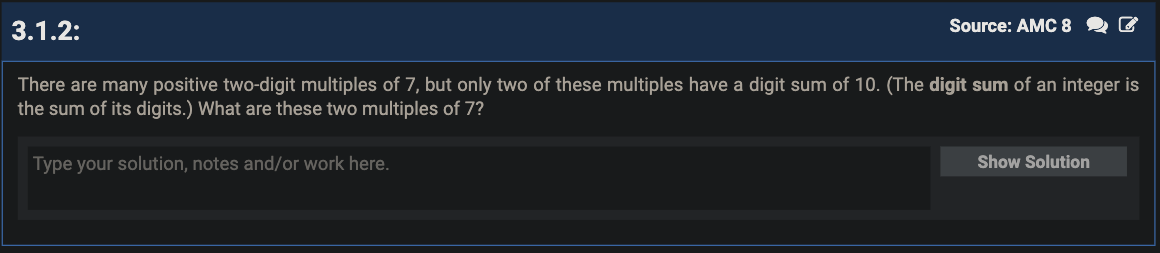
uhh 14, 21, 28 that sums up to 10, 35, 42, 49, 56, 63, 70, 77, 84, 91 that sums up to 10
28 and 91
3.1.3) Correct

13 + 26 + 39 + 52 + 65 + 78 + 91
78 + 78 + 52 + 65 + 91
130 + 78 + 65 + 91
364/13 = 28
so 364
3.1.4) Correct

add a number to 173 so that the result is a multiple of 20. it has to be positive.
uhh 7
173 + 7 = 180/20= 9
3.1.5) Correct

multiple of 17 with four digits (0000)
999/17 = 58 R 13
58 * 17 = 580 + 56 + 350 = 930 + 56 = 986 add 17 you get 1003.
3.1.6) Correct.

greatest four digit multiple of 18
10,000/18 = 555 R 10
9,990/18 = 555
3.1.7)

multiple of 33, has three digits, and is written with entirely three different digits
start from the top ig?
999/33 = 30 R 9
990/33 = 30
i guess just start subtracting? 990 - 33 = 957. ok.
3.1.8) Correct.

so 22 is the first integer (11 * 2)
2678/11 = 200 + 40 + 3 R 5
243 R 5
2673 = 243 * 11
(11 * 243)
243 * 11 = 2430 + 243 = 2673. ok
so 22 to 243
22 is the first integer and 2673 is the 243rd integer
243 - 2 + 1 = 242
Is there a good way to organize out my division when typing? I didn’t use a calculator at all, but for some of these problems I did write out my long division work (not shown) since it was getting hard to keep track of in my head.
1 Like
what was their solution? your way is good and practical in this case but did they have some more complex approach involving using variables for digits or something?
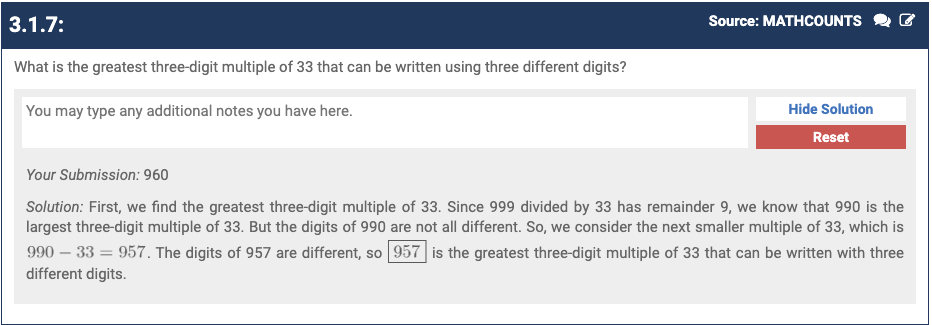
Looks like they did the exact same thing as me.
no, i noticed that the authors/website founders (same people I think run the alcumus part of their website and write the textbooks) kinda go back and forth between more complex approaches and just kinda intuitively thinking about it (in general, I don’t think I noticed anything in this chapter).
1 Like
Chapter 3.2 Divisibility Tests
-
- a is divisible by b if a/b returns an integer.
- numbers that are multiples of a number are also divisible by that number
- 12 is a multiple of 3, it is also divisible by 3

- Ok. So we’re just running through divisibility tests here. I’ve done this before and remember some of them.

Start of Chapter Problems (all correct)
3.6) Correct

a.) if all the numbers that add up to 121212 are divisible by 3 then the whole thing is divisible by 3. we can use that fact because it’s easier to check each of those if they are divisible by 3
b.) 37 is not divisible by 3
3.7) Correct

If it ends with a 0 it is a multiple of 10 (I guess this works for 0 too)
3.8) Correct

a) yes
b) if it ends in 0 or 5
c) if the number is even (ends in 0,2,4,6,8)
ok i got b right but i never really thought about why its valid, i like how they explained it:

same logic applies to c

3.9) correct
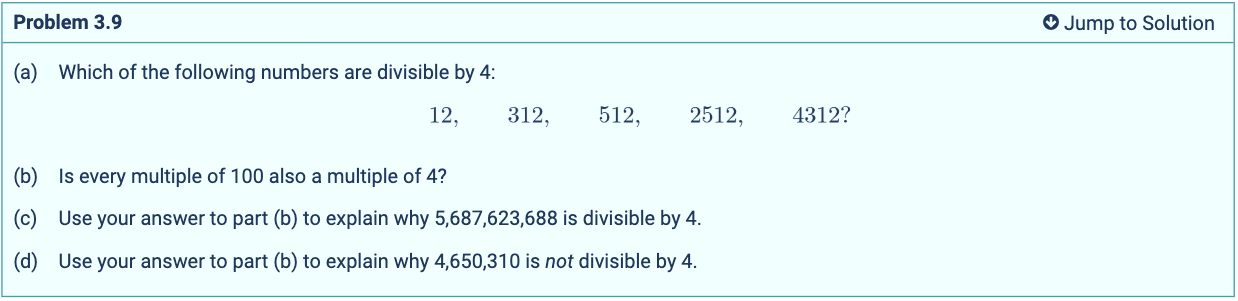
a) 12, 312, 512, 2512, 4312
b) yes, since 100 = 25 * 4
c) 5, 687, 623, 688 is divisible by 5 because 88 is divisible by 4. The rest of the term can be broken down into: 5, 687, 623, 600 = 56,876,236 x 100 = that whole term x 25 x 4, ← is divisible by 4
d) using that same logic above we only have to check the last two numbers 10 is not divisible by 4 so the whole number is not divisible by 4
3.10) correct
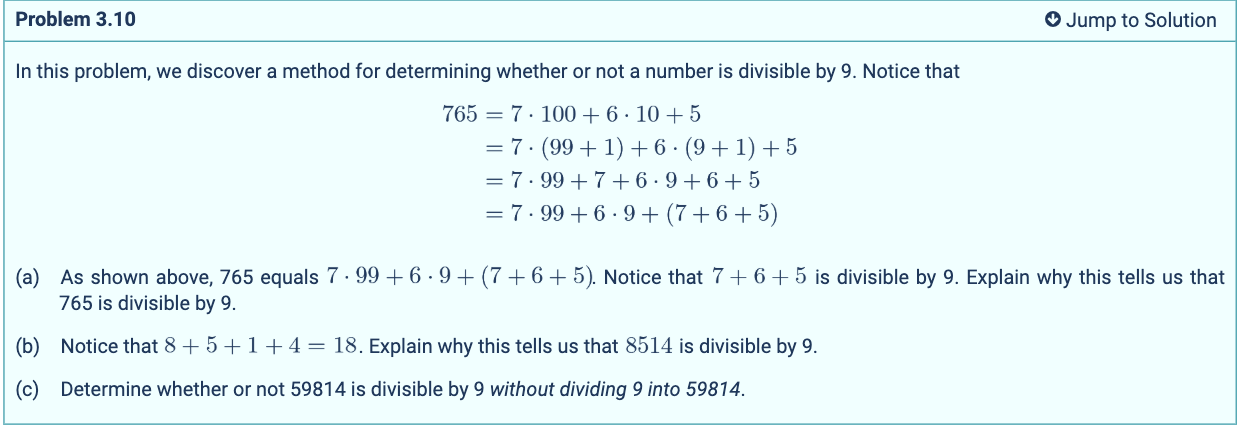
a) ok. I get how they did that. 765 can be broken down into 700 + 60 + 6 which can be further broken down into 7 (100) + 6 (10) + 5 then 7 (99+1) + 6(9+1) + 5 then the numbers distribute and we get 7 (99) + 7 + 6 (9) + 6 + 5.
7 + 6 + 5 = 18 which is divisible by 9. ok
after all the break down above we we have an equation saying that 765 = 7 (99) + 7 + 6 (9) + 6 + 5, 7(99) and 6(9) can be easily told they are divisible by 9 so all we’re checking here is whether what the terms sum up to is divisible by 9
b)8514 = 8 (999 + 1) + 5(99 + 1) + 9 + 1 + 4
8 (999), 5 (99) and 9 are all divisible by 9. so al we need to do is check if 8 + 5 + 1 + 4 is divisible by 9.
c) 5(9999 + 1) + 9(999+1) + 8(99+1) + 9 + 1 + 4
so check if 5 + 8 + 1 + 4 is divisible
that equals 18 which is divisible by 9
so 59814 is divisible by 9
3.11) correct
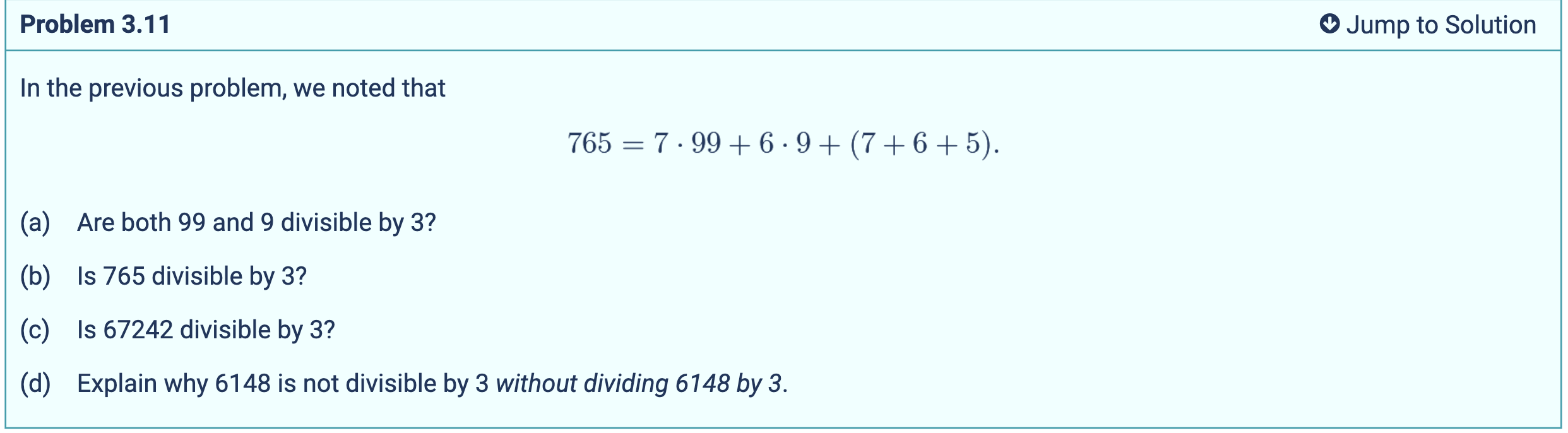
a) yes
b) ok so idk if im skipping ahead here or not, but going off of the fact 99 and 9 are divisible by 3 (and so is 999, 9999, etc.) i assume the goal here is that we use the same process.
so 7 + 6 + 5 = 18, which is divisible by 9 and therefore 3
c) 67242, 6 + 7 + 2 + 4 + 2 = 21 which is not divisible by 9 but is divisible by 3. ok i know the rule applies ig but let me go through it here
6(9999+1) + 7(999+1) + 2(99+1) + 4(9+1) + 2
so the numbers 6(9999), 7(999), 2(99) and 4(9) are divisible by 9 and therefore 3. so same idea we just need to check if 6 + 7 + 2 + 4 + 2 is divisible by 3 which it is
d) 6148, 6 + 1 + 4 + 8 = 19, 19 is not divisible by 3 so 6148 is not divisible by 3
3.12) correct

463A is divisible by 3 and 4. For it to be divisible by 3 the numbers have to sum up to something divisible by 3.
4 + 6 + 3 = 13
so 0 makes it 13 still, 1 makes it 14, 2 makes it 15, 3 - 16, 4, 17, 5 18, 6 19, 7 20, 8 21, 9 22
so 2, 5 and 8 work here
for it to be divisible by 4 the last two numbers have to be divisible by 4. 32 is divisible by 4 = 8, 35 is not and 38 is not
so the only possible value of A is 2
3.13) correct

24,6N8 if divisible by 9 then divisible by 4?
I guess we’d check the values where it is divisible by 9 and then see if it still is divisible by 4.
2 + 4 + 6 + 8 = 20
so 0 no work, 1 21, 2 22, 3 23, 4 24, 5 25, 6 26, 7 27, 8 28, 9 29
uhh so the only value of N that works is 7.
is 78 divisible by 4? no
so if 24,6N8 is divisible by 9 then it is not divisible by 4
End of Chapter Problems (all correct)
3.2.1) Correct
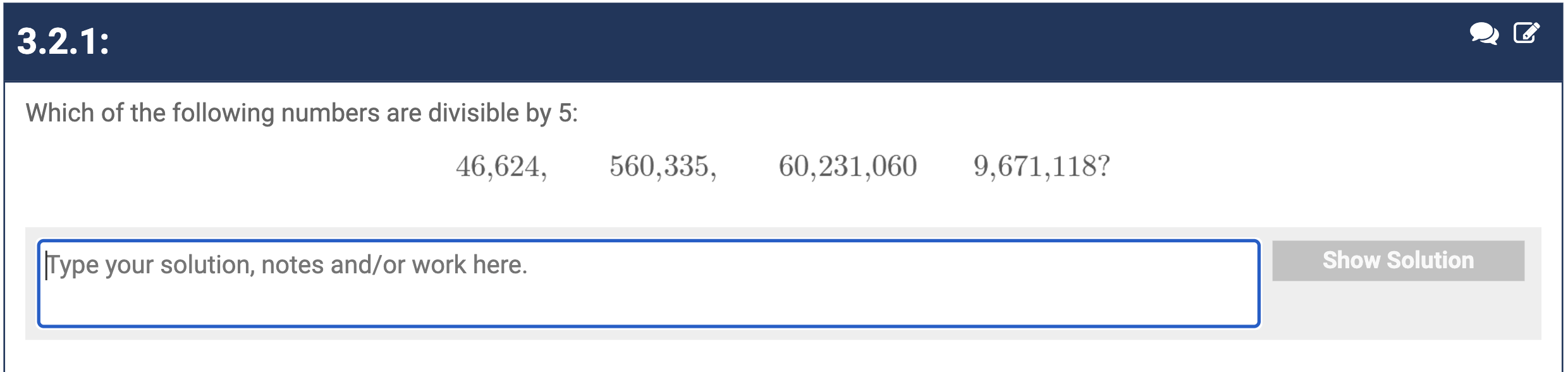
560,335 and 60,231,060
3.2.2) Correct
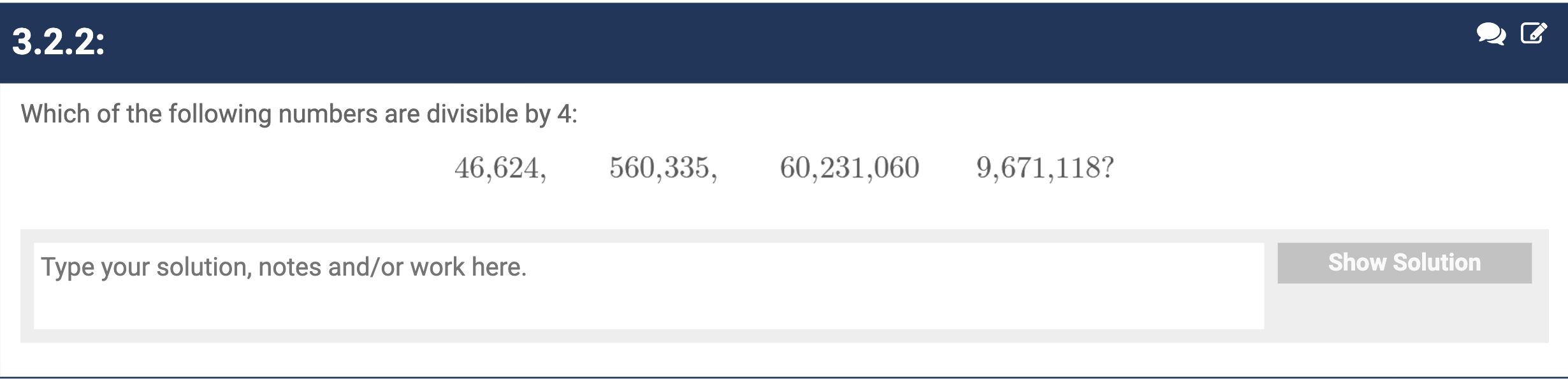
46,624 and 60,231,060
3.2.3) Correct
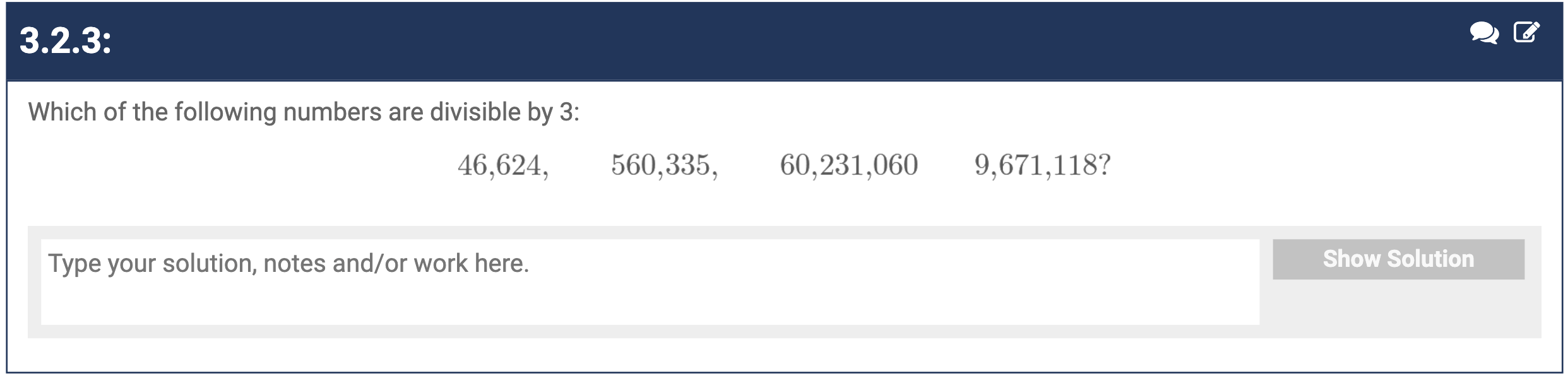
46,624 - 4 + 6 + 6 + 2 + 4 = 22, not divisible by 3
560,335 - 5 + 6 + 3 + 3 + 5 = 22, not divisible by 3
60, 231, 060 - 6 + 2 + 3 + 1 + 6 = 18, divisible by 3
9, 671, 118 - 9 + 6 + 7 + 1 + 1 + 1 + 8 = 33, divisible by 3
so 60, 231, 060 and 9, 671, 118
3.2.4) Correct
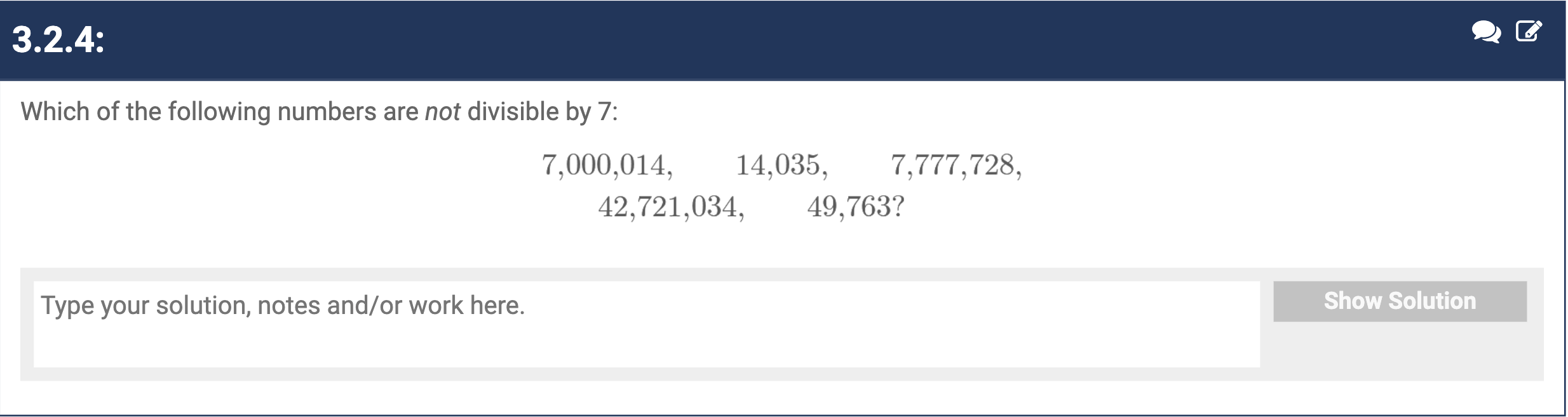
42,721,034
3.2.5) Correct

so we’re looking for numbers that: have a 2 in the units place/as the last digit and are divisible by 4. so a number like 12.
12, 32, 52, 72, 92, and then all the 100, 200, 300 variants
5 + 5 + 5 + 5 = 20
3.2.6) Correct
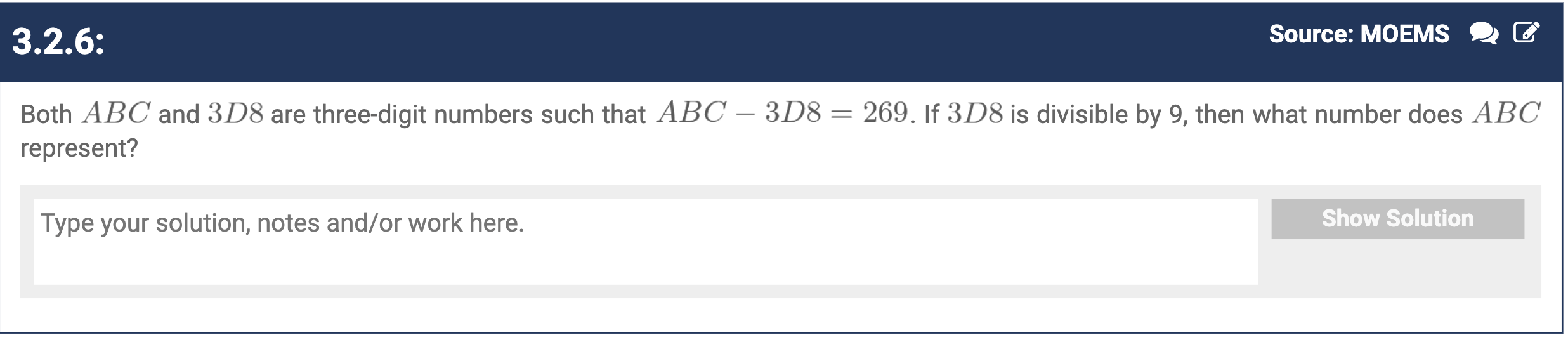
ABC - 3D8 = 269
3D8 is divisible by 9, so what is ABC?
3D8, 3 + 8 = 11
0 11, 1 12, 2 13, 3 14, 4 15, 5 16, 6 17, 7 18, 9 19
so D = 7
so we have the number 378
378 + 269 = ABC
ABC = 647
3.2.7) Correct

2 + 1 + 4 + 7 = 14
let’s start from the other direction
9 23, 8 22, 7 21
d = 7
3.2.8) Correct

ok. so i just remember this 125 (8) = 1000
therefore we just need to check if the last three digits are divisible by 8 since a number like 4,454,124 can be broken down into 4,454 (1000) + 124 which is equal to 4454 (8(125))
oh yeah the 4454124 is not divisible by 8
1 Like
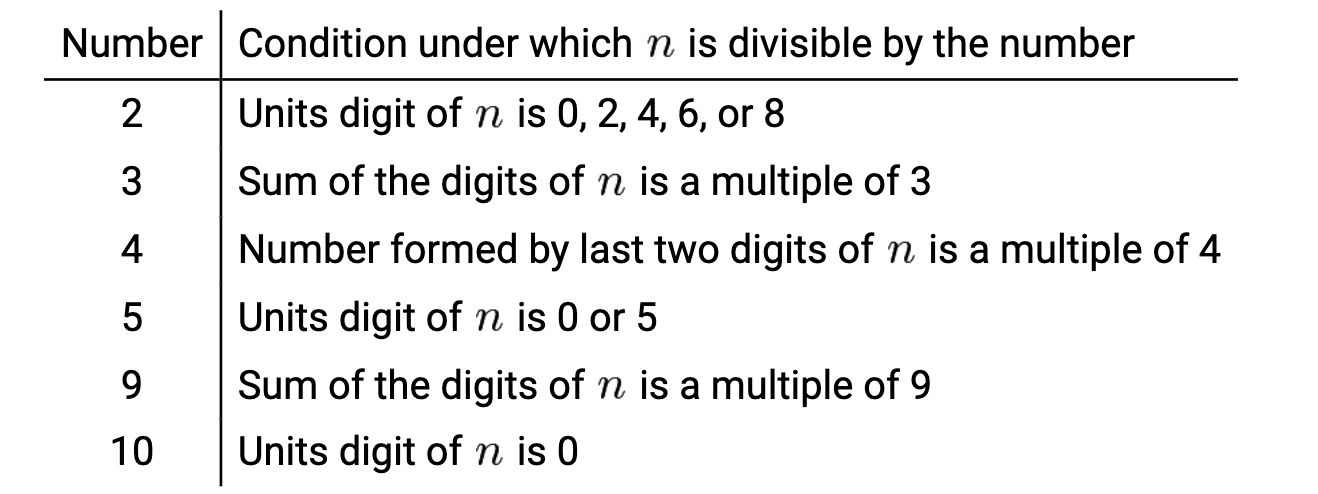
The chart you showed doesn’t have a 7 divisibility rule but then problem 3.2.4 deals with 7 divisibility. Why?
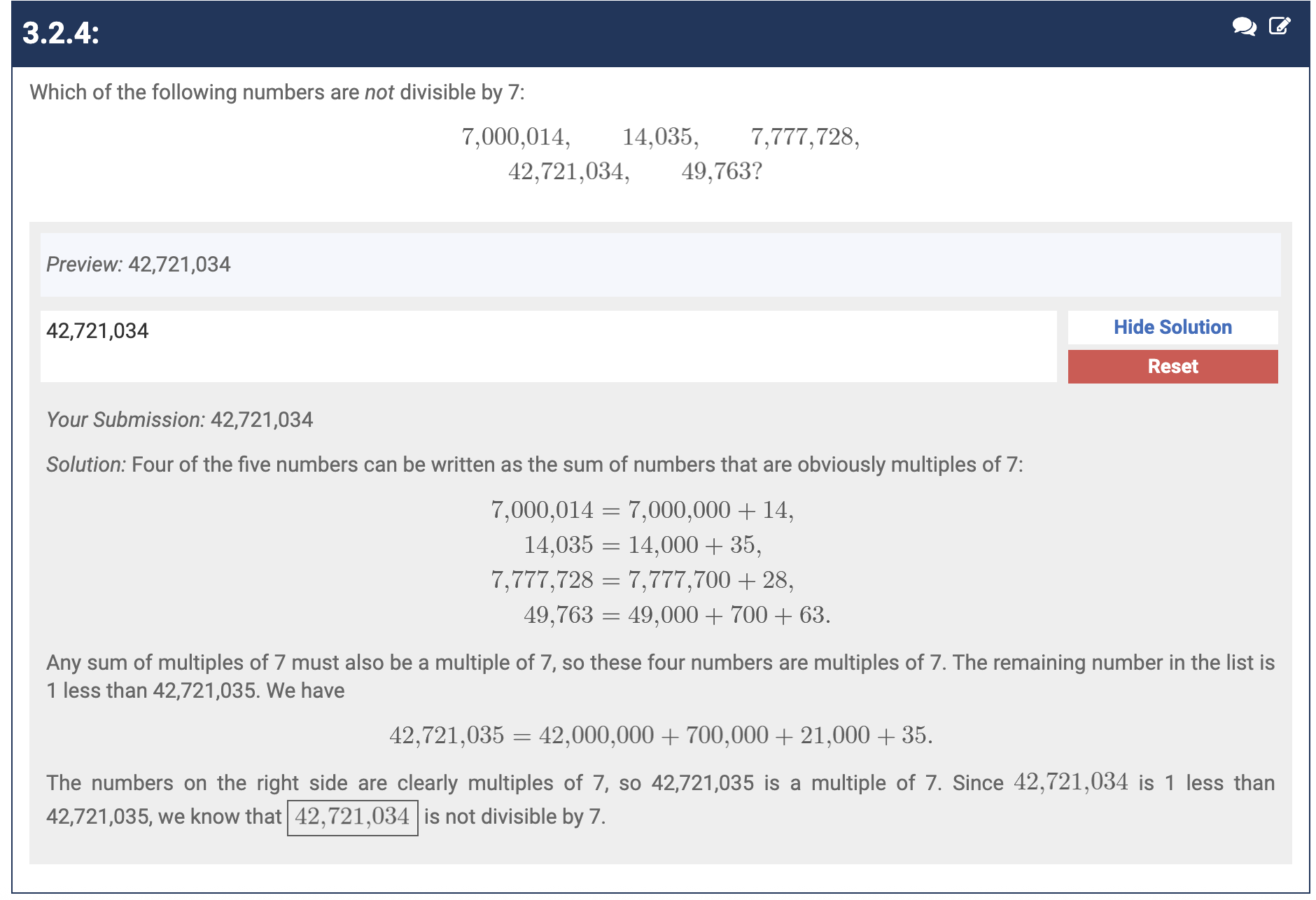
Idk. Going off of the breakdown of their solution. They just gave a bunch of numbers that are easily divisible by 7. I wonder if that’s a property of 7 (that you’ll get numbers that are easily divisible by 7). but yeah they just threw it in there. Idk if they plan to build it on later or smth.
and yeah to clarify: i didn’t go over any 7 rules in the chapter up until that problem
1 Like
Chapter 3.3 Prime Numbers
-
- A number is composite if it can be divided cleanly (without any remainders) by a number other than 1 and itself.
-

- I wonder if there any interesting math facts that happen because of that/related to that.
-
Numbers after 1 are either prime or composite.

Beginning of Chapter Problems (all correct)
3.14 (Correct)

2, 3, 5, 7, 11, 13, 17, 19
3.15 (Correct)
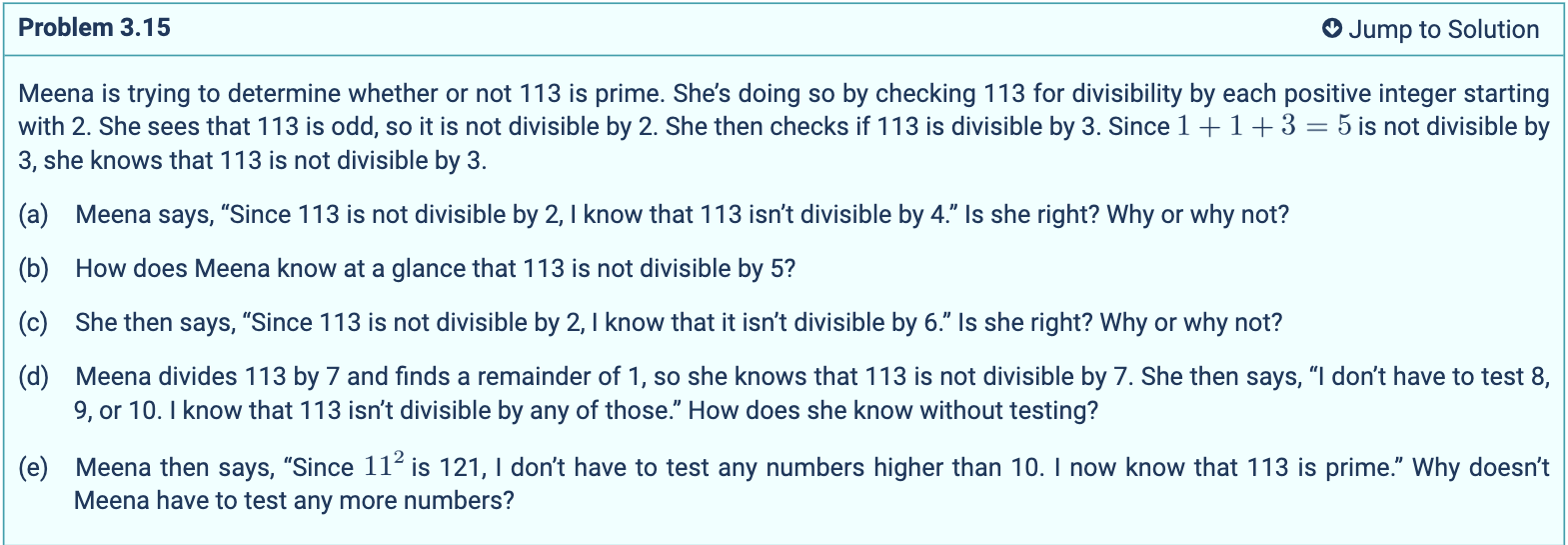
a) Yes. 4 is a multiple of 2. If a number was divisible by 4 than it is also divisible by 2.
b) 113 does not end in 0 or a 5.
c) Yes. 6 is a multiple of 2. If a number was divisible by 6 than it is also divisible by 2.
d) 8 is a multiple of 2, since 2 doesn’t divide neither does 8. 9 is a multiple of 3 and if 3 doesn’t work neither does 9. 10 is a multiple of 5 and since 5 doesn’t work neither does 10.
e) I’ve thought of this before so let’s try and recall this again. We only have to check up to 11^2 because if 113 is not composed of the numbers 2-11 it cannot be composed by anything larger. if we go to the next term 12 we know that it cannot be composed of 1-11 (from all our previous tests) but if we multiply it against 12 we will definitely get some bigger than 113. We stop at 11^2 because it is greater than 113 and if it is not composed of the numbers before 11 it cannot be composed of the numbers after.

3.16 (Correct)
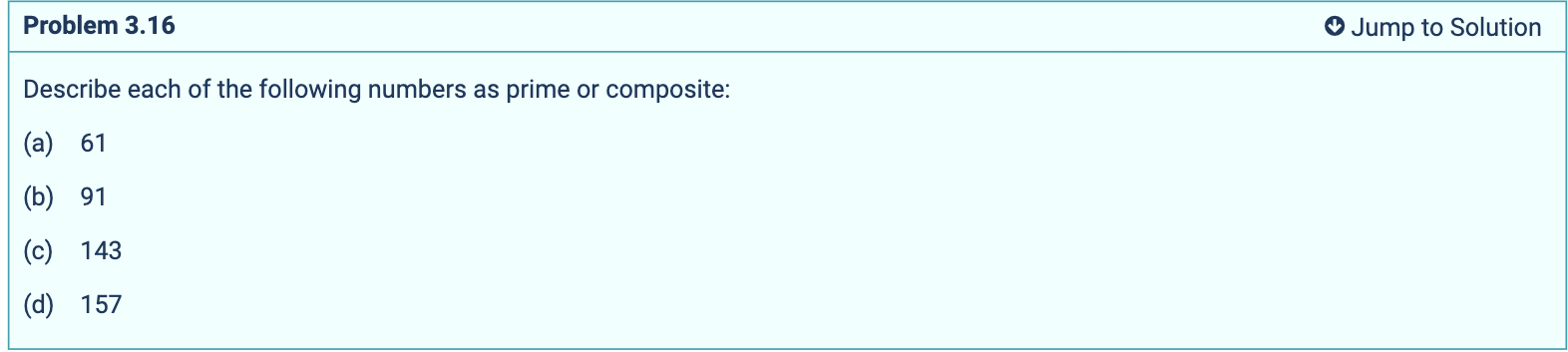
a) 61 - Prime
b) 91 - Composite, 7 (13)
c) 143 - Composite, 11 (13)
d) 157 - Prime
3.17 (Correct)

digits have to be prime, but the number composite
2,3,5,7 so 7 is my best option
it doesn’t say two different primes
77?
3.18 (Correct)

prime pairs: two primes who add up to 61
2,3,5,7,11,13,17,19,23.29,31,37
2 + 59
quick thing uhh after 2 all remaining primes are odd numbers, summing up any of those odd numbers will result in an even number. 61 is not even. so 2 + 59 is the only pair that works here unless maybe negative numbers work? i don’t think so
3.19 (Correct)
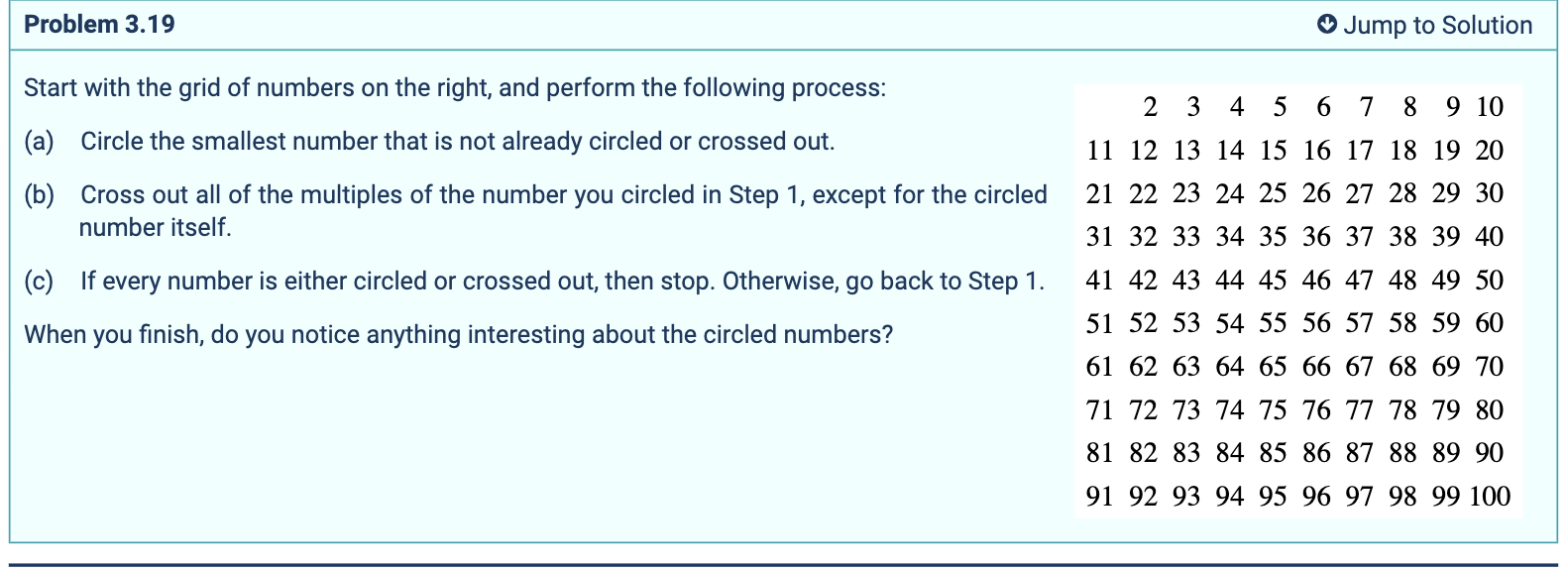
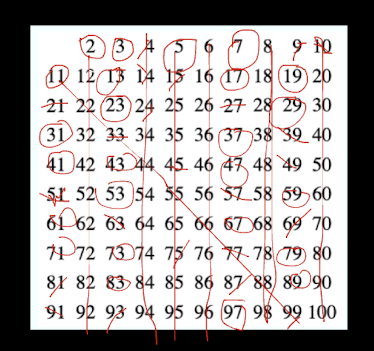
The circled numbers are all prime.
End of Chapter Problems (all correct)
3.3.1) Correct

83 + 89 = 172
3.3.2) Correct

71 - prime
72 - multiple of 2
73 - prime
74 - m2
75 - m5
76 - m2
77 - works multiple of 7 and 11
78 - m2
79 - prime
so just 77
3.3.3) Correct

uh 8 (125) = 100
124 is composite, 123 is composite, 121 is composite, 119? no its composite, 117 is composite, 113?
2, 3, 5, 7
p = 113
3.3.4) Correct

prime pairs (is this an actual math term?) that sum to 40
2,3,5,7,11,13,17,19,23,29,31,37,
3 + 37 = 40
11 + 29 = 40
17 + 23 = 40
there are three pairs
3.3.5) Correct
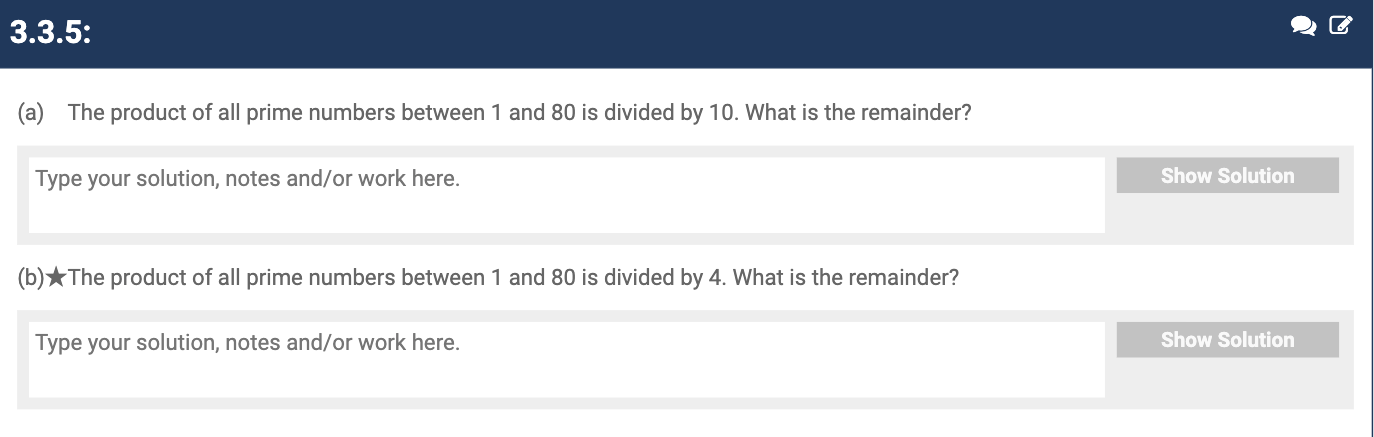
a) let’s see
2 (3) (5) (7)
:o
that will contain 2 and 5 to make 10 meaning no remainder
b) remainder 2?
90/4 = 22 R2
2 3 5 7 = 210/4
52 R2
3.3.6) Correct

three prime groups
2,3,5,7,11,13,17,19
2 + 7 + 13 = 22
hmm all answers will need 2 otherwise adding three odds will leave me with an odd
so 22 - 2 = 20
what primes sum up to 20?
3 + 17
7 + 13
and that’s it so
(2, 3, 17)
(2, 7, 13)
3.3.7) Correct
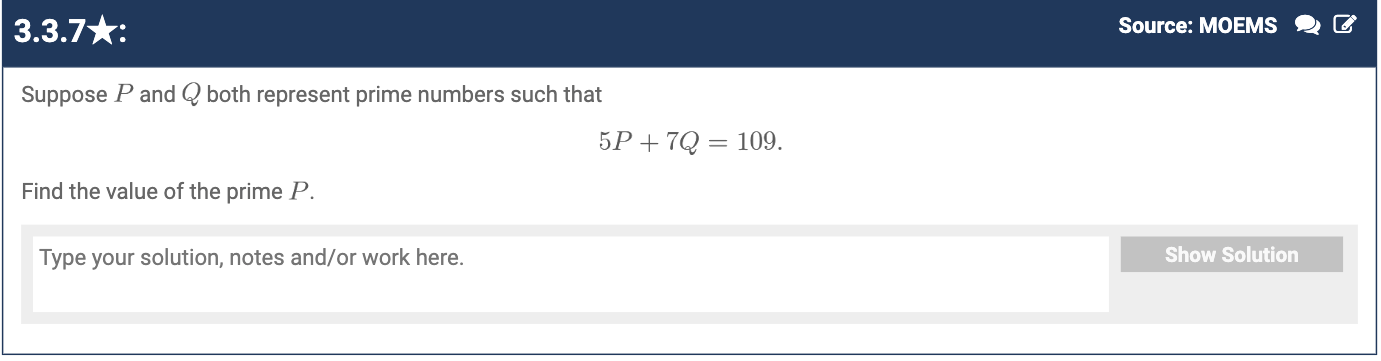
So some multiple of 5 plus some multiple of 7 equals 109.
so idk what the process is supposed to be i just ripped some numbers while looking at the problem
5 would never give me 9, so its coming from the 7. i know 7^2 = 49, ok and then is there a number that works for 5 here? there is: 12.
P = 12 Q = 7
oh there PRIME
hmm
still same idea
14, 21, 35, 49, 77, 91,
10, 15, 25, 35, 55, 65
109 - 14 = 95
95/5 = 19 das prime
so 14 + 95
or
Q = 2, P = 19
How come you’re working on this instead of more rate problems (which you have a harder time with)? It’s fine if this is useful for you. Also keep doing some short writes.
I should! ngl I just forgot. I’ll do some tomorrow!
I’m just working on this because I just started my spring break (ended my last two classes with an A) and wanted to spend time catching up on something. I figured I might try and start working on this textbook again.

A rate problem for some practice:

This seems easy?
75mi/h and he has to go 60 miles? So I just to find the time it takes for him to travel 60 miles at 75mi/h.
60mi/(75mi/h)
60mi (1h/75mi) = 60h/75 = 12/15 = 4h/5. 4(60m)/5 = 240m/5 = 48m
So 10:32 + 00:48 = 11:20
ok got it right. that was simple
hmm the next one is simple too. ill do a bunch in bulk later til i get some harder ones.
1 Like