Yeah, I messed up. I think I changed it in my head and it made sense, but I didn’t write it down in the post that I had changed the hypothetical ,and I can’t expect you folks to read my mind.
See above in my response to Elliot. I think it’s hard in the way that learning a language is hard. But, in context the vast majority of children learn language. And in this context, changing from someone who tortures, rapes and murders a family to someone who doesn’t (and who becomes like an average late abiding citizen who respects people’s rights tot the same degree an average law abiding citizen does), isn’t impressive imo. Def not Galt level.
I think in this context, torture would also be uncontroversially seen as wrong culturally/traditionally in the west. But, even if I took out torture completely from the hypothetical that doesn’t change my point much.
Do you agree with it? Or are you indifferent either way or something else?
Hmm, Ins’t this asymmetrical though (I think that’s the right word)? In the case where a person is murdered, the victims is the one whose rights were violated and can’t be restored. That’s a tragedy. In the case of the murderer, he was the rights violator. Him falling to his death is just an accident. Nobody violated his rights and there’s no innocent victim whose loss now needs correcting.
It also doesn’t seem like the right counter example because they’re casually unrelated events. If the murderer wins the lottery after the murder, that’s not a reward for murder. In a similar way, the murderer slipping and falling to his death isn’t a punishment for murder.
That’s a question of proportionately, which Rand said was complex. Idk if stuff similar to that should be ruled out though? Like if we had an experience machine where they could feel the painful consequences the criminal made the victim suffer?.. Sometimes there’s potentially knowledge in that too? You can explain to someone why punching someone in the nose is bad, and explain scientifically what happens in the body, nerve reactions, etc, but actually experiencing it happening to you may make one understand it better? IDK, kind of a half baked conjecture. Its a tough problem.
You also have to be careful when it comes to proportional consequences because of errors in the justice system.
I’m curious about something in your revised hypothetical, and I want to explore it in my own hypothetical.
Imagine someone who is severely mentally disabled. Maybe they were brought up by abusive parents who kept them out of school and kept them locked in a dungeon for the first 30 years of their life. Or some other scenario; I don’t want to get sidetracked by disagreements about what might lead to someone being severely mentally disabled, so you can just supply a scenario where you agree the person is so.
Then that person overcomes their disability. They learn to talk and read and function reasonably well. They become, effectively, a person of average intelligence who can do things average people can do. They become indistinguishable (even by magic sci-fi testing apparatus) from an average citizen with a normal upbringing.
Would you be impressed? Or would your response be more in line with your sarcastic response to the reformed criminal? I assume you might not be as sarcastic, but my guess is that isn’t really due to any logical decisions — my guess is that you feel comfortable being sarcastic/mean to criminals and reformed criminals, but you aren’t comfortable being mean to a mentally disabled victim in the same way.
But setting aside sarcastic insults… would you be impressed? Would this be a notable achievement to you? Or would it be a bit more of a shrug, like “that’s good for them, I wish them well” but not much else?
I’m considering whether I should give more of my thoughts here or just post the hypo and question first. I guess I’ll start with just this.
Yes, if he just reformed to be average, that would be less impressive. It’d still be quite notable though for a super extra bad criminal to reach average. There could still be lecture circuit potential there, but I’d drop the Galt’s motor comparison.
It depends on some details that are kind of ambiguous here. Just being sorry and partially regretful about your crimes is pretty easy. Being fully reformed to be just as good/safe as someone who never committed crimes, after doing severe crimes, is actually really unusual, especially without joining a religion.
People who are sorry about their crimes usually have mixed feelings. The sorry is genuinely there but they aren’t 100% sorry. If he reached 100% sorry that’s a lot more impressive than 90%. It means he no longer sees any benefit to himself from his crime, zero upside, zero part of him likes or values the crimes or their results.
If someone is 90% sorry, they might do it again, given the chance, esp if they knew they’d get away with it. They know it’s bad in lots of ways, but they still see an upside, e.g. revenge. If someone is 100% sorry, they definitely wouldn’t do it again; they see no upside to it; they don’t/wouldn’t feel in the slightest like the got away with something even if they were not punished. They see their crime itself as a punishment for themselves (not saying it’s sufficient, just that it’s entirely negative, not positive) – they did something bad they wish they hadn’t done, and the whole experience was thoroughly awful, likely traumatic.
This 100% sorry thing is an above average way to be. I think the large majority of people find some crimes (including ones that are genuinely rights violating, not just violating dumb laws) partially tempting rather than fully repulsive.
If someone is 90% sorry, jail has a defensive purpose. If they are 100% sorry, plus reformed to be average in general, it doesn’t (but in real life you have uncertainty, so you can’t tell exactly how reformed each criminal is. so if you have 100 criminals in jail and you’re pretty sure a few could be safely released, but you don’t know and can’t find out which ones, it’s reasonable defense to keep them all in jail).
I’m normally not very impressed when people communicate remorse. I was impressed by the infallible sci-fi device that determines real remorse and reform. (I think you know that based on the rest of your paragraph. Just clarifying anyway.)
I think any criminal who reforms to average merits more like a genuine “good job” or more. That’s a real accomplishment that I’m guessing (didn’t check any statistics) the majority of criminals don’t manage, even petty ones, let alone people who did major crimes.
If someone is a murderer, are you advocating the death penalty? What if they’re a rapist? What if they put out someone’s eye in an assault? I don’t think proportionality is very clear and/or accurate to what we want.
And proportionality can be used with defense. If you’re already doing the right amount of proportional defense somehow, then any retribution that is non-defensive would make the total consequences non-proportional (and too high) when you add the defense and retribution. To leave room for retribution while keeping the total response proportional, you’d have to do less defense.
I see proportionality as a limited tool – very disproportionate responses are usually if not always wrong – but nowhere near a full solution.
Nah. I’ll just summarize: I am not convinced retribution is a good idea. This is referring to things that are neither defense nor restitution, and using a broad view of defense, so e.g. deterring future crimes from other people does count as a type of defense. And its referring to actions that would be rights-violating in general, if they weren’t justified, like imprisonment.
Thanks for conceding that you were mistaken about the hypothetical and being reasonable about this. I hope you’ll reflect and make changes to do better in future conversations, e.g. more rereading when you’re claiming someone is wrong and previous text is relevant. Tracking complex discussions is hard and rereading a lot is part of the practice that helps one get better at it (and more rereading than typical people do is still important even with super high skill). When you double check things, you find out if your memory and confidence level were right or wrong, so you’re giving yourself feedback that can help you improve your memory and confidence estimates. And then also at the same time you’re avoiding a lot of mistakes and discussing better, so it helps with both practice/learning and the current discussion.
Hmm. I think it’s still impressive. Maybe not Galt level, sure. However, why is it not impressive?
I guess you’re thought process is something like:
People pick up languages passively. Pretty much everyone. even someone “dumb”, knows a language. It’s not impressive.
In that same way, most people pick up not to be immoral (do they?). Pretty much everyone, even someone “dumb”, knows not to, in this context, rape, murder, and torture. It’s not impressive to not do those things.
Does that sound right?
If so:
Do you think learning a second/another language is hard?
Do you think reform is easy? Put differently: you probably have a bad habit you want to fix (not meant as a call out or anything) maybe it’s related to sleeping, exercise, socializing, whatever. If you’re like most people you’ve tried to fix it and have found it hard (maybe you’ve succeeded in some things, but I doubt it was “easy”). Change isn’t easy in a lot of cases.
Related to the above point: do you think because something is a baseline(?) it’s not impressive? People, more-or-less, should exercise, eat well, and hang out with friends. Getting your life in order is how things should be, so it’s not impressive?
Or is it because he’s discovered and done something everyone else has done (which is back to my comment on 2 + 2). He’s figured out what we all have. Rape is bad. Murder is bad. We knew that already.
Idk. Just some guesses and idk how important this line of questioning is.
I’ll respond to the other stuff from you and others later.
Yeah, this is related to what I was trying to get at with my hypothetical above, about a mentally disabled person improving into an average person. I was waiting to see @Neo 's response but I don’t think my point was very subtle anyway, and regardless I don’t think Neo is going to lie and say he understood if he didn’t. So I’ll say more now, because it is relevant to what you said as well.
IMO, significant improvement is generally impressive. If you improve by ~40 arbitrary value points on a 100 point scale that represents some aspect of your life, that is impressive. It is kinda obviously impressive if you go from 60 to 100 (!), but it’s also impressive if you go from 10 to 50.
I think that improvements from 10 to 50 are a bit more controversial or contested. But my guess is that this controversy is not usually due to the improvement actually being unimpressive, or due to the logic of the situation. It’s due to specific biases people have about certain types of 10/100 life states.
Here are some examples of improvement from ~10/100 to ~50/100:
A murderous criminal reforms into an average law abiding citizen.
A mentally disabled person develops into a person of average function and intelligence.
A severely obese person gets down to, and maintains, an average body weight.
A person with no arms learns how to write/type at an average speed and legibility by using their feet.
An elderly person who grew up without electronic devices learns how to play some modern video games at an average skill level.
A suicidal person gets therapy/medication/etc. to improve their life, and becomes an average person in terms of how depressed/unhappy they are.
A person with severe schizophrenia/psychosis/hallucinations gets therapy/medication/etc. to improve their life, and becomes an average person in terms of how disconnected from reality they are.
A person who dropped out of school goes back and gets a GED/Bachelor’s.
An homeless impoverished person with few skills learns new skills and gets an average job and can afford an average standard of living.
A 40-year-old virgin meets someone, has sex, gets into a decent relationship.
A severely traumatized person (victim of abduction/rape/etc.) gets over their trauma and is able to function at an average level.
A racist neo-Nazi changes their views and becomes a person with average (centrist?) opinions on race and politics.
There are lots more scenarios one could imagine.
What I think is interesting is that for many people (Possibly including Neo?) — some of these improvements would be considered impressive, but some would not.
Common ones that many people might scoff at/be sarcastic about/be unimpressed with might be…
Criminal [1], Obese person [3], Homeless person [9], Virgin [10], Nazi [12].
Some people would be impressed, but I think those are instances where I’d expect at least a large minority of naysayers who did not find the improvement impressive.
I think there is a decent shot that Neo or other psych-skeptical conservatives or TCS/CR/FI people would be similarly unimpressed by the mentally ill people [6, 7].
By contrast, I think a large majority people would absolutely not scoff at the mentally disabled [2], the armless [4], or the traumatized [11]. My guess is most people would find those achievements impressive.
So… what is going on?
Assuming my guesses are right, why is this the case? Aren’t all of these similar examples of someone with a way below average life state (along some specific axis) improving into an average life state?
I think a lot of it has to do with who we think is worth having sympathy for, or empathizing with. And with how we perceive one’s responsibility for their poor life state.
If you think someone made bad decisions (that you would never make) in order to end up in their bad life state, you’re a lot more likely to have little or no empathy for them. They fucked up, they couldn’t manage to do the average stuff everyone should do, they got in a bad life state. Then they fixed it… big whoop. Now they’re just doing what they should have been doing all along. What, do they want a cookie?
Whereas if you perceive the bad life state as being external, inflicted on them by bad luck, then you are more likely to be empathetic. People don’t choose to have no arms or be kidnapped and traumatized. If you lost your arms or got kidnapped, you would want people to be kind and empathetic towards you. So you treat them the same way, and you find it impressive that they overcame those unfair disadvantages to achieve averageness.
Hence why the mental illness ones had a distinct split — many people in modern American society view mental illness as an unfortunate affliction. Out of the hands of the mentally unwell, bad luck, worth sympathy/empathy. But the psych-skeptical types I mentioned tend to view it as a character flaw that one could simply fix by making better choices. I think that is the dividing line between whether they find those improvements impressive or not.
I think one could argue that this distinction (chosen/inflicted) is not arbitrary, and is meaningful. People who made bad choices to get to 10/100 don’t deserve sympathy, and if they get to 50/100 it isn’t impressive because they should not have chosen to be at a 10 in the first place.
I’m not convinced. First of all, I think that people are complicated, and shaped in subtle ways by many different experiences, especially as children. So they often have a lot less direct control over their lives at any given moment than they might want, or you might think they do. The difference between the traumatized person in example 11 and the criminal or the obese person or the nazi may be a lot less than you would think.
But even if we can clearly point to the bad intentional decisions they made to get to 10/100, at the end of the day IMO any drastic improvement is still impressive. Whatever the reason you ended up at 10/100, once you are there, you are in a bad situation. You are in a deep, deep hole. I think it is very difficult to climb out of that. So if you manage to do so… I think that’s impressive.
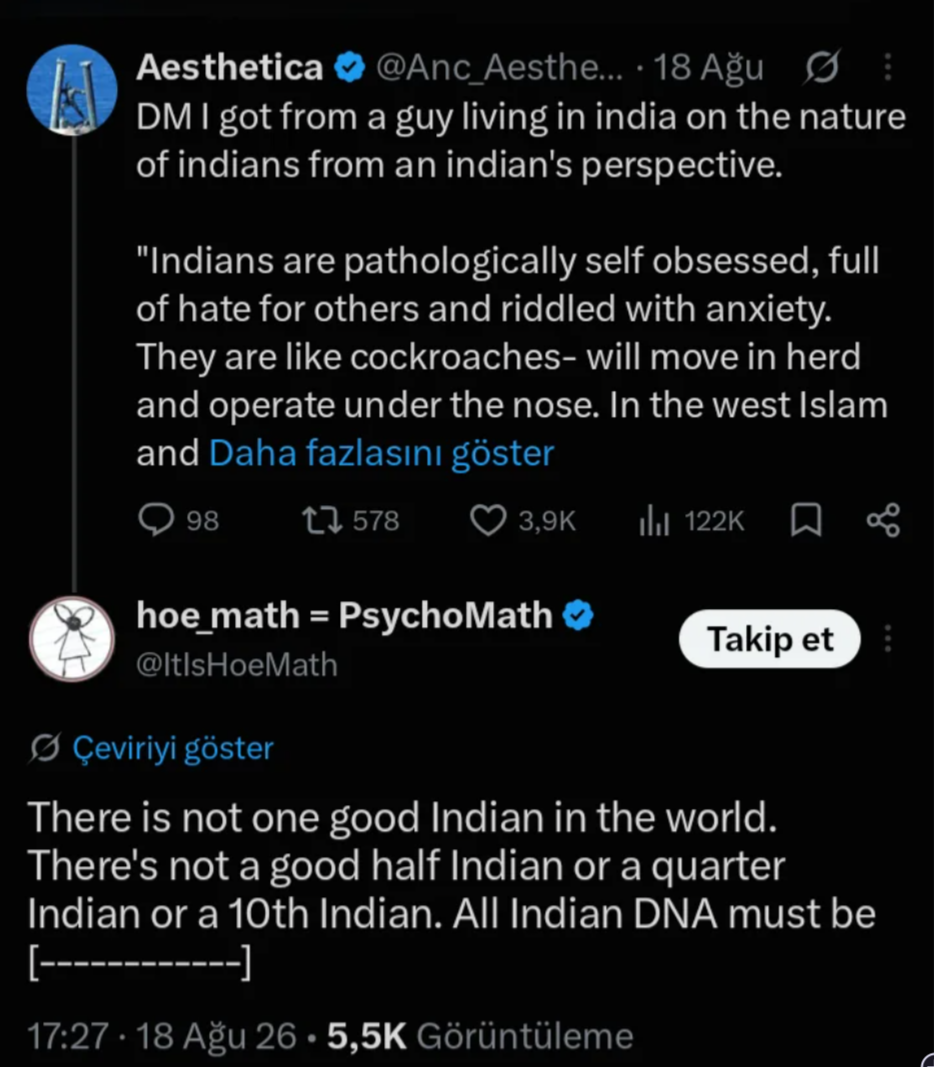
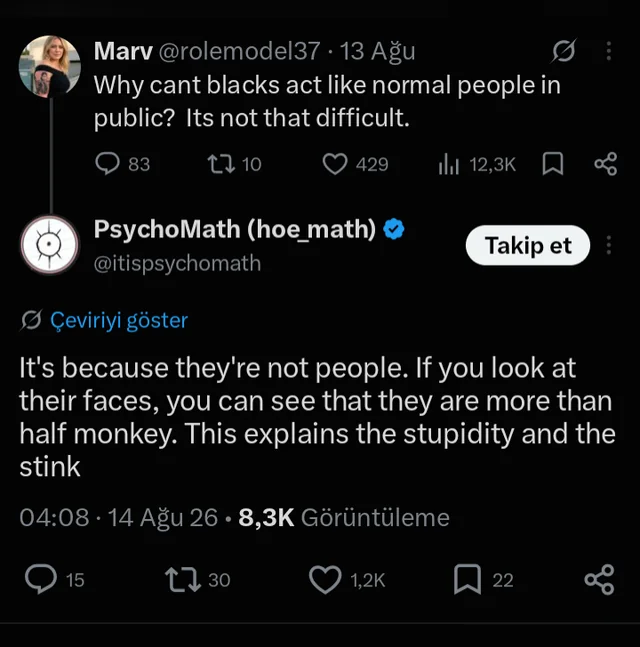
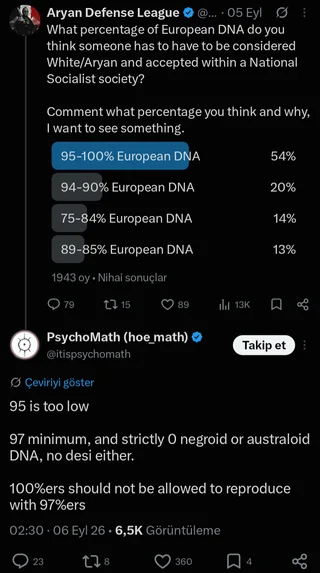
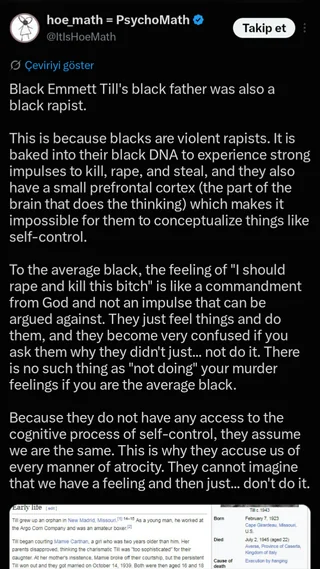
I recently stumbled across a mention of hoe_math on Reddit and was reminded of this discussion.
If you are still around I am curious to see what you think of some of the stuff he’s been saying lately. Content warning for very offensive racist statements. Here is the link: https://www.reddit.com/r/Destiny/s/wc0lkmtTm5 (Edit: note that there are 20 screenshots in that reddit post, so make sure you scroll them a bit. The first one is mostly someone else who is trying to appeal to hoe_math and ask for a special exemption from the general racist views)
My guess is that you would disagree with all of this stuff and disavow it. It’s really extreme and disgusting, and I’m guessing you would agree with that.
But I’m curious… do you think that these opinions of his are going to have consequences and reach into his other views and statements? Do you think it makes sense to consider his points in other areas valuable?
I think that this stuff is totally disqualifying. I think a reasonable default is that someone with these opinions is not worth listening to on any subject. If you are given some really convincing argument for why they have some super valuable insight in another area… okay, you can investigate that. But IMO even then you should proceed with extreme caution.
Curious what you (or others) think, though. Is it fine to just disregard his racism and focus on finding value in his opinions of feminism and liberal ideology?
Haven’t some scientists had some awful views, but were still worth listening to about science? Including some of the scientists who supported Hitler or Stalin? You only said to ignore by default, so maybe you’d give them an exemption, but in that case I’d be curious how exemptions are determined.
Before looking at that reddit gallery, I hadn’t seen anything from him for like 6-12 months. The last thing I recall is like a tweet about him thinking he solve ‘an ought from an is’.
You weren’t kidding. His mask is off I guess.
select hoe_math racism examples for posterity
These are from a105’s link. I verified the first one I pasted. Also the nazi one. Note there are 2 twitter accounts but seems legit still.
Funnily enough, I thought he was like 1/4 asian (just based on skin tone, not really much to go off).
Maybe, but it depends. I think it’s more likely when people are publicly open about the ideas. So there’s like a proximity factor; it’s more likely now than two years ago.
It depends. I strongly believe against discrediting ideas based solely on either source (ie person) or what they are coincident with.
I think it depends, at least in general.
A thought: most of the ideas (that he talks about) aren’t unique to him, so I don’t see anything particularly bad about like watching his video on a topic rather than someone else’s, assuming it’s accurate enough (which generalizes to other people with other views, too). Would the ideas be any better/worse coming from other less/non racist creators that said the same things about hypergamy or whatever? I don’t think so. The unfortunate reality is that bad people can have good ideas, too. Whether hypergamy is a good (explanatory) idea or not is besides the point here, I just mean to illustrate that we can’t really tell based on some racist tweets, especially ones that happen after.
In the hoe_math case it’s moot (for me at least) because he’s not producing any intellectual/notable content.
This next bit is about a more general idea that your question reminds me of. You can ignore it if it’s off topic or not interesting.
There’s an idea in your question about how to treat people based on their ideas taken broadly. The way that I intuitively generalize this idea is that there’s some standards we apply to someone’s ideas (broadly) and if they fail (even in narrow cases) then we make specific choices (like ignore them or avoid their content or ostracize them etc). There’s a practical followup question then about what standards? and I don’t have an answer for that which avoids including too many or too few people. So I reject the idea.
I would guess you’d reject the idea too, but I’m not sure on what grounds.
There are other issues too like whether the treatment is just and what methods of error correction are present, but the social/connectedness aspect seems decisive to me. Maybe, if somewhere like Galt’s Gulch really existed, then there’d be more of a reason to.
On the other hand, I kind of do already do this in a much more limited way, where I’ll give special attention and favor to people whose ideas pass higher standards.
First of all, “supported Hitler or Stalin” can have multiple possible meanings. A scientist who wanted to stay alive and get his work funded in Nazi Germany would, to some extent, need to support Hitler due to the nature of that regime. But they might not really mean it, they might just be doing what they have to do to exist. In such cases, their science could be basically as good as anyone else’s, I don’t think you can draw much conclusion based on that behavior. You could maybe say they were cowardly, but most scientists and most people are cowardly in various ways. That’s not remarkable or disqualifying.
Even if they do believe it to some extent, their context is still important. They are in a society where Hitler is highly esteemed, there’s lots of propaganda, their culture is heavily pushed to agree with Hitler. So them supporting Hitler still makes more sense in that society as a default position, as compared with hoe_math endorsing views that are outside the mainstream even of something like the current MAGA zeitgeist.
Even if we mean a scientist who was staunchly supportive of Hitler, and truly bought into Nazi ideology… that is a bad sign, but again, the cultural default needs to be considered.
In general if someone is being conformist to a standard awful cultural idea, that seems less informative to me than if they are being iconoclastic by following an awful idea. Default views might not be very well considered. They might have not given the cultural default much thought but they might give their unrelated scientific research a lot of thought. But someone making a big point to go against the cultural default like hoe_math has given it a lot of thought, kinda by definition.
Also, how relevant their scientific research is to the bad ideas is probably important. A staunch Nazi physicist seems more likely to be able to do good science than a staunch Nazi biologist, since Naziism doesn’t really require you to believe false things about physics (AFAIK), but it does require you to believe false things about biology. So that is another context that would matter.
Do you see any difference between “discrediting ideas based solely on either the source (ie person)” vs. “someone with these opinions is not worth listening to on any subject” ?
Sincere question. I think there is a distinction. Paraphrasing the dichotomy: I think saying that I have no interest in spending my time listening to someone I find reprehensible is not the same as saying that their idea is automatically discredited.
One reason it could be bad is that watching his videos gives him support. Maybe you don’t want to do that?
I think his racist views have direct consequences for his other views. In my reply to Elliot above this one, I mentioned that a Nazi biologist would probably be less reliable/able to do good scientist than a Nazi physicist. Because adherence to Naziism kinda requires that you believe false things about biology.
My understanding of people that advocate for ideas like hypergamy, including hoe_math, is that their arguments are at least partially from a biological perspective. The racism implies that he has a really poor understanding of biology. So his biological arguments in all other areas are worth extra scrutiny.
None of this is 100% reliable. I agree with this:
But the horrible understanding of biology should affect how much credibility you give him. It should impact stuff like how much you trust anything he says, how much you assume he may be lying or trying to trick you, etc.
It’s bad enough that, e.g. you should never just trust any statistic he ever cites. You should go look up all of his sources and read them all very thoroughly, then hear his arguments based on those sources. At an absolute bare minimum.
But you don’t reject it. You say yourself later:
That’s doing exactly what you said you reject above, isn’t it?
I think you actually do have an answer to this. I think your answer is pretty decent, too. It’s just intuitive, not explicit.
When I say I think his racism is totally disqualifying, that is a statement about reality. Including constraints like time, attention, interest, etc.
If we imagine a situation where we have infinite time, infinite energy, etc. then in that scenario I think that all ideas anyone ever suggests ought to be exhaustively considered. No matter how strange or disgusting or outlandish or stupid they sound.
But in reality all of that stuff is finite. We have extremely limited time and attention and energy. If someone says stuff that seems super duper awful and wrong, much much worse than default mainstream views, I think it is fine to decide that person is not worth your time.
It would be good to have some avenue for correction in place in case you’re wrong, but that does not need to include hearing that person out. If you are a public intellectual/philosopher like Elliot maybe that could include having a debate policy so that the person you have disregarded can directly plead their case to you. Or you could follow a public intellectual like that so that you will see if such a debate were to happen. Or you could find a trustworthy secondary source that suggests good stuff to look into, and the guy that you disqualified could convince that secondary source instead. There are probably more options, too.
But IMO it’s fine to decide that you’ve considered someone’s ideas enough, given them enough of your time, and you now think that they are not worth listening to because of the awful stuff they said. As a general position, I don’t see that as impractical at all.
To me, it seems like a good thing that bad people can have good ideas. Would you want fewer good ideas in the world? Would you want bad people to have thoroughly bad lives instead of mixed lives?
Yeah. If hoe_math had a debate policy or wanted to use my debate policy then I would consider talking with him. But failing that, I see no reason to spend time on his ideas (besides that a forum member brought them up).
I agree with the sentence if you ignore the word “unfortunate.”
Now let’s see if I can agree with it and still include that word.
One possible way to interpret the statement is that it’s unfortunate that good ideas do not automatically make bad people into good people. The structure of the sentence is a little weird for that meaning. It is a bit of a stretch, I don’t think that works.
How about… it is unfortunate for you as an outside observer of ideas that bad people can have good ideas, because it means that sometimes you could have a reason to listen to a bad person in order to glean their good idea. That’s messy, because bad people are bad and most of their ideas are bad, so you’ll have to wade through some crap in order to glean the good stuff.
It might be good for the bad person that they have good ideas. It is good for the world overall that the good idea exists, regardless of who holds it. But it’s like, inconvenient for us.
I think that makes more sense than my first attempt. That seems to hang together okay. Maybe I still agree with the sentence including the word “unfortunate”, if I interpret it in this way.
I thought the intended meaning/emphasis/point was basically that filtering people is harder (more work) than it could be. You shouldn’t just find one flaw and stop. But that also basically means people should be less dismissive of others, so I’m not really a fan of regretting that one can’t optimally get away with being more dismissive.
I didn’t really think much about the word “unfortunately” in that sentence, until I saw your message. I was just considering the idea that bad people can have good ideas, generally.
It seemed kind of amusing to ponder alternate ways of considering the sentence though, once I was scrutinizing it more closely.
A good example might be Klaus Fuchs, the communist atomic spy. I couldn’t figure out exactly how in vogue communism was in the University of Leipzig when he went, but I would guess he did find himself in an academic sub culture where it was. Let’s suppose that my guess is correct. It wasn’t mainstream, but there was a sub culture to conform to. Would that be all too different from hoe_math socializing in online sub cultures where the more racist you are the more based you are regarded (which I’m also guessing he’s doing)? It’s not MAGA mainstream but wouldn’t that be the same as communist students not being leftist mainstream at the time?
Do you only find it understandable when they believe in truly large scale mainstream ideas (held by something like 50% of the wider society’s population), or would you also find it understandable when someone happens to find themselves in a sub culture which is also associated with radical ideas? I guess there might be a difference between hoe_math and Fuchs here where hoe_math would likely have been more actively searching for, or steering toward, his sub culture, whereas Fuchs might originally just have been interested in his studies and it happened to be that his peers were communists. In general I would consider that a significant difference, although in Fuchs’ case he had to have been a very devoted believer to become an atomic spy.
Yeah, that’s why I added ‘particularly’. Working for a bank (at this point in history, at least) is bad but not particularly bad. Being hostile to actual capitalism while refusing to learn the difference vs what we have today is bad, but not particularly bad. Giving some view-counts to some guy who becomes racist in a year’s time? Whatever. I’m not worried about it.
Not to mention that if I did raise my threshold to include that, then it will only make me more anti-left (anti-right too). So, you know, if someone were to advocate this kind of thing, I’d say ‘careful what you wish for’.
On the whole I don’t think going down this path of reasoning (transitive badness via mundane/everyday actions) leads anywhere good.
Same for the left and their racism and other ideas. So it seems moot.
What’s the principle here that you’re advocating? If I intuit one and apply it, then there are catastrophic consequences (for me interacting with the world). Can you make it work in this case but not the others that would be catastrophic?
example of catastrophic consequences
Do you remember how Nature and a bunch of high-status scientists got together at the start of covid to spread propaganda and misinformation about the origins of covid to discredit valid scientific inquiry? That is a strong signal for their lack of ability to do science (and I think what they did is worse than anything hoe_math has done).
So the challenge is: what is the principle by which you can achieve your goal without also excluding like 95% of those scientists?
There is a similarity but they aren’t the same and don’t lead to the same kinds of societies. Tolerance differs, how people are treated differs, whether there is a puritanical death-spiral differs, etc.
Analogy: curating a select library is not the same as banning/destroying select books.
most of the ideas (that he talks about) aren’t unique to him, so I don’t see anything particularly bad about like watching his video on a topic rather than someone else’s, assuming it’s accurate enough
But now you are summarizing what I think is meant to be the same concept as:
Those seem different to me. I generally agree with your examples now, of not “particularly bad” stuff, but I think you’re accidentally switching contexts.
You can’t necessarily know what someone will think in the future, so if you watch someone and their ideas are fine and then a year later they become horrible, yeah, I agree that may not be something to worry about much.
Unless the person’s views were just as bad back when you were watching, and it was apparent at that time to many people, but you missed that somehow. That is a different scenario than the one you just described, right? And that might be more worth worrying about?
What are the mundane/everyday actions in this situation, exactly?
Assuming that’s true (you didn’t elaborate, so I have no idea what racist left ideas you’re referring to and I have to guess/provide my own. But we might disagree, so this is a fairly big assumption) I still don’t see how that makes it moot.
Couldn’t you take the principled position that racists with a bad understanding of biology are like… maybe not the best people to trust when it comes to other arguments about biology? That could apply to people on the right and the left, couldn’t it?
I don’t really think I’ve advocated for a specific principle. Not sure we’ve gotten that far yet. I guess I kinda did above… one example principle could be “racists with a bad understanding of biology are not the best people to trust when it comes to other arguments about biology.” That doesn’t mean there is 0% chance of them ever saying a true biological fact. It just means you shouldn’t trust them. You should not use them as a trusted source of information. If they say something, you should verify it elsewhere.
I don’t see why that would have catastrophic consequences. I think you are trying to extrapolate into an even broader principle? Something like “if someone is ever wrong then you should never trust them again” maybe? Or if not “ever wrong” then like “ever wrong within X amount if truth units” or something. Ever egregiously wrong? Ever wrong and dishonest? IDK.
Your Nature covid article is a good example of a super controversial aside, FYI. I am not sure what exactly you think the scientists did that was worse than saying all Indian DNA should be eliminated, black people are hardwired to be violent rapists, etc. I’m guessing it was when they said that covid was started by zoonotic spillover and not a lab leak?
Currently to this day most experts in the field still think covid was an instance of zoonotic spillover, and not a lab leak.
My guess is that you think it was obviously a lab leak and so any scientist who disagrees is wrong and maybe lying? And, extrapolating, the general principle you were getting at above would require you to not trust/listen to those scientists anymore? And since the large majority of competent scientists in the field are on the side of zoonotic origin, that would mean you would need to distrust a majority of competent medical scientists in the world, and then that would have catastrophic consequences for you?
Just guessing, trying to understand the catastrophe.
So your stance is that disqualifying people who think that all black people deserve to be beaten and all Indian children deserve to be gotten rid of would constitute a “puritanical death-spiral” ?
Is choosing not to read a book the same thing as banning or destroying it?
Going on offense against the left comes off as avoidance, changing the topic, or otherwise not being open to criticism and changing your mind, growing, learning, or losing debates. You’ve done this (bringing up and attacking the left) repeatedly. “The other side is bad too” is a tribalist mindset. Who cares? No one here said “so, in conclusion, join the left, the grass is greener over here” to you. The point was you seem to have underestimated or missed how bad hoe_math is. Which you don’t seem to be acknowledging or learning from:
You still think he wasn’t racist a year ago? He went all the way from not-racist to this in a year? Is that a serious, considered opinion that you would debate and be surprised to be wrong about?
Perhaps more importantly, you may be mistaken about what you thought the good parts of hoe_math were. Instead of attacking the left, you could be saying things like “dang, it’s concerning that he’s so bad in these ways. here are a few specific things i thought were good, with links and timestamps. would anyone be willing to review and see if you think those were actually bad too? I want an outside perspective on whether you think those should be reconsidered or they’re fine.” When you choose to counterattack instead of seeking more criticism, it looks like your mindset isn’t one of wanting to receive criticism, and instead that you prefer to criticize. But receiving criticism is the activity that helps more with your own learning and growth. Counterattacking often comes from a place of defensiveness (offense is the best defense in lots of ways) and that defensiveness hinders improvement (and is generally a poor experience for the other people in the conversation, too).
A more charitable take, IMO, is he thinks obviously it might have been a lab leak. The people who said it couldn’t be a lab leak used bad, biased arguments. They seemed to be following political/career incentives, not truth seeking.
That seems much less bad than wanting to eliminate Indian DNA though.