The tendency of some women to sleep with and seek relationships with more attractive and/or ‘higher value’ men, particularly in a way that prices themselves out of the long-term relationship market. (They will mostly never get these guys to commit, in part because those guys have way more options.)
From the male perspective, basically taking advantage of the situation to maximize the number of sexual partners, novelty, etc.
Yeah, I think that’s one thing I was trying to do (probably because it’s easier).
Well the trans sports issue is more on topic so I’m sharing more about that, and while I agree with stricter immigration laws and enforcement (not just in the US), I don’t mind disagreeing with the US administration as much as I mind being internally inconsistent. Even before this thread, I wouldn’t say that I agreed with everything the Trump admin was doing (some examples: BBB, AI (anti-)regulations, relaxed approach to crypto scams, epstein). I agree with less, now.
As I said and anon pointed out a few posts ago, maybe I’m part of the problem. I also worry because if I’m wrong, maybe I’d support something much worse. On the other hand, I’m not that worried about supporting something really bad because of other values and the fact I’m worried enough about it to consider and discuss the topic. I’m also worried about it because if I ever needed to say something publicly or object to something, I’d want to have a better position (and understanding of my position) than I do currently. There’s also the idea that it’s negatively affecting me and my general mental state.
And yeah there are lots of other problems in society, but often I can’t do anything besides vote, maybe, and it’s generally better to focus on the problems I can solve alone rather than bigger societal problems that I can’t do much about even if I had a solution.
Also lots of societal problems worry me too.
Can you expand on what this sentence means? What way is that? What does “prices themselves out” mean, specifically?
“Some” women is pretty vague, which is often fine but I think maybe problematic for this discussion. Most women? A lot of women? A small minority of women? Is this an issue for women across a wide spectrum of social subcultures, or is it specific to certain ones?
This reminded me of a story I heard in League about an all female team.
Looking it up now I can’t (easily) find the negative comments I remember seeing, but I remember there being this whole thing about this all female league team that sucked and that got crushed. It was shared as an example of women not being able to complete.
Do you mind if I ask why you think the team was underperforming?
Huh, we are just diamond players, when other players were like challenger and above. And it’s not about being male or female. You can take five boys from diamond and they will have the same performance, plus, some girls were auto-filled.
That didn’t get shared around to me when I heard this story. I think part of this could have been addressed by me at the time (I definitely did have opinions along the lines of thinking women are intellectually inferior, since I heard that a lot), since commenters on that reddit post pointed out that they were just diamond players (btw league ranks go diamond, master, grandmaster, challenger and I remember someone mentioning that the elo gap between master and challenger is double).
Yep. So the rough idea is: one’s relationship market are all the people who are looking for partners around you at the same time (can vary by context but this is a good starting point). Next, each person has different breakpoints to meet (having kids, relationship purpose, gender, etc) and other things they will prioritize like attractiveness, personality, income. From this, for each person (Alice), we can derive two sets: Bobs who meet Alice’s criteria and where Alice meets the Bobs’ criteria, and all other Alices who meet the Bobs’ criteria. ‘Bob’ and ‘Alice’ are interchangeable, I’m just picking two names for demonstration. This is also a bit of a simplification, the sets aren’t clean or exact.
Pricing oneself out happens when there is a small population of Bobs and a large population of Alices, such that after preferences are applied, an Alice is left without a Bob. There can obviously be higher or lower variance for this pairing-up allocation depending on context, but there are going to be some Alices that are consistently picked less often.
So pricing oneself out is basically having standards/preferences too specific or high given the context and one’s relative position in it.
It depends on context. Particularly I think we are at a relatively high point for hypergamy due to access via dating apps, many people prioritizing other life things rather than relationships, some social media / pop culture memes, bad ‘feminist’ takes, broader social dynamics, cultural divide and polarization, and maybe other things too.
It feels like it is becoming more common but I don’t have hard data on that. Disillusionment with dating is also growing for both men and women.
I’d say a lot of women currently on dating apps (maybe most). This is also survivorship bias since those (hypergamous) women stay on dating apps, whereas women prioritizing longer term relationships are probably more selective and leave once they’re in a relationship.
Not sure what that translates to as a % of the population, but also that might not matter since I can’t / don’t want to date women in relationships anyway.
I think it’s fairly common in mainstream culture, but there are some obvious subcultures that probably don’t have the same problem (some religious subcultures come to mind). I don’t know if there’s really a difference with women on the left or right, though. I’d guess a bias left but I’m not that confident about it.
Generally, the more desirable traits the better. That basket of desirable traits is pretty general: looks, physique, status, wealth, income/job, height, power. Maybe a few other things too but those are the main ones to come to mind.
Yeah that would be a reasonable response. But the current market has very bad feedback, which helps people stay hopeful/deluded.
They could also try seeing more people / going on more dates. They could try moving to different areas or travelling further. They could try improving their life in a way that their prospective partners value. They could try different dating strategies like doing mutually fun activities (other than sex) instead of dinner. They could try changing the order with which they try to fill priorities to fail faster.
Why? It’s not meant to be an exact description, and it is just a slice of one moment. A market is full of people who can change at any time, so it doesn’t need to stay like this. But when one has higher standards/demands whatever, how is this not a description of what happens?
Maybe? Do you have examples?
Being priced out doesn’t mean permanent exclusion or anything, just that one’s metaphorical bids didn’t meet any asks at this time.
Often it implies that women are hypergamous until their own value drops and they end up alone after hitting “the Wall”.
Sorry, to clarify, I don’t have difficulty believing your view of the situation might be true for some unspecified amount of people within specific subcultures.
I don’t know everyone, I’m not familiar with every subculture. From the outside some subcultures seem pretty dysfunctional. So it’s not implausible in that sense.
As for why… it’s just not congruent with my experience. And by that I don’t just mean my dating experience, I mean the experience of basically everyone I know. All of my friends, family, and acquaintances. I could just be in a bubble, but this is across friendship/acquaintance circles that span multiple regions, US states, countries, and ages. So it’s a very big random bubble.
I’ll pick another example:
Notably, I think that your basket of desirable traits actually includes literallyzero of the decisive traits that most women consider when choosing a partner.
At best, some of your traits might sometimes be related to some decisive floors, e.g. many women may not want a guy who is badly deformed, or homeless, or a dwarf. Though even then, there are important exceptions where some women will not have those even as floors. Can you think of what those might be?
But setting aside floors, you talked about “high value” and “desirable". I don’t think most women actually desire those traits. And I don’t think any of those traits are good decisive factors most women use when choosing a partner.
What’s going on here? Am I totally out of touch and ignorant of what women want?
Can you think of any decisive factors you may have left out?
Oh sure I see what you mean. there’s the pejorative term ‘alpha widow’ that describes women who do that.
I think that can happen to an extent, but there’s still a dating market for 50 and 60 year olds (and younger) so it’s not a universal or inevitable thing. It might limit the type of relationships available, though. I’ve talked with a widow in this age bracket about dating and she doesn’t have that much trouble finding new friends of partners. But she also mentioned that there are a lot of people still searching for ‘the one’.
Sure, I think in the past we experienced this market in a very granular and high-variance way. Like we got to know friends and colleagues and whatever and it wasn’t nearly as clear cut as I described. It was also easier to use other selection criteria.
The hypergamy situation is also mostly not congruent with my experience, but most of my experience is from 5 or more years ago.
I think now it’s a lot more like this now though. Like the last 5 years particularly, maybe starting ~10 years ago. It’s still way more granular than I described because there is no actual market with this kind of specific operation. Something like ok cupid probably got closest at one point, and there have been some experiments that tried more specific things that failed. The closest you get now is some basic filters on tinder. I also don’t know of an app that has ongoing, passive two-way filtering.
However, conceptually, a lot of the mechanics I described do happen I think. We filter people out and break off relationships for all kinds of reasons, and compromise for all kinds of reasons too (which would basically be testing a relationship and deciding it’s better to keep it and forego some things you wanted in favor of not needing to break up and continue looking). If you wanted to consciously and efficiently look for a partner that met a lot of your criteria, then the search would look more like what I described.
Also, women who date like this are less likely to stay with these guys or talk about them (in person, unless you’re a close female friend perhaps) so if you do know women who do this then there’s survivorship bias in your sampling, too.
Right, in previous contexts I mostly agree with you. (Well, actually I think you are probably underestimating things like status, but I don’t have anything solid to back that up.)
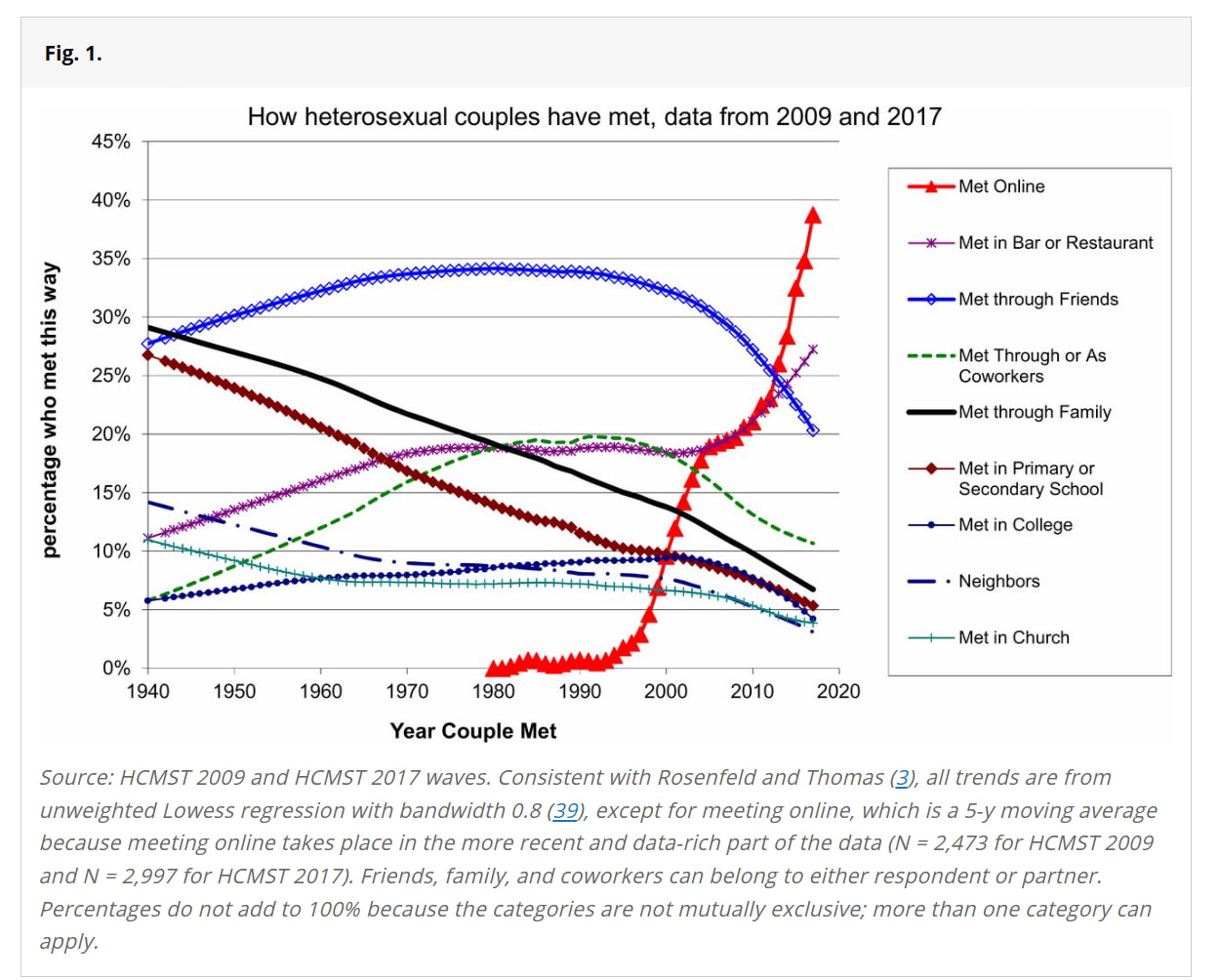
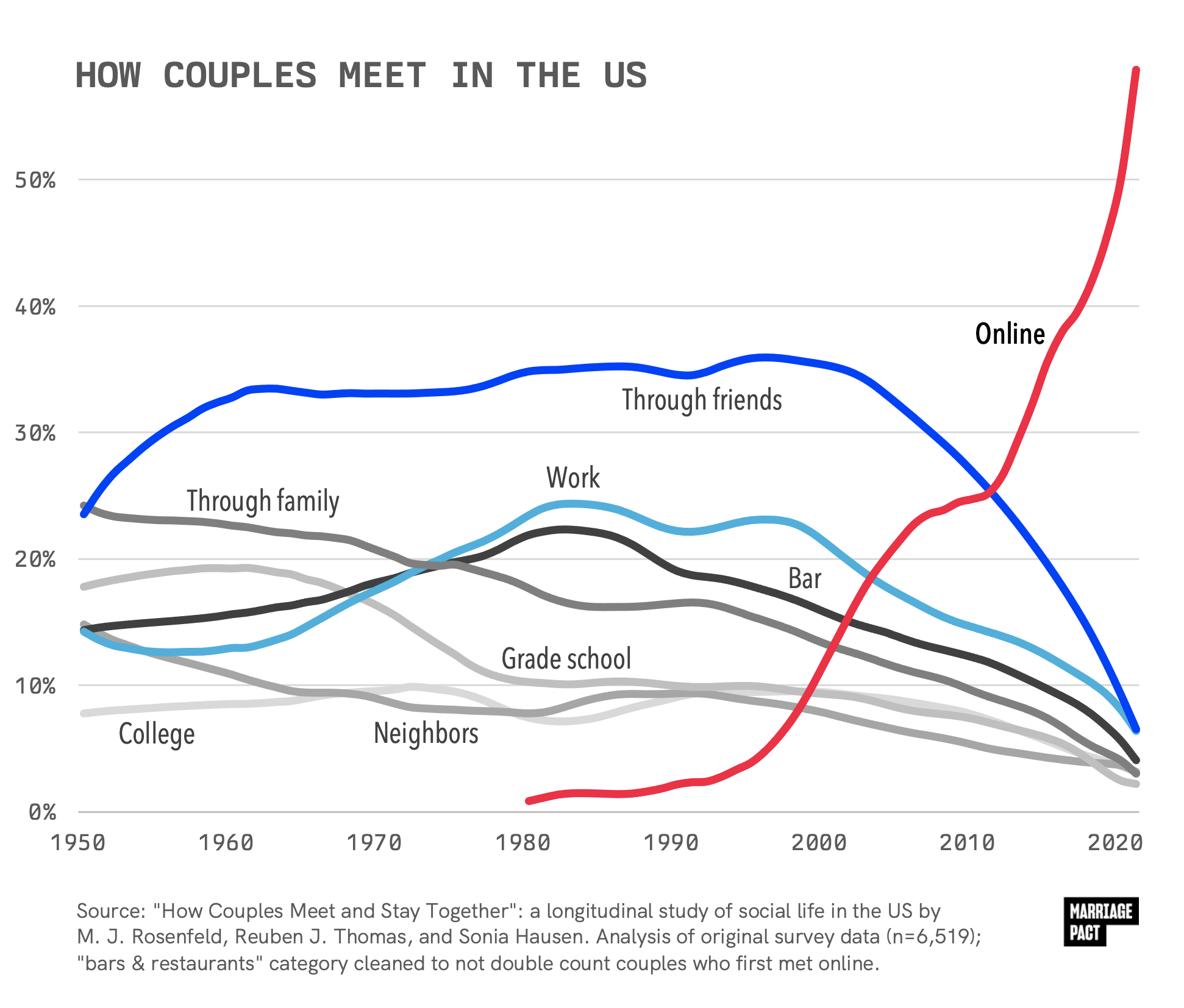
But now consider the context of 70-80% of couples meeting on tinder/bumble: you see some photos, there’s a small bio. Which men do women swipe right on and why? What is in those photos that convinces them? What else do they have to go off?
Conversely, what decisive traits do you think women consider or want to consider? How many of them are easily communicated via a tinder profile? What age / life-stage of women are you considering?
There are always going to be some women that go to more effort in this regard and go out of their way to select for other things.
choosing a partner
Another thing: when women go on dates with guys from apps, are they actually choosing a long-term partner every time or are there other reasons? (e.g., validation and sex are two big other reasons that come to mind)
re priorities and selection criteria: I think both of us can be right at the same time, even when talking about the same subset of women (but not all subsets), since we’re talking about two different behaviors.
If anything I think you might be out of touch with what some women do.
Do you know what the distribution of right-swipes is like on dating apps?
Also dating apps use an elo-like rating system AFAIK which skews things even further.
That said, I might well be over-estimating how much this occurs. I don’t have any data about people in general, just data from dating apps (the little that gets released or is crowd sourced) and things that float to the top on social media.
Uh maybe (and I can think of some things I would want women to use as selection criteria) but you asked me to define hypergamy originally and then you said you disagreed. I don’t want to get too distracted.
I think that women’s preferences in partners are pretty relevant to the concept of hypergamy.
If the hypergamy idea is built around the desirable high value traits you mentioned, and actually very few women use those traits as their primary decisive factor when dating, then how does the hypergamy idea survive?
If that’s the case, why does it matter much?
I know why manosphere dudes think it matters, but you seem to be avoiding committing to the idea that once a woman has had a few partners she becomes a used up whore.
Not sure where those numbers come from?
Those articles show quite different percentages than you used.
But even taking your numbers, and accepting that many initial contacts go that way… okay. Do you think most of your desirable traits are well illustrated in a dating profile?
Sure, though I think men are much more likely to be seeking validation and sex than women. It’s easier for women to get sex, and men typically define themselves around validation from women in a way that is not symmetrical.
I’m not sure that many women are seeking tons of sex and validation via apps. I think that’s a minority, actually.
–
One thing that may be a big disconnect is that I think women are broadly correct to be selective and date less men. Men are not very good partners for women, for the most part.
This has always been true but in the past women had greater need for men due to misogynistic social restrictions. So if you were a woman a mostly worthless man that could provide money and e.g. vote for you, or get you a credit card, was providing tangible value to you.
But women can cover their own financial needs now. So a partner needs to actually provide something else. Maybe a hot guy is fine for a date or two, but that is not a decisive factor when choosing a partner.
Most men are bad at talking to women, treat women poorly, are not equal partners, do not take care of themselves or their households, etc. They are often sexist. They are more argumentative and their emotional outbursts are more often external and even dangerous.
They just kind of suck. If you look in women’s spaces where they talk to each other, women often say the bar is on the floor. A man who is actually kind and fun to be around and genuinely shoulders an equal burden of the partnership (household, kids, etc.) is very rare.
That is a consistent thing I have seen across 100% of the successful happy relationships I’ve actually encountered in real life. Those are the traits women want in their partners. Physical appearance, wealth, status, and power do not make the list at all.
It matters insofar as it exists and thus shouldn’t be ignored. Personally I don’t think I’d be interested in someone who would do that anyway so it’s kinda whatever to me. I think it’s bad for society generally because it’s counterproductive to long term relationships. (Hard to start a stable long term relationship when you’re in a situationship or roster dating.)
WRT women being ‘used up’ yeah I’m not going to commit to it because I don’t think that’s a good way to judge people. There are exceptions maybe (like triple digits seem like a red flag for other reasons) but if I had to have a rule of thumb to go by for body count it’d just be around or less than mine (which is above both median and average) — that seems reasonable.
Just so we’re on the same page, this conversation branch started from this:
What about the women on the apps right now? Alternatively: women in their 20s, not in a relationship, and proactively open to dating in some manner?
I agree with the first part depending on what you mean by ‘date’. I think lots of low stakes first dates are fine since selection has to start somewhere and relying on in-person social stuff for meeting new people is a pretty low volume and unreliable method.
Not sure how I feel about the second sentence.
What do you think about the difference in divorce rates between gay and lesbian couples?
Well it should be easy then. I can’t personally claim to have recent contradictory experience but I know guys who can.
What kind of preselection are the women doing? Because if they are using online dating but not going on many low stakes first coffee-esq dates, it sounds like they might be sampling a small proportion of the male population on dating apps. And if most men find that they need to swipe hundreds of times more than women to get dates, this suggests there could be some bias in the men these women are complaining about.
How many people do you know with significant wealth, status, or power? How confident are you that none of those things would have sweetened the deal as such?
I’m not sure I really believe that physical appearance wasn’t a factor. Both my mother and her mother have described to me how they thought their husbands were physically attractive. Not like chiseled abs but attractive nonetheless. Depends what you mean I guess.
Also, this might say more about what people who find themselves in successful relationships look for vs those that don’t.
Okay that’s fair. I don’t know how to do that. (Though, I’d argue allowing all trans women in still hurts some cis women some.)
re bathrooms: okay I’m not really sure what to think. On the one hand, I think it’s bad that you have that experience. On the other hand, some (SA) harm will come to some cis women if trans women are allowed in. I think it’s rare but it’s not zero. Do you agree with that? How do you reason about the apparent conflict?
Do you think there’s any merit to what I said earlier about unisex bathrooms? It seems like there are no great solutions.
re genital checks: yeah I think they’d be bad to enforce and I can see why you’d prefer not to play a sport instead of undergo one.
Since anon105 changed my mind on some sports things in posts 68-80, I won’t reiterate that here.
It doesn’t need to be either/or like that but I can see how it would be impossible to enforce in many cases. Well, maybe it does need to be either/or because what happens if there’s a complaint or accusation or whatever. It needs to get resolved some how. IDK. At least if it’s allowed there’s no reason for a trans athlete to hide being trans.
Whether it’s offensive or not, if anyone at any time can just declare themselves trans and then compete in a women’s league, and say the entire podium is now trans women (good faith or not), I think plenty of women might not like that and might feel like it was a waste of time competing. Track and field might be good examples. I think many cis women might feel hurt by this. Do you think they’re wrong to feel that way?
I’m not sure there are any good solutions here.
Well I was speaking somewhat pejoratively about it which is why I used “hole”. It’s not my intention to imply that’s all vaginas are or that without being part of active reproductive systems they are reduced in any way (other than the quality of not being part of an active reproductive system).
There are still many differences, though, like all the associated musculature, nerves, secretions, and structure.
If we could somehow move (via surgery) one’s vulva and vagina and all the other connected bits somewhere else on the body, the names wouldn’t change. But if someone had m2f bottom surgery somewhere else on their body, would that still be an artificial vagina? Or would it start looking more and more like a weirdly placed hole?
What matters I think for the naming is that it’s a part of the body that grew. Even if the reproductive system never worked, that part grew for the purposes of reproduction. If someone has a deformed arm, it’s still an arm even though it might not have all the functionality. Similarly, even if a female woman is infertile or has gone through menopause or whatever, that doesn’t mean her vagina stops being a vagina.
I can see why it’d be offensive and it’s fair to call me out on that. It’s something I’ll consider in future. But I should let you know that you haven’t changed my mind on what an artificial vagina actually is, just how I should refer to it.
You’re probably right. I will revise my criteria a bit to performing the characteristic/essential functions. So for a heart it needs to pump blood and that’s about it. A prosthetic leg needs to let you walk. Artificial eyes need to let you see.
Hmm but what about an artificial ear or nose? Those are somewhat or entirely cosmetic (we do have cochlear implants but we don’t call them artificial ears, and artificial ears probably means the sound funnel part to most people). So IDK when it comes to artificial vaginas.
Many other procedures aren’t touched by ideology (unless you count medicine as ideology).[1] And for me it’s not so much about adults regretting them (although I have sympathy for people who do), but it’s that this kind of thing is suggested as something that will substantially help (despite a lack of convincing research), is expensive (if state funded), and results in life long permanent destruction of sex organs. A lot of other surgeries are life saving or reversible. But an 18 yo getting mastectomies for what could be political reasons is quite frankly a scary world (granted, in most cases I’d guess political reasons are a minor factor (edit: or not at all), but there are definitely people who have done it for political reasons).
Moreover, I think people are scared of their kids being talked into it, and they’re scared of it becoming more common.
To pick an extreme example: if 10% of men tomorrow decided they wanted to be castrated, they might well be within their rights to do so, but should we as a society be worried? Is it possible that this maybe leads to something bad and irreversible?
Granted, bottom surgery is no where near this high, but if it’s totally fine then why would it be bad if 10% of the population tomorrow decided that they wanted it?
Is the only acceptable response to that to nod and go ‘yeah, sure, do what you want’?
Same for HRT (which is also often nonreversible), and the science around it has historically been biased.
I think it’s fine to just ask with no further questions. If she’s being raped multiple times a year then that sounds like the police should get involved, anyway. If she’s lying to get a free abortion, well she’s lying to take advantage of something offered to rape victims, which is a shitty thing to do.
Edit: thought of another example: the COVID vaccines were touched by ideology and people kicked up a stink about those and all the corners cut. I can’t think of other examples off the top of my head. ↩︎
FYI regarding dating app dynamics. I think the self-reported experiences of women (‘bar on the floor’) are compatible with them largely dating a small group of men who have way too many options.
Here’s a video about simulating dating apps from data (compatible with hypergamy and hints at how it arises naturally out of the dynamics)
Why Men Get So Few Matches on Dating Apps - Memeable Data (2023-07-13)
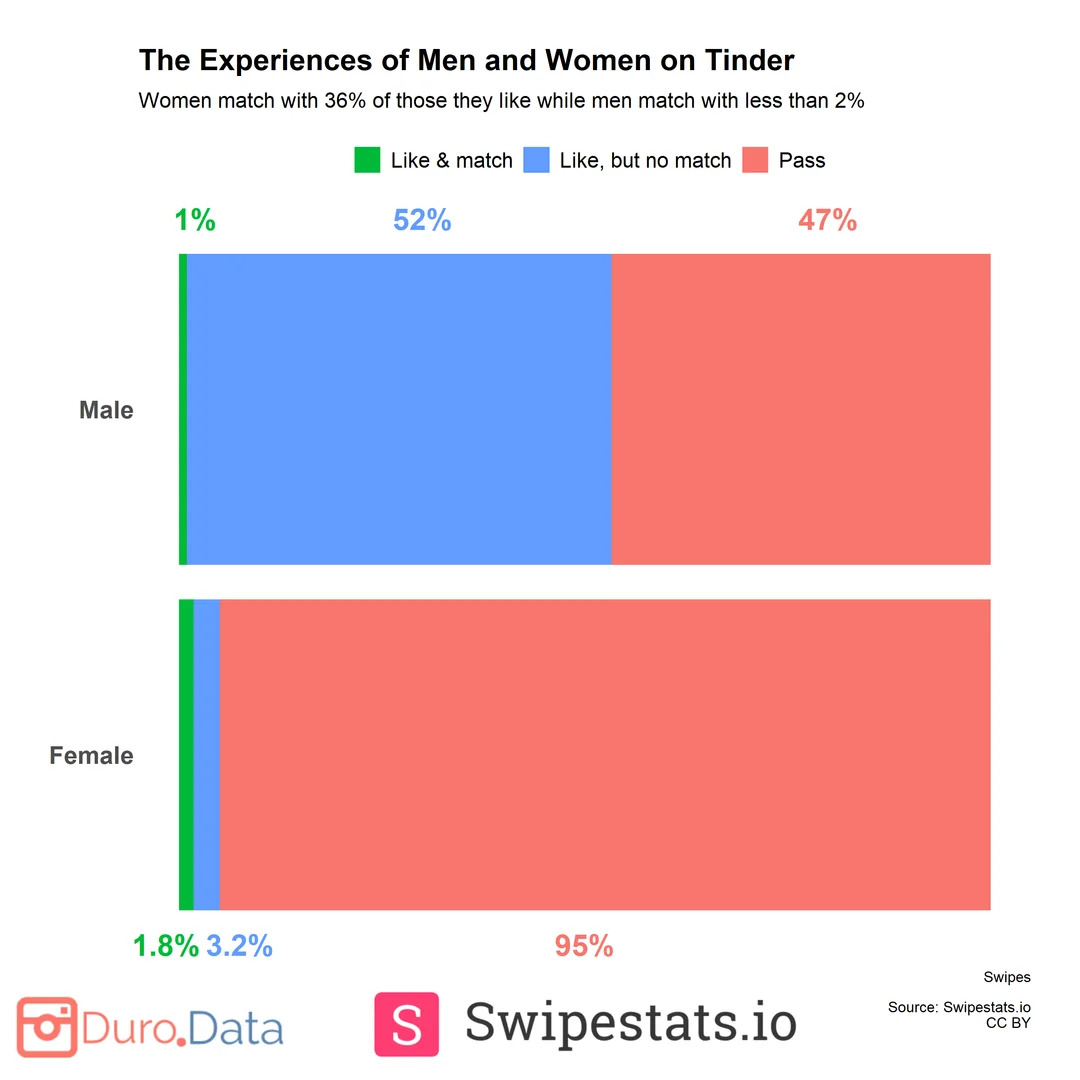
Some data from swipestats.io (also compatible with hypergamous behavior from women)
Maybe, but I don’t think they’re getting it (except the top percentiles).
It doesn’t make any sense for regular men to use dating apps for validation because the opposite will happen.
Women largely might be lying to themselves about what they’re selecting. Especially if they see an over supply of men on dating apps and preselect via attractiveness or visible wealth/status whatever in photos. I think it’s somewhat naive to expect people to fully understand what’s going on in their head, too, or admit to doing something they disapprove of.
There can also be survivorship bias in that women who are better partners are more likely to find relationships, and less likely to complain about men online. So maybe you’re right about the women you know but also a lot of women have bad ideas about dating and aren’t honest about their behavior.
This can also lead to a ‘purification’ type process where impurities (people good at relationships) are quickly removed from the dating pool, which then becomes concentrated with people bad at relationships, or burnt out, or whatever.
You seem to have a high regard for women by default and a low regard for men. I have to wonder if you’re a bit biased. Why not a low regard for both? Why do you think that women aren’t contributing to the problem?
I sometimes meet women on apps right now, and none of them seem to be seeking exclusively sex and/or validation.
So I guess… I still stand by my statement?
Women also initiate more divorces in straight relationships, which I think they do for good reasons.
I think women are on average much more emotionally mature and intelligent than men. So they’re better at identifying when a relationship is not good for them, and ending things. Men often stay for a long time even if unhappy because of a combination of stoicism and laziness (plus probably more stuff, but those 2 are big).
Though also, I think queer people in general are better at relationships on average than straight people. I would be wary of taking stats from queer people and extrapolating to straight people.
I’m skeptical that it would be easy for most guys. I think it is actually really difficult for most men to not be shitty and unappealing in the ways I’m describing.
Source: I dunno, I know a lot of men? Most of the ones who seem emotionally mature and stable enough to actually be good partners are already partnered up.
It does not take very many women to be motivated by those things for the small number of men with those things to be surrounded by such women.
I’m not sure you get to take that position when you’re also taking the redpill/manosphere “high value man” position.
Yes, most women want to be physically attracted to their sexual partners. But this is highly variable in terms of what it actually means. That sort of physical attraction is heavily informed by the other traits. There’s no physical body standard that is very reliable here. Bald men, hairy men, fat men, skinny men, tall men, short men all routinely meet women’s threshold for being physically attractive… because they are charming in other ways.
The reason nerds and “nice guys” are often seen as unattractive has a lot more to do with their character traits and personalities than the fact that they have acne or they’re out of shape or whatever.
But they’re desperate for it, so they seek it anyway.
Related: are you familiar with the common claim that men don’t get complimented and when they do it sticks with them forever?
I think this claim is factually not very true but it makes sense to me, because a large amount of men primarily derive self-worth from the validation they get from women.
Sure, this probably happens to some degree.
But new people also enter the dating pool.
This is kinda related to the political discussion I’ve been having (regarding how I view left vs. right).
Everything I said here is actually compatible with me having a low regard for women by default. It would only require that my default regard for men is even lower.
Because the social and emotional traits men commonly have — traits they are often proud to have, and social psychologists say they have, and manosphere podcasters say they have — are less conducive to good relationships than the traits women commonly have.
Editing in some example masculine traits: Argumentative, disagreeable, competitive, angry, judgmental, stoic, risk-taking, individualistic… I think there are more but that’s an easy start.
Also, wouldn’t this mathematically follow? I would think that being more selective would yield a higher match percentage on your yes-swipes than being less selective. No? Am I missing something in the math here?
I wouldn’t be surprised if women are more successful in real numbers, too, but this percentage breakdown does not seem to tell the story you think it does.
Sure, but you’re not in the top 5% of men and the women who were there for validation already got it. So your experience doesn’t contradict the idea that sex and validation are two big usages of dating apps by women.
Why don’t you think it’s a mix of good and bad reasons? Are women just like innately better thinkers? More emotionally stable? Better at reasoning? Better at long term planning? Immune to social media suggestion?
You mean emotionally intelligent, right?
Couldn’t possibly have something to do with wedding vows, too, could it? Maybe men are just more honest or willing to honor a commitment. Or maybe the incentives are such that often there is little downside for the woman but a big downside for the man? (This doesn’t always happen, but it does seem to happen often enough)
Anyway, if you’re just going off vibes I am not sure how you intend to convince me that you’re right and not just biased. I’ve pointed out numerous ways that your views might be biased but you haven’t acknowledged a single one.
What makes you say that? It shouldn’t be divorce stats because we haven’t had gay marriage for long enough, yet. (It’s only been like 10 years, plenty more relationships will fail in the next 10)
Okay.
So I take this to mean that you don’t know many people in that situation, and you don’t have any actual argument against it. Like if all women had these biases, you wouldn’t expect them to be expressed in happy long term relationships between ordinary people. And if the women never had the chance to be with someone who had more status or money or whatever, on what can you base your conclusion?
Like, what you said is correct, but it isn’t addressing the topic directly.
I am using the common name for the thing being described. And plenty of women use the term, too.
I think you’re a bit head-in-the-sand here. You are believing what women say instead of what they do. They are not magically more honest or something (arguably their nature is more geared around social cohesion which is more compatible with dishonesty). Look at the cover of some romance novels, for example. a list. Moreover, you’re ignoring the difference between meeting people through a workplace of friend group and online. No one is saying that women don’t find men more attractive (generally speaking) after getting to know them (assuming they like them after that). Arguably, this has actually been really important for most men. That’s one of the reasons that women act so hypergamously on dating apps. There is no getting to know the men first.
Also, your reason that men routinely meet women’s threshold for attractiveness is because of something other than their attractiveness, which means without that other thing they don’t meet the threshold. That implies a higher standard prior to appreciating the other qualities.
Which are?
Also your argument doesn’t answer the question:
I didn’t ask whether men or women contributed more to the problem, I asked why you think women aren’t contributing at all.