BTW, “crony capitalist” is a problematic term because it basically refers to non-capitalists. It should be “crony businessmen” perhaps. But I don’t think it’s worth fighting over. It’s in the dictionary now and means an important thing:
an economic system characterized by close, mutually advantageous relationships between business leaders and government officials.
(I think it’s understandable and common to use it to refer to some people and their behavior rather than a whole economic system.)
It is a very problematic term, especially because many leftists believe that crony “capitalism” is the only alternative to statism.
I call “crony capitalism” cronyism, and I call “crony capitalists” cronyists.
Google, Facebook, Twitter and many similar companies are connected with government a ton.
Source?
Edit: Err rather, I am sure they are connected with government in a ton of ways, as is every company in a mixed economy. But I am assuming you mean that they are more connected than they need to be to keep themselves from getting screwed over (e.g. do they get subsidies? does the government help them quash competition somehow?).
Minor issue: I guess you mean every large company. I’m less pessimistic than I think you are about this. I think Apple was notably pure 15 years ago. But Steve Jobs died, Apple got bigger, and they got repeatedly screwed over by government, media, investment analysts and pressure groups (e.g. Greenpeace). These groups treat Apple better today. Samsung (and Android more broadly) copied Apple’s work and didn’t pay for it (Samsung did lose a case and pay something, but the inadequate reward got reduced and is less than Apple has paid to patent trolls). Long before that, Microsoft ripped off Mac OS and didn’t pay much.
Part of the issue with new money in general is that it isn’t integrated into the hierarchies of power and control yet. (It depends how you get it. Some people get rich by climbing existing hierarchies but some do other stuff like invent something or run a company efficiently and expand.) New money is pressured to conform before being accepted because they aren’t yet playing the same games as pre-existing powerful people. This is not just a matter of social life but, especially for the richest people, of government connections.
Silicon Valley is like new money and has, in various ways, been mistreated and persecuted by old money: by media, government, and the east coast social hierarchies. Some tech companies more than others have been eager to befriend old money/power.
For example:
Here are two videos about how California courts and Patreon are corrupt:
Here’s a Twitter story:
People have repeatedly tried to sue Twitter and others – with good cause – but the government keeps siding with their friends in tech. Example story:
Google, via YouTube, censored unedited streaming of political hearings related to the election fraud against Trump. They acted as an arm of powerful outside interests that have nothing to do with what their company is allegedly about (advertising and free ad-supported software).
Here’s a story about how aligned Twitter, Facebook and YouTube are with old power:
Payment processors are involved, which is a major problem. Stripe is a Silicon Valley startup from 2010 who does the bidding of establishment power:
https://www.cnn.com/2021/01/10/business/stripe-trump-campaign-suspended-payments/index.html
That came about a month after the CEO of Stripe personally told me not to worry about being deplatformed by Stripe for political reasons since they process payments for right wingers like, specifically, Trump.
Apple example:
All the major social media platforms are full of illegal filth, e.g. (I’ll explain the point next):
And plenty of calls for violence, too.
But then a bunch of tech cos (including Amazon, Google and Apple) colluded essentially to kick Twitter’s rival, Parler, off the internet. This was allegedly done because its moderation policies weren’t good enough:
But it was actually done for political reasons and to help Twitter, Facebook and a few other social media platforms maintain power and market dominance.
The government routinely helps them get away with stuff like this:
I don’t know which things you’ll consider particularly important but here’s one more:
The US government still leeches off and screws over these companies anyway. (Other governments do too, e.g. EU governments keep fining US tech companies tons of money.) They aren’t just fully government departments and they have a ton of money to loot. Appeasement doesn’t work well. It helps some in the short term but also emboldens and empowers the government.
The tech companies do break some laws (including some of the laws that actually should exist), lie, and do some things wrong that alienate their users and the public, which makes things easier for government power. But on the other hand, friends in Washington is how Twitter, Facebook, Google and others can get away with massive ongoing fraud at all.
Yeah, I meant every large company.
Exactly. Noticing how much politicians and journalists have been trying to hard-sell the public on social media regulation, my assumption til now has been that Facebook/Twitter/Google have basically been acting in self-defense (albeit in a bad and unprincipled way).
I’ll check out some of your links though.
Broadly: Apple, Amazon and Microsoft sell stuff to the public. Facebook, Google and Twitter don’t, so they’ve been much more eager to befriend power. A lot of advertising dollars come from establishment power. Plus they are speech platforms and the government really wants to control speech, and the establishment media wants to suppress competitors.
Plus I think the social/speech platforms did tons of fraud in order to get big, so they needed government protection as part of their growth strategy.
It can be hard to say what can be excused as a bad attempt at self-defense, but committing fraud and befriending power doesn’t look like self-defense to me.
Facebook, Google (e.g. web search and YouTube) and Twitter have lied over and over to users about their neutrality. We don’t bias our search results! We support free speech and open debate! We’re just a platform to let users speak, not a publisher deciding what can be said! etc etc. They’ve broken contracts, including the EULAs they write. They’ve lied to congress under oath, which you don’t get away without friends in government.
I don’t think this stuff would be nearly so big if right wing people knew from the start that they’d be unwelcome and persecuted. So many groups have invested in getting 100k followers and then gotten banned, and they wouldn’t have done that if they weren’t lied to about the platform’s policies.
But maybe the speech platforms intended to be neutral initially and started persecuting some groups (while lying about it) after they got big enough to be pressured by power. I don’t know their plans or intentions, and how much those were changed by pressure, or when. Maybe power pushed them to start doing fraud quite a while ago, and then they needed favors and so could be pushed further. I don’t know all the details.
My guess is that Paypal and Stripe had reasonably neutral intentions initially before they were pressured behind the scenes by visa, mastercard and the banks (all of which the government has a lot of control over).
But it’s not like Google has to do business in China and help the CCP with internet censorship. Pursuing that isn’t defense, right? Google has been caught trying to do that: Dragonfly (search engine) - Wikipedia
The Dragonfly project was an Internet search engine prototype created by Google that was designed to be compatible with China’s state censorship provisions.
So that’s a clearer type of evidence about the nature of Google than it’s US behavior. But you could claim they never would have done that if they hadn’t been pressured by US power and corrupted first. That’s conceivable I guess, but at some point companies have to be held accountable for what they do.
There are also some particularly awful examples that seem really hard to classify as defense like Amazon using anti-trust against Apple:
And I don’t really follow the news much. I’m sure there are many more.
Another example I forgot to put in my post was that Bezos bought the Washington Post.
That’s a really good point. I had been dismissive of the cries about censorship: Kicking someone off your property isn’t censorship, and most of the right-wing commentators (incl the lady in the second Lauren Southern video c.a. 32:00) don’t seem to understand this. But if you’re breaking contracts by kicking someone off your property, and the government is letting you get away with it on purpose, that is indeed censorship.
I understand that. A lot of them simply are not classical liberals.
But I think classical liberals should recognize a lot of what is happening – e.g. deplatforming – is bad and then try to make a classical-liberal-compatible case against it instead of defending it. Some Objectivists and libertarians have given me the impression that they actually like or approve of a lot of the deplatforming, rather than that they hate it but regretfully found their principles require accepting it. I think not being very against it is one of the main reason they haven’t done a good job of finding or making classical liberal arguments against it.
I talked about that in my main post about it:
There are hundreds of links to examples in the comments.
Another thing I wrote about it is:
BTW the people who want to repeal section 230 and say facebook is a publisher (due to having any moderation at all) and should have no protections as an open speech platform are awful people (e.g. Ben Shapiro). They would destroy the internet and basically make it impossible for forums to exist.
Yes, completely agreed. Some of them even call section 230 a “subsidy” too, it’s absurd.
Meta Company’s founder writes:
The attorney representing Facebook declared they would respect our existing right and registration.
[8 days later] Facebook decided to commit trademark infringement and call themselves “Meta”.
Meta Company is suing. How does Facebook/Meta expect to get away with this? I think by political pull.
I thought some of the other examples mentioned here and in that blog post were pretty damning, but with this example specifically, I’m very skeptical that facebook is in the wrong. I find it really fishy that MetaCompany doesn’t describe what they do in their letter or elsewhere on their website or social media acct. Whose livelihood is at stake and why? What product was it that had its launch delayed?
See MetaCompany ‘Facebook Stole Our Name and Livelihood’ Letter – Truth or Fiction? too.
Another theory for what’s going on here that I find more plausible: Some random dude trademarked MetaCompany in 2016 thinking he was going to do something with it, and then he gave up or forgot about it, until 5 years later when he got a phone call from facebook’s lawyers and he thanked his lucky stars for an opportunity to extort a few million dollars.
The filing for the original mark says
Consulting services in the field of design, selection, implementation and use of computer hardware and software systems for others; Development and implementation of software, hardware and technology solutions for the purpose of productization of electronic components and electronic systems
That sounds pretty vague to me.
I pulled the specimen that they submitted, which I think is supposed to represent a use of the mark in commerce:
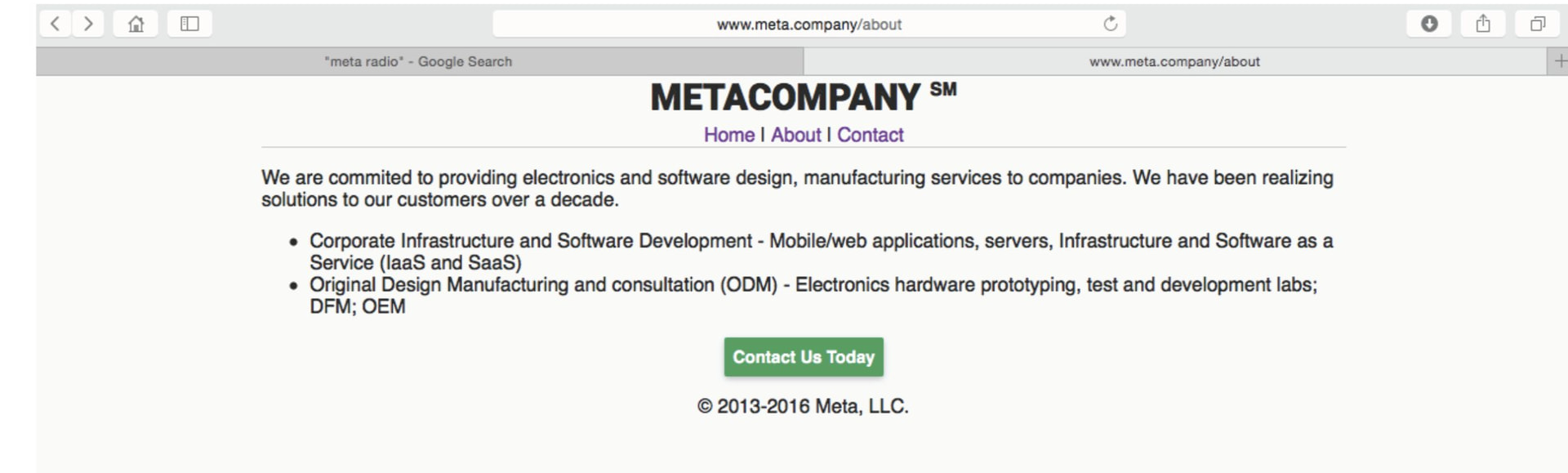
I don’t know what standards the USPTO typically uses to determine whether or not something represents a bona fide use of a mark in commerce, but I’m not really convinced.
Ok I found some information in the Trademark Examiner’s manual. Based on reading it, I’m not convinced a very minimal website should count, as it seems like it might be “token use”. Based on my very superficial review, seems like maybe the mark should have been filed as an intent-to-use filing instead of being accepted as it was, and then that an adequate specimen should have been submitted later (or the trademark denied).
The definition of use in commerce ( TMEP §901.01 ) was amended by the Trademark Law Revision Act of 1988 (TLRA), Public Law 100-667, 102 Stat. 3935, to add the phrase “the bona fide use of a mark in the ordinary course of trade, and not made merely to reserve a right in a mark.” The primary purpose of the amendment was to eliminate the practice of “token use,” or use made solely to reserve rights in a mark.
The legislative history of the TLRA makes it clear that the meaning of “use in the ordinary course of trade” will vary from one industry to another. The report of the House Judiciary Committee stated that:
While use made merely to reserve a right in a mark will not meet this standard, the Committee recognizes that “the ordinary course of trade” varies from industry to industry. Thus, for example, it might be in the ordinary course of trade for an industry that sells expensive or seasonal products to make infrequent sales. Similarly, a pharmaceutical company that markets a drug to treat a rare disease will make correspondingly few sales in the ordinary course of its trade; the company’s shipment to clinical investigators during the Federal approval process will also be in its ordinary course of trade…
H.R. Rep. No. 1028, 100th Cong. 2d Sess. 15 (1988).
The report of the Senate Judiciary Committee stated:
The committee intends that the revised definition of “use in commerce” be interpreted flexibly so as to encompass various genuine, but less traditional, trademark uses, such as those made in test markets, infrequent sales of large or expensive items, or ongoing shipments of a new drug to clinical investigators by a company awaiting FDA approval…
S. Rep. No. 515, 100th Cong. 2d Sess. 44-45 (1988). See also Paramount Pictures Corp. v. White, 31 USPQ2d 1768, 1774 n.8 (TTAB 1994) , aff’d, 108 F.3d 1392 (Fed. Cir. 1997) (Table).
Therefore, some factors to consider when determining compliance with the statutory requirement for a “bona fide use of a mark in the ordinary course of trade” are: (1) the amount of use; (2) the nature or quality of the transaction; and (3) what is typical use within a particular industry. See Automedx Inc. v. Artivent Corp., 95 USPQ2d 1976 (TTAB 2010) (finding sales of demonstration models of portable medical ventilators to military constituted bona fide use of mark in commerce); see also Clorox Co. v. Salazar , 108 USPQ2d 1083, 1086 (TTAB 2013) (finding that applicant had not made bona fide use of its mark in commerce, as applicant had not sold or transported goods bearing the mark in commerce as of the application filing date).
The specimen says “We are commited [sic] to providing electronics and software design, manufacturing services to companies. We have been realizing solutions to our customers over a decade.” But like, have they been providing those services under this mark? Cuz if not, I don’t think that’s really relevant (like if Bob Jones was providing some kind of solutions under his own name, and then tries to register a mark to provide similar services under, but hasn’t used it yet, I don’t think he’d get to relate the mark back to his providing services under his own name). And if they HAVE been using the mark for years in commerce, shouldn’t there be a better specimen to submit?
I didn’t research it. Your points are reasonable.
But my focus was primarily on what I quoted. Unless Meta Company is simply lying (which I figure would come up in court and also expose them to a defamation lawsuit), FB’s behavior still seems really problematic to me. Why would FB’s lawyers say they would “respect our existing right and registration” if they were not going to do that? If FB’s lawyers had said they were doubtful the mark was valid, or nothing, then their side would seem more reasonable to me.
BTW I got the story from Daring Fireball: Meta Company
What is surprising to me is that Facebook didn’t use their “infinite money” cheat code and just buy these names. I think that’s basically what Apple did with the “iPhone” trademark that was held by Cisco back in 2007. (I had forgotten that the prototype iPhones on display at Macworld Expo didn’t have “iPhone” printed on them.) There’s an entitled petulance at play here on Facebook’s part.
Daring Fireball is pretty reliable about only linking real news in general, but he also hates Facebook.
There’s a Meta PC company too: