Early Conceding While Reading and Not Starting Discussions

Were you able to get your concerns addressed? It seems that being burnt out is a like a bigger whole and the motivation that one loses is part of the burn out.

I’m going to reply to @LMD’s earlier reply about Roark being burnt out:

I think you could still practice some of what ET discovered about CF and not know much about it. Like, I think maybe Roark practiced some of ET’s ideas intuitively. I think though since he doesn’t know about them that he may not do them well. This is hard to explain for me cuz it doesn’t make sense to me to practice something that hasn’t existed yet. But I think Roark not practicing ET’s ideas well is probably why you bring up Roark being burnt out.

edit: I think by “concerns” in the beginning I meant “questions answered.” Using the word concerns sounds like @LMD is worrying about something. That doesn’t sound correct.

I’m not sure what mental blocks or psychological blockers are.

I assume in Roark’s case it means just being very tired/frazzled. Though some people have literally worked themselves to death.

I agree. I think burn out is due to doing (too much) work that one doesn’t enjoy. And/or due to a chronic lack of happiness/enjoyment in one’s life in general. Ayn Rand has a great quote about this in Our Cultural Value-Deprivation:

A chronic lack of pleasure, of any enjoyable, rewarding or stimulating experiences, produces a slow, gradual, day-by-day erosion of man’s emotional vitality, which he may ignore or repress, but which is recorded by the relentless computer of his subconscious mechanism that registers an ebbing flow, then a trickle, then a few last drops of fuel—until the day when his inner motor stops and he wonders desperately why he has no desire to go on, unable to find any definable cause of his hopeless, chronic sense of exhaustion.

She also quotes Branden:

“Pleasure, for man, is not a luxury, but a profound psychological need. … pleasure serves as the emotional fuel of man’s existence.”

I think burn out is different from being too physically tired to work properly but still loving one’s work (and still having enough spiritual fuel and happiness in one’s life in general). A bit like what ActiveMind said here (which I agree with):

Yeah I meant the ‘working almost to death’ part in a casual, non-literal, exaggerated way. To sort of mean like working lots and neglecting your health and needing rest.

That makes sense. You could get burnout and then you have problems returning the task without internal conflict, even after getting sufficient rest.

1 Like

This is a digression, but the idea of pleasure as emotional fuel reminded me of a quote from Cyrano de Bergerac.

LE BRET

You are not quite so gloomy.

LE BRET

So now, you are going to be happy.

CYRANO

Now!…

(Beside himself)

I—I am going to be a storm—a flame—

I need to fight whole armies all alone;

I have ten hearts; I have a hundred arms; I feel

Too strong to war with mortals—

(He shouts at the top of his voice.)

BRING ME GIANTS!

I think that does a good job of capturing the fortifying/invigorating power of happiness.

When people are depressed, sometimes they can’t even muster the energy to get out of bed and even small things can feel crushingly overwhelming.

Whereas when one feels very happy, all of a sudden it can feel as if one can do anything, that one could “fight whole armies all alone” and as though one has “ten hearts” and “a hundred arms” and as though mere mortals are an insufficient challenge, hence “BRING ME GIANTS!”

1 Like

I think a mental block is when you go through a state of not feeling creative about your work. Like, wanting to write a story but being stuck on finding any good material. That’s my default definition and example of a mental block. I’m unsure about it now. I thought Roark probably felt that he wasn’t making good progress on his architecture and thought he needed some rest. Idk about this.

I think blocker is one of those words used to describe a kind of problem, and it’s talked about in FI or CF discussions. I’m not sure about the word so I don’t know if it’s a good idea to use it in my vocabulary. I’m unsure cuz people go through actual blockers and that sounds like an important thing to get right idk.

What i want to know now is what is it to enjoy something cuz I didn’t know enjoying something was important to avoiding burnout. That and happiness/enjoyment in one’s life in general. On a personal note, sometimes when I do philsoophy I’m enjoying myself but I guess not enough cuz I don’t get “distracted” enough that I start thinking too much about my health. I start worrying about it too much.

The ayn rand quote from Our Cultural Value-Deprivation:

Having pleasure like that(not the lack of it) seems important for still having the desire to go on. I bet there are multiple inner motors that could stop cuz people can feel burnt out of one thing and are ok with doing something else. I also bet that a chronic lack of pleasure as described in the first sentence of the quote stops one’s innter motor in general. I also think though they’re not solving problems and just being stuck often and so feel unhappy. I don’t know how being bad a problem sovling fits into having a chronic lack of pleasure.

Oh like writer’s block. Yeah I understand that.

That explanation makes sense to me. That sounds similar to what Roark said about how he’d “been wasting too much paper lately and doing awful stuff.” Maybe his creativity/innovativeness was drained/sapped and so despite being able to work, he wasn’t able to produce work that met his standards.

I think that’s different from writer’s block (or architect’s block in Roark’s case :rofl:) because it sounds like Roark was still able to draw designs, just bad ones. Whereas with writer’s block, I think writers just stare at a blank page and can’t write (or draw) anything at all.

I don’t think enjoying something is essential to avoiding burnout. For example, many people work 9–5 jobs that they don’t enjoy, but they don’t burn out AFAIK. What I meant is trying to force oneself to work too hard/intensely on something that one hates/doesn’t enjoy for a long period can cause one to burn out (IMO—I’m not an psychologist). Whereas I’d guess that working hard/intensely for a long time on something that one loves wouldn’t lead to burnout.

So I think if, e.g., one just works an easy 9–5 job that one doesn’t enjoy, one probably won’t burnout. But working intense, 80+ hour workweeks on something one hates could lead to burnout. (Idk if I’m communicating my perspective clearly.)

I think enjoying other parts of one’s life can make doing work that one doesn’t enjoy more sustainable. For example, if someone works a 9–5 job that they don’t like, but they enjoy watching Netflix of an evening and eating yummy food and seeing friends and they work in a beautiful environment/city with gorgeous weather, etc., etc., I think these can give the person things to look forward to and enjoy and can make up (somewhat) for less enjoyment in other areas of life (like having to work a not-so-enjoyable job). Whereas if they had no sources of pleasure/enjoyment whatsoever in their entire life, I think they would burn out (“his inner motor stops and he wonders desperately why he has no desire to go on” to use Ayn Rand’s line).

So I think having pleasure (or something to look forward to, or something rejuvenating) in one part of one’s life can enable one to power through other parts of one’s life that are less enjoyable.

I’m not sure what you mean by this. Do you mean that you don’t get so engrossed in philosophy that you like forget to eat etc?

I agree.

Hmm. That’s an interesting perspective. I never thought of it in terms of multiple inner motors before.

I agree.

That makes sense. I guess if people were rapidly solving problems (aka making rapid progress), they’d feel happier. Also, if people were better at problem solving, maybe they could figure out a way to create a life that they enjoy more.
1 Like

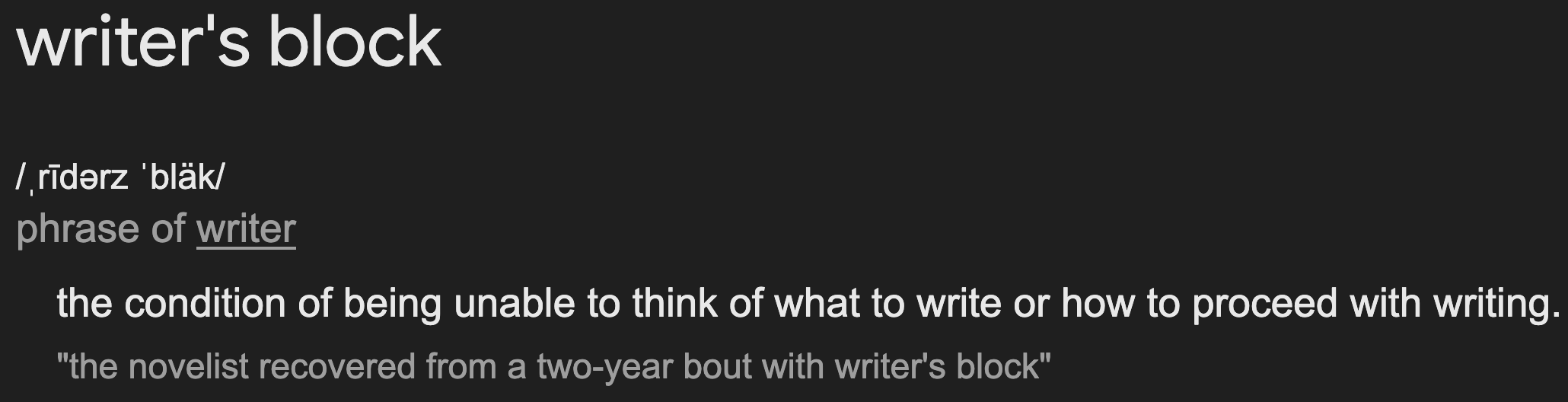
Yeah, i think it’s different than writer’s block. Wait do all writers with writer’s block just not do any work at all? Do they draw a little and are left unsatisfied? I read an oxford languages definition and it said they are unable to think bout what to write:

Post-Mortem about treating writer’s block the same as being motivated and making bad material:

I thought that if one is unsatisfied with their work and think they need a break that means they have a block like a writer’s block.

Why? because I thought you could make any work at all for it to count as writer’s block. You just gotta be unsatisfied.

Why did I think you just gotta be unsatisfied? Cuz I thought wanting to make work and it coming out badly and then wanting to take a break meant you weren’t motivated to do it. Like, you were not motivated to keep going.

Why did I think not being motivated to keep going meant losing the motivation to work? I thought those were the same, like maybe you’re motivated to do the work, but not motivated to keep up the routine.