Eternity Async Tutoring

1.) Got it right (almost got it wrong, but I double checked and caught a mistake, my work doesn’t show the mistake)
My Work

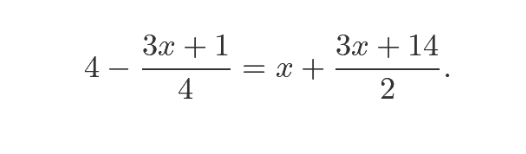
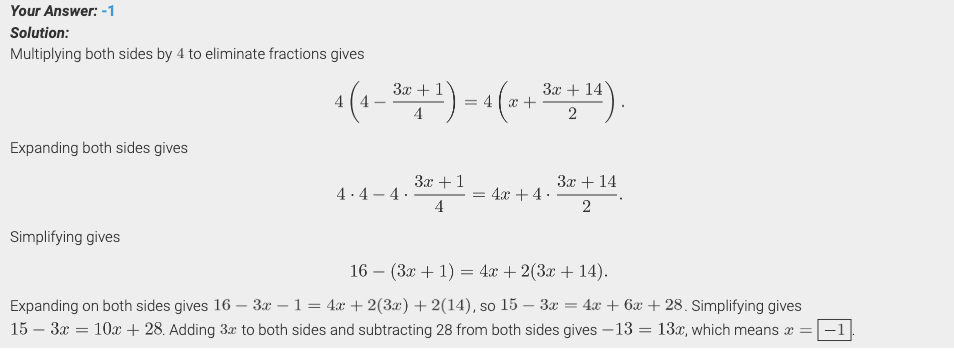
4 - ((3x + 1)/4) = x + (3x+14)/2

4 - 3x/4 - 1/4 = x + 3x/2 + 7

16 - 3x - 1 = 4x + 6x + 28

15 = 13x + 28

-13 = 13x

x = -1

4 - ((3(-1) + 1)/4) = -1 + (3(-1)+14)/2

4 - (-3 +1)/4 = -1 + (-3 + 14 ) / 2

4 + 1/2 = -1 + (11/2)

8/2 + 1/2 = -2/2 + 11/2

9/2 = 9/2
Solution

2.) Got it right.

My Work

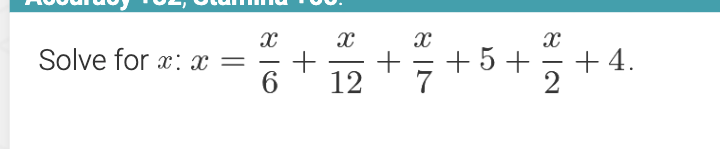
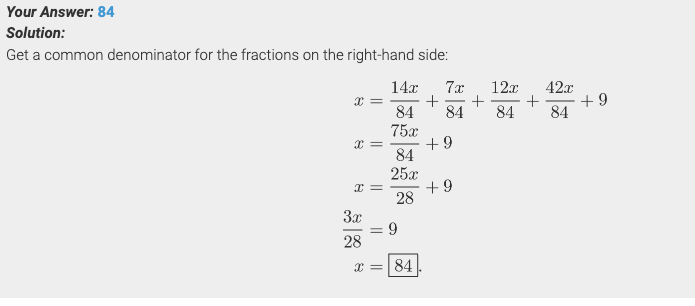
x = x/6 + x/12 + x/7 + 5 + x/2 + 4

x - x/6 - x/12 - x/7 - x/2 = 9

12x - 2x - x - 12x/7 - 6x = 108

3x - 12x/7 = 108

21x - 12x = 108(7)

9x = 108 x 7

x = 12 x 7

x = 84

84 = 14 + 7 + 12 + 5 + 42 + 4

84 = 84
Solution

3.) Got it right.

image

My Work

1 + 3(1 + 3(1 + 3(1+x))) = 13

1 + 3(1 + 3(1 + 3 + 3x) = 13

1 + 3(1 + 12 + 9x) = 13

1 + 39 + 27x = 13

40 + 27x = 13

27x = -27

x = -1

1 + 3(1 + 3(1 + 3(1+ - 1))) = 13

1 + 3( 1+ 3(1)) = 13

1 + 3(4) = 13

1 + 12 = 13

13 = 13

Solution

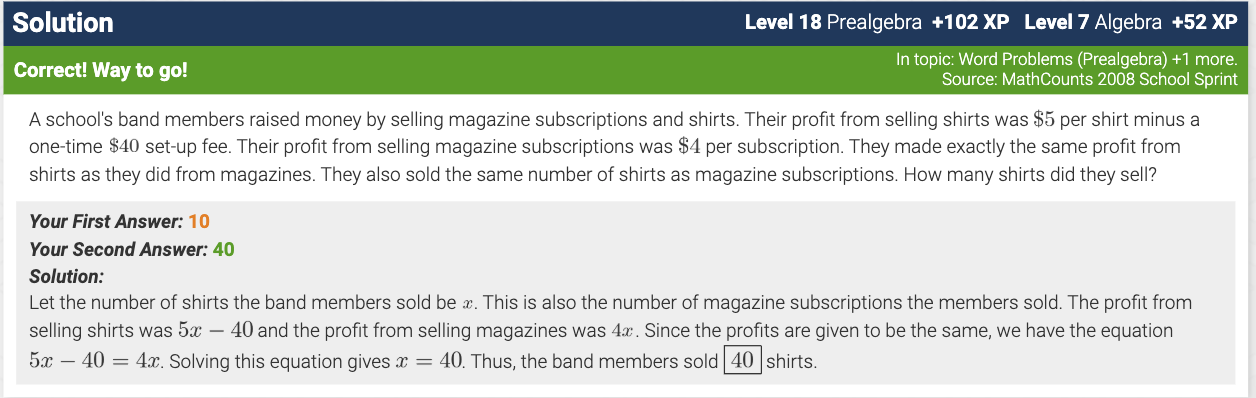
4.) Got this right the second time. I double checked my work, but I didn’t check it directly(?) through the word question. If I had did that maybe I would’ve caught the fact that I wrote -10 as the set-up fee instead of -40.

My Work

s = shirts sold

p_s = profit from shirts

5s - 10 = p_s

p_m = profit from magazines

t = subscriptions sold

p_m = 4t

p_m = p_s

t = s

4t = 5s - 10

4s = 5s - 10

10 = s

s = 10

if they sold 10 subscriptions they made 40 bucks. if they sold 10 shirts they made 50 bucks - 10 bucks. Profits from shirts equals profits from subs.

Got it wrong. I read 40 as 10.

4t = 5s - 40

4s = 5s - 40

s = 40

if they sold 40 subs they made 160 bucks, if they sold 40 shirts they made 200 bucks - 40 bucks = 160 bucks. profits from shirts equal profit from subs
Solution

5.) Got it right.

My Work

t = tank full of water. it has some volume

1/6t + 130 = 3/5t

130 = 3/5t - 1/6t

130 = 18t/30 - 5t/30

130 = 13t/30

130(30) = 13t

t = 10 (30)

t = 300

so when the tank is 1/6(300) we add 130 to get 3/5(300) 50 + 130 = 180, and 300/5 = 60 * 3 = 180

Solution

1 Like

1.) Got it right the second time. Even after checking it through the problem I was a bit confused on whether Cedric was included in the invited people.

image

i = people who were invited

2i/3 + 6 = 5i/6

4i + 36 = 5i

i = 36

2/3 of those invited (36) equals 24. 24 + 6 - 30 30/36 = 5/6. I assume Cedric is not counted later on too.

Hmm I got it wrong. Maybe it did include Cedric?

2i/3 + 6 + 1 = 5i/6

2i/3 + 7 = 5i/6

4i + 42 = 5i

i = 42

2/3 of 42 (those invited) = 28 add the seven people (six plus cedric) you get 35/42 = 5/6

2.) Got it right.

image

5 - 4x > 17, whats the highest integer value of x for which 5 - 4x is greater than 17

-4x > 12

x < -3

x has to be less than -3, so it can be all the negative numbers lower than -3 such as -4, –5, etc. The one with greatest value would be -4.

5 - 4 (-4)

5 + 16 = 21 21> 17

also lets check -3

5 - 4(-3) = 5 + 12

17 > 17, false, doesn’t work.

3.) Got it right

looking at just one workday

one workdays costs are $500 + $15 x 8 hours worked a day x number workers

one workdays revenues(?) are 5 widgets x 8 hours x 3.10

we want revenues greater than cost

w = number of workers

5 widgets per hour x 8 hours x 3.10 x number of workers > $500 + 15 x 8 x number workers

5 widgets per hour x 8 hours x 3.10 x w > $500 + $15 x 8

x w

40 x 3.10 x w > $500 + $120w

$124w > $500 + $120w

$4w > 400

w > 100

So they need to hire a minimum of 101 workers.

You pay $500 + ($15 per hour x 8 hours x 101 workers) = $500 + $120 x 101

You earn 5 x 8 x 101 x 3.10 = 124 x 101 =

uhh 500 compared to 4 x 101 = 404, hmm.

$124w > $500 + $120w

4w > $500 (not 400 woops)

w > 125

You pay $500 + ($15 per hour x 8 hours x 125 workers) = $500 + $120 x 125

You earn 5 x 8 x 125 x 3.10 = 124 x 125

500 compared to 4 x 125 = 500

ah 126 ttttt

You pay $500 + ($15 per hour x 8 hours x 126 workers) = $500 + $120 x 126

You earn 5 x 8 x 125 x 3.10 = 124 x 126

500 compared to 4 x 126 = 504

4.) Got it right

image

5m - 3 > 8m + 21

-3m > 24

m < -8

-9?

5 (-8) -3 > 8 (-8) + 21

-40 - 3 > -64 + 21

-43 > -43

5 (-9) -3 > 8 (-9) + 21

-48 > -72 + 21

-48 > -51

yes

5.) Got it right

image

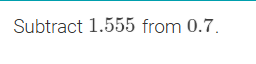
.7 - 1.555

0.700 - 1.555

? subtract 1.5 from .5 = .5 - 1.5 = -1or -( 1.5 - .5)

so -(1.555 - 0.700)

-.855?

1 Like

Got all right. :slight_smile:


1.) Got it right

image

My Work

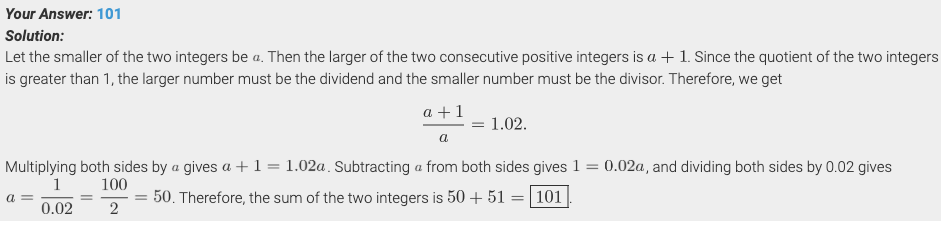
(x+1)/x = 1.02, find x + (x + 1)

x + 1 = 1.02x

1 = .02x

.02x = 1

x = 1/.02

x = 1/(2 x 10^-2)

x = 1/2 x 1/10^-2

x = .5 x 10^2

x = 50

so 50 + (50 + 1) equals = 101

the quotient of two consecutive numbers with the larger one on top 51/50 equals 1.02 50/50 = 1, 1/50 is the same as 2/100 which equals .02. 1 + .02 = 1.02

Solution

2.) Got it right

image

My Work

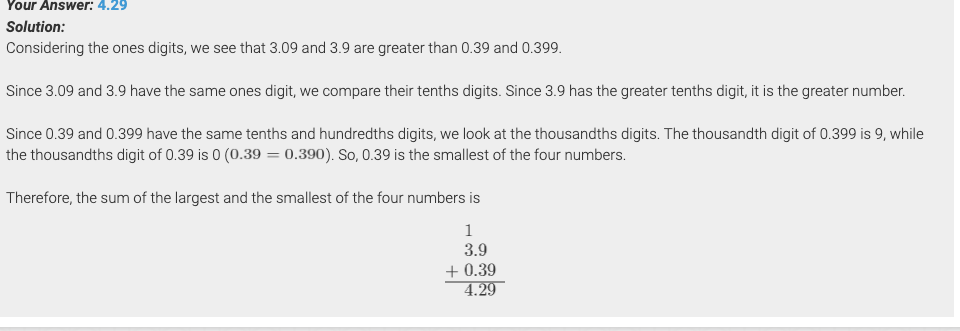
we are adding the largest number and the smallest number of the four

3.9 is the largest, .39 is the smallest

4.29

Solution

3.) Got it right

My Work

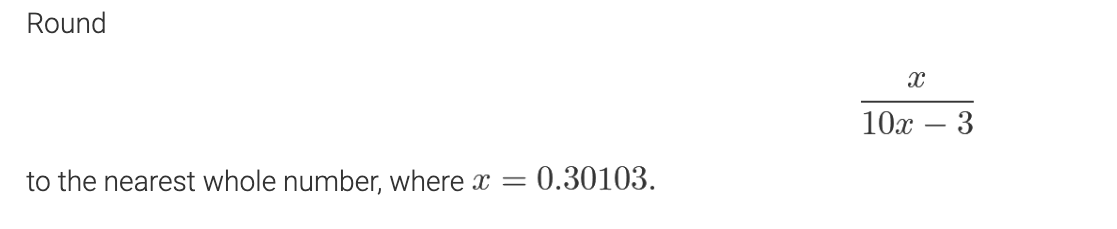
round x/(10x - 3 ) to the nearest whole where x = .30103

.30103/(10 (.30103) - 3

.30103/3.0103-3

0.30103/0.0103

just thinking i think its 30

3010.3 x 10^-4 / 103 x 10 ^ - 4

3010.3 / 103

100 x 29 = 2900 3 x 29 = 87

2987 is the closest i can get to 3010. so 29 prob works?

Solution

4.) Got it right

My Work

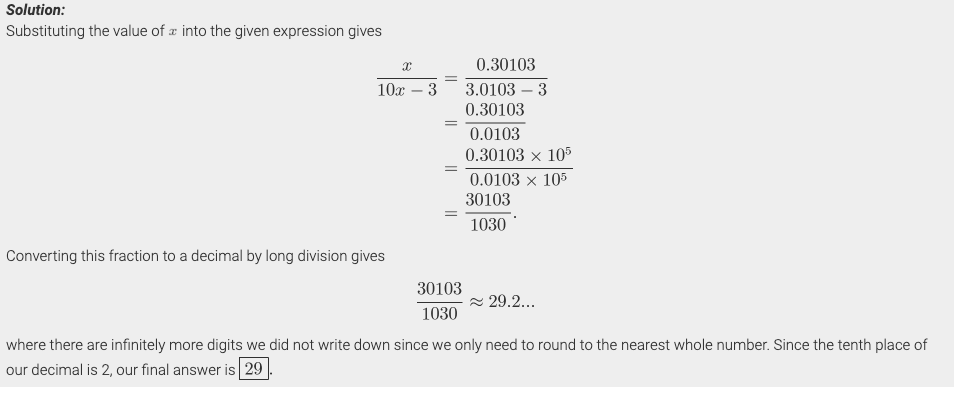
roundest these numbers to the nearest ten = 20 / 10 + 20 = 2 + 20 = 22

nearest whole = 15 / 15 + 18 = 19

22 - 19 = 3

Solution

5.) Got it right.

image

My Work

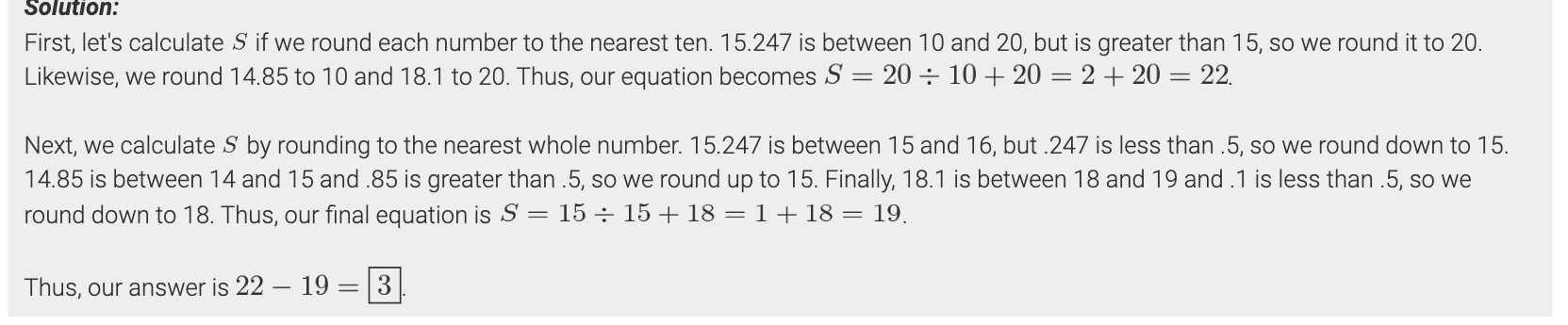
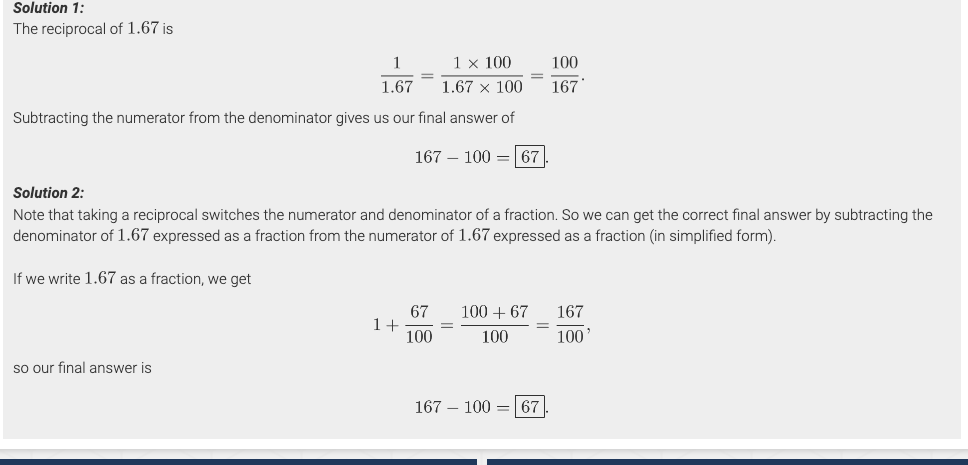
reciprocal of 2 is 1/2

reciprocal of 1.67 is 1/1.67 (because 1.67 times that would equal 1)

expressing it as a simplified fraction? like no decimals. i assume no decimals

so 100/167

167 is not divisible by 2, 3, 5, 7, 11, 13 therefore 167 is prime

subtract numerator from denominator?

subtract 100 from 167? so 167 - 100 = 67

Solution

1 Like

Don’t worry about that one. That problem is confusing.

1 Like

Decided to share some of my daily writing (after I go through book quotes I tend to just more or less journal, I didn’t share the journaling). The stuff in square brackets is the title of book the quote is from. I said I’d share these more often in the past. Might as well start now.


Abusive men are masters of excuse making. In this respect they are like substance abusers, who believe that everyone and everything except them is responsible for their actions. - [[Why Does He Do That?]]

  • Hmm. Right. Like an abuser may hit their wife for, idk, making the food a bit too salty (which can be debatable, because he probably just felt its too salty today because he wanted to hit her for whatever reason). The abuser puts it on them for ruining their food after they’ve had such a long day.
  • Right. If they even think what they are doing is wrong, they are only doing this wrong action because they “have to”.

You’re never going to achieve your true potential if you’re hooked by what other people think. In fact, you could change your life overnight if you simply abandoned the notion that other people’s opinions matter. Life goes on, opinion heavy or opinion light. - [[Unfuk Yourself]]

  • I wonder how much he means this. I forgot about this book and its a self-help book I want to revisit.
  • I wonder how much we’re actually affected by what other people think? Probably a lot. How much could we improve if we ignored others though? Taking some standard complaints:
    • Am I too lazy to workout because what others may think of me?
      • Hmm. Maybe if you feel like people will judge you and that is a subconscious issue you have that leads you to not feeling like working out
    • Why am I too lazy to do dishes?
      • I may not care about having a clean house. I don’t think this is necessarily tied to others. Is it?
    • I don’t want to eat healthy
      • What about others is affecting my decision on what to eat? if anything I think the stigma would lead to eating healthier (or developing an eating disorder), but most people don’t eat healthy

The goal of a manufacturing organization is to make money. - [[The Goal]]

  • Right. The goal is to make money. The goal is to be profitable(?). The goal isn’t necessarily maximizing profit.

(A male heart, Oz says, is in fact slightly different from a female heart. A heart surgeon can tell one from the other by looking at the ECG, because the intervals are slightly different. When you put a female heart into a man, it will continue to beat like a female heart. - [[Stiff]]

  • From Gemini:
    • “No, female hearts in a male body (or generally) beat differently than male hearts==; female hearts are typically smaller, beat faster (higher BPM) to pump enough blood, have stronger contractions (contractility), but generate a lower overall blood volume (cardiac output) per minute compared to male hearts, due to intrinsic biological differences in size, structure, and function, not just body size. These differences, rooted in genetics and hormones, mean a female heart isn’t just a smaller male heart.”
      • Huh. Neat.
1 Like

Hello. Happy New Year! I’ve been quite busy for the past two weeks. I have done some math and writing over the past two weeks. It’s been very sporadic and low-quality. I was busy with a mixture of holiday stuff and moving. I’m currently in a nice clean rental property while my house is getting cleaned out (along with some renovations being done to it). This time the water damage was from a clogged toilet getting everywhere along with certain issues with the flooring installation or something making it easier for the water to get where it should never get to.

Since this time we ended up in a rental property and because we’re not living there I think my family is more open to trying to clean it out more. We’ll see. I know, for example, that our moldy bathrooms ceiling was just left in. I asked if we can get rid of that this time. So we’ll see how it goes.

Some writing I did today while reviewing some book highlights:

“It was only when the philosophical conviction grew that the senses are valid and that sensory perception is the only legitimate basis of knowledge, that they could turn their full thought and attention to this world.” - [Capitalism]

  • I think that makes sense. So long as we doubted our senses and the information we gained from our senses, the longer we would fail to interact with the world. After all if I can’t trust the fact that the thing in front of me is what it is, that it has certain rules to it, then I can’t do anything. Or, put another way, I can’t reasonably expect myself to do anything.

“More generally, any complete, correct formula that defines amounts of success based on any number of factors suggests that you should maximize success (which brings us back to binary goals). If maximizing the formula doesn’t give you the best outcome, that means the formula is incomplete or wrong. If it’s imperfect but a good enough approximation to use, that suggests maximizing it. There’s no reason to choose not-best over best unless your way of evaluating is incomplete or wrong (so we end up with binary evaluations: best = success and not-best = failure).” - [[Introduction to Critical Fallibilism]]

  • Related to that: lets say an option is better in a way. You want the fastest car. So there are two cars, one that goes 100mph and the other that goes 110mph. The 110mph car is the fastest and best option. Except, you have a budget. Within your budget the fastest car you can get is the 100mph. While the 110mph is better at speed, it fails at being affordable. Therefore, the 100mph car is better even if its slower.

“Economics brings to the understanding of history and journalism a foundation of scientific knowledge which can serve historians and journalists in much the same way as a knowledge of natural science and mathematics. Namely, it can give to historians and journalists a knowledge of what is and is not possible, and therefore a knowledge of what can and cannot qualify as an explanation of economic phenomena.” - [[Capitalism]]

  • That makes sense. Instead of just trusting different statistics and “facts” shared by people with different political view points, you can evaluate if their evidence is even possible. Can a specific economic policy actually do the thing they’re saying? Could it have done the thing it said? This is similar to how certain historical records (well that I’ve heard of at least) reference mythological beasts and what not, yet we know such accounts are fake. This lets us learn which parts of the history is accurate or not.

“The company’s few remaining apologists blame its failure on everything from government regulation to companies biased toward college degrees, but make no mistake, the company failed because the program failed.” - [[Fast Crimes at Lambda School]]

  • So this, plus a comment I made on it in the readwise app, reminded me of something: how much harm does regulation actually cause . I’m sure there’s a lot of real harm. Well, I’m sure because I trust smart economists like Von Mises and Reisman that regulation is bad. Yet companies, such as the Lambda School mentioned in the article above will blame government regulation and what not in their failure. How much of the blame on regulation is misattributed?
    • Though I guess thinking on it more regulation can vary. I’m sure stuff like the production limits put on Rearden are much more harmful than the banning of the use of a certain substance.
    • Also, maybe Lambda School isn’t a great example because they seem to be blaming everything (but themselves). So maybe their comment was made without much thought, but idk. A lot of companies suck.

“The problem is that most airline safety improvements are assessed from a cost-benefit viewpoint. To quantify the “benefit” side of the equation, a dollar amount is assigned to each saved human life. As calculated by the Urban Institute in 1991, you are worth $2.7 million.” - [[Stiff]]

  • So shes talking about airlines here. I’ve heard similar claims made about car companies back in the day. It was cheaper to pay out victims, or something like that, then address an issue. I’ve heard claim regulations fixed this. This doesn’t sound like a bad thing. If, from the companies point of view, I’m just a cost that sounds scary..
    • I guess a certain type of free market response would be that a new car company would come by that didn’t treat their customers as costs. Or, alternatively, that is what happened. I don’t trust these claims anymore, but I remember a lot of conservative commentators/general free market types back in the day (idk what they say now) would make comments pointing out how industry would first make things safer then government would impose a safety regulation. Apparently construction jobs, for example, required hard hats first and then OSHA came in and made it a requirement. Idk how true that is anymore.

1.) Got it right. Is there a notation for writing infinite decimals when typing?

image

My Work

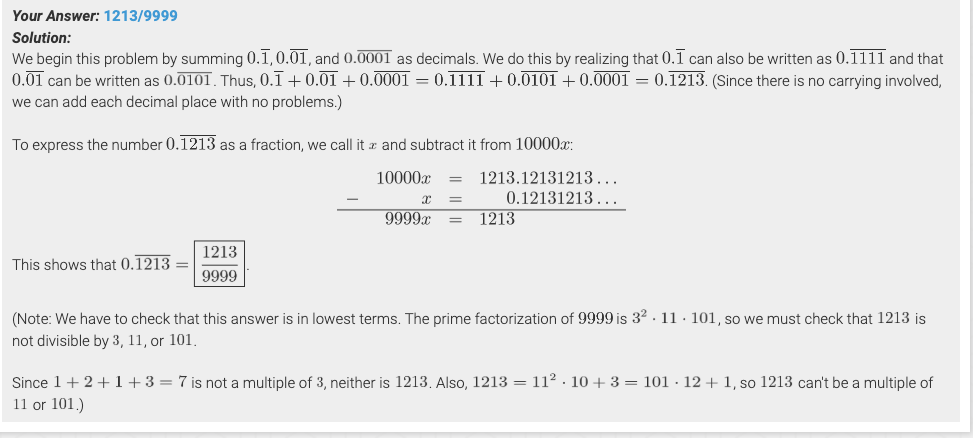
The process from converting inf to regular goes something like this:

lets convert .1111 (etc., is there a way to write bars?)

x = .11111 whatever

10x = 1.111111

9x = 1.0

x = 1/9

0.01010101

x = 0.010101

100x = 1.010101

99x = 1.00

x = 1/99

x = 0.00010001

10000x =1.0001

9999x = 1

x = 1/9999

so we have 1/9 + 1/99 + 1/9999

1111/9999 + 101/9999 + 1/9999

1111 + 1 + 101 = 1112 + 101 = 1213/9999

Solution

2.) Got it right the second time. Didn’t input my answer as negative/didn’t pay attention that it should be negative.

image

My Work

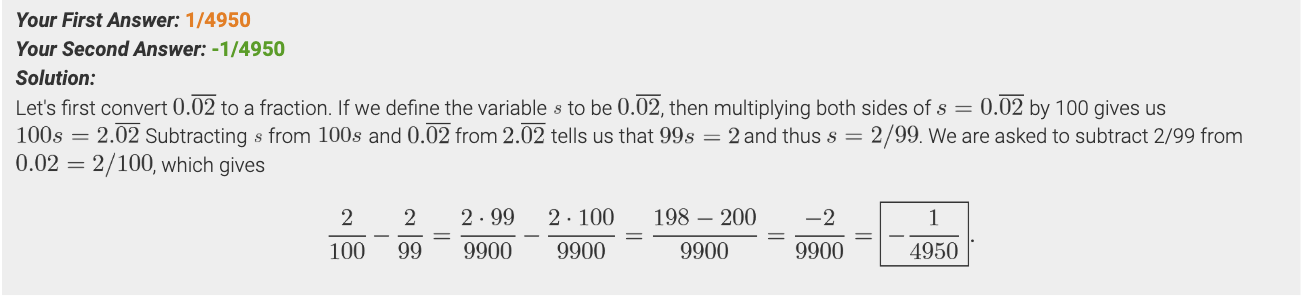
2/100

x = 0.02

100x = 2.02

99x = 2

x = 2/99

2/100 - 2/99 =

198/9900 - 200/9900 = 2/9900 = 1/4950

Solution

3.) Got it right.

My Work

Three week stay = 21 days. 7/21 (1/3) of those days was rain. 11/21 was sunny. 3/21 (was overcast). Mmm. I’m not too too sure how to approach this, but it rained 1/3 of those days. So we expect it to rain the same amount out of 366 days. So 1/3 of 366 is 122.

I think thats what the ratio here refers to? After all if we do we 122 out of 366 we get 1/3 again.

Solution

4.) Got it right.

image

My Work

o = oranges

4o = 1.00

o =. 25

10 * .25 = 2.50

Solution

5.) Neat. Got it right. Was a bit confused on this. The ratio wording always confuses me.

image

My Work

for every 3 wins Kyle’s team had 2 losses. 3:2.

lets say they play the same number of games. Five here? but won twice the games. So out of 5 games they won 4, and therefore lost just 1?

1 loss to 4 wins?

Solution

That’s hard. Good luck.

1 Like

Do you have a question about ratios?

Nothing specific in my mind. I’ll focus on a few more ratio problems tomorrow to communicate the problem better, but, for example, problem #5 says that they have 3 losses to 2 wins. Is that equivalent to 3/5 losses and 2/5 wins? I think so, but then I also sometimes think I see stuff like represent 1/3 as a ratio and they do 1:3 (unless they don’t?). So that makes me think the conversion from ratio to fraction is just turning the : into a /.

Ratios are usually part:part like 3 apples to 2 oranges. You add both parts to get the whole (5 things total). It’s also possible to specify part:whole ratios like 3 apples to 5 total fruit.

Fractions are part/whole.

People sometimes directly convert ratios to fractions (2:3 → 2/3 not 2/5). Depending on what you’re doing, that may work in terms of arithmetic, but it’s confusing.

The book is being confusing to make the answer 1/4 and call that a “ratio” when the ratio is 1loss:4wins and the fraction of games they lost is 1/5 (20% not 25%).

1 Like

Who, in ancient times, was doubting their senses besides some philosophers? I think most people were focused on the practical world.

It’s not like most people were solipsists until some logician disproved solipsism.

Maybe it’s about believing religious authorities when they claim God exists even though you can’t see him yourself? But billions of people today still do that.

Fake like people were lying on purpose? I don’t know that.

1.) Got it wrong. Bit tired and the numbers seemed a bit annoying to work with so I didn’t double check.

Oh. Nvm. Checking the numbers wouldn’t have helped me here. Maybe double checking against the problem somehow would’ve helped? I set-up my initial inequality wrong. I set it up as if we wanted to find when the homework percentage is greater than the quiz percentage. It was the other way around. Woops.

My Work

Harvey answered 13 out of 17 questions correctly on a quiz.

If he correctly answered 78 of the homework questions prior to the quiz, what is the fewest possible number of homework questions that could been assigned such that Harvey’s percentage of correct problems on the quiz is greater than the percentage of correct problems on the homework.

Uhh so if there were 78 homework questions, That means he got 100% of the homework right. Which is not what we want. We want homework % to be lower than quiz %. If there were 100 questions and he got 78 right, that means he got 78/100, 78% is probably higher than 13 out of 17 or not. Mm. Ok I get what we’re doing here

We want 78/x > 13/17

78 * 17 > 13x

78 * 7 = 56 + 490 = 546

546 + 780 = 1326

1326 > 13x

x < 102

so 101?

Solution

2.) Got it right the second time. I set it up correctly. I think going back to the problem would’ve helped here (I did double check my writing). I understood that there were 3 green for every 1 blue, yet when I went to calculate how many are blue I switched them. I don’t have any good reason besides I’m tired and my thinking may have been biased in a way like this: 3/4 is bigger, more important, the question is not gonna ask about the smaller 1/4, so i just assumed that blue marbles were 3/4.

My Work

There are 3 green marbles for every 1 blue marble? 3 : 1. Out of four marbles. Three are green, one is blue?

How many are blue? 3/4’s of the bag should be blue. Right? 3/4 * 60 = 45

if we have 45 blue marbles. for each set of 3 we will have one green marble. there are 15 sets of 3 in 45 giving us 15 green marbles. this should be right.

Solution

3.) Got it right.

My Work

gorge 80 feet wide/tresle 80 feet wide

we’re going from a height of 172 to 112.

if you’ve traveled 3/4 of the way, what height are you at?

So from 172 to 112 its 60 ft. every quarter of ft we’re 15 lower. so 3/4 is 15. we’d be at a height of 172 - 45 = 127.

Solution

4.) Got it right. I don;t know how I’d go about checking this one.

image

My Work

Least?/Lowest? four digit positive integer with all different digits that is divisible by each of its digits.

So the number needs to be divisible by 1,2,3,4,5,6,7,8,9

1 is good

2 is good

3 and then 6?

smth like 1236

Solution

5.) I got this wrong the first time. I haven’t tried it a second time. I’m looking for some help on it. What is it saying here? I read it as 3/4 of time is spent on homework. 1/4 of that 3/4 is spent doing math hw. 1/4 of 3/4 is 3/16. Thats wrong. I keep re-reading it and am still confused.

My Work

3/4 of his hours(?) doing hw

1/4 of 3/4 was spent doing math hw

what is 1/4 of 3/4 3/4 * 1/4 = 3 / 16

does that make sense? yeah? cause if you have four 3/16 you get 12/16 which is 3/4

Solution

Didn’t pull up

Some of my writing from today:

"The Siriona Indians of Bolivia and the Brazilian Yanoama people don’t have words for anything larger than three; instead, these two tribes use the words for “many” or “much.” - [[Zero]]

  • That’s interesting. I remember that one of the themes(?) of the book was about how zero was a pretty big discovery, a pretty controversial discovery, and a pretty difficult discovery.
    - I wonder what made the difference in any particular culture when it came to numbers. After all this specific example talks about not going past two but he mentioned other civilizations I believe that eventually had an end(?) to their counting system.

The events are determined by the goals that the characters want to accomplish, and each event is necessitated by the preceding one—necessitated not deterministically, but logically. “If A, then B logically had to follow.” - [[The Art of Fiction]]

  • What would be a supposed deterministic event in a book? Hmm. Maybe something like rain. You, as the author, can make it rain anytime and there really isn’t a reason for it. Though I think this is primarily talking about character actions and what not. What would be a deterministic character action/sequence of events?
    • Mmm. Would something like this work? In a book John is just someone who works out. Him just working out as a descriptor of himself is deterministic. Characterizing him as someone who is trying to better himself to pursue some goal of, idk, bodybuilding and thats why he works out is more natural?

“So the courts turned their attention from the terms of the contract to the competence of the contracting parties. And that, without doubt, was the end.” - [[Liability The Legal Revolution and Its Consequences]]

  • I need to finish this book.
  • I don’t know if I quite agree with the sentiment above anymore. Or at least the sentiment the book shares up to where I read it. I do understand, wanting to uphold agreed upon contracts, but I do think theres an alternative problem where companies just make you sign bad contracts with stuff you don’t know about/with stuff thats very hard to understand. I think almost all Terms of Service are probably quite complex legally documents (i haven’t heard anyone say this, I’m just assuming) yet we all just accept it without a care without really knowing what we agreed to. Is it on the individual to read something that requires a lawyers help to understand at times?

I see the issue. I think you could figure this out with close reading. Try doing grammar trees for the problem.

1 Like

You could check divisibility for each digit and check that the answer looks plausible, e.g. I’d guess the thousands digit should be 1 and the hundreds digit 2. You can use intuition and logic to see if the answer looks reasonable or not, like is it near the minimum for a four digit number or not. 1259 is kinda plausible but 5912 isn’t.

1 Like

Yeah checking against the original problem is important so you don’t re-use some work that contains an error.

Hmm. I can believe that. Idk much history. The original quote was from Reisman but I think he got the sentiment from Miss Rand. Do you think Miss Rand was wrong about that or that me/Reisman misunderstood her here (though I could be misunderstanding Reisman here)? Oh yeah, “that” meaning that there was a lack of progress in the world for the longest time because of stuff like doubting the senses.

Here’s a little more surrounding context of the quote from Capitalism (oart I’m interested in is bolded)

It was no accident that the gradual development of capitalist institutions in Western Europe that began in the late Middle Ages paralleled the growing influence of prosecular, proreason trends in philosophy and religion, which had been set in motion by the reintroduction into the Western world of the writings of Aristotle. It is no accident that the greatest era of capitalist development—the last two centuries—has taken place under the ongoing cultural influence of the philosophy of the Enlightenment.

Philosophical convictions pertaining to the reality and primacy of the material world of sensory experience determine the extent to which people are concerned with this world and with improving their lives in it. When, for example, people’s lives were dominated by the idea that the material world is superseded by another, higher world, for which their life in this world is merely a test and a preparation, and in which they will spend eternity, they had little motive to devote much thought and energy to material improvement. It was only when the philosophical conviction grew that the senses are valid and that sensory perception is the only legitimate basis of knowledge, that they could turn their full thought and attention to this world. This change was an indispensable precondition of the development of the pursuit of material self-interest as a leading force in people’s lives.

The cultural acceptance of the closely related philosophical conviction that the world operates according to definite and knowable principles of cause and effect is equally important to economic development. This conviction, largely absent in the Dark Ages, is the indispensable foundation of science and technology. It tells scientists and inventors that answers exist and can be found, if only they will keep on looking for them. Without this conviction, science and technology could not be pursued. There could be no quest for answers if people were not first convinced that answers can be found.

Hmm. Idk. So what comes to mind is using some bare bones chinese culture stuff I know of as an example: the great historian of an emperor says that dragons come down on his coronation or idk something like that. Dragons don’t exist, so they couldn’t come down. Thats all I meant there. Though also part of me has a maybe biased perspective/idea that the people in China at that time believed that. This isn’t particular to the Chinese. I have this idea that people in the past actually believed some stuff that may have been in history books related to impossible feats.

Companies won’t negotiate a lot of their contracts, like terms of service or employe contracts, with most people.

People have no realistic choice but to “agree” to this stuff, without informed consent or the opportunity to participate in drafting the contract or negotiating the terms, because it’s so widespread in society.