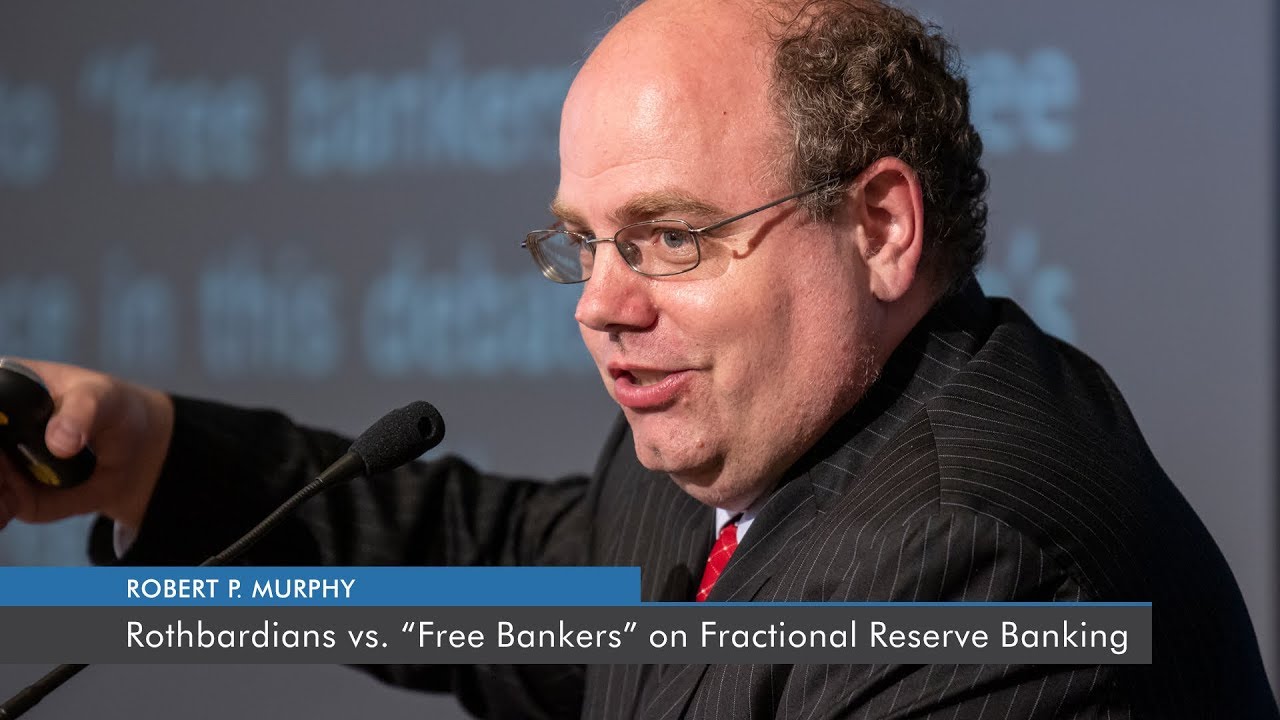
I have no idea what fractional reserve banking is. I know a meaning of the word “fractional”, “reserve” and “banking”, but put together I can’t think if a solid explanation of what it is. Maybe it has something to with the federal reserve or the gold standard.
So I listened to Elliot’s YouTube video discussing it while I worked out. However the video was only nine minutes and 50 seconds long so I listened to other unrelated videos after I finished his.
From what I gathered, the gist of it is, banks are more experienced lenders then your average individual. Banks hold your money and then lend it out, and one goal is for your money to earn money while they hold it. If you just had banks hold your money and not lend it out, then it’d be more like a storage space for your dollars, and they’d charge a storage fee (some banks charge your account a fee if you don’t have a certain amount in your account though, kind of like a storage fee).
The thing is, once they have your money, if you want to withdrawal all of it, there’s no guarantee they’ll have it all for you at the ready. That’s because they’re lending out a large percentage of the money you give them. Maybe they’re lending out 80% and have 20% in their reserves. If only a small amount of people want to withdrawal all their funds, maybe it’s not a problem for them to give it all to you right away or within a few days. But, if the number of people trying to withdrawal funds increases past a certain point, they won’t have enough in reserves to give back to everyone.
Apparently some people complain about this. One criticism is the banks are committing fraud? Maybe because their contracts/agreements don’t make fractional reserve banking explicit or misleading advertisements? I don’t know, I haven’t looked into it or read any contracts..
After listening to the video, I’m curious what happens to our money if the bank goes under. I know some banks in the US are FDIC insured and I think that means you can get up to $250,000 of your funds from the government if a bank fails? How do they do that though? Do they print the money? Do they have it stored somewhere?
I’ve had some difficulty finding out what bank contracts actually say in order to determine whether they are promising to honor all withdrawals immediately (which they can’t do given they loan money out for years, so I think that would be fraud) or if the fine print says they won’t necessarily always do that.
I’ve listened to the podcast before. I’ve also seen other videos and read about fractional reserve banking. I’ll respond from memory. I’ll read up on it later to compare. I remember disagreeing with Elliot, but I have to rewatch his video and read to compare exactly what Elliot says and what the literature says.
It used to be that you had a deposit account and a savings account. I might have this terminology wrong.
Deposit accounts were liquid and had 100% reserve. You put the money in and it stay there ready for you take out at any time. So you would pay a storage fee on it and get no interest on it.
Savings accounts were less liquid. You put money and the bank loans it out. You get paid interest but since the money is lent out you can’t get whenever you want. You’re essentially just lending the money out to the bank. It’s not that exactly the money you lend out has to be returned. What you get back isn’t determined by how the money you lent out did as an investment. The bank pools all the money and pays out from the pool. The important thing is that money that is being handled by the bank can’t be used for both investing and being able for withdrawal at any point in time. This way money doesn’t pop out of nothing.
Fractional reserve banking blurs the line between deposit accounts and savings accounts. There are no true deposit accounts around anymore. There are savings accounts where your money is less liquid but you get a higher interest rate.
Fractional reserve banks create money like this:
I put in $100 in a deposit account. The bank is allowed 10% reserve. Which means they can lend out $90. It’s a deposit account so I can withdraw the money immediately. I do that and spend it. Result: $90 was created by the bank and entered circulation.
The banks created money but they didn’t actually print anything. I think the money they created is called “fiduciary media” by Mises and austrians. 100% reserve people call this fraud. I think Mises says this is the reason we have boom bust cycles. It is how we have expansionary credit.
There are arguments that this would fail in true laissez-faire capitalism where there is no central bank to bail out the fractional reserve banks, which are very prone to bank runs. They also argue people would choose 100% reserve banks because fractional reserve banks would be devaluing their bank notes. It would be like choosing to money in a currency that doesn’t get inflated vs. one that does.
As I see it, there’s nothing inherently wrong with fractional reserve defined as: loaning out a fraction of deposits and keeping a different fraction as a reserve. That would mean promising immediate withdrawals to any depositor in good times (e.g. when over half the standard amount of reserve is remaining), and organized, equitable delayed withdrawals for everyone, on the same schedule as loans mature, as a worst case scenario if everyone wants to withdraw at once.
Do you disagree with this?
Loaning out a fraction of deposits isn’t inherently bad. Something that would be bad is mislabelling accounts or misleading people about withdrawal policies/timelines or something like that. I have never seen anything from fractional reserve haters which clearly establishes that banks do this or what most banks actually do today. I haven’t found clarity from the other side either.
In 2016, Harry Binswanger sent me an email in which he claimed that he personally witnessed a discussion between Ayn Rand and George Reisman, in which Rand defended fractional reserve banking while Reisman opposed it. Binswanger himself thinks fractional reserve banking is OK and may be an unreliable narrator.
Binswanger said that Rand said it’s OK that not everyone can be paid back at once just like it’s OK that a car insurance company can’t pay out to everyone at once if all if its customers got in car accidents on the same day. (He said she brought up insurance and this concept; using car insurance specifically is my wording.)
Binswanger made further claims about Reisman’s position which Reisman personally denied were accurate when I told Reisman. But I didn’t get clarity about what Reisman’s position actually is.
Binswanger claimed typical banks today do not fraudulently guarantee immediate withdrawals to all depositors no matter what. He claims their contracts basically let them delay withdrawals to wait for loans to mature if that is necessary. I don’t know if he’s empirically/factually right.
I don’t think it would be fraud. It should be legal. I recall I changed my mind or became uncertain on whether I disagreed with you, but the disagreement was on how you explained what FRB was, not on whether or not it was fraud. I don’t think I’ve ever been in the “FRB is fraud” camp.
I think the disagreement was that you didn’t mention deposit vs. savings accounts and how it creates new money called “fiduciary media”.
Quickly watching this video:
The argument is that multiple have a claim on the same piece of property. From the sense I get from Rothbardians like LiquidZulu it makes sense since they think the most important part about political philosophy is to avoid conflicts over property by defining who has legal ownership over it. I could be misrepresenting Zulu and Rothbardians here, I didn’t check.
I don’t think the coat example in the video works because coats aren’t fungible like money is. If the coat was exactly like or new then people might like that coat care-taking policy. but only if there were some other benefit like getting interest to make up for the risk that all the coats are requested at the same time.
On the economics of it my intuition is that FRBs would survive without a central bank in laissez-faire, but the reserve would be like at least inverted, i.e., 90% instead of 10%.
Most people believe they can immediately withdraw I think. Is it a thing that fine print contract details can be deemed fraud if not actually advertised clearly enough to the customer?
Are you/they claiming there are multiple claims on the same piece of property in the non-fraud scenario, or just in the fraud scenario?
I guess in a proper world, the banks would advertise their loan maturity information (e.g. they always keep at least 25% of loans maturing within the next year, 50% within 3 years, 75% within 10 years, 100% within 20 years) so you’d know your worst case scenario for loan payback. They’d also advertise their goal reserve % and the % of reserves at which they start slowing down withdrawals. Or some other plan for how it’s handled if too many people try to withdraw money at once. This should be easy to find. It isn’t. So I guess that’s damning regardless of the fine print and actual plan.
I forget what I said in my podcast and I don’t like how either side argues their case, but looking at the issue now the real world situation does look like fraud to me. (By fraud I mean the concept from political philosophy, not according to current courts/laws/congress).
I don’t see why. Aggregating stuff with variance is good and useful as e.g. Goldratt discussed. Random uncorrelated deposits and withdrawals should approximately cancel out a lot of the time. It makes sense to me to have a type of bank account that takes advantage of that. Most of the time, a 10% reserve may be adequate to handle variance. You clearly need a contingency plan for the times it doesn’t work, too, but there are many potentially reasonable contingency plans that don’t have the downside of keeping far higher reserves (and instead have other downsides like potentially having to wait years to get some of your money back).
Do you think that economically the main potential problem is bank runs? I think that part is fine, in a way. But if I’m right about reserves then people would move their money from lower generally reserve to generally higher reserve banks which could cause bank runs earlier than you would think based just on variance.
The reason I think the reserves would be higher is that the bank notes/claims would be devalued if they keep too low reserves. The reserve percent they keep is the inverse amount of fiduciary media they can issue per dollar put in. The reason I think they would survive is that the money is invested and if the investments are successful the bank has greater purchasing power and thus the devaluing is counteracted. My intuition is that the amount of fiduciary media they can issue can’t be much more than what they earn from the investments. I don’t actually see clearly how this would be the case though, it’s something I would need to look into if my premises before it are correct.
I’m not sure that if the bank claims are devalued then successful investments would counteract it. I haven’t read anything on this since last post and I don’t know if I’m using correct terminology. I’ll read tomorrow or in the next couple of days, correct myself and come to a more steady conclusion.
A question I have to ask myself: If issuing fiduciary media is how new money is created then how come inflation isn’t way higher than currently based on current reserves?
My current understanding of fiduciary media: credit lent out based on a fraction of deposit reserves. I’ll have to check if this is correct.
I read that banks pay into FDIC insurance, and the FDIC has a pool of money it can use when a bank goes under. It insures accounts up to $250,000. The money may not all come from that pool though. Sometimes the FDIC will move your account to another bank, and your funds will be there. Other times, the FDIC will take over the failed bank’s assets and liquidate them to help pay customers.
If enough FDIC insured banks go under at once, though, there may not be enough money in the FDIC insurance pool or in the failed banks’ assets to make everyone whole. In that case, the government may take more extreme measures, such as borrowing money or creating new money indirectly.
Maybe you should make a flowchart or tree mapping out exactly you think is happening in the non-fraud fractional reserve case, how it creates new money (or not), and how it compares to lending.