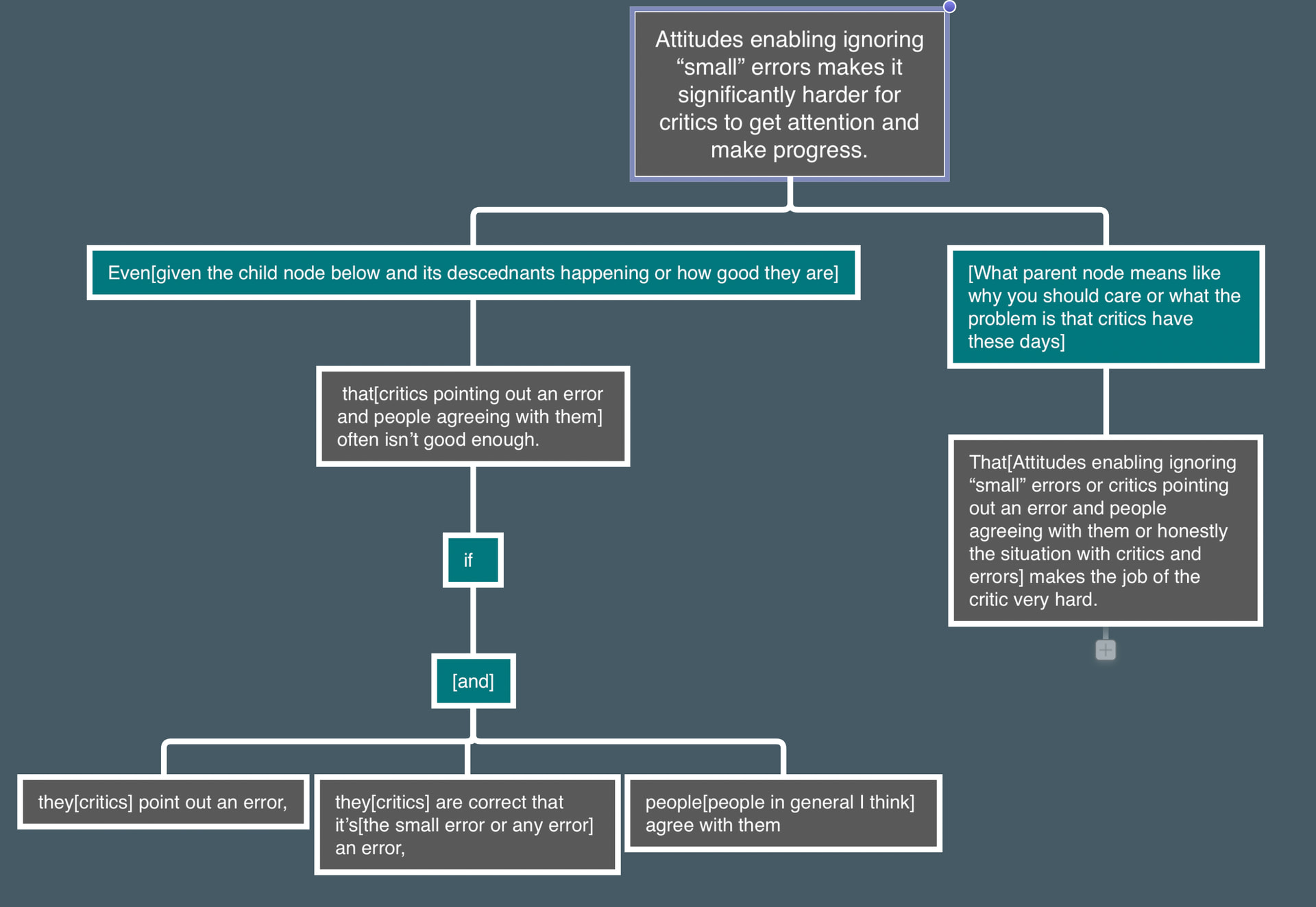
Attitudes enabling ignoring “small” errors makes it significantly harder for critics to get attention and make progress. Even if they point out an error, and they are correct that it’s an error, and people agree with them … that often isn’t good enough. That makes the job of the critic very hard.
I thought I’d make a paragraph tree to help me understand what the first paragraph of the article is saying. I’m unsure which is the root of the paragraph and if I can rearrange the nodes a bit to make it make more sense.
I think the second sentence of the quote is saying that even tho errors are pointed out in good case scenarios, it’s not good enough. I think good enough means like not good enough for progress or for critics and people to achieve their goals.
I think “That” in the third sentence is probably the attitudes, critics finding errors and people agreeing with them, or maybe how many systems are often not good enough to make progress. Critics don’t get very far or it’s a very difficult landscape for them in a way.
I wanna know more what social climbing, marketing, and the other activities are. That and those things vs. truth seeking. It’s interesting that those things are separate from truth seeking. I wonder what kinds of errors are being made if truth seeking is not the main activity being done. Like, are a lot of people getting hurt thru social climbing?
The third sentence has items that are probably social-climbing skills. I’m questioning why we do those other skills, like they’re so automatic to me that I don’t try to question them. I don’t question them to see how useful they are for truth seeking. I’m thinking if you gotta make a positive first impression for a person and it doesn’t go well, their opinion of you will probably change the way they agree/disagree with topics you bring up. They can overly agree with you or something.
I already read ahead of the quote, but a downside for being similar to others is what if being similar to them has errors in it and you don’t correct them?
“That” is the idea explained in the prior sentence. It’s hard for critics to be effective if correctly pointing out an error (that people agree is an error) isn’t enough for making progress.
Yes, similarity can lead to shared errors. It means less intellectual diversity.
Ok, I think there may be an error wit my grammar. I thought i saw an error there that needed a subject. Why do i think the subject “it” is needed again in the sentence? Idk. Here’s the quote again:
This doesnt look like a typical sentence i read cuz of the “if” in the first clause. I could break down the sentence like this:
They’re easier to get anyone to care about, but harder to get anyone to agree actually is an error.
I took out the condition or “if” part. It looks like the sentence kinda makes sense. Like the format present is: They’re easier…, but harder…
“They’re” is implied in the second clause. “They’re” means “Big” errors. Those errors are talked about in the part of the article called:
The last sentence is saying that if people agree soemthing’s an erorr then it’s easier to make em care about it. Tht “if” clause is important to understand the last clause. It’s harder to get anyone to agree tht a “big” error actually is an error. Like, it’s cool to get people to care about the “big” error if they agree it’s an error. If people dont agree on the “big” error being an error then thats an extra step.
Things im not sure about:
About getting people to agree on the “big” error being an error that it’s an extra step
About things being easier and harder. I think theyre probably easier and harder compared to each other.
I think I get more tht because the “Big” error is big, people care about those more. If the error was a “small” error they would think it’s a waste of time. Im thinking small errors are easier to point out so theyre easier for others to agree on. I think “big” erorrs are harder to point out so it’s harder for people to care about them maybe.
In my experience people can be similarly reluctant about small and big errors. I think small and big errors are partly about complexity/ease of explaining? If yes then small errors are easier to make evident to people but the response often has the attitude of why are you focusing attention and energy on such a small issue? It’s seen as pedantic or nit-picky.