I remember Peikoff talking about why he isn’t a fan of public defenders or something of the sort. I think it was from his podcast he used to do. He was asked something like “Are people entitled to a defense attorney?” and he more or less said, “No. If you can’t find someone thats your problem, your not entitled to it.”
I think at the time I agreed with it. Now I think he’s wrong, but I want to get his opinion right. Anyone, by chance, know what I’m talking about? Have a source?
I have heard Leonard Peikoff say that public defenders should not exist, since it forces lawyers to assist clients. He has also said that if defence lawyers consider the defendant to have compelling evidence of guilt, then it would be immoral to represent the defendant.
I looked back on the notes I took in the forum and it didn’t mention anything like what I was talking about. Looks like I didn’t take notes on the Q and A part.
Hmm. ngl, I don’t remember if I responded to you based on the video or independent of it.
Looking at the time-line I responded to you first and then saw Peikoff’s video.
But also I’ve changed my mind. I’m going to build on it some more soon, but specifically to the question you originally asked:
Before I said that in an ideal world, there wouldn’t state provided lawyers. Peikoff thinks that if no private lawyers would work with you then you shouldn’t have an attorney.
I now disagree with both.
For state provided lawyers:
My disagreement comes after learning about this case: Gideon v. Wainwright - Wikipedia and, after thinking about it, we need to fund prosecutors through tax payer money I see no real issue with state funded defense attorneys. Especially because in Gideon it was shown how crucial a lawyer is for our legal process. Pro se representation is not fair.
To clarify though this is what I picked up from hearing opinions of the case through legal lectures and stuff. I have added to a list of court cases/opinions I want to read.
Btw Gideon is what established the right to an attorney for the indigent/poor.
For no private lawyers working with you:
Not exactly related to Peikoff but more so to your original question: I think it makes sense to have a state attorney because their could be bad reasons why no defense attorney will represent you (though, to be fair, public defenders are only for the poor today afaik). Such as public outrage against the defendant such as in the south previously with black clients or modern day controversies surrounding someone.
I’ll comment later about Peikoff’s point on defense attorneys shouldn’t be a hired gun and they should judge the defendant before helping them.
I don’t know how I feel about stuff like eye for an eye anymore. Intuitively I think it makes sense. Someone cut off your arm, you cut off theirs. Someone killed someone, we kill them back. Sure, I get the idea, but who cares?
I lost an eye. I get rid of their eye. I am not better off because the guy who took out my eye also lost his eye. It may feel good to me to see the others person’s life getting messed up a bit because he messed up mine, but as a practical matter I’m still stuck with no eye. Because of that I’m now wondering if there’s a value in that idea when it comes to justice and the law. Why waste time and effort into hurting someone else?
Now I do think there are other reasons to punish. For example, it’s a deterrent (though I don’t know how effective it truly is). I think an eye for an eye gives a good basis to determine punishments if those punishments serve a greater role than just punishing.
(Disclaimer: I know almost nothing about justice and law.)
I have wondered about that sort of thing too.
Like I’ve wondered whether ideally the point of the criminal justice system would be deterrence or rehabilitation or minimizing recidivism or something else (or some combination of goals).
But there’s various factors at play I suppose. Like if you wanted to minimize recidivism (or maximize deterrence), you’d just execute every single criminal, even for small crimes. But that seems unfair so I suppose it isn’t the only factor.
(So maybe fairness/justice is the goal? But then what is the goal of enforcing fairness/justice? Deterrence? Which goes back to my initial question…)
Also I’ve wondered whether ideally the goal would be more social/utilitarian (i.e., keeping all citizens safe) or more personal/individual/retributive (i.e., avenging the wronged party).
That policy would not maximize deterrence effectively. It’d cause people to put a ton of effort into corrupting the judiciary and then at that point, once they’ve done that, they’d probably do a bunch of crimes they know they can get away with.
It’d also cause many people to be willing to murder witnesses to small crimes, so it could easily increase murders other than the government executions. People would attempt more jailbreaks. People would shoot at cops more or try to drive away at high speeds, so there are a variety of types of crimes it could increase.
In that system, if you want to steal food because you’re poor and hungry, you might do a masked robbery and steal a lot of food and money instead of shoplifting one small item. Because the punishment is the same either way, deterrence for the more serious crime is reduced, and that crime is actually incentivized because then you’ll be able to eat for longer before you risk another crime.
Oh that’s such a good point. So if anything it’d actually not only not maximally deter but would actually incentivize(!!) crime. Yikes.
Reminds me of the cobra effect and unintended consequences.
(For people who don’t know, the cobra effect refers to a story that apparently happened in British India where they tried to deal with the problem of too many cobras by offering a monetary reward for people who killed a cobra and turned it in. This lead to people breeding heaps of cobras so that they could then kill them and turn them in for $$. IOW, it incentivized people to breed more cobras. So the plan totally backfired.)
Good point. I hadn’t considered that.
So maximizing deterrence could be somewhere in the middle (so to speak)—i.e., not too much punishment (else you incentivize more crime), but enough punishment that crime is still not de facto rewarded/incentivized.
That’s so interesting. I’d never considered that before. I just kind of thoughtlessly/naively assumed that more punishment = more disincentive.
Oh that’s another amazing point!
I hadn’t considered that, even within the spectrum of crimes, having the same punishment for everything would incentivize people who otherwise would’ve committed smaller/less harmful crimes to commit bigger/more harmful crimes. So once again, it doesn’t actually maximally deter crime. Quite the opposite.
I’d have to think about it some more to fully digest it, but I feel like this gives me a better understanding of why justice—even if one thinks its purpose is to create the right incentives (I wonder if that is its purpose?)—should presumably be somewhat proportional (or something like that).
Here’s a real world historical example of harsh death penalty laws leading to worse crime, wikipedia:
The harsh Qin laws mandated execution for those who showed up late for government jobs, regardless of the nature of the delay. Figuring that they would rather fight than accept execution, Chen and Wu organized a band of 900 villagers to rebel against the government.
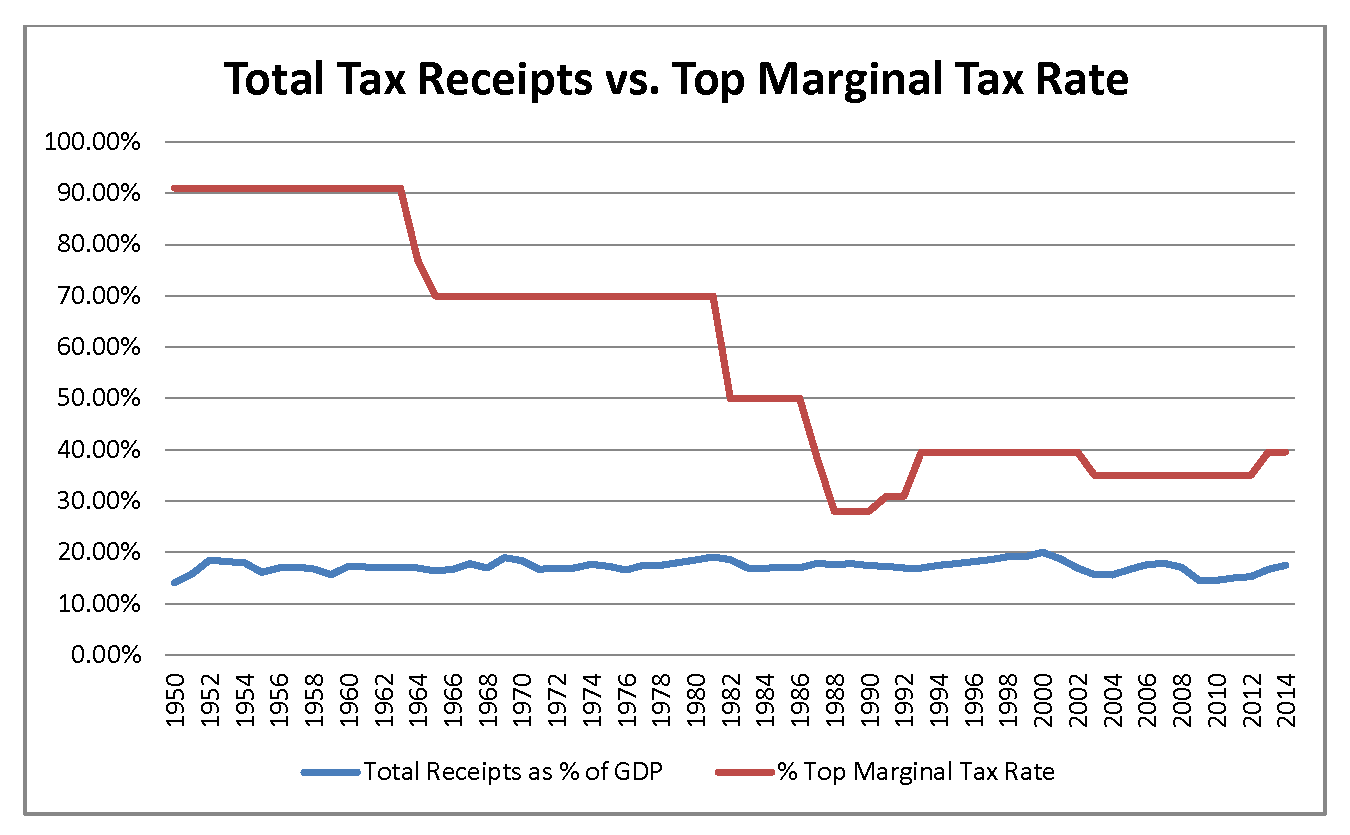
It’s similar with taxes and government revenue. Very high taxes don’t maximize revenue. Medium taxes work better. This is a somewhat standard point I’ve seen multiple people talk about. I’ve also seen a claim somewhere about government revenue staying around a specific percentage of gdp (maybe ~20%?) for a wide variety of tax rates.
In the past, very high taxes in the US has led to employers offing non-cash compensation that isn’t taxed, has presumably led to tax fraud, and can encourage people to work fewer hours (if more hours will not provide much more income because they’ve already reached the 90% tax bracket).
(And they have a similar one for income tax specifically which shows the same phenomenon.)
I guess it didn’t occur to me to connect those ideas because I guess I don’t view government revenue as something to be maximized whereas I suppose justice (and/or deterrence specifically) is something I have fewer reservations about.
I think a mix of deterrence and rehab (which would hopefully reduce recidivism) would be pretty good. I just don’t care much about strictly punishing people.
Though that doesn’t mean that I’m perfect about this new viewpoint of mine. Recently a dude threatened to beat up my family and broke some of our property (with enough value for it to be considered a felony). I was, and still am, mad at him and a part of me definitely wants him in prison for what he did.
I know there’s some other comments on this below, but I also am unsure on how to think about justice broadly. I don’t think stuff like this is so easy anymore. An eye for an eye sounded simple. Or something like justice should be blind sounds simple, but that can be hard too. I think it’s easy to say that someone should go to prison for stealing some food because they’re poor and starving. Is that helping people out though? I guess another way to put what’s the end goal of a justice system?
I changed my opinion driver’s licenses a while back.
I used to have a, I think, libertarian opinion (though idk how truly representative that opinion is) that drivers licenses are bad. I forgot the arguments but I assume it’s something like national identification is bad (though I think social security is more relevant there) and requiring a license to drive is bad. I disagree with second one. I think it’s perfectly reasonable to require a license to drive. As long as the government’s owns the roads I think it has a requirement to take steps to make sure people are safe on them and make sure people who get on their roads know what they’re doing (should they have the roads is a separate issue).
Kinda related to the above (though this is definitely less law related): I think people too casually say stuff like we should take away old people’s licenses. In one sense, yes, a lot of older people have issues driving and they’re a safety risk. In another sense, I think thats unreasonable because of how car dependent America (and some other places) is. Taking away someone’s license can be life ruining.
The comments seem to share a sentiment that under Trump the DOJ has went from a prestigious job for the best of lawyers to a joke that hires anyone who praises Trump.
The beginning part of the case(?) that I can see in the reddit post is odd to read.
I’m used to thinking there would be sophisticated legal language and what not. Instead I’m hit with “their name is FAKE” and “They are very bad for our country.” Apparently a lot of legal stuff under Trump is low quality. People speculate that it’s written to please him as opposed to being good legally.
Looking this case up, I found that it’s apparently about the ballroom stuff Trump was/is doing. Apparently two different courts granted an injunction against Trump and prevented his ballroom project. SCOTUS, however, recently overturned those injunctions and allowed for Trump to proceed.