Misogyny discussion topic.
Oh, neat(?)! I had some stuff on my mind. I can probably find example clips, but I’ve seen a lot of shorts where a women will be doing a workout class that may look a little odd and it will be titled(?) with stuff like “10 sets of wasting husbands money”. Its lame. Sometimes** comments will point out that a lot of these women are probably paying it out of their own pockets.
I remember seeing something similar from a different YouTuber/shorts creator. They made a clip about doing xmas or thanksgiving without a man or something. Some random dude reacted to it and said that the man bought all those things (the food, tables, etc.). Seemingly not being able to comprehend that she doesn’t have a boyfriend/husband and did all her holiday stuff her self.
** The comment sections on some shorts can really vary. I’ve seen this on other platforms too. At times a post will have a certain view on a post and then months later I’ll see that some post again with a completely different comment section. One that stood out to me was about a backyard wedding. Someone did a backyard wedding and mailed their neighbors to not make some noise at a certain time period. Someone made noise at that exact time period. First time I saw that post most of the comments were like, “yeah fuck that guy” “its your house nobody should tell you what to do”. see it a few months later and the comments were like “the guy respectfully asked for a few moments of peace. the neighbors a dickhead”.
This tweet has what looks like a Reddit screenshot (though it might not even be a real Reddit story):
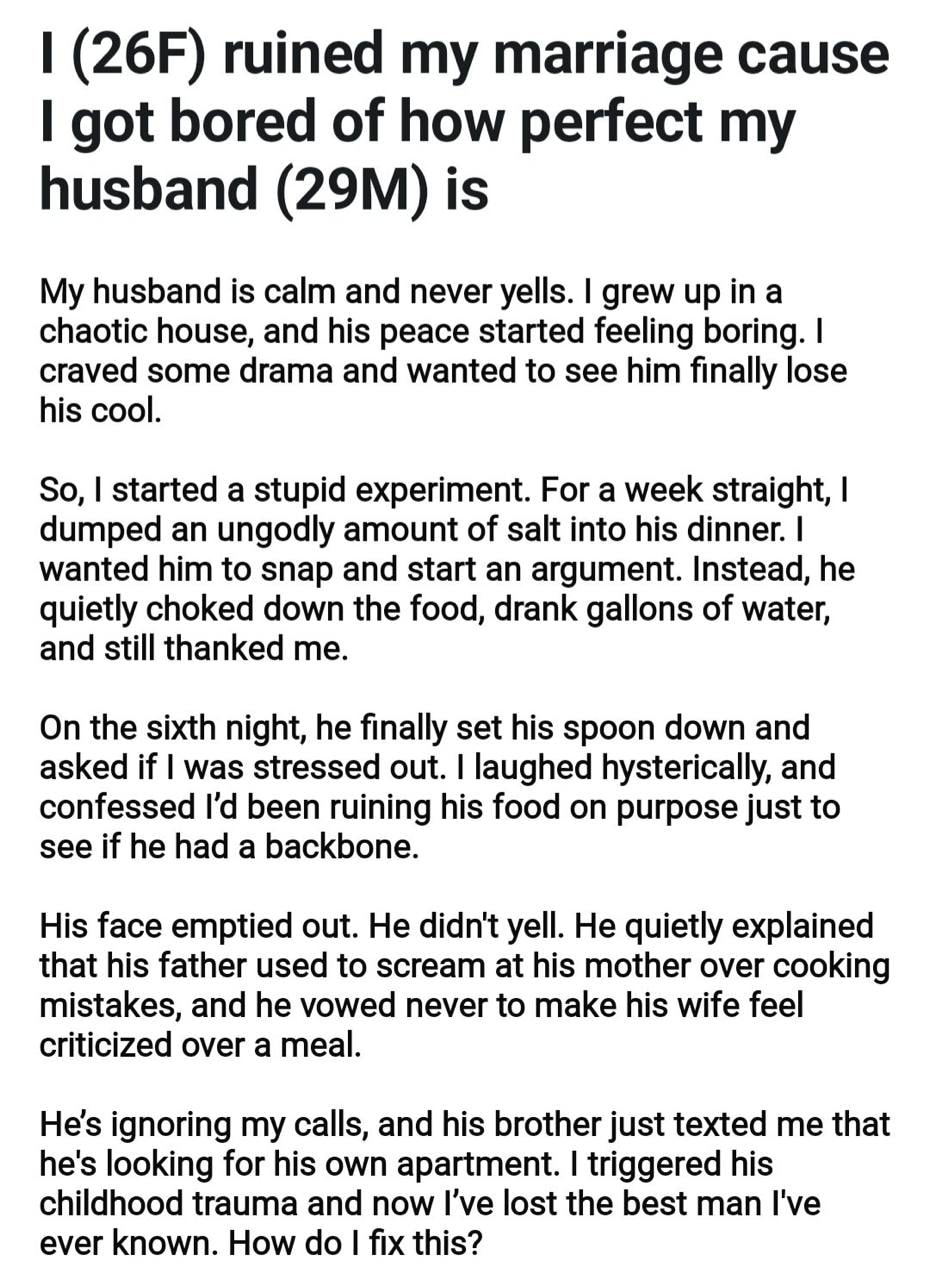
There’s a good chance the story is fiction, but that doesn’t stop many of the reactions to it from being genuine.
What do you think of the story? I’ll put my opinion in spoiler tags in two parts.
I think the man is much worse, but the story is popular primarily because people find the woman outrageous. It’s rage bait for people to rage at the woman, who is actually the better person in the story. I think it shows serious bias and misogyny in our society.
Think it over more if you want to. Part two with much more detail:
- The man left his spouse abruptly, without discussion, over minor events. This major escalation is by far the worst action in the story.
- The woman was right – intuitively, subconsciously, or otherwise – to be concerned about the stability of her marriage or her partner’s communication style.
- There were almost certainly many red flags by this man previously which contributed to the woman’s concerns.
- Testing people isn’t inherently bad. Finding it intolerable to be tested is a sign of fragility, ego, toxicity, etc. Saying “don’t you trust me?” and expecting people to trust you on faith is irrational.
- Testing people is a well known, common part of social interaction including dating and marriage. There is widespread dating advice for men telling them that women will test them and that they need to react in cool, calm, stable ways. The man in the story failed to do that, showing he was an unstable, emotional, unsafe man. Men test other men all the time too, at work, in sports locker rooms, when hanging out in friend groups, etc. But they say “can’t you take a joke?” instead of saying it was a “test”.
- The man should have communicated about the salt the first or second time. He was repeatedly demonstrating that he’s a bad communicator.
- The man was pretending to be calm but likely was not calm and was actually getting more and more upset with each salty dinner. I think it’s more likely that he was being dishonest and misleading every night than that he escalated to leaving her all of a sudden on the sixth night.
- It doesn’t matter much, but I think it’s reasonably likely that the first night the food was just a bit over-salted, and then when he didn’t communicate the kept escalating the amount of salt every night to try to get him to be honest and communicate.
- Salty food isn’t that big a deal. In our society, people prank each other with worse food stuff like putting too much spice or insects in food. Many people think that’s OK.
- After she messed up dinner for five consecutive days, he apparently still didn’t cook dinner himself or buy takeout, which seem like reasonable things to do if you aren’t going to bring up the problem. If she’s too stressed or tired to cook dinner correctly, maybe she needs a break. If the salty food is bothering him, maybe he needs a break from it. I suspect this man has very strong expectations about wives cooking for husbands, which get in the way of him cooking dinner even occasionally, which do not qualify him as a “perfect” husband.
- Lack of “drama” can mean people holding things in, not discussing problems, hiding their emotions, being dishonest, etc.
- If the story is fictional, I think it was written by a misogynist man (or by an AI prompted by a misogynist man). I suspect it’s written from the woman’s perspective so that people will take her word for things more, like about how perfect or calm her husband is, or how her motivation was craving drama. I think the woman should be treated as an unreliably narrator even if it’s a true story, and even more so if it’s fiction. People often have relevant intuitions and other knowledge which they leave out of stories. Not all stories are biased in favor of the author. If the story is true, then the woman is suffering from some misogynist biases too.
- In general, if you test someone and do find a huge problem, it was probably fairly reasonable to test them, even if your test wasn’t the 100% best way of handling the situation. Even if someone passes a test, the test can help calm your own insecurities, which can be reasonable. Reasonable tests should involve reasonably mild actions without longterm harm, which salty food qualifies for.
- Based on the title, I expected the woman to have done something much worse, e.g. had an affair. That made the actual story a big letdown (even without the man doing anything wrong), which to me made it totally unsuitable as rage bait. The title is obvious rage bait, but then reading further reduces instead of aggravates outrage, and also disproves that the man is perfect or even decent. Yet somehow it works on lots of people anyway? Lots of people seem to find the story lives up to the title and is extremely outrageous. I see this as showing huge misogynist biases.
- It’s likely that she tried to talk to him about some problems before salting his food, and it didn’t go very well or else she would have continued with direct, open communication. If she never tried to discuss any problems with him first, that’d be bad, though still not nearly as bad as him abruptly leaving his spouse.
- The brother texting her information about what’s going on, which her husband clearly chose not to text her on purpose, likely indicates the brother is partially on her side and is undermining the husband (his own brother) on purpose. The brother may think the husband is rushing to divorce too much and be trying to give the wife a chance to save things. The brother may think that his brother, the husband, would be better off keeping this wife. It’s also possible, in the alternative, that the husband told the brother to send that text because he had too much of a fragile ego and/or emotional mindset to send a text himself.
- If your marriage is highly unstable, it’s often better to find out now rather than later. It depends. Some people are in situations where they’d rather avoid finding out and try to keep things stable. But if she was willing to do this test, then presumably she’d rather get divorced now than next year.
- The story seems designed to play into some harmful, misogynist stereotypes. It’s trying to blame women and excuse men for some common types of relationship problems. Nevertheless, it made the man worse. And if it were true that women were like this, it’d still make no sense to marry one anyway, then find out and divorce her. Like is the guy supposed to be super naive and unaware of female nature, and this story is being read by a bunch of people who are reading it going “yeah, i knew women were like that”, but the man in the story is being excused for being so clueless at to not know?
- It’s interesting how the man seems like he almost passed the test, but then he failed badly right at the finish line. But the lack of communication earlier in the story was actually bad too. And somehow a lot of readers don’t see the man as failing the test because he got mad about the test itself not the salt, so he was meta-mad, so they think that counts as passing? I think if he gets mad about any aspect of it then he failed the test and it’s some weird cope to think that only being mad directly about the salt would count as failing the test. If the woman does the test and the man gets mad, the she found out he wasn’t calm regardless of which part of the test he was mad about.
- I think a lot of people see jumping to divorce as OK because they are outraged by the woman’s behavior and also have a poor sense of perspective (salting six meals is pretty small) and also ironically a poor grasp of the value/importance/significance of marriage (even though a lots of them are right wing Christians and some are even against no-fault divorce). Lots of people seem to read online stories by getting mad at someone and looking at it in a really one-sided, tribalist way. So they just see him as justifiably mad instead of questioning his huge escalation. I think some of the readers are also telling on themselves that they too would leave their spouse without discussing it first, not merely over an affair but over much pettier things.
- He could have stopped eating the salty food after one bite on the first night with no real harm done to him from one salty bite. Any additional salty food he ate beyond the first bite of each meal was fully voluntary since he has plenty of access to other food. And if he says nothing and then gets a salty first bite on day two, that’s kind of on him - if he really didn’t want to risk it he could have spoken up before biting into it. I think it’s important to keep in mind that her prank did not really involve him eating a whole salty meal, just the initial bite.
- Saying nothing about problems is more reasonable if someone is a scared abuse victim, which is presumably not a good excuse for this man, and not how people are reading the situation. If they say the man as weak I don’t think they’d side with him as much.
- The woman’s framing of the man as perfect and calm, when he’s anything but, shows either misogynist biases by the woman (which is common) or that it’s a fictional story written by a misogynist man. Misogyny is widespread and powerful enough to be part of the thinking of most women.
There are many ambiguities in the story. In general, if you’re going to be outraged about women, you shouldn’t do that based on imagining very anti-women things in the parts that were left blank. It doesn’t make sense to use this story to confirm how awful women are if you do it by making up a bunch of facts, yourself, that are biased against the woman. If there are reasonable readings in which the woman is a decent person and victim, and the man is the villain, then it’s not reasonable to be outraged at the woman just because you can also make up some (IMO less reasonable or plausible) versions in which the woman was less reasonable. Basically I think you should guess the missing details somewhat contrary to the conclusion you’re reaching, and if that prevents you from reaching your conclusion, just don’t be outraged and don’t reach any strong conclusion from the story. If you guess a bunch of details using confirmation bias, that’s irrational – that’s not merely using likely-fictional viral online stories as evidence about the world but actually using your own imagination as evidence.
To conclude, I raised a lot of points and some are more speculative than others. The main points don’t depend on much interpretation. The man left the marital home without communicating or problem solving first, isn’t responding to calls and texts, and his brother says he’s trying to get another home. That’s a big deal. The woman salted six meals and tested her husband. Those are much smaller things. More harmful pranks than the salt are socially acceptable. And testing people is common, socially acceptable behavior in general (though usually you don’t call it a “test”, instead it’s unlabelled or a “joke” or various other things). So I see massive misogyny and bias in people finding her outrageous and taking his side (not every single one of them is a misogynist, but most are).
1 Like
My initial thought after reading the story: I know a girl who seemed to crave a dramatic lifestyle. Old coworker. It always felt like when things were going well she would do something to ruin it (cheat on her boyfriend, start an argument over something small). Though it could be less of a craving for that lifestyle and more just habits. I think I fit into that kind of thing. I think I’m much better at controlling my anger and getting less angry nowadays, but in the past I would easily get angry. I don’t think I necessarily craved/wanted a messy relationships. Its just how it happened.
Hmm. Some other stuff:
- I wonder if this is real. Idk how to put it but it feels to me a ragebait story about women.
- Hmm. Seems like their relationship wasn’t the great. Treating this is as real, she clearly wasn’t enjoying this boring relationship. I wonder what kind of communication, if any, was done prior to this. I do think it’s bad her go to thing to “spice up” this relationship is trying to create bad drama.
- Ignoring her for a second, this husband has some issues too. Why not communicate that it was overly salty? Why wait six days? Two max maybe? He could, without arguing, tell her the food has been too salty. She mentioned wanting to see if he had a backbone. From how he’s been portrayed I don’t think he does. That’s not good. Though I guess this is explained by his upbringing? Assumably he would’ve said something about a different issue?
- One reason why I think it’s fake: holy shit that escalated fast. For someone who has no backbone he grew one real fast over childhood trauma. I assume there was some other stuff that maybe she didn’t mention? Otherwise, leaving her this quick and fast sucks. This husband doesn’t seem good.
- I do think its kinda interesting(?) that childhood trauma never came up?
Final thoughts: Idk. Think the story is kinda sus, but treating it as real the wife kinda sucks and the husband doesn’t that great either.
After looking at the first spoiler tag of Elliots:
Hmm. I think the woman is a bit outrageous. Mainly cause shes doing this with food. My minds thinking something like poison or something. If she was doing some other kind of “safer” test. I think I’d find it a lot less bad, but idk.
Is the woman better? Idk. The husband sucks and is leaving her over not much at all with no communication. I think comparatively he’s worse.
I’ll look at the more detailed breakdown soon.

Streamer breaks down some drama around a mobile game called Love and Deepspace. A good amount of the drama stems from homophobia from China, so that’s not why I’m sharing this here. CDawg brings up something I thought was interesting:
When women are consuming games like this men feel like they have to compete and get mad at women for playing these kinds of games (there’s an “actual” game to it, but the larger appeal is the ability to unlock more-or-less sexual scenes with various characters). He points out, referencing someone else, that men have had adult contents and other stuff for a long time and it hasn’t stopped them from having families and stuff. He feels that the view on a lot of this stuff for women is misogynistic. Mainly: guys consume this kind of content (and much “worse”) and think nothing much of it. Women consume it and their labeled as goobers who forget about the real world and will obsess over imaginary men.
I would not assume that.
I wouldn’t assume that either.
Oh yeah good point. She probably would have chosen something else to mess with, not food, if she knew about the trauma. So maybe the guy bringing up trauma was kind of making an excuse (it didn’t come up before because it’s not that serious), or he just never shared much about himself with his wife. Or else if she did know from past discussions, and she chose food anyway, then that would make her worse than how I read the story.
But it’s not poison. It’s just salt. It’s not dangerous/unsafe and he could stop eating after a bite and get some other meal if it was too awful.
Yeah that was my #1 point.
I think those are both possible, but IMO there is another notable possibility that is a bit different from either of these.
I think it is pretty common for people with unresolved trauma to be uncomfortable sharing that trauma.
It’s common for people to be reluctant to tell even their partner about previous highly traumatic/abusive experiences. For example: many people will wait many years to divulge that one was sexually abused as a child, or even never divulge it at all.
I don’t necessarily think that it would be fair to characterize such a case as a partner who “just never shared much” about themself. Traumatic experiences, especially ones from childhood, can be really difficult to talk about for a lot of people. So it seems plausible that you could have a husband or wife who shared lots of other stuff but never shared details of a specific bad childhood trauma.

Not sure this needs much explanation for why I would post it here.
The rise in popularity of guys like this is genuinely scary to me.
2 Likes
Before I read Elliots bigger breakdown:
I also thought her comment about the “best man I’ve ever known” was sad(?). The guy doesn’t sound great, but this is the best this women has. I think I remember Elliot having a similar sentiment in a different discussion.
Oh yeah and the day I first read this, I had a women coworker read over the story out of curiosity. Tbh, idk what I was expecting. This particular coworker says they hate all men (in a sense) and has a bunch of negative stories about guys, yet even she thought the girl was wrong. After a bit of conversating, she did think the guy overreacted a little. Overall, she did still think the women was more-or-less wrong.
So do you view this as more a subconscious/intuitive testing, instead of what her stated reason was (wanting to make things less boring and all that)?
Huh. That makes sense. I think the most(?) I’ve ever heard in defense of testing is that its just what women do, so just deal with it if you won’t relationships. I forgot where I read this. They didn’t treat it as some unfortunate “fact” or whatever. It was whatever. Just deal with the tests.
I do think guys reaction to a lot of testing stuff is odd. They always felt like overreactions to me,
Oh yeah, he also asked six days later if she was stressed out. Like the first or second time could be attributed to a one-off mistake on her own part, but after that it probably wasn’t. It took him six days for him to check in one his wife.
Oh yeah. Arguments are a way people problem solve(?) in relationships.
~yeah I found that too. I wonder if the title set their expectations of the story and so it felt worse to them anyway?
That makes sense. You’re filling in the blanks with the bias instead of seeing reality for what it is.
Hmm. That makes sense.
I do think it’s still bad for him to leave over his wife apparently “uncovering” a trauma that she couldn’t have known about (since he didn’t communicate it, for good or bad).
I agree that it is bad.
But also, people do stupid stuff when their traumatic experiences are triggered. I tend to be a judgmental person but I think in cases like this it may not be the right lens.
My initial read on the story was pretty negative of both people. They seem like they have dysfunctional relationship dynamics and might benefit from therapy for their traumatic childhoods. If I try to take a charitable view, both people in the story are basically damaged, have inadequate coping mechanisms, and have learned bad ways of communicating love. So they probably both deserve more sympathy than condemnation.
I will say that when I first skimmed the story, I did think the narrator (the wife) seemed worse than the husband. A few thoughts:
My first, strongest impression was that it was incel/redpill ragebait intended to make men upset at women. This was probably enhanced because I first saw it in the form of being shared on twitter by a manosphere white supremacist guy with an additional caption that endorsed the husband’s father yelling at the mother over food. I assumed it was a fake story.
Even when I tried to consider it as if it was real, I think I inadvertently glossed over lots of details. Basically, the details that made me think it was ragebait (massive gaps in the story, nonsensical actions)… I didn’t try very hard to fill in those gaps with plausible real world possible explanations, I just left them as gaps that proved it was fake and analyzed the surrounding details. So e.g. the guy not saying anything about inedible salty food (or cooking for himself, etc.) for 6 days seemed like an obvious fake story point, and I didn’t take it seriously and consider what kind of guy would actually do that.
When I read online reddit stories I tend to assume the narrator is worse than they claim and is lying to make themselves look better, so I did not try very hard to look for more understandable unspoken motives behind the wife’s claim that she wanted the husband to fight with her.
Personally, my methods of conflict resolution and relationship communication tend to be more confrontational and less avoidant. I sometimes find avoidant people difficult, and I have spent a lot of time learning how to be respectful of them and be more patient with them (there are a few people with a more avoidant style who I am very close to). So to some degree I think the wife is closer to my style, and the husband is closer to the style of people I love and have learned how to communicate with. So I think I found it easier to be more critical of the wife, who has not learned what I’ve learned. Being more understanding towards the avoidant husband is something I already learned how to do in my personal life.
I also find the idea of intentionally messing with someone’s food to try to upset them really disturbing, emotionally. Especially the way the wife describes doing it in the story. If someone I loved did that to me IRL it would probably change how I saw that person in a significant way.
So those were some of my initial thoughts/analysis of those thoughts.
I’ve reflected on it some and discussed the story with a few people and I no longer think the wife is significantly worse. I still think they both seem like they need therapy, but mostly I just feel bad for them both. Or I would, if it was real. But I still don’t actually think it’s real.
1 Like