Topic for practicing text analysis, reading, writing, grammar.
https://youtu.be/F1S1FZ-bn5E?si=8sYCLn8h2KU8rGFZ&t=1553
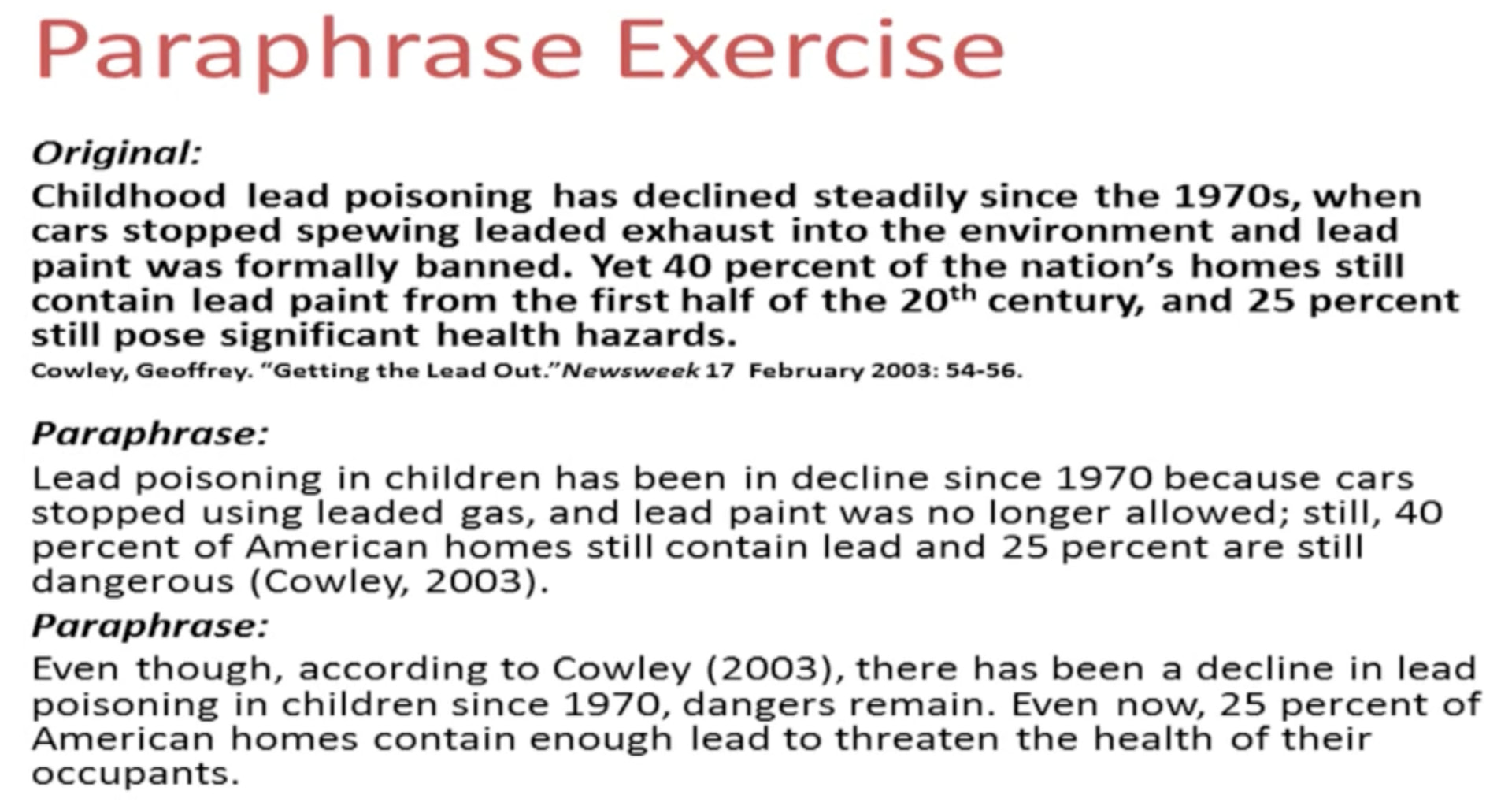
The speaker asks which paraphrase is better. I thought people might like to analyze all 3 versions for practice.
Paraphrase 1:

I noticed that the second part of the sentence where it says ‘40 percent of American homes still contain lead’ leaves out that the paint is from the 20th century.
For the last part of the sentence, does dangerous equal significant health hazards?
The paraphrase is written in the same format as the original writing. What was the paraphrase for then? To see the individual sentences written in other words?
2nd paraphrase:

The paraphrase is missing both reasons why the decline has been happening.
The paraphrase is missing the fact that 40 percent of the nation’s homes still contain lead paint from the 20th century. Maybe it’s intentional?
The paraphrase makes it a point that dangers remain even though there’s been a decline in lead in the US. Is the main point of the original source that dangers remain?
No indication that the last sentence contradicts the decline in lead through a conjunction like ‘yet’ or an adverb like ‘still’.
What is the goal of paraphrasing?
Brainstorm:
- To write in your own words what a text says?
- To interpret the text in your own words?
- To write in your own words what was important about the text?
- To write in your own words what the author was trying to say or claim?
I suggest taking all 3 versions and writing out stripped down versions where you only include the grammatically essential words. Then compare those. (There isn’t one single right answer for which words to include. The goal is to do a reasonable job.)
Their last sentence is trying to follow up on the “dangers remain” idea. (Not saying whether they do a good job, just explaining in case you didn’t understand why they did it.)
One reason is to quote less. If you quote a ton, readers, such as teachers grading your paper, may think you’re just a middle man repeating what other people said. Paraphrasing shows some ability to do your own writing.
Another goal of paraphrasing is to shorten things or adapt them to your context. Sometimes a quote is long and you want to explain it in fewer words. Sometimes a quote is confusing (unless you quote multiple pages of context), so it’s best for your reader if you just explain it in different words, possibly leaving out some premises, examples or themes that were present in the original but aren’t necessary to explain to your reader.
Original:
Childhood lead poisoning has declined steadily since the 1970s, when cars stopped spewing leaded exhaust into the environment and lead paint was formally banned. Yet 40 percent of the nation’s homes still contain lead paint from the first half of the 20th century, and 25 percent still pose significant health hazards.
Paraphrase 1:
Lead poisoning in children has been in decline since 1970 because cars stopped using leaded gas, and lead paint was no longer allowed; still, 40 percent of American homes still contain lead and 25 percent are still dangerous (Cowley, 2003).
Paraphrase 2:
Even though, according to Cowley (2003), there has been a decline in lead poisoning in children since 1970, dangers remain. Even now, 25 percent of American homes contain enough lead to threaten the health of their occupants.
I think the first paraphrase is better. Though I’m not too sure on what a paraphrase is supposed to be. From wikipedia:
A paraphrase (/ˈpærəˌfreɪz/) or rephrase is the rendering of a text through the use of different words without altering the text’s original meaning.[1] Most of the time, a paraphrased text can convey its meaning more effectively than the original words. In other words, paraphrasing uses different vocabulary than the original text but maintains the same concept. For example, when someone tells a story they have heard, in their own words, they paraphrase it, with the meaning being the same.
So the goal of a paraphrase is to rephrase something for a particular goal. Maybe you want to shorten a story and just get the main points across or maybe you want to better communicate a point of some writing. Ok.
I think paraphrase 1 better communicates everything the original communicated. Why lead poisoning is on the decline, and why its still dangerous.
Paraphrase 2 just communicated a decline without communicating a why. If you go off the second sentence you may think the decline was only due to less lead in homes. Also the Cowley (2003) being put in so early makes it seem like the second sentence may be the persons own original thought or something?
Why is it better?
I think its better than the second paraphrase because I think it communicated all the same information as the original but shorter (though now I realized after seeing @Dface 's post that it doesn’t mention that paint from being from the 20th century). I think the second paraphrase missed some stuff like why there is a decline in lead poisoning.
Also I liked the citation(?) thing at the end in the first paraphrase. I think it makes it clearer that the whole thing is a citation (though I guess one could read it like only the second sentence in the 1st paraphrase was being sourced?). When its at the beginning in the second paraphrase it makes the second sentence look original to me.
I thought you meant the first paraphrase was better than the original.
I think paraphrase 1 better communicates everything the original communicated.
Clarify?
Oh. I was just comparing between the two paraphrases.
I thought it said everything the original said except for the part about lead paint being from the 20th century.
I liked paraphrase 2 more because it didn’t repeat as many details (e.g., about lead paint, 40% of homes, etc.). So it seemed like a better summary. It just kept the key points/ideas.
Analyze how? By creating dependency grammar trees?
I’ll start with the first one.
Since I’m still studying grammar, I’m not sure what “the grammatically essential words” are. But I made a tree (see below). For the tree, I circled the bits that I’m not quite sure how to tree properly yet. I’ll practice that stuff later as I study more grammar. I highlighted stuff that felt important.
(I also omitted the “when cars stopped spewing…” bit because I wasn’t sure what it was. (I asked AI and apparently it’s a “relative clause” but I haven’t learned about that yet. Also, I thought the info it contained wasn’t essential to the paraphrase anyway.))
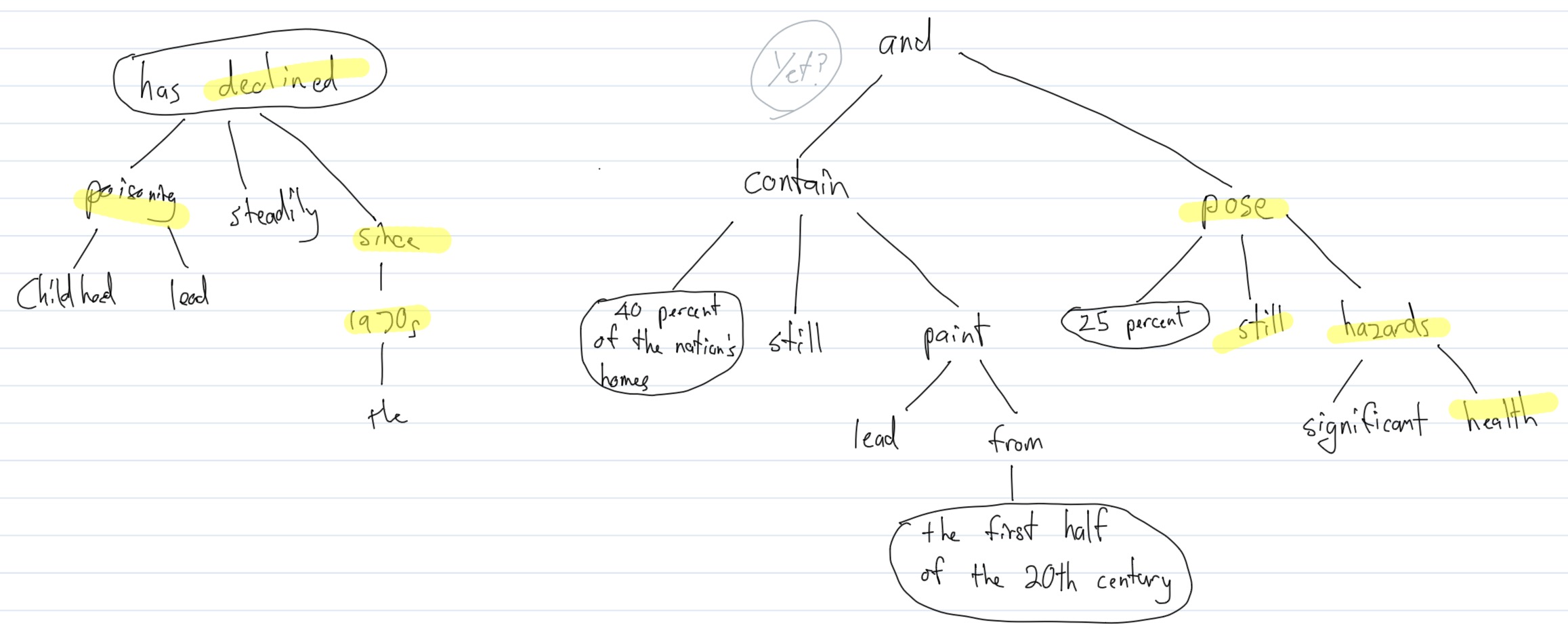
My condensation (based on the bits I highlighted): Childhood lead poisoning has declined since the 1970s, yet significant health hazards remain.
I wonder if I should’ve included “in the US” at the end since that seems like an essential caveat/detail. I probably should’ve. Or done something like “yet 25 percent of the nation’s homes still pose…”. Whoops, I guess I should’ve included more details from those branches. Oh well. I’m not sure how “stripped down” to go tho.
I could be wrong, but I assume getting really good & quick at paraphrasing (and/or condensation) can also help with general reading comprehension skills? Because I assume it trains you to identify/notice the key details and actual exact meaning (rather than reading things in a sort of hazy way where you just get a vague impression of what they might mean).
My attempt:
Childhood lead poisoning has declined steadily since the 1970s, when cars stopped spewing leaded exhaust into the environment and lead paint was formally banned. Yet 40 percent of the nation’s homes still contain lead paint from the first half of the 20th century, and 25 percent still pose significant health hazards.
poisoning has declined, when cars stopped spewing exhaust and paint was banned. 40 percent contain paint, and 25 percent pose hazards.
Lead poisoning in children has been in decline since 1970 because cars stopped using leaded gas, and lead paint was no longer allowed; still, 40 percent of American homes still contain lead and 25 percent are still dangerous (Cowley, 2003).
poisoning has been in decline because cars stopped using gas, and paint was not allowed; 40 percent contain lead and 25 percent are dangerous.
Even though, according to Cowley (2003), there has been a decline in lead poisoning in children since 1970, dangers remain. Even now, 25 percent of American homes contain enough lead to threaten the health of their occupants.
though there has been decline, dangers remain. 25 percent contain lead.
Out of all these I preferred paraphrase 1. It still conveyed the same information in a similar way to the original. Though I don’t see the point of paraphrasing it.
I don’t like second paraphrase because it drops some information from the original such as 40 percent of homes contain lead. It also places an emphasis on dangers remaining, while the original seemed to focus more on dangers declining while commenting on how things are still dangerous.
Why are those details the key points/ideas? For example, why is 40% of homes containing lead not a key idea, but 25% having amounts of lead that are dangerous is?
Because it says that only 25 percent pose health hazards. If they contain lead paint but don’t pose a health risk, then presumably they won’t cause lead poisoning in children.
I guess I assumed that childhood lead poisoning was the key issue.
1st attempt of breaking down paragraphs
Original:
Childhood lead poisoning has declined steadily since the 1970s, when cars stopped spewing leaded exhaust into the environment and lead paint was formally banned. Yet 40 percent of the nation’s homes still contain lead paint from the first half of the 20th century, and 25 percent still pose significant health hazards.
Lead poisoning has declined steadily since the 1970s. Cars stopped spewing leaded exhaust. Lead paint was banned. 40 percent of the nation’s homes still contain lead paint. 25 percent still pose significant health hazards.
1st paraphrase:
Lead poisoning in children has been in decline since 1970 because cars stopped using leaded gas, and lead paint was no longer allowed; still, 40 percent of American homes still contain lead and 25 percent are still dangerous (Cowley, 2003).
Lead poisoning in children has been in decline since 1970. Cars stopped using leaded gas. Lead paint was no longer allowed. Still, 40 percent of American homes still contain lead. 25 percent are still dangerous
2nd paraphrase:
Even though, according to Cowley (2003), there has been a decline in lead poisoning in children since 1970, dangers remain. Even now, 25 percent of American homes contain enough lead to threaten the health of their occupants.
There has been a decline in lead poisoning in children since 1970. Dangers remain. Even now, 25 percent of American homes contain enough lead to threaten the health of their occupants.
2nd attempt after asking Gemini about sentences that only include grammatically essential words:
Original:
Childhood lead poisoning has declined steadily since the 1970s, when cars stopped spewing leaded exhaust into the environment and lead paint was formally banned. Yet 40 percent of the nation’s homes still contain lead paint from the first half of the 20th century, and 25 percent still pose significant health hazards.
Poisoning has declined. Cars stopped spewing exhaust. Paint was banned. Homes contain paint. 25 percent pose hazards.
1st paraphrase:
Lead poisoning in children has been in decline since 1970 because cars stopped using leaded gas, and lead paint was no longer allowed; still, 40 percent of American homes still contain lead and 25 percent are still dangerous (Cowley, 2003).
Poisoning has been in decline. Cars stopped using gas. Paint was no longer allowed. Houses contain lead. 25 percent are dangerous.
2nd paraphrase:
Even though, according to Cowley (2003), there has been a decline in lead poisoning in children since 1970, dangers remain. Even now, 25 percent of American homes contain enough lead to threaten the health of their occupants.
There has been a decline in poisoning. Dangers remain. Homes contain lead to threaten occupants.
Comparing my 2nd attempt:
The format for the original and the 1st are the same, like both are made of four clauses. Both start their sentences with the grammatical subjects poisoning, cars, paint, houses, and 25 percent. And they pretty much have the same subject + verb+ object format for their sentences.
The 2nd paraphrase emphasized that the houses still contain lead to kill its occupants by making a clause saying, “Dangers remain.”
2nd paraphrase uses less clauses for the ‘there’s been a decline in lead’ and more and less clauses for the danger remains idea.
2nd paraphrase makes the connection that since leaded houses still pose a danger, then they threaten its occupants. The original and 1st paraphrase didn’t specifically say that.
Half baked analysis:
Third paraphrase did a zoom in and zoom out of its details compared to the original and the 1st paraphrase. What I mean by zoom out is that it put the two clauses of “Cars stopped using gas” and “Paint was no longer allowed” as folded child nodes of “Poisoning has been in decline.” After that, the third paraphrase zoomed in on the “Houses contain lead.” and “25 percent are dangerous.” and got the detail that these are still a problem.
Did you get your question resolved? I was wondering too. Some further related questions I would have are what is a key point/idea? If you know what that is does that make the left out details key ideas/points or not? What is a key issue? I think the key issues was probably lead poisoning in childhood. I was also thinking since we’re talking about including key ideas/issues then is ET’s quote about goals of paraphrasing related?:
First reason doesn’t say it’s wrong to leave out the reasons why child poisoning is declining.
Idk what it is to adapt paraphrasing to your context, but I think an example is if you were to tell a friend in a social setting about article, you wouldn’t harp so much on the details and you would keep it short and sweet.
Also, I don’t think the quote was confusing, like what was happening(e.g. lead exhaust being banned and 25% of homes containing dangerous amounts of lead). I do think what’s probably confusing is the point the author was trying to make. Like is the author’s main point that dangers remain? Just like the second paraphrase mentioned? Or something else?
I want to say that’s the key issue too, but I’m also wondering why the article just brings up childhood lead poisoning? Why not everybody’s lead poisoning? Each paraphrase says that homes are still dangerous or a hazard, but does that mean only for children or for everybody?
Edit: For my reply to @Jarrod above, i think i meant in the first sentence ***childhood lead poisoning declining*
Huh. Neat. Is your 2nd attempt done with you + A.I. or just A.I. (and you just copy and pasted)?
Unrelated commentary: I think its kinda neat how AI can understand somethings better than most people. I believed it was on the forum where there was a grammar(?) discussion about a paragraph from an old book (I think this started from a TikTok Elliot shared). It was related to understanding what that old book said. People, including myself, struggled with it. A.I. more or less did a good job of understanding the passage. Idk much about A.I. but it got trained by people right? Its interesting that it can do certain things better than people (though I guess it just happened to scrape the right thing for that passage maybe?).
~yeah I think I would’ve done it like this initially. i didn’t pay too close attention to grammatically essential words.
Are you comparing your 2nd attempt at grammatically essential words here?
Four clauses? Uhh I’m not personally too sure, but your breakdowns have five different complete thoughts, no?
~yeah the original said “poisoning has declined” and “25 percent still pose significant health hazards”. thats a bit different to then saying “dangers remain”. Also the “even though” at the beginning takes away from talking about the decline in poisoning.
Mmm. Idk. The original saying health hazards I think communicates something similar.
Idk if you’re still too interested in this, but did you look at my attempt? what’d you think of it?
Oh. Idk. Let me check.
I guess? (btw if you watch the original video the professor also likes paraphrase 2, I disagree with her)
I’m unsure of this myself but how do you know what the key ideas are for a passage? My thought process on this is that it depends on what the author wanted to communicate. Maybe they wanted to communicate about the remaining lead in homes, but also wanted to clarify that only 25% is dangerous. I feel like its wrong to get rid of that 40% part. Its putting words in their mouth almost.
Mmm. I’m not too sure, but I guess they point would be the most important argument/information in something?
I think there can be left out ideas that aren’t key points.
A random example:
My cat is cute, this is because she is fat.
I think in that one the key point can vary?, but from my pov, the author, the main thing i was communicating was “my cat is cute”. that, i think, is the key idea.
~kinda, but what about. i think that’s the key topic(?) (am I making up a term here?), but the key issue, I think, would be the commentary afterwards about the decline in lead poisoning.
ye
I think its about the decline. I mean they even have the part after explaining reasons for the decline.
If I remember right, I used ai to give me random example sentences of grammatically essential words. After that, I thought I could use the pattern the ai used and apply to make our paraphrases.
Yeah, idk how AI figures that stuff out like does it use algorithm? Or did it use a predetermined answer from somebody who already figured it out? I don’t think everything is figured out so I think it used rules from its algorithm to say correct things about the passage. I think those rules are what’s figured out by somebody and so the ai uses it for the passage.
I tried to pay attention to the grammatically essential words on the first attempt, but I kept feeling unsure if I was right about them. After I made a certain amount of sentences in the first attempt, I decided to look for online help to do another attempt.
Yeah, I think so. I wanted to compare the grammatically essential words of each paraphrase for attempt 2.
Oh yeah, that was my bad. There is 5 clauses. I thought maybe it was ok if I left it there uncorrected so maybe someone can point it out and see it. I don’t know if that was an ok thing to do.
I just saw this part. I’ll respond to it tomorrow.
Here’s a discussion tree i made for this discussion: