Thanks. I’m happy to accept that the IPV same-sex couple stuff I posted is flawed.
Looking back on it, I’m quite disappointed in the quality of all of this data. Recording is sloppy, very few sources include error info (like ± X), lack of age breakdowns, IPV definitions changing, etc.
Even the reddit post is sloppy. Multiple dead links and at least one article behind a paywall (did the post author just read the abstract?).
Also, a commenter pointed out (replying to OP)
Worth noting that the stats cited in your screenshot and the first half of your post are cherry picked by the article and misrepresentative.
ONS (the source the article uses but does not cite or link to) publishes their data for each year and you can look at the stats yourself: https://www.ons.gov.uk/peoplepopulationandcommunity/crimeandjustice/datasets/domesticabuseprevalenceandvictimcharacteristicsappendixtables
The tabloid article you cite that references their data exclusively references the 2024 dataset which is the only year where gay women have a lower rate than hetero women. If you look at the data across all the other years, this number is very clearly an outlier, with lesbian rates usually falling between 8-15% and almost always nearly equal with gay men.
(If you want to look at the linked ons.gov.uk data btw, I found it on table 4 (scroll down) on the latest data at least)
Continuing with that commenter’s post:
In 2019, the lesbian rate was 10.2% compared to 7.3% of hetero women, 3.7% of hetero men, and 5.1% of gay men. (and 12/17 for bi women/men)
In 2025, the lesbian rate was 13.0% compared to 8.4% of hetero women, 5.9% of hetero men, and 15.5% of gay men.
Note: this uses the ‘any domestic abuse’ stats (which includes family) instead of partner stats. Since it includes 16-19 years old, it also includes e.g., a straight dad threatening his gay son or something. So it’s not even directly responding to what reddit OP was saying.
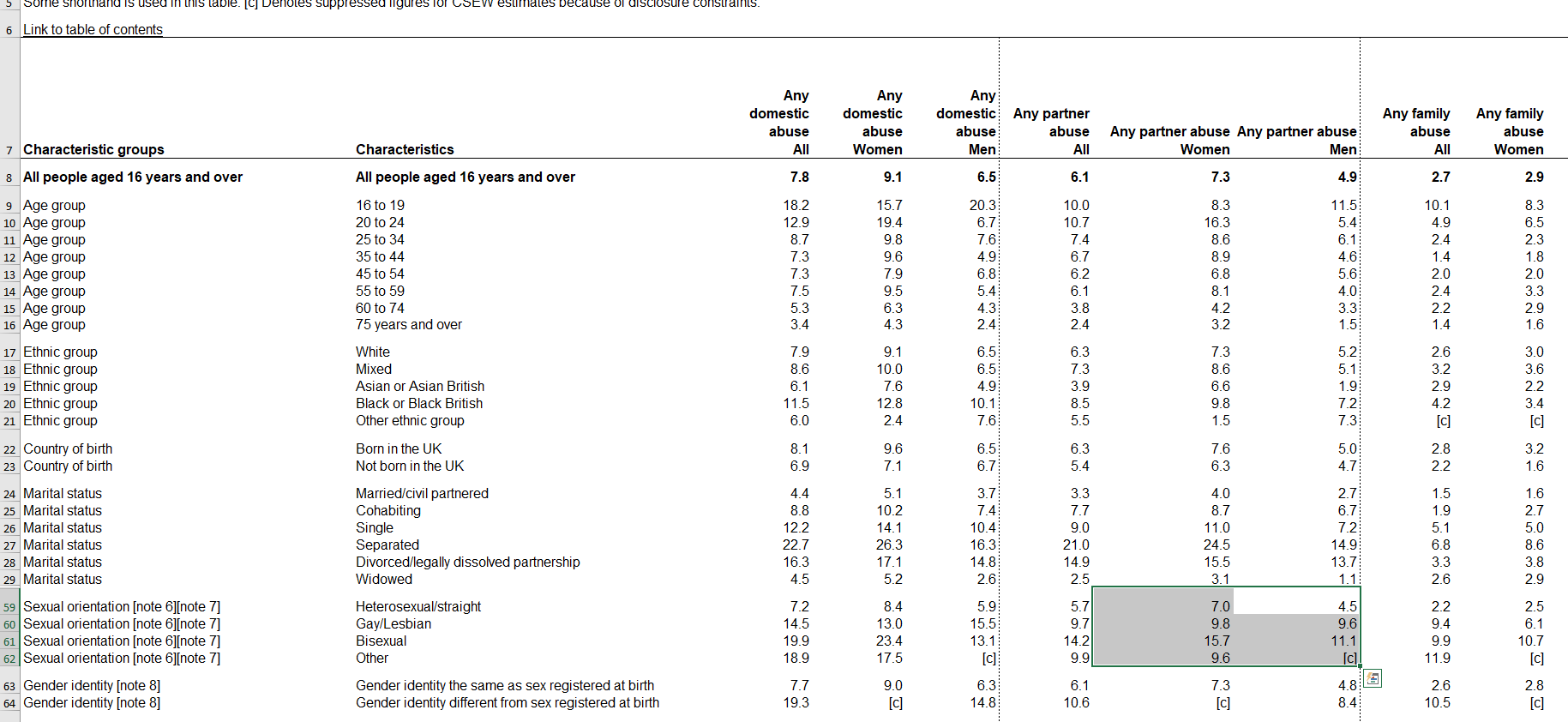
(Note re screenshot: a bunch of less relevant rows are hidden)
continuing reddit comment for completeness:
If you average the rates across multiple years, we see a clear pattern. Hetero men/women are about 40% less than gay men/women which are usually about 60% less than bisexual men/women.
This reinforces the data from the CDC study, and also from the other report you cite later, which asserts that young people have the highest rates. But also we see a very consistent pattern, bisexual people, of all genders, have shockingly higher rates than both gay and hetero populations.
If we take the ONS data across all years, the rates from highest to lowest are: Bi Women → Bi Men → Gay Women → Gay Men → Hetero Women → Hetero Men
I don’t know how the ONS gathers their data, what the impact of under/over reporting is, or any other factors that might impact this data, but we should be clear about what the data actually says.
Anyway, going back to what you originally said (“queer people in general are better at relationships on average”), I now think IPV isn’t a great way to judge that. For one, actually experiencing IPV isn’t the average experience. There’s also all kinds of confounding factors, like if an abuser wanted to find a new victim, someone young kicked out of home for being gay is vulnerable and a potential target.
You and I also might have quite different experiences of what the average non-queer relationship is like (particularly religiosity around where I live is much lower than in the US, so “traditional” relationships here might be a lot less traditional compared to the US).
All-in-all, I think how good people are on average at relationships is mostly cultural/memetic and probably independent of sexual orientation.