

the small comment section on this low popularity video is a bunch of people agreeing and saying they’ve seen it, either in law or in some other industry
1 Like
Also I watched the new Netflix documentary Inside the Manosphere which was OK.
Great video. I hadn’t considered the networking aspect or heard about that in discussions about the gender pay gap before.

2 Likes
wow.
Coincidentally saw this today:
In September of 2017, if you had asked men in the United States “what percentage of the women that you personally know have experienced sexual assault?” most of them would have likely said a fairly low number.
In October of 2017, the hashtag #MeToo went viral.
In November of 2017, if you had asked men in the United States “what percentage of the women that you personally know have experienced sexual assault?” most of them would have given a much higher number than before.
(It’s difficult, for many people, to remember that they would have said a number that we now know to be outrageously low; by default most of us tend to project our present knowledge back onto our past selves. But the #MeToo movement was sufficiently recent, and the collective shock sufficiently well-documented, that we can, with a little bit of conscientious effort, resist the mass memory rewrite. Most of us were wrong. That’s true even if you specifically were, in fact, right.)
Watching this, I am kind of embarrassed about much I stopped caring about womens’ reproductive issues and abortion stuff in general over the past few years (coinciding with adopting some more currently-right-wing ideas).
I used to think that the religious right in the US (circa 2000-2010) were bad, but I think that was based a lot on other things like my then-dislike of religion (including Christianity) or disapproval of practices/messaging (eg west borough baptist church). Even though I was fairly left-aligned, my understanding of the issues was insufficient for a view to endure. By contrast, my specific view on abortion hasn’t changed much in a technical sense (in that I’ve been pro-choice the whole time) because it’s grounded in ideas about individual rights and when one acquires a right to life and that kind of thing.
So, as my tolerance of religion and religious people/practices increased, I didn’t have much internal opposition to letting my views on reproductive issues slide and deteriorate. Most recently, I think this gave way to me ignoring issues about women being treated badly and adopting somewhat misogynistic views about women-seeking-abortion. I don’t think those views are entirely misgrounded (eg I don’t think it’s good when abortion is used as first-line contraception), however, I do think I’ve been much too judgmental about it. It also now seems like the safe, legal, and rare view (which sounds pretty reasonable on the surface) can be problematic when combined with moral judgement and not caring about how we treat ‘immoral’ or ‘problematic’ people.
Both of those (judgement + not caring) seem pretty common on the right at the moment, eg ICE and illegal immigrants, violent or repeat offenders, lefties FAFO-ing, etc. I also think they dishonestly deny the problem, simultaneously saying they don’t glorify or encourage death/assassination/etc, while also repeating “FAFO”, and doing things like making content out of people being shot by ICE and enjoying it. If enjoying someone getting ‘what they deserve’ or whatever (wherein they’re killed), I don’t see how that isn’t glorification or celebration (at least a little bit).
I’m getting a bit unfocused so might leave this post there, but I have more thoughts on this still.
initial reaction right at the start before watching the whole thing:
would women be better? maybe. idk. there probably aren’t too many examples and I do agree somewhat with the sentiment(?)/idea that the current world we are in right now is the one that was created by men. sure.
after the video:
so there were some better outcomes for rwandan people and he talks about women spending money more wisely when women were the primary(?). hmm. so jumping around a bit i think part of what kinda bothers me with this dudes claim is the way he’s portraying it as a “women” thing. idk i haven’t given this stuff deep thought but i think women just have a better culture(?) in regards to how they’re raised about this stuff. are women naturally more caring? idk. do I think women are raised in a way to be more caring? i think so.
something i just remembered: what about the cultural female spender stereotype? is that a lie? this is not me saying men are better spenders, but their is the notion that i have been about the average american wife who likes shopping and spending money. is that a bs narrative shared bc sexism? or is there some truth to that?
he talked about lack of examples for politics but i wonder about businesses? are women ran businesses better? actually asking, idk. if they are that’s great.
i will say from work experience that women have been better workers compared to the guys. for management. mmm. i will say women have been stricter in my experience and guys are better at playing the social games. i think female managers are actually better, but, uhh, ive come to the prefer the social manager to an extent. i think because i’ve become partially jaded i’d rather have the manager who does things like makes the store look perfect only when the boss comes around and stuff like that, rather than the manager who always wants that (mainly because they suck at it, i don’t think its their fault per se corporate guidelines i think suck)
Do you think it’s a common, uncommon or rare problem that people use abortion as first-line contraception? (Also, when they do, how often does the man push for that while the woman would prefer not to? It sounded like maybe you were putting the majority of the blame for this on the wrong gender.)
at best I think dougweaverart’s video is evidence mostly of his bad reasoning, and at worst it’s an attempt (perhaps subconscious) to equate western men with nonwestern genocidal men.
I’m okay assuming for the sake of his argument that the graphs are accurate and good faith.
The infant mortality chart seems like the best argument/evidence that he puts forward. I think it’s better than GDP for a number of reasons, like that it doesn’t suffer from inflation and doesn’t require a log y axis to show meaningful data. Also I think what ppl put forward as evidence reflects their reasoning process somewhat, so this guy didn’t find an infant morality chart with years (he could have added them too), nor did he find a GDP graph with a log-y axis. I don’t think he understands numbers or stats.
The chart itself, 1st thing that stands out to me is trend vs peaks
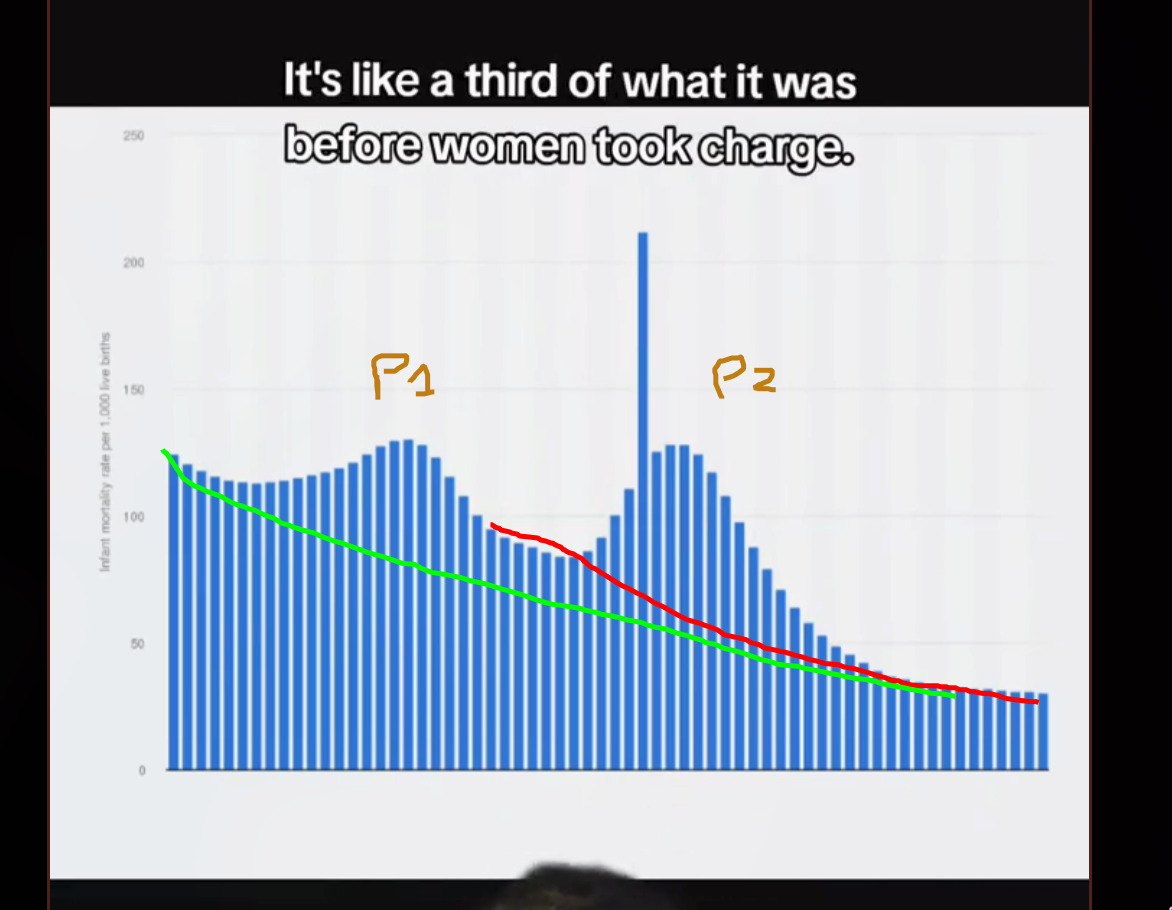
P2 is the genocide (according to him, but that seems reasonable).
There are 1 or 2 obvious trends that seem to dominate.
The problem (for Doug’s argument) is that left of the big outlier line is the pre-genocide side, and the trend that dominates seems to already have started. So it seems to me that the actual good interpretation of the graph is that women in power doesn’t change much, or at least that it doesn’t have a significant effect in this case. (Their health care sounds like it’s improving, which is good, but I was sucked in by Michael Moore’s 2007 documentary SiCKO that claimed Cuba had great healthcare, so I’m skeptical about lefties claiming cheap healthcare is possible and easy.)
The same trend line exists for gdp too actually:
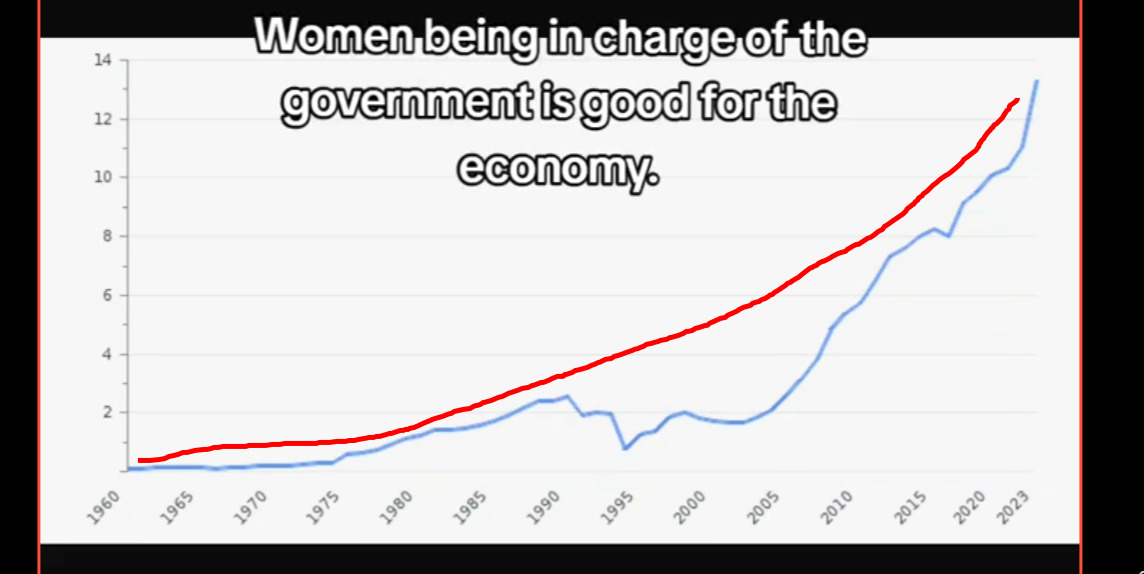
An assumption of mine that I didn’t state before (but should have) is that catching up is easier than making progress ahead of the curve. If catching up were just as hard, that would change things, but then that presents another problem: why did the progress stop while women were in charge? (Seems like an obvious trend exists between 2005-15 where catch up was happening)
I’m not sure what you mean here. Are you trying to imply that genocide is nonwestern?
Disclaimer, I did ask Claude (AI) about this. I wasn’t sure about what you were trying to imply. I thought that the statement seemed to imply that nonwestern men are (or can be) genocidal, while western men are not genocidal. I wanted to check my interpretation against something else, so i asked Claude what the statement implied, and it said:
the statement treats genocide as a distinctively nonwestern phenomenon, such that being “equated” with nonwestern genocidal men is an obvious degradation
I’m not sure, but two things come to mind:
- Personally I have a small sample size, but I know women who have used it as their first-line contraception.
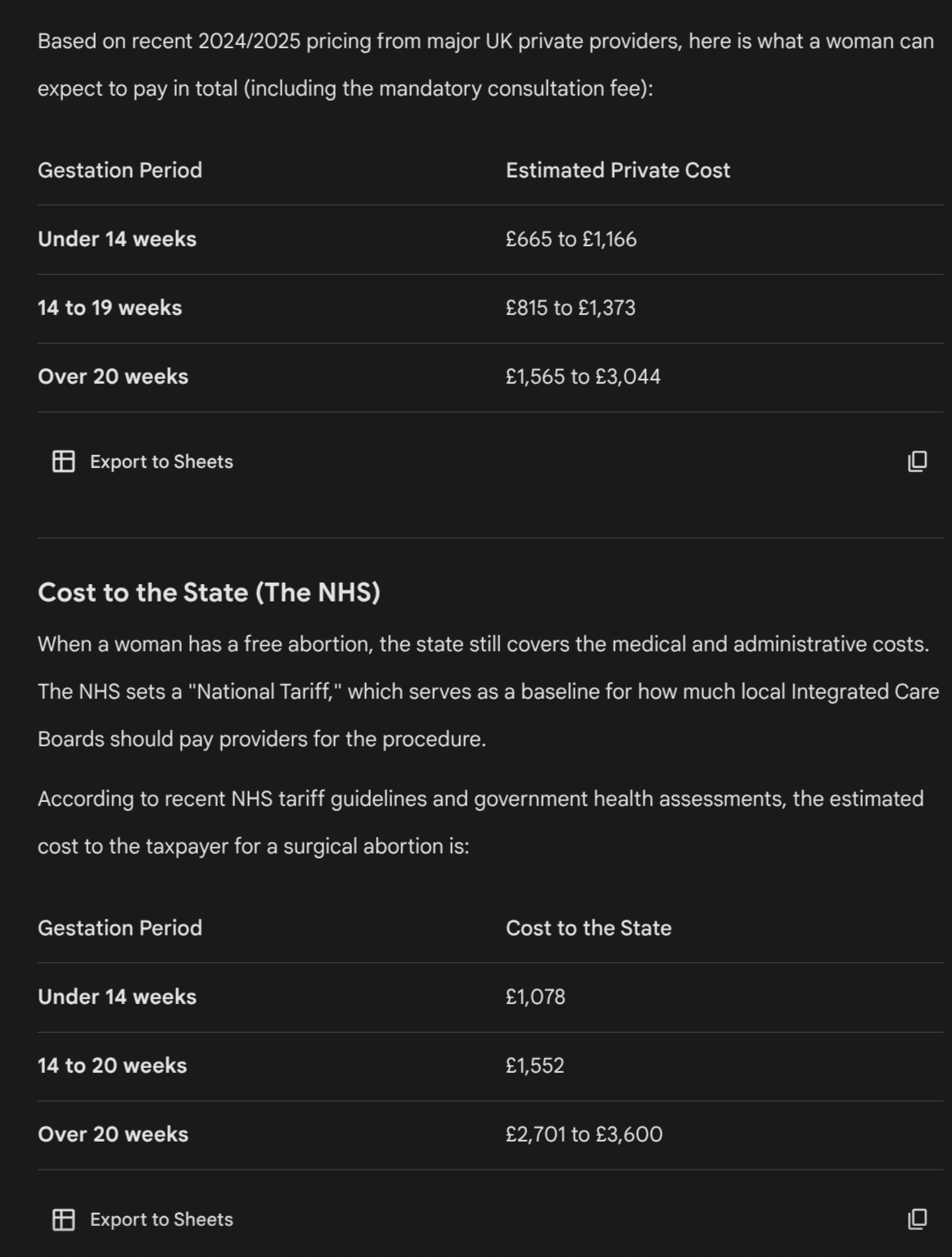
- While not first-line exactly, things like Lily Allen not remembering how many she’s had and making light of it as examples of clearly irresponsible reliance on them. Also she’s rich so it’s not like economics is a major factor in her decisions (whereas I think it’s kinda reasonable for normies to be worried about the cost of groceries). Part of the reason I dislike this kind of thing so much is that it seems obvious that, to her, having unsafe sex is more important than the outcomes. She has every opportunity to have changed and has not changed. So if I’m wrong about her priorities, why hasn’t she changed? She’s also a role model for young women, so I think she’s doing measurable harm when she promotes abortion like she does and makes them sound easy/painless/routine. (It’s unclear if they were all surgical, but my understanding is that pills are painful and surgically is at the very least uncomfortable if not slightly traumatic. At least one sounds surgical as Lily says 500 quid. I asked gemini for UK costs and seems like ~600 is the low end for private under 14 weeks; NHS is free. Cost to NHS is 1000 quid for under 14 weeks, so I guess that the private cost is subsidized some.)
Not sure, but Lily and the host of Miss Me (Miquita Oliver) both agreed that it was romantic for the guy to offer to pay.
So in terms of today and not 1970 or whenever, I don’t know, but it certainly seems like it’s not much of an issue, but maybe that has more to do with anti-natalism than anything else.
Oh and maybe important context: Miss Me is form the BBC so basically state-sponsored (see UK TV licensing for why I added the ‘basically’ qualifier)
Have you tried thinking about it statistically? Like if abortion were commonly being used as first line contraception, how many abortion per year should we expect there to be? Do you know the stats on likelihood of getting pregnant?
I tried claude and got a different response. Can you share screenshots of the prompt and claude’s response? I’ll do so also for mine in my longer reply that will answer your first question, too.
There are tons of harmful male and female influencers. Celebrities aren’t known for being great people in general. I’m not sure this is very relevant. But would you watch the video again and double check what their opinions about paying for abortions were?
Also, when I said “how often does the man push for that”, what do you think “that” refers to?