Yeah, I noticed this too. (Edit: maybe this is because there’s no conviction. You don’t need a conviction to report the victim, but it might be problematic if recording perpetrators.)
That said, if intimate partner violence is marked as coming from a gay/lesbian relationship, I don’t see how this isn’t a close approximation for the perpetrator.
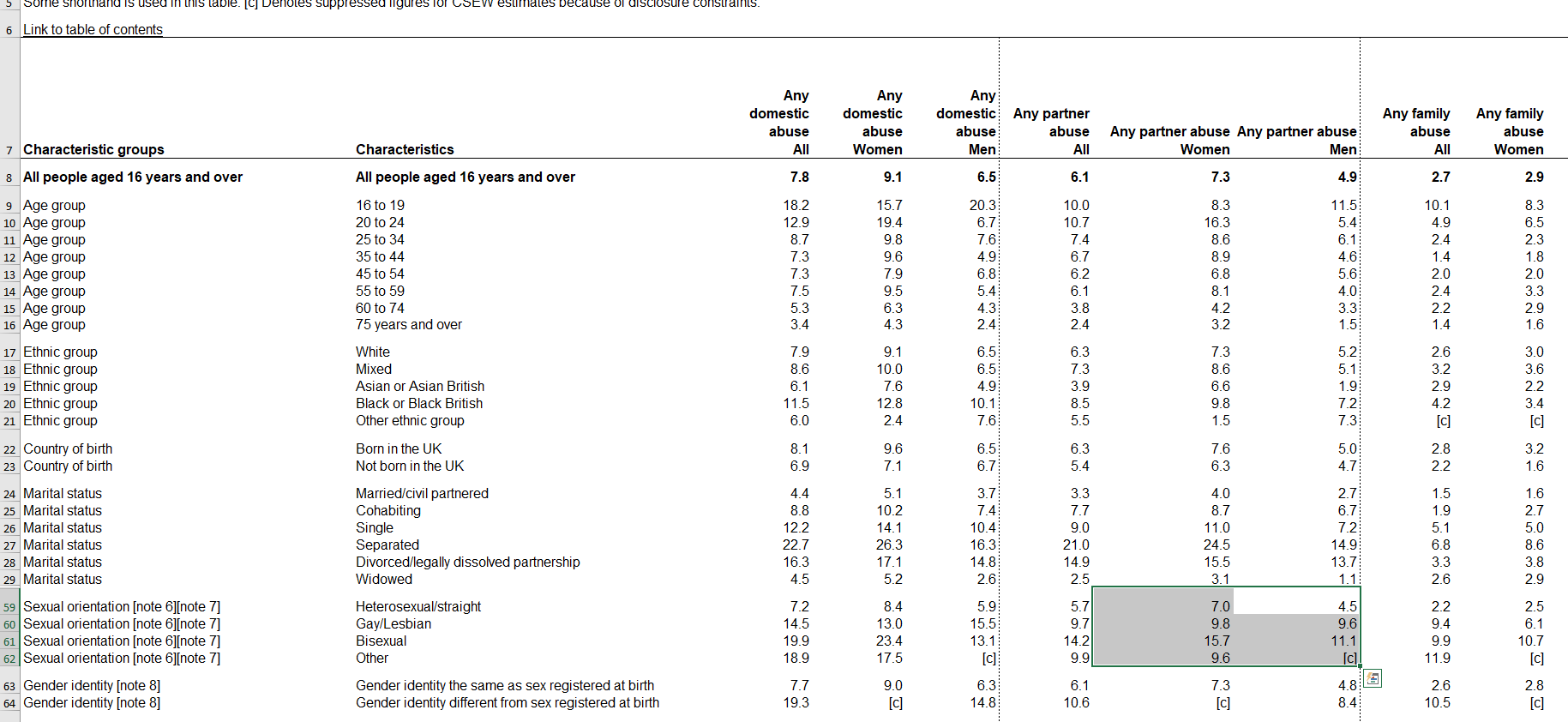
I’m not sure how you get to this conclusion. The screenshot I posted says (as I read it) that the rate for any kind of abuse from one partner on the other for gay/lesbian relationships where the victim is a woman is 9.8 somethings (I’m not sure of the units, the reddit commenter says it’s % but I’m not sure about that, and % of what?). Putting aside variance and assuming the units are comparable, how do you read 9.8 vs 7.0 or 4.5?
It seems like the data could be saying rates in lesbian relationships are higher than typical hetero relationships, but you seem to think it definitely doesn’t.
If you’re referring to the screenshot you just posted of the reddit thread, then disregard what I am about to write. I did not have access to the full post anymore when I wrote that comment. I’ll review the rest of the thread for other claims later. But for now I’m assuming this is the screenshot in question since it was what I was replying to above.
Looking at this screenshot, I stand by what I said. I also downloaded one of the spreadsheets and scrolled through it and did not see anything that contradicts what I said. I’ll try to explain it more clearly.
The lefthand columns are for the characteristics of the respondents. The individual respondents. What age are they, what nationality, what marital status, what sexual orientation, etc.
None of these fields are for characteristics of the relationships. Quoting just a snippet of your sentence to focus in:
That’s the inaccurate assumption you’re making. What it actually says is the rate for any kind of abuse from one partner on the other for women who identify as lesbians is 9.8 somethings.
You are assuming this implies a female perpetrator. But it doesn’t. Someone identifying as a lesbian on the survey does not imply that their previous abuse was in a lesbian relationship. It doesn’t tell us anything about their previous abusive relationship one way or the other.
As I said before…
Although… note that a girl who thought she was straight, tried to break up with her boyfriend because she realized she was a lesbian, was assaulted by the boyfriend when she broke up with him, then was kicked out of her home for being gay and entered into a non-abusive lesbian relationship would present as the exact same person in these studies. e.g. “Lesbian who experienced IPV within the last 12 months.”
Given the largest age categories surveyed are 18-19 and 20-24, it’s not implausible at all for them to have experienced more than one relationship in the past 12 months. And given that this is true repeatedly across multiple years of surveys, the surveys are consistently capturing different people, since the same person can’t be in the same age category for more than a few years in a row. If the surveys were following the same people we would expect the largest age categories to get older over time, but they don’t.
Does that make sense now?
As a thought experiment to help crystallize my point: imagine a regressive society where 100% of women who come out as gay are assaulted by state appointed agents as a punitive type of conversion therapy. In that society, 100% of lesbians would report having experienced abuse in their past. And the numbers on a 12 month rolling period would still be huge, especially for lower age brackets where people are more likely to have come out. Even if there were 0 abusive lesbians in such a society, a survey like this would show massively larger numbers for abuse reported by lesbian respondents.
Hopefully that helps clarify my point. This is why I said:
It’s worth emphasizing that this data doesn’t say that lesbians are more likely to commit IPV, or that lesbian relationships have higher rates of IPV. It has never said that, previously or now.
One addendum… I’m not saying the data is incompatible with abusive lesbians. I’m just saying it does not tell us anything in particular about abusive lesbians.
So if by “it definitely doesn’t” you mean “it definitely does not say rates of abuse are higher in lesbian relationships” I agree, that is what I was saying.
But if by “it definitely doesn’t” you mean “it definitely says rates of abuse are not higher in lesbian relationships” then that’s not what I was saying, no.
Sure that’s technically correct, assuming it’s a direct count of survey responses without any sanity checks. (Sanity checks that would catch inconsistencies eg, IPV by a man against a woman who puts her orientation as lesbian.)
I also think the argument you’re making is less sensible now than, say, in the 90s when there was way more stigma around coming out.
Yes and no. Yes in that I understand what you’re getting at. No in that it’s clutching at straws. I think it makes some sense that what you’re describing would show up in the bi category (rather than LG).
Okay. Before, you seemed to have a strong desire to avoid acknowledging that LGB relationships even could have higher levels of IPV.
Anyway, I am not sure we’ll get anywhere important by continuing this branch of the discussion.
That’s not a sanity check. And IPV by a man against a lesbian is not an inconsistency.
Once again, I think you are confused about the goal of studies like this.
Here is an article about disparities of pregnancy risk in teens across different sexual orientations:
One thing you’ll note is lots of consideration of pregnancy risks due to lack of condoms used by self-identified lesbians. Because sexual minority teens report less condom use than sexual majority teens. And the study isn’t focused on making political points, it is focused on identifying risk groups in order to help them.
And then there is an issue where on some studies have a combined sexual minority group that includes bisexual girls and lesbians together.
But also, from that analysis:
Some inconsistent findings have also emerged in the literature on sexual minority girls’ pregnancy risk. Findings from studies using New York City YRBS6 and other data,15 in which lesbian and bisexual girls have been combined, suggest that both groups are more likely than their heterosexual counterparts to report a teen pregnancy. However, studies that separate lesbian and bisexual girls in analyses have found that bisexual-identified or bisexual-behaving girls are more likely than heterosexual girls to report a pregnancy1,3,9 or a pregnancy termination,16 whereas for lesbian-identified girls, there is either no difference1,9,16 or lower risk3 of teen pregnancy.
It turns out lesbian girls don’t have higher risk of teen pregnancy than heterosexual girls. Though in some studies, they have comparable risks.
Your assumption that “self-identified lesbian in a survey” equals “this respondent’s relationships are exclusively with other women” is not accurate.
In those studies, bisexual girls have higher risk of teen pregnancy than heterosexual ones. This makes sense because bisexual teenagers report higher rates of alcohol use, less rates of condom use, etc. Lesbian teenagers also have higher rates of alcohol use, less condom use, etc. So presumably the reason their pregnancy rates are lower than bisexuals (but not necessarily lower than heterosexuals) is due to having fewer relationships with men.
The risky behaviors above make sense because those are also correlated with teenagers who have a history of abuse, and LGBT people also have higher likelihood of having experienced childhood abuse:
Bisexual women also have the highest rates of IPV based on the data we were discussing earlier. Of course, most bisexual women are in relationships with men:
84% of bisexuals are in relationships with the opposite gender, versus gay men (2%) or lesbians (1%).
Note that this 1% for lesbians doesn’t preclude any of my earlier points because this is specifically polling people who currently identify as lesbians and who their current long term partner is — which is not the case for the IPV surveys, which are based on any instances of IPV experienced with a given timeframe.
Yeah it is even more pronounced in the bi category, as I just went over. But most lesbians have had relationships with men in the past.
So for a survey that is specifically overrepresenting younger people, this all makes sense to me. I don’t think I’m grasping at straws at all, I think I am presenting a coherent, logical possible explanation of the facts.
LGBT people have higher rates of abusive childhood, and that comes with various negative predictions about risky behaviors. Alcohol usage, low condom usage, and subsequent abusive relationships all go along with that. But there’s no reason to assume those abusive relationships are predominantly with women, even for respondents that identify as lesbians. The abusive relationships could easily have been with men.
There’s also some good discussion on this general topic here, which I stumbled across when looking up some of those studies above.
I don’t have a problem acknowledging it as a possibility, but I don’t think it is the most logical explanation. I think that is a conclusion that gets draw in order to try to score political points about feminism or LGBT people, not a conclusion based in reality.
Also, all of this is setting aside other possible factors for IPV rates (such as likelihood of reporting) that I mentioned a few months ago but haven’t brought up again in this discussion. I noticed that reddit thread I just linked does have a few comments that bring that up though.
Sure, maybe not. Feel free to bow out of the discussion if you like. I figured it might be useful to state my disagreements in case anyone could learn from them, or noticed any flaws in my thinking.
I think she had better views than what Tew has, whom I guess thinks he had at least close views to Rand.
I haven’t read the article in a while. I don’t remember exactly what it said, but I only remember thinking it was horrible and not what Rand would’ve thought.
I read a only few paragraphs of this after watching Tew’s recent video on YouTube that Jarrod also mentioned. I was disturbed by the video, I found myself wondering how on earth I was even there listening to something like that.
I get the sense he is unable to do philosophy without putting in place things like this that remove him from any feedback from others. Which seems so dangerous and irrational.
Wtf? Why would he even go a hike with her in the first place?
I read that some people do it to murder their girlfriend/wife or leave them to die. But in that TikTok it seems like he just took her on a regular hike and… ditched her? Why even bother going on a hike in the first place then lol. It’d be less effort to just text her or tell her that he’s not interested in pursuing things further or seeing her again.
Maybe it gives the guy a sense of power or satisfaction or something?
When I read the comments, I was amazed by how common it seems to be.
Comments claim this is so common it has a name, “alpine divorce” — but as far as I can tell, that name goes back to a fiction story of a man that tries to murder his wife on a vacation. One comment claimed it’s so common that there is a support group for it, but I can’t find any evidence for such support groups existing online.
I’m not skeptical of the video itself, or the specific comments from people citing similar experiences, but I am a bit skeptical of the idea that it is super common or a new trend or whatever. The only articles about this idea that I can find are all very recent and cite back to social media posts like this.
I also wonder if a lot of instances of this happening are due to them having a fight on the hike and the man getting mad and leaving, rather than it being a calculated scheme the man planned prior to the hike.
To be clear, hiking can be dangerous if you are unprepared. Getting mad at your partner and abandoning them in that situation is really messed up and inexcusable. Even if you get mad, you should cancel your hike together and get to safety before you break up or whatever. I’m not trying to excuse that behavior. Just expressing some skepticism towards the comments that say this is a very common thing.