I’ve run into no more math done in the article that I didn’t understand. But there were some math concepts mentioned that I know I don’t understand like:
And choosing non-linear units in one dimension (like pH or the Richter scale, which are logarithmic) can change which option has the highest number.
I think I understand the point of this, but I know I don’t thoroughly understand logarithms and non-linearity. Is that possible?
Am I right that this is a linear equation and I should be looking into solving linear equations? The thing I am having trouble with in your question is that there are multiple instances of x.
Something I am confused about: When you say to ‘do’ the equation, I assumed that you meant to solve for x. Is that what you meant or did you mean to simplify the equation? Or does that amount to the same thing in this case? I feel a bit out of my depth here.
I can rearrange simpler equations to make x the subject like y = 3x + 4 is (y-4)/3 = x.
Is the equation 5x+20=x/3 that far beyond that? Why is 5x+20=3/x harder?
What I think I know about the problem:
It is a polynomial (many-termed) equation
It is a linear equation
Not improving. I haven’t logged exactly how many hours I’ve spend on typing this week. I estimate around ~2-3 hours. I’m going to keep more of a precise log this week.
Practising with a metronome has got my accuracy up for low speeds. With the metronome at 60bpm and typing four keys per beat I can get 45-48 wpm with 100% accuracy regularly.
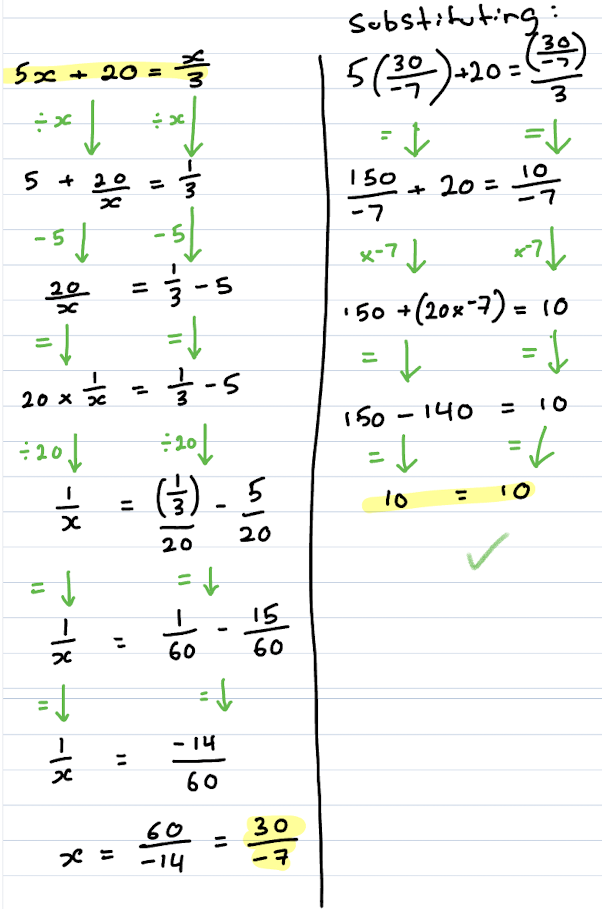
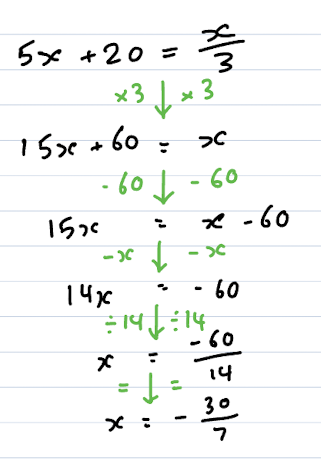
So it turns out I did already know most of the elements involved in solving the equation. When I initially tried to do it, I approached it from a few angles and each time it seemed like I was on a path to an answer that didn’t make sense. So, instead of seeing it through and finding out, I backed off, did some more reading, and looked for a different angle. I had expected the transformations to make the equation get simpler and simpler, and the answer become clearer. I think that’s because I was used to worksheet style questions that are kind of made like that, so that after a few steps it becomes kind of obvious what the answer is.
So I stopped a few different times because my transformations didn’t seem promising. I even got to the answer once but didn’t bother to check it in the equation because I thought I must have messed up somewhere.
So I ended up coming at it from another angle and then ended up with the same answer again, so this time I substituted it for x in the equation, and it was right. I think I am confident I can start practising more of these equations.
Dividing by x works for the first step but there’s a simpler way to do it. I’d suggest making a list of all the things you can do to equations so you can look through what your options are.
Generally one of your main goals is to reduce the number of terms with variables like x in them (and also to prefer powers of x closer to or exactly 1 or 0, so having 20/x isn’t ideal because that x is to the -1 power). You can do that on the first step.
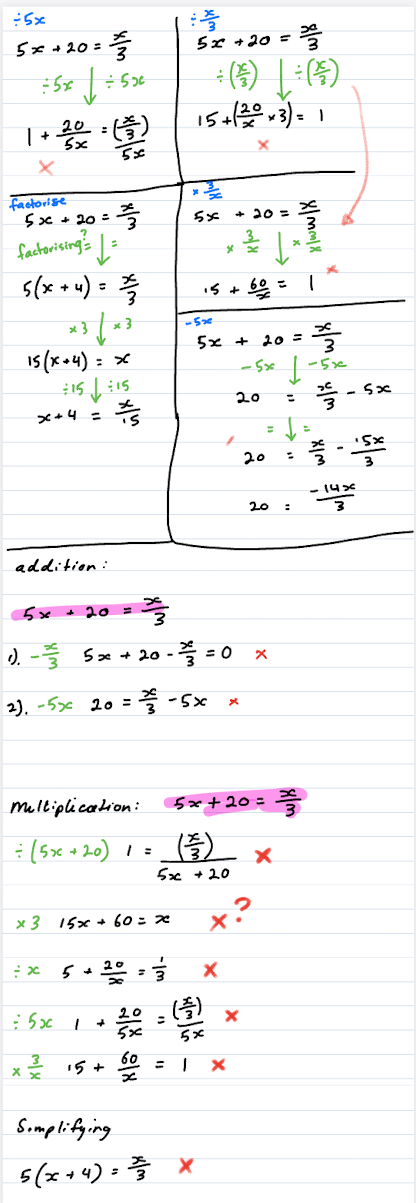
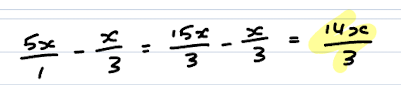
Spent about ~1.5hr trying to figure it out. I didn’t find anything simpler. Here is some of my working where I went through different first step option I thought could help/that I’d done. I think I must be missing something if both reducing the number of terms with variables in them and them not being to a negative power are possible on the first step.