Math for Business Analysis

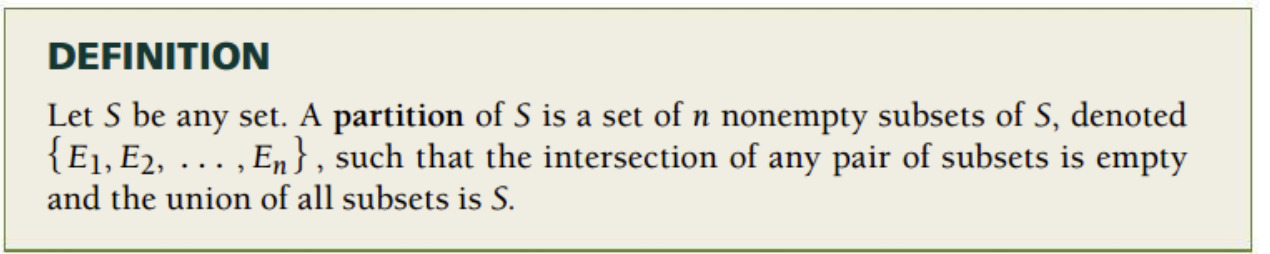
Notes on partition of a sample space

Ok so each subset/partition in this case has completely unique values that don’t share any values with the rest of the other subsets/partitions.

Hmm. That would make sense. Since you’re dividing up a set you could only divide them up in a way where they only have unique values. So the set S = {1,2,3,4,4,5} could, i guess, be partitioned a way like E1 = {1} E2={2} and so in (each having one value). The two fours wouldn’t be an issue because they are counted only once for the set.

Yes because the union of all the partitions is just all the individual events put back together. The probability of all the events defined in a sample occurring is 1.


It varies by game. They ought to specify how they count it in the problem.

That isn’t a set. Sets can’t have duplicates.

Hmm. I’ll doublecheck my textbook later for more exact wording on how they define a set, but the definition they seem to give is that the duplicates don’t count (which I believe I said in the post you replied to). Like a set can apparently have duplicates but they don’t affect anything, don’t count towards the cardinality or anything like that. Here’s a quick example from some notes I took in this thread:

I don’t think they ever said B was not a set. They just said not to count duplicate elements.

From 12.3 Permutations and Distinguishable Arrangements:

Permutations refers to ordered arrangements and I guess this section will be dealing with the math of how many different ways things can be arranged.

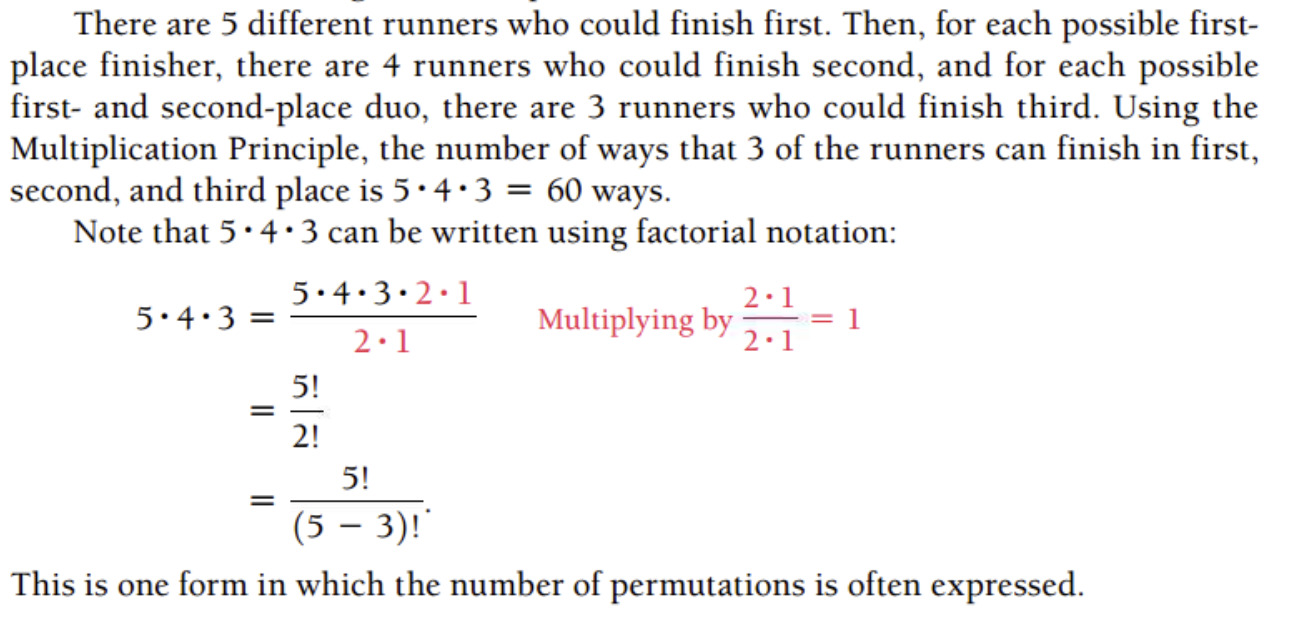
Hmm. The places make sense. Five different runners can finish first. Then four different runners can finish second. And then three different runners can finish last. Hmm. What about the two runners who don’t place? oh they’re already taken into consideration. five of the various runners can get first, then four of them can get second, etc.

Uhh. How is this permutation expressed? Is it saying that from 5 objects we are trying to see how many ways they can be organized in three groups or something. 5! is the number of different ways things can be grouped. Hmm. I’m getting a little confused. Lets just read ahead.

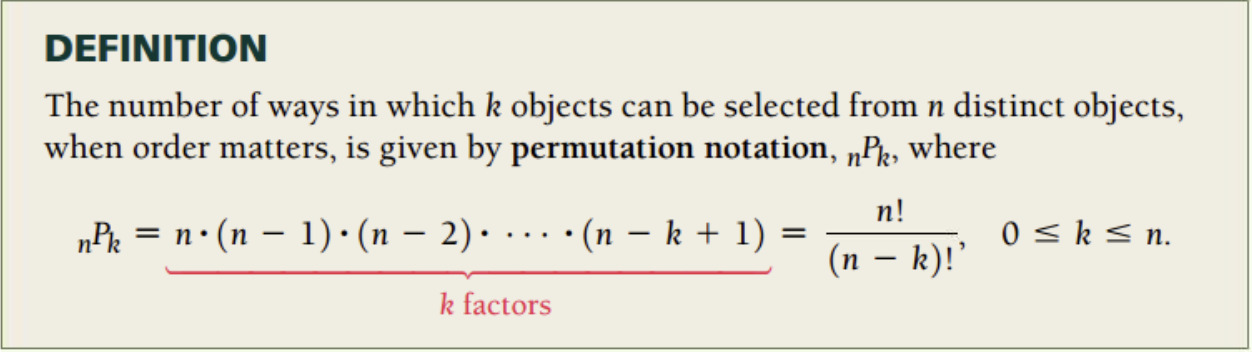
k represents the objects taken/used from n. Why the k + 1?

im just gonna do a) to see if I get the idea

a.) 11!/(11-5)!

11 objects taken to be sorted into 6 groups where order matters

hmm. seems like i was wrong the answer is:

image

Okay so permutation is about selecting objects from a set where the order of the selected object matters. You pick objects from a set and it matters where they go.

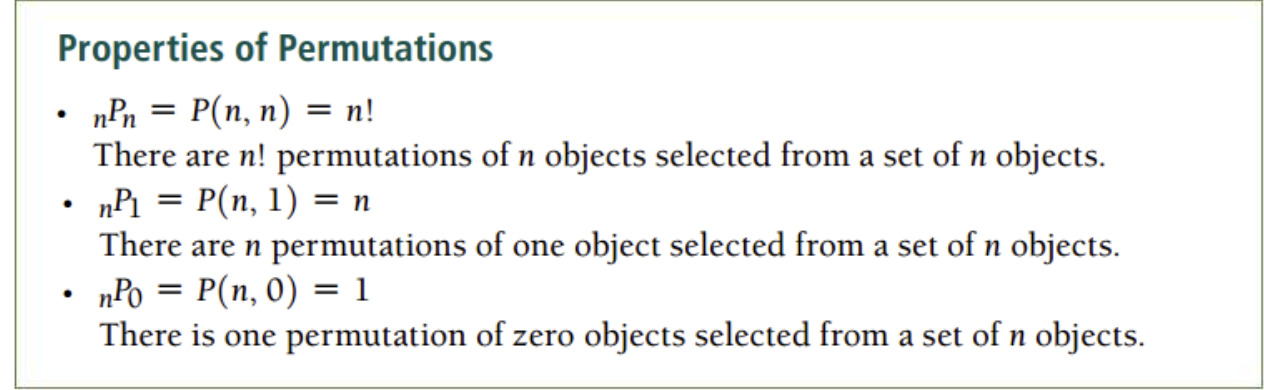
nPn = n!/(n-n)! = n!/(0!) = n!/1 = n!.

nP1 = n!/(n-1)! = n * (n-1)!/(n-1)! = n

nP0 = n!/(n-0)! = n!/n! = 1

Third place isn’t last place in a race with 5 ppl.

oh yeah. hmm. i think i just assumed that after third place there is no more placement. i forgot that even = though the top three is usually what people care about, people are usually still ranked after that

This is something you can figure out. How many different terms do you think should be multiplied?

Hmm. k terms? In the definition it says k factors. So in 5P4. Four different terms should be multiplied, so: 5 x 4 x 3 x 2 = 120.

I did all the below work before properly reading what you said. I just read the first part saying I could figure it out and tried to think about.

So whats each part representing? The first part is the notation. P for permutation. n is the amount of distinct objects. Or, in other words, if we’re looking for permutations of 5 different balls. The five balls are the five distinct objects. k represents how many objects we’re selecting?

Mmm. I’m a bit lost. Let’s see. We have 5 objects. Let’s say k = 1. I learned that one of the properties of permutation is that it will equal n. In this case 5. Why? Because there are 5 different objects to choose from that we can select. What about k = 2? Well when we pick the first time around we have 5 different choices. When we pick the second time around we have four different choices. So 5 * 4 = 20. Thats represented by the above formula because you would do (5 x 4 x 3!)/(5-2). The bottom simplifies to three factorial and the top and bottom “cancel out”. Leaving you with 5 x 4.

Ok. I think I get permutations a bit better now but still why the k+1?

n x (n-1) x (n-2) x (n - k + 1)

Mmm. 3P3. 3 - 3 + 1 = 1. 3P2 = 3 - 2 + 1 = 2. Hmm. The full thing for 3P2 =

3 x (3-1) x (3-2) x (3-2+1) = 3 x 2 x 2 = 12. Hmm this is wrong. Maybe I’m reading it wrong? Could it be saying you go until k? so 3 x (3 - 1) x (3 - 2 + 1) = 3 x 2 x 2. Hmm wrong again. We have a total of k factors. So I should only have 2. So we have 3 x (3-1) = 6. Ok that makes sense but it doesn’t help me figure out what k is. 3 - 2 + 1 = 2. Hmm. Would it then be 3 x (3 - 2 + 1)? That works but I don’t get it.

(this is after reading the part in Elliot’s original question of how many different terms i think there should be, it made me think of the terms) Maybe k + 1 represents the biggest number we subtract up to?

so in 4P2. k = 2. k + 1 = 3. Going off the formula we have:

4 x (4-1). That’s it we stop. so 4 x 3 = 12. Ok that works. Lets try something else to make sure.

6P4. k = 4, k+1 = 5, so 6 x (6 - 1) = 6 x 5 = 30. Ok thats wrong, plus theres only two terms being multiplied instead of 4. Maybe its something like this?:

k is the number of factors. k+1 represents the factors plus 1. Hmm. Let’s expand out P(6,4)

6 x (6-1) x (6-2) x (6-3) = 6 x 5 x 4 x 3 = 360. (6 - 4 + 1) = 3. Hmm. So I’m noticing that by subtracting k+1 we get the last term we multiply by in the sequence. P(5,2) = 5 x (5-1) = 20. 5 - 2 + 1 = 4 = 5=1.

So n-k+1 is representing the last term. Hmm. How and why?

Well you subtract -

Hmm. Does it something to do with it being a factorial? From wikipedia:

I think so. Mmm. Why is k+1 representing the last term? Why not just k? Does it have something to do with 0! = 1? Because 6P0= 1, but 6-0+1 = 7.

Hmm. Overall thinking through this I feel more comfortable with permutations than before but I’m still lost on the k+1 part. :frowning:

Spent ~45 minutes

You sound unsure.

There are 157 cupcakes with unique designs. You are allowed to eat 22. How many different ways can you choose your cupcakes?

Don’t solve it. Just tell me what n and k are.

n is the cupcakes with unique designs, so

n = 157

k is the number of cupcakes you are allowed to eat, so

k = 22

Yes.

You can eat 2 cupcakes out of 7. What are n and k? Do you know how to solve it without using the formula, just with a simple explanation?

From 12.4 Combinations and the Binomial Theorem:

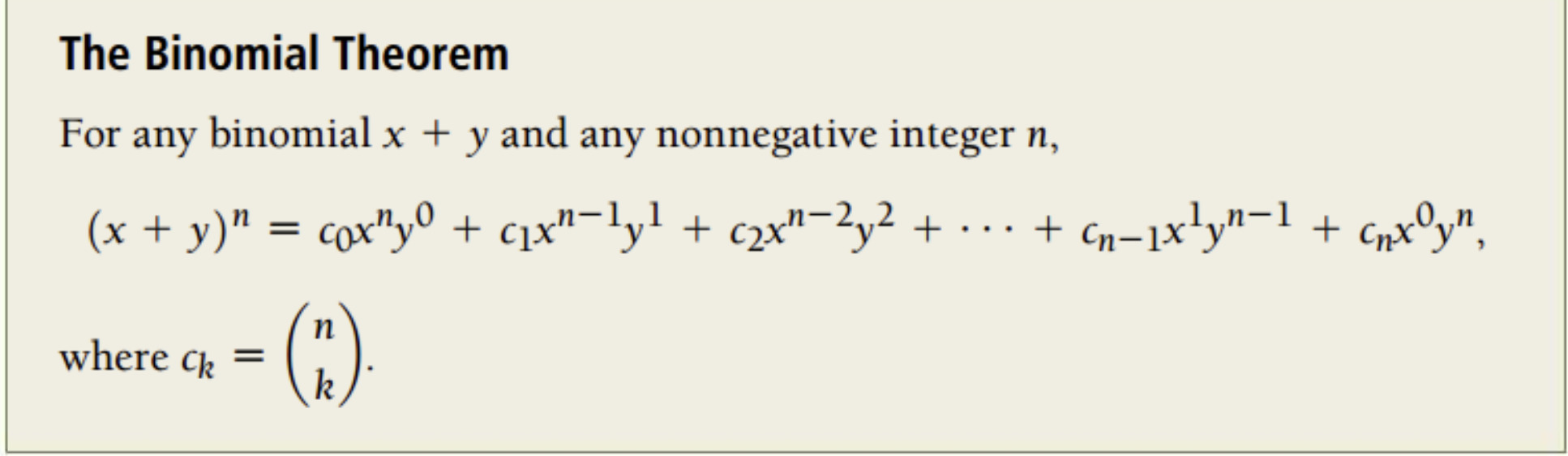
The Binomial Theorem and Combination Coefficients:

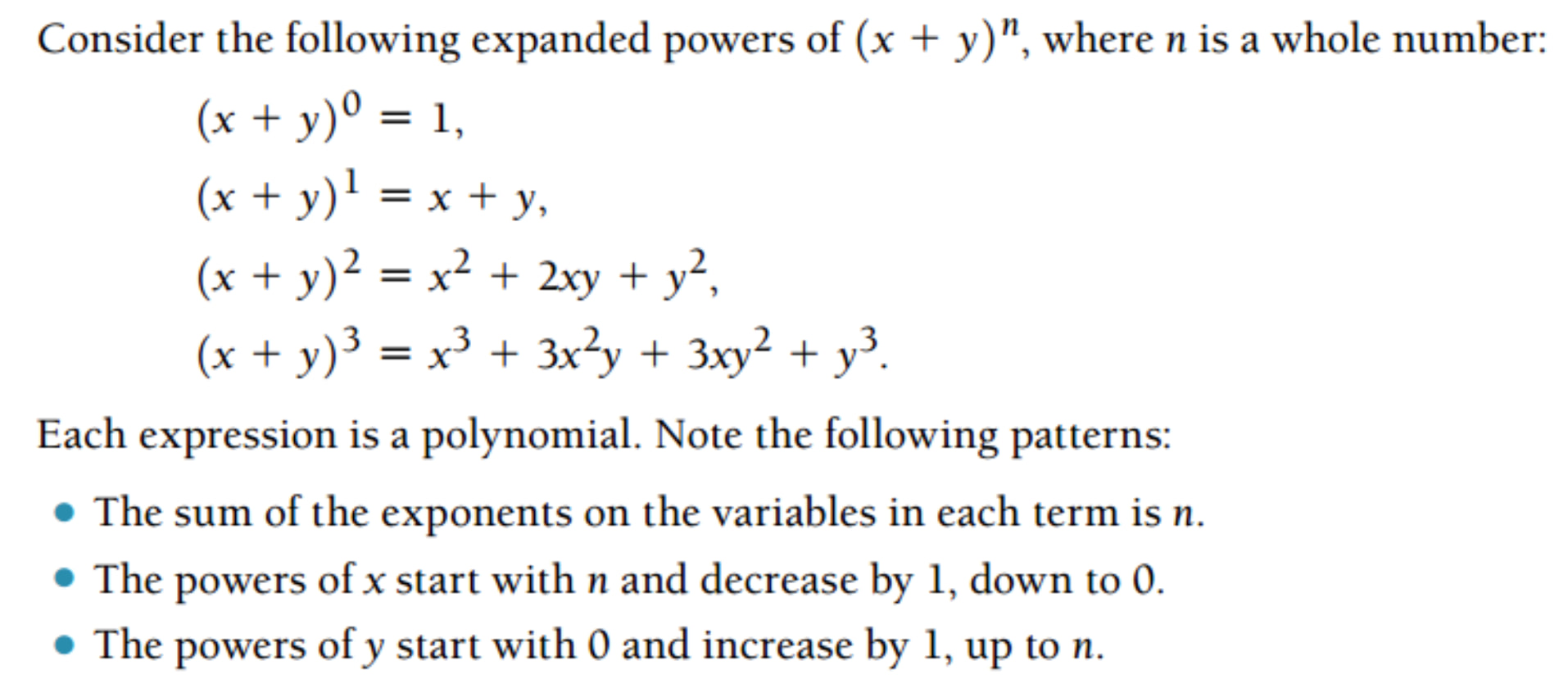
1.) “The sum of the exponents on the variables in each term is n.” Heh. So for the first one I kinda see it, no variable but I guess there could be an x to the 0 there equaling 1. Or 1 could have a power of 0. So the n values equal each other but the other ones are more confusing.

(x+y)1 = x + y. The sum of the exponents on the variable. What are the exponents on the variables? 1, no? 1 + 1 does not equal 2. Same with (x+y)2 , the variables add up to 6.

Hmm. I read it a bit closer. I think the “term” part is important. Whats a term again? Looking at some old notes a term is a number and a variable raised to some power (remembering that 1 and 0 are powers). Ok. So the sentence is saying that the sum of exponents on the variable parts of each of term is equal to n. Ok. Yeah that makes sense now.

2.) Ok. I see that. x2 then x then I assume (1)y2 .

3.) Ok. I see that.

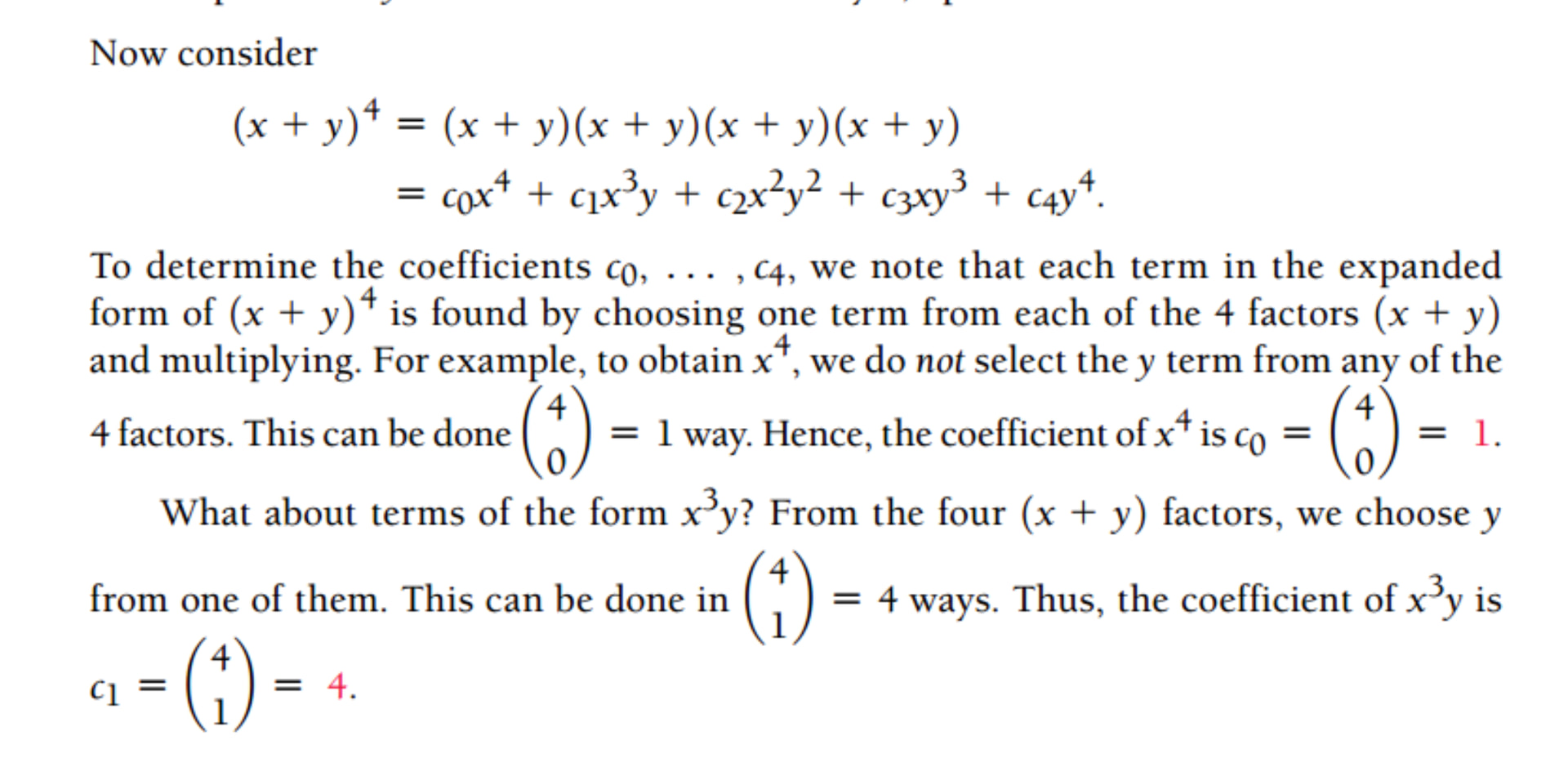
Ok. I get what they’re doing here in the sense of I get the combination stuff somewhat, but I don’t understand the relationship. They just say “we note that each term”. I’m confused. They make it sound obvious. I tried reading this a bit more closer too and I’m still confused. Is the confusion on this due to not understanding combinations well?

I think so.

n = 7

k = 2

Explanation:

You can only have two cupcakes. When you have the first cupcake you can have any of the first 7 cupcakes. When you have the second cupcake you have 6 cupcakes left so you can only choose from 6. So 7 * 6 = 42.

Hmm. Why can you multiply them? The you have 7 different objects. Those can be combined with 6 different objects. So the first object can have 6 different things with it, the second object can have 6 different things with it, etc.

So you multiply one number for each thing you pick, right? So how many numbers will that be in general?

How many numbers are multiplying in general? k numbers. If you ate 3 cupcakes out of the 7 you would be multiplying 3 numbers. So yeah, you multiply by the number of things your taking out(?) of the group of objects, k.

OK so for 22 cupcakes out of 157, how many numbers will you multiply? What are the first 3 numbers? What is the pattern? How do you figure out the 4th number?

I will be multiplying 22 numbers. The first three numbers are 157, 156, and 155. You subtract one number each time. Or like for the for the third number it was n - 2. So the fourth number is n - 3. First number starts off at at 1 or n-0 and then you subtract 1 each time. So the second term is found by n-1, third term is n-2, fourth term is n-3, etc.

I feel like thats kinda wack. It did this for the other two exams too. I can understand maybe not wanting to pressure them to go through everything but idk. If you don’t go through everything you will not know enough for the exam potentially. Like it says I can do the Review (which are the quizzes btw). But it doesn’t take into account what you’ve learned/mastered. It just gives questions from the whole unit.

Yes. So what’s the last number you’ll multiply?