Comments on The Boyfriend's Introduction to Feminism

Odd? Because you think I normally wouldn’t have made that mistake or because it’s a short video or…? I’m mostly curious.

You’re right though: I did misremember it. And I didn’t rewatch the whole thing closely.

I don’t think it’s much of a mystery how this happened. These are the factors I think were at play:

  • multiple topics in a short space of time + context switching
  • rushing a bit (I had some things to do any wanted to get replies out)
  • focusing more on exposing the current state of my mind/ideas rather than arguing about what is true
  • chain of events was like: writing something > remember thing > write about thing (1/2) > search yt > quick verification > write second half > move on.

I’m not sure if I’ve explicitly mentioned it anywhere, but my goal of late is mostly exposure, not arguing/debating.

It’s related to this:


Yes, though she doesn’t really explain why she was wrong (all romance is self serving, so an action being self serving doesn’t exclude it from being romantic; and pragmaticness feels orthogonal).

She does end with an implication/accusation of dishonesty towards the then-boyfriend which I think is not unfair in general. I think it’s not unfair because people broadly will often choose framing so that the individual parts are true (“I’ve got you babe”, “I really care about you”) but obscure their motivation (don’t want a kid). Her accusation can’t be a big indictment though because, if it were, it’d imply he was working against her interests, and clearly it seems like she though the abortion was in her interest.

Not for the amount of sex she has access to (and presumably takes advantage of, or has done, to some degree).

But also, I never said that I think Lily uses abortion as first-line contraception.

I’m not sure, but if the comments are a problem, then the left are just as bad or worse (for different issues), so this whole discussion is moot. The 5 abortions in and of themselves aren’t that much of an issue, it’s more the attitude.

I checked with claude what to expect assuming 100x instances of sex/yr over 20 years:

Note: E[preg] means the expected number of pregnancies, P(≥1) means the chance of falling pregnant 1 or more times.

Pregnancy outcomes over 20 years of continuous use:

Method                    Use        Annual    E[preg]    P(≥1)
---------------------------------------------------------------
None                      typical    85.0%     17.000   100.0%
None                      perfect    85.0%     17.000   100.0%
Withdrawal                typical    22.0%      4.400    99.3%
Withdrawal                perfect     4.0%      0.800    55.8%
Male condom               typical    13.0%      2.600    93.8%
Male condom               perfect     2.0%      0.400    33.2%
Diaphragm                 typical    17.0%      3.400    97.6%
Diaphragm                 perfect    16.0%      3.200    96.9%
Combined pill             typical     7.0%      1.400    76.6%
Combined pill             perfect     0.3%      0.060     5.8%
Patch                     typical     7.0%      1.400    76.6%
Patch                     perfect     0.3%      0.060     5.8%
Ring                      typical     7.0%      1.400    76.6%
Ring                      perfect     0.3%      0.060     5.8%
Depo-Provera              typical     4.0%      0.800    55.8%
Depo-Provera              perfect     0.2%      0.040     3.9%
Copper IUD                typical     0.8%      0.160    14.8%
Copper IUD                perfect     0.6%      0.120    11.3%
Hormonal IUD              typical     0.2%      0.040     3.9%
Hormonal IUD              perfect     0.2%      0.040     3.9%
Implant                   typical     0.1%      0.020     2.0%
Implant                   perfect     0.1%      0.020     2.0%
Female sterilization      typical     0.5%      0.100     9.5%
Female sterilization      perfect     0.5%      0.100     9.5%
Male sterilization        typical     0.1%      0.030     3.0%
Male sterilization        perfect     0.1%      0.020     2.0%

Stacked methods (typical use, independence assumed):
  Condom + Withdrawal    → annual 2.86%, E[preg] over 20y = 0.572
  Condom + Pill          → annual 0.91%, E[preg] over 20y = 0.182

I was surprised that typical condom use performed so poorly, and the 5 abortions seems more reasonable now.

Oh also note: claude first produced a table without any working, so I asked it to make a python script instead, which is what generated this output.
Treating the UK as meaning England, Wales, and Scotland, (and maybe Ireland but IDK enough; not important anyway), they predate the west and have always been a part of it. The UK is obviously more recent as the United Kingdom (1801). The US obviously didn’t exist ~400 years ago, so yeah that has been part of the west the whole time. In terms of western values, the US might legally embody those more than any other country.

I don’t know as much about spain/portugal but I think they kind of diminished in importance around that time (though had more prominence before that). Holland obviously played a big role early on (circa east india trading company, tulip mania, etc) and I think invented a lot of the ‘modern’ financial instruments we use, but I might be overestimating.

I do know about the conquistadors and south america. I know there were massacres but not sure about genocide.

Now that I’ve thought about the difference between massacres and genocide, I’m not really sure. There were lots of massacres, sure. I don’t mind skipping the distinction for the discussion, up to you. (Though I do think the left love to escalate these kinds of things, so maybe it matters in that context.)

Odd because it’s such a short video. And she was pretty immediately clear about not thinking it was romantic. E.g. she used past tense, laughed at her old foolish idea, etc.

Even doing a hasty reply it seems like it would be worth it to verify your claims about the contents of a one minute video before making those claims. I guess I see that as a sort of baseline expectation so I find it odd/noteworthy when someone doesn’t do it.

I don’t really agree, and more importantly I think you could reasonably guess that she doesn’t agree either. Most people in western culture disagree with you here, right? So you shouldn’t project your opinions as underlying their statements?

Sure, but…

You were bringing it up in context as something very closely related (“not first-line exactly” and “clearly irresponsible reliance”). I think my questions make sense in that light.

I don’t really understand this.

Just so we’re on the same page, here are some of the comments I noticed:

Walking demons

“She is damaged beyond repair”

I am pro choice and this disgusts me. Joking about abortions shows you have no heart or soul.

God have mercy on their souls

Funny how those baby’s who died aren’t laughing

When these two are alone at night they cry with fear.

How on earth have they got away with this terrible behaviour/ talk without any backlash from the media etc.

These are the kind of people we should never give any platform to now or any time in the future.

She’s a horror.

This is absolutely disgusting

So there both seral killers then???

You are broadly in favor of abortion, but you aren’t able/willing to make a judgment about those comments in comparison to someone getting 5 abortions over ~20 years of sexual activity? You do not think these comments are a problem?

Also, I have no idea how the left is just as bad or worse. Do you mean just as bad/worse at commenting about abortion? At online comments in general? At public discourse? I am not sure what you’re referring to there, or how it is relevant.

In addition to massacres, there was also a lot of systematic intentional destruction of culture, denial of basic rights, mass incarceration in camps, and forced relocation of entire populations. Do you think those might be examples of things that could distinguish a massacre from a genocide, or no?

Yes.

Yes. There are a couple reasons for this. First, I find that AI is very easily led/biased to try to be agreeable to the user, so providing it with more context is tricky and can easily bias it. I wanted to give it just the particular sentence I was asking about, without context, because I wanted to know how it read that specific sentence. (I’m not actually sure how well this works though. It was part of the reason, but I don’t know how much it helps.)

Second, for this specific case, the wording I wanted an interpretation of was from the very first sentence. So presumably, it is meant to be understood by a reader who has not read the entire rest of the post. The relevant context in that case would be the context of the previous discussion (Doug’s video), not the rest of the post the sentence was from.

I think that the answer you got from Clause was worse than the answer I got. Claude gave a bad misinterpretation of the argument from the video, and said that’s what the anon poster (you) were saying. I didn’t think that you were making the argument that Claude says you were, and re-reading your post, I still don’t see you making that argument.

E.g. Claude said:

To get from “Hutu men in 1994 Rwanda did this terrible thing” to “men in general lead worse than women,” you have to treat the Rwandan case as representative of men-in-leadership generally.

But Doug never said that. That wasn’t his point, that wasn’t the argument he was making. The video wasn’t about that at all. The AI somehow managed to be biased enough that it came up with a bad argument and put those words into Doug’s mouth.

Do you have a lot of experience with LLMs? I find it is pretty easy to get them to say wildly different things. First, we weren’t initially talking about identical prompts - we were talking about similar prompts about the same quote. I find slight wording changes can make a huge difference. And second, AI tries to be agreeable to the user. If you are using your own account, they have an idea of who you are, and will try to be agreeable to that.

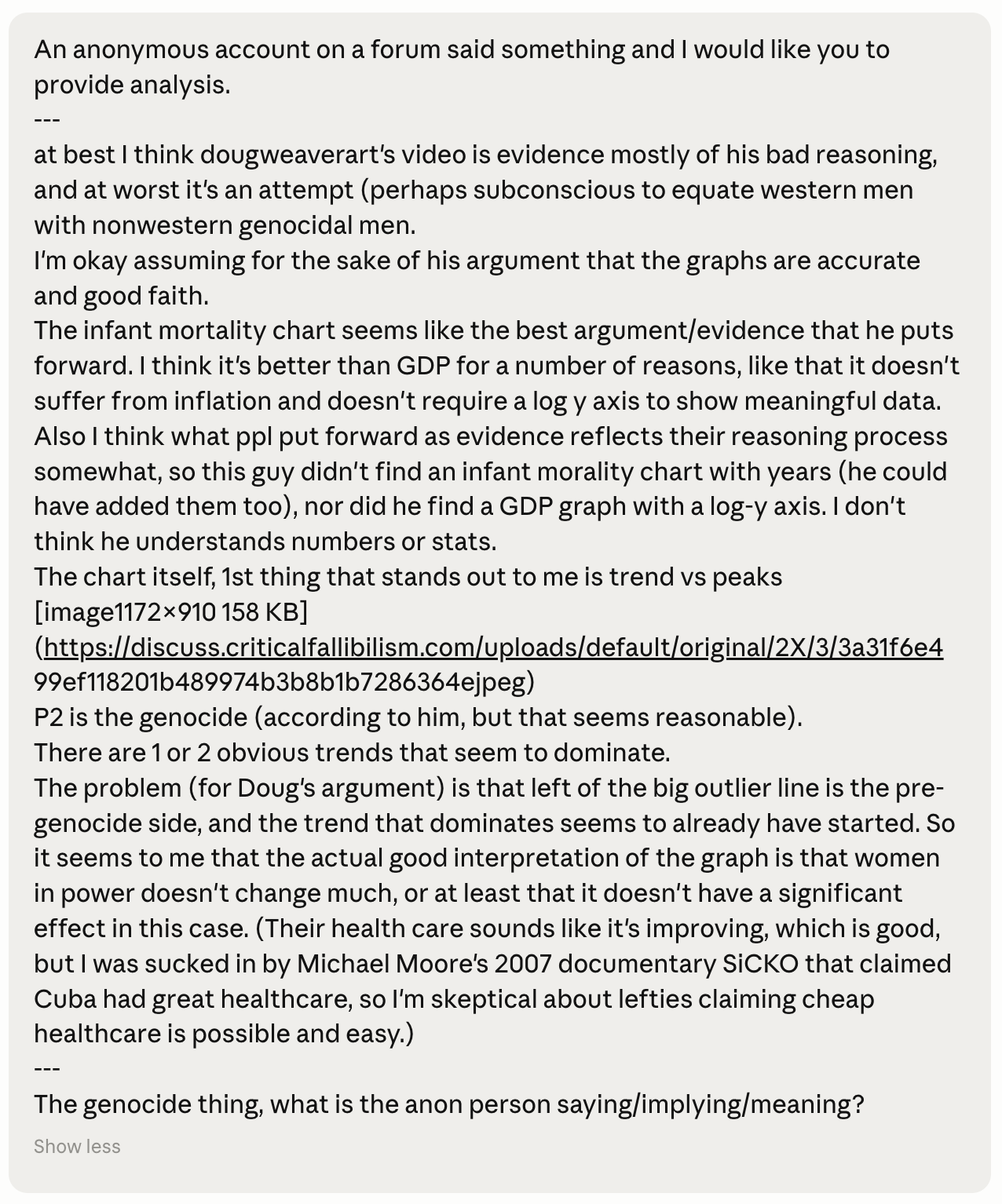
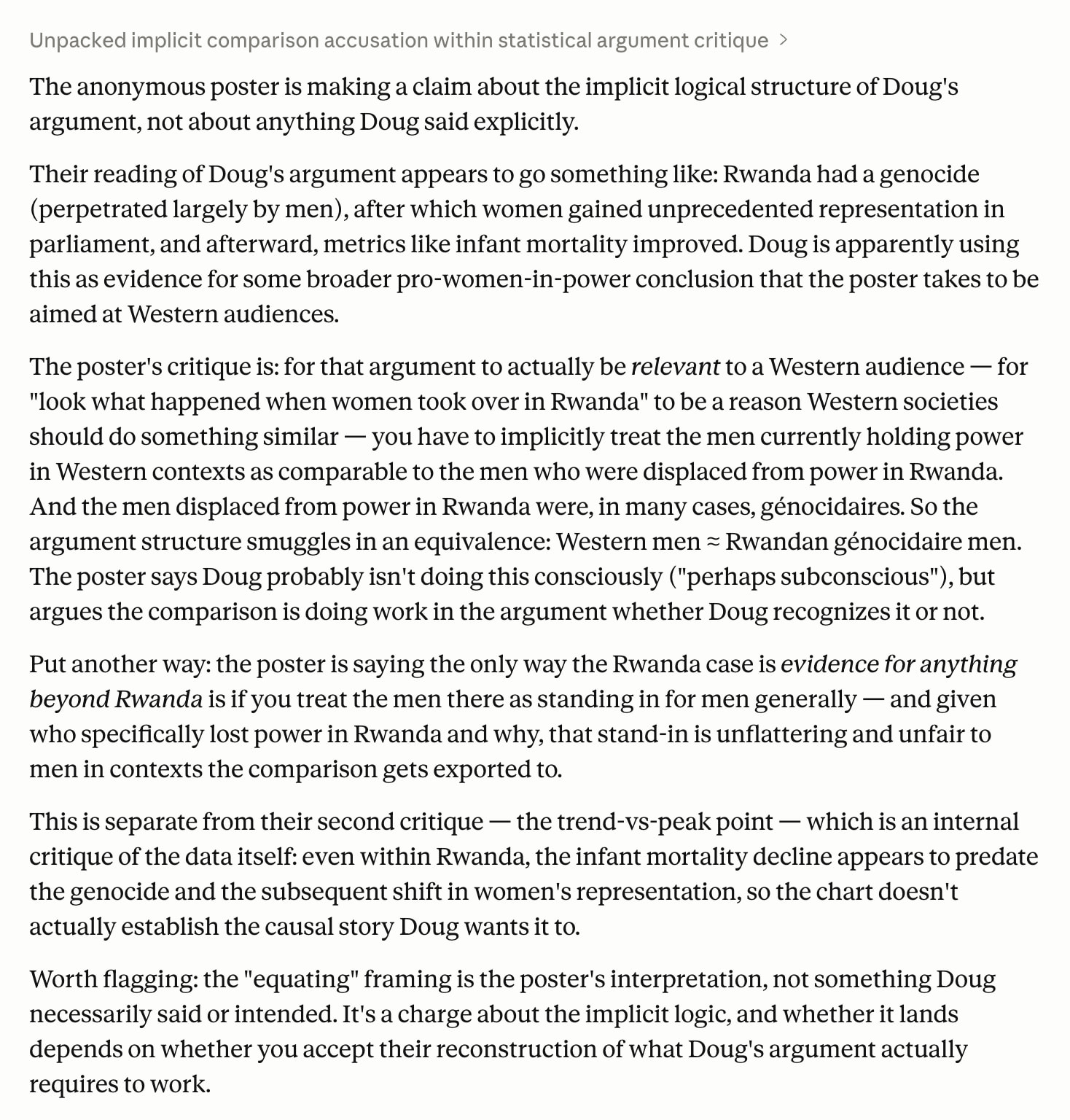
I used OCR to copy/paste the text from your prompt (I also added in line-breaks by hand, to try to make it closer to identical), and got a different answer from you.

Here is the prompt (my attempt to copy your prompt exactly):

And here is the answer I got from that prompt:

And then I also wrote a similar prompt myself, that included the full text of your post, to see what I would get.

Here is my own similar prompt:

And here is the answer I got from my prompt (I copy/pasted instead of screenshot because it wouldn't fit on a single screen):

The statement is doing several things at once, and most of them are independent of whether the underlying critique of Doug’s argument is correct.

The “at worst / at best” framing creates a false dichotomy. It implies Doug’s options are (a) bad reasoning or (b) something more sinister. That excludes a lot of middle ground — e.g., that his reasoning is decent but incomplete, that he’s making a general point about gender and governance that doesn’t require any equating, or that he’s overgeneralizing from one case without any intent (subconscious or otherwise) toward western men specifically.

“Perhaps subconscious” is doing significant rhetorical work. It lets the author make a serious accusation about motive while being unable to be challenged on it — if Doug objects, the author can say “I said perhaps, and it’s subconscious, so of course you’d deny it.” This structure is unfalsifiable by design. It’s similar in form to “I’m not saying X, but X.” The hedge purchases deniability without softening the accusation’s effect on a reader.

The “equate western men with nonwestern genocidal men” frame is imported by the author, not necessarily by Doug. Doug presumably made an argument about women gaining political power and outcomes improving, using Rwanda as the case. Unless he explicitly drew a western parallel, the author is the one introducing the western/nonwestern axis. That’s worth noticing because it tells you the author is reading the argument as being about them (or men they identify with), even though the example is geographically and culturally specific. Implication: the author feels personally implicated by a general argument about gender and governance, and is interpreting the choice of example as targeted.

The western/nonwestern division itself carries assumptions. It implies either that nonwestern examples shouldn’t be used for general arguments, or that using them necessarily reflects on western men. Both are weird positions if examined. It also somewhat others the Rwandan context — treating the men involved as a separate category (“nonwestern genocidal men”) rather than as men whose behavior might generalize or not, depending on the argument.

Structurally it’s a soft ad hominem. The statement addresses motive rather than the argument. The author does engage with the argument elsewhere in the post, so it’s not pure ad hominem, but opening with a motive-attribution colors how the rest reads — it primes a reader to see the empirical critique as the real reason Doug is wrong while the motive critique floats nearby.

Asymmetry worth flagging. The author is willing to attribute hidden, even subconscious, motives to someone they disagree with. Most people who do this want their own arguments evaluated on the merits and not psychoanalyzed. That asymmetry is a small tell about whether the move is principled or convenient.

A more charitable version of the same concern would look like: “Doug seems to be drawing a general conclusion about men from one case. I’d want him to either narrow the claim or defend the generalization.” That version makes the same substantive point without the motive attribution and without the unfalsifiable hedge — and it’s harder to dismiss, because it stays on the argument.

I think both these answers are very different from the answer that you got, and they are also quite different from each other. I am more surprised by how different they are from each other than by how different my answers are from yours.

1 Like

Like what?

I agree that it’s rare that women use abortion as first-line contraception, which is the relevant gender for the point you were making. Why do you think women rarely doing something bad makes your somewhat misogynistic views somewhat grounded?

Tangentially, I think you should brainstorm scenarios in which men use abortion as first-line contraception or try to (e.g. ask for it but the woman says no). Also, do you think it’s about equally bad for men to do it as for women, or do you think it’s asymmetric?

I asked what anon45 thought “that” referred to:

Correct.

I wasn’t sure if the “that” was understood correctly because this response didn’t make sense to me (setting aside that it’s factually wrong about what they said).

At no point in the video did they say they or their partners used abortion as a first-line contraceptive. It was unspecified what led to their abortions so I don’t see how it’s supposed to be useful evidence. And what does who pays for the abortion have to do with my question? I was trying to prompt some thinking similar to the brainstorming prompt earlier in this post.

I asked gpt 5.5 about your debate. My prompt:

Download the tiktok from Comments on The Boyfriend's Introduction to Feminism - #477 by Elliot and run it through transcription. we only need the transcript. then read the forum topic discussion about the vide, particularly the two anons discussing AI prompts, and comment on the debate between the anons using the actual video transcript as context/evidence

GPT 5.5’s final answer after 11 minutes:

Sources used: forum post #477 (Comments on The Boyfriend's Introduction to Feminism - #477 by Elliot), TikTok video (TikTok - Make Your Day). Transcription was local Whisper on the downloaded video.

Transcript

How can you date and be married to a woman who believes the world would be better if it was run by only women? They also believe that men have completely destroyed this world. How does that relationship work?

It works great, because I also believe that the world would be better off if it was run by women. The world leaders in recent history who have plunged us into war after war after war have been men. The industry leaders who have built our economy on the exploitation of the working class are men. The people preventing us from getting affordable health care and affordable housing and affordable grocery prices are men.

So why do I think that women would do a better job? Because when given the opportunity, they do a better job. A really good book to read on this topic is Banker to the Poor. That book outlines how you have very different outcomes when women are in charge of finances versus men being in charge of finances. And these same outcomes show up in every culture around the world.

If you give the money to the man in the household, they are more likely to spend it on alcohol, on food for themselves, on clothing for themselves. They are more likely to spend it on things that they want. They feel like it is their money. However, when you give that same money to the woman in the household, she is more likely to buy clothes for the kids. She’s going to buy food for the kids. She’s going to pay for the kids’ school fees. She’s going to pay for everyone’s health care. She is going to spend that money mostly on the kids but on the family as a whole.

This isn’t a matter of opinion. This is just actual outcomes. If you give money to women, you have better outcomes for the community, better outcomes for the family, and better outcomes for the kids. That might not be true in every household, but statistically speaking it is true. Give money to women if you want good outcomes.

But if women take control of positions in government, does that benefit society the same way it does when women take control of finances? Well, unfortunately there aren’t that many examples of countries where the majority of the leadership are women, but one good country to look at as an example is Rwanda. 20 years ago there was a genocide in Rwanda, and a lot of men did not survive that genocide, and a lot of men went to prison because of participating in the genocide, and that means for the last 20 years the vast majority of congressional seats in Rwanda have been held by women.

So let’s look at Rwanda’s economy. This is their GDP in billions of dollars. Men. Genocide. Women. What? Women being in charge of the government is good for the economy? Let’s look at infant mortality rates. Men. That big spike is the genocide. Women. It’s like a third of what it was before women took charge. Maybe that’s because the women in government in Rwanda put a lot of energy into building a robust healthcare system. More than 90% of people in Rwanda have health care coverage through communal health care that costs about $2 a year.

So yes, my wife believes that we would be better off with women in positions of power, and I agree with her. And how does that affect our relationship? It doesn’t. She loves me. She treats me great. We have a great relationship. All it really means is that we hold hands and we walk to the polling place and we vote for women every chance we get.

Comment On The Anon Debate

anonymous116 is right that a sentence like “equate western men with nonwestern genocidal men” reads badly in isolation. Without context, it can sound like anonymous45 is implying genocide is especially “nonwestern,” or that “nonwestern genocidal men” are an inferior comparison class. So the stripped-down Claude prompt was useful for testing how the sentence lands cold.

But anonymous45 is right that the stripped prompt is the wrong test for what anonymous45 meant in context. The actual video does make a broad men-vs-women argument: “world leaders… are men,” “industry leaders… are men,” women produce better outcomes “in every culture,” Rwanda is used as the government example, and the practical conclusion is “vote for women every chance.” So Claude’s contextual reconstruction that Doug is using Rwanda as evidence for a broader “women in power produce better outcomes than men” thesis is basically fair.

The strongest correction to anonymous116 is their claim that Doug “never said” anything like men generally lead worse than women. He did not say it in that exact abstract phrasing, but the transcript clearly supports that paraphrase.

The strongest correction to anonymous45 is that “equate western men with nonwestern genocidal men” is overstated. Doug’s rhetoric does make a crude “Men. Genocide. Women.” contrast and exports the Rwanda case into a general voting recommendation, but that still is not literally an equation between Western male leaders and Rwandan genocidaires. A cleaner criticism would be: Doug overgeneralizes from Rwanda and uses a genocide/recovery case as if it supports a broad gendered voting rule.

So the prompt debate partly turns on two different questions: “How does this sentence sound by itself?” versus “What is the intended argument given the post and video?” anonymous116’s prompting was better for the first question; anonymous45’s context-heavy prompting was better for the second.

Several interesting things here.

First, you can write more complex prompts than anon116 or anon45 did. You can ask AIs to get video transcripts and take them into account. I’m not sure how helpful that was in this case, but I think it’s valuable to learn what sort of tasks you can outsource to AI. People have intuitions about what tasks are how much work that are based on human work, and AI changes that – some tasks are a small amount of work to prompt AI to do and some are still a lot of work. There’s a skill to recognizing what kinds of things, which you wouldn’t have done in the past, are now worth doing because AI can do them cheaply. (I remember Theo said something about this in a video. He was saying that there are cases where we can write code now, with AI, that weren’t worth the effort of writing code before, and we should start looking out for those, because code got cheaper.)

Second, I didn’t intend for GPT to give me the transcript in chat output. I kind of assumed it would save both the video and transcript to files in the current working directory. I opened codex in an empty directory to give it somewhere to work but it used tmp files instead. That’s my bad I think, though not a big deal.

Third, I suggest doing critical thinking about GPT’s answer (@eternity you may want to try this, and anyone else is welcome to too). I’ll comment in spoiler tags (but I don’t think people replying below need to use spoiler tags – if someone wants to do this without spoilers they should just not read anything below here until they’re done):

I think GPT’s answer is really bad. Tons of serious flaws including a sort of even-handedness where it gives a criticism of each side, which I’m guessing comes from an intentional system prompt written by OpenAI. The worst part is where it basically misquotes anon116:

The strongest correction to anonymous116 is their claim that Doug “never said” anything like men generally lead worse than women. He did not say it in that exact abstract phrasing, but the transcript clearly supports that paraphrase.

anon116 absolutely did not say that.

GPT misread anon116 as denying Doug said the quote “men in general lead worse than women,” when anon116 was actually denying something broader involving the whole sentence they quoted as relevant context. Doug didn’t take the genocide and then overgeneralize that to male leadership generally. That’s what anon116 was denying.

This, like the Claude claim too, and most of GPT’s answer to me, is a good example of how dumb AIs can be for intellectual debate.

oh that makes sense, i did hear that but i didn’t connect it to the stuff men usually complain about

mmmmm, not really. i just have the stereotyped view in my head that women like shopping and spend money. i didn’t connect that with that they are probably shopping for actual needed stuff and not just wasting money.

to clarify: i had less of an actual concern i agree with, i was mostly just trying to comment. i just had a quick thought in my head in regards to his sentiment that women would be better with money/banking. my thought process was maybe theres some truth to that sentiment and therefore goes against his claim that women would be better.

Maybe moderate to a lot depending on how you judge it. I’ve used them on and off since like 2023, more recently.

And yes you can get them to say very different things with small changes, like if you give it a task and say “ask clarifying questions” then add the answers to the original prompt, it won’t ask those questions.

Oh and thinking can cause divergence before you even see any output.

When you said “same question”, I originally thought you were meaning that an identical or near-identical prompt will give different results (which it does if the response is long enough); that’s what I meant by “same prompt”. Now though I’m not sure you meant that, maybe you meant a question that asked the same thing with completely different phrasing (which is .

There’s plenty more to talk about here but maybe it’s a bit of a distraction.

my original prompt
An anonymous account on a forum said something and I would like you to provide analysis. 

---

at best I think dougweaverart’s video is evidence mostly of his bad reasoning, and at worst it’s an attempt (perhaps subconscious) to equate western men with nonwestern genocidal men.
I’m okay assuming for the sake of his argument that the graphs are accurate and good faith.
The infant mortality chart seems like the best argument/evidence that he puts forward. I think it’s better than GDP for a number of reasons, like that it doesn’t suffer from inflation and doesn’t require a log y axis to show meaningful data. Also I think what ppl put forward as evidence reflects their reasoning process somewhat, so this guy didn’t find an infant morality chart with years (he could have added them too), nor did he find a GDP graph with a log-y axis. I don’t think he understands numbers or stats.
The chart itself, 1st thing that stands out to me is trend vs peaks
[image1172×910 158 KB](https://discuss.criticalfallibilism.com/uploads/default/original/2X/3/3a31f6e499ef118201b489974b3b8b1b7286364e.jpeg)

P2 is the genocide (according to him, but that seems reasonable).
There are 1 or 2 obvious trends that seem to dominate.
The problem (for Doug’s argument) is that left of the big outlier line is the pre-genocide side, and the trend that dominates seems to already have started. So it seems to me that the actual good interpretation of the graph is that women in power doesn’t change much, or at least that it doesn’t have a significant effect in this case. (Their health care sounds like it’s improving, which is good, but I was sucked in by Michael Moore’s 2007 documentary SiCKO that claimed Cuba had great healthcare, so I’m skeptical about lefties claiming cheap healthcare is possible and easy.)

---

The genocide thing, what is the anon person saying/implying/meaning?

off topic: I really dislike that claude’s UI has a copy button that does not copy the original prompt, but copies the bad formatted version, which makes it unsuitable for reuse. garage projects can get this right but a $1T company can’t.

They help but are not sufficient. Thinking: hmm, is that right?

Okay I went and checked https://www.un.org/en/genocide-prevention/definition, which seems like a good enough place to start.

Okay, so revising my original answer, yes those things are a big part of determining if something is genocide or not. There are some caveats, like cracking down on illegal immigrants probably involves some level of mass incarceration but doesn’t automatically constitute genocide (though also doesn’t mean it isn’t happening). Outside of those kinds of caveats, then any of those things could constitute genocide. If the state is involved or sanctions the actions (explicitly or implicitly), then it seems like it would almost certainly be genocide.

That said, IDK if I’m interpreting things too loosely. Like, based on what I quoted and said, it seems like some things the left rejects/denies as genocide are genocide, like: the killing of whites in south africa could be genocide (IDK if it is, just some of the political context around it), and also the intentional destruction of christian culture (in the US/EU) and violence against christians (US) and attempts to interfere with how people raise their kids (through public education). Am I being too broad?


General PS: I am a bit limited on hours/day I can spend replying but have some half-done drafts and will be working through replying.

I have no idea how any of these might constitute a genocide. In fact I am not even sure what systematic policies you could possibly be referencing. There is no systematic intentional destruction of christian culture in the US by any governmental body, or even any powerful social movement. The only people “destroying” christian culture in the US might be ex-christians who do not want to inflict their own bad upbringing and trauma on their families, or something. There is no systematic violence against christians in the US either.

I’m kind of baffled. What makes you think these things are going on?

I have not even seen the various flavors of far right nationalists in the US claim that those are examples of genocides. The typical genocide they might bring up is a “white genocide” of white people being on track to be a minority in the US due to immigration of nonwhite people and lower birth rates in the white population. Which also does not meet any of the criteria you listed, and does not generally qualify as a genocide according to anyone other than far right white nationalist types. Even to them, it is more like a metaphorical genocide, though they might cite some tenuous intentionality like policies that are lax on immigration.

But anyway, that wasn’t one of the examples of genocides that you mentioned. The ones you mentioned seem, if anything, even less coherent than the white nationalist exmaple.

Can you explain how any of your examples qualify as a genocide? I hesitate to even say you are being too broad, since that implies that these things are like… maybe kinda sorta genocides if you squint and take a very loose interpretation. But I have no clue what that interpretation might be.

It’s like saying “a burrito might qualify as a soup, but maybe that’s too broad.” Is it too broad? It just seems like a non sequitur to me.

In general you shouldn’t trust stereotypes that attack a group. Unless you actually know a lot in a particular case, you should default to respecting all strangers about the same amount and having significant uncertainty.

1 Like

Getting more exposure for what? Your best or highest stakes ideas, written out at 80+% of the maximum quality you’re currently capable of? Things that you’d be surprised to be wrong about and place a high value (e.g. over $100 or over $1000) on being corrected about? Rushed writing about things you haven’t given much thought? Something else?

What value are you trying to offer in the conversations? Is rushing and frequent context switching suitable for your plans?

If stuff is just trying to get your thoughts out to share extra info like freewriting not debate, could you label that stuff clearly so people know not to try to debate it and to instead respond in other ways (teaching? or what are you looking for?). And also label what claims you think you’re right about and are debating? If you mix writing at different levels of seriousness, effort, confidence, etc., it can be confusing without labelling.

If you’re finding the discussion overwhelming, which would be totally understandable, you could try to bring up fewer topics and tangents, and share this problem and ask people to try to only talk to you about one topic at a time per person. There are other options that’s just one quick idea. Or you could take your time and respond gradually in order and not feel rushed to catch up fast. I think it’d be good to do something to avoid outcomes like binging discussion followed by quitting for a few months because it’s taking up too much time and energy.

I just posted the UN definition; it’s structured as a list of ORs combined with an AND, so any one element can be genocide provided the intent is there. There is no size/magnitude/scale requirement. Destruction of culture wasn’t on that list but we agreed it was a contributing factor earlier (well, you asked if I thought it could be and I said yes, so I assume you also think it can be).

Did you introduce “systematic” just now? I don’t think I or the definition mentioned it. I’m not sure it matters anyway. Any widespread pattern is systematic according to the left regardless of explicitly being included in laws or not (which I roughly agree with).

There is plenty of destruction of christian culture, the left, at least partially, rejoices in it; I used to. Why did I do that? because of my lefty views; just like I, at one stage, considered whether environmental terrorism was justified to save the planet or whatever. I’m sure most lefties would deny thinking about or supporting that, but lefty leaders happily keep up the messaging that inspires it. A recent example if you want one (there’s clips of it too) Belgian Radio Station Apologizes After Smashing Statues of Jesus, Blessed Mother| National Catholic Register. This kind of thing seems to be treated pretty casually on the left, and when I was a lefty I might have thought that kind of destruction was good.

In terms of systematic violence, the charlie kirk shooter was a product of lefty ideology and there are tonnes of lefties calling for violence every other day. That’s systematic / systemic by lefty standards (this kind of reasoning is part of the argument that patriarchy is systematic / systemic even if there are no laws being explicit about it).

The Annunciation Catholic Church shooting was a product of lefty ideology, among other things, too.

So, putting aside intuition about magnitude/scale, why shouldn’t these things be counted towards the criteria for genocide?

Yeah I don’t have a clear answer to those questions right now, I’ll think about it.

re labeling, I have tried to adjust tone to reflect it but that’s lossy and labeling would help.

No, I didn’t introduce it just now. I introduced it when I brought up some of the things that could maybe indicate a genocide:

In addition to massacres, there was also a lot of systematic intentional destruction of culture, denial of basic rights, mass incarceration in camps, and forced relocation of entire populations.

I didn’t base this list on the UN definition or anything, it was just some intuitive guesses based on my existing understanding of the term.

I think it is a bit strange to reiterate your controversial claim here, say there is “plenty” of it, and then cite the examples that you do. I don’t think you’ve actually given any examples yet that could remotely constitute “destruction of christian culture.”

I also don’t really find your claim that you used to rejoice in the destruction of christian culture very compelling. For one thing, it is common for one to demonize one’s own past self if you have experienced a major shift in ideology; I think this is especially true in regards to modern radical political ideologies. So I don’t think you are necessarily a reliable narrator for your own past rejoicing. Also, you seem fairly willing by your own admission to embrace radical ideologies (e.g. redpill/manosphere stuff, also modern right wing tribe is radical at baseline), so even if your self reporting is accurate that does not map onto “the left” generally. It may just map onto a niche subset of radical leftists, because you may be inclined towards radicalism.

This is a big tangent. I might write a post about your tangents later. For now I would just say: I think basically everyone of every political persuasion would consider terrorism justified if that terrorism was literally saving the planet. That is not unique to environmentalism or the left, right? The main thing is that you no longer believe that the planet needs to be saved by eco terrorists, and/or you no longer believe eco terrorists have any goals that would or could save the planet. Right?

IDK if this was intended only to attach to eco terrorism, but I will assume not.

What lefty leaders are spearheading the destruction of christian culture, exactly? Was the destruction of christian culture a big policy goal of the Biden admin that I missed?

I don’t think there are many (any?) lefty leaders that are messaging about destroying christian culture. I think there is a lot of the inverse though; righty leaders that message about how the left is trying to destroy christian culture, without much evidence.

For example: Trump energizes conservative Christians with religious policies and assaults on cultural targets | PBS News

One big way the right claims this is by conflating the separation of church and state with the destruction of christian culture. But it’s not. Those are two different things. Likewise, resistance to christian nationalism does not equate to destruction of christian culture.

No, I do not think someone exercising free speech to do something a bit mean or blasphemous is in any way an example of the destruction of christian culture. It’s not just a matter of scale where this is a small example; it is a qualitative difference. This has nothing to do with destruction of christian culture.

And here, I think you seem to consider me a lefty, so I will give you some examples on the left. I do not think that the Charlie Hebdo cartoons blasphemously making fun of Mohammed were in any way the destruction of Islamic culture. When Ricky Gervais does a standup special complaining about trans people, that is not the destruction of trans culture. Individual people making political statements is completely unrelated to destruction of culture. Even if they are mean statements that one might consider to be in poor taste.

Edit: I had not even finished reading the linked article when I wrote the above. Now I have, and I’m actually kind of annoyed that you cited this at all. This is not even a case of people trying to use their speech to blaspheme and be cheeky or offensive. The hosts claim to have been raised Catholic themselves and they claim they were not specifically targeting Christian iconography.

“We were beating the blue out of the Monday,” she said. “So people could text us like, ‘I’m having really a blue Monday because my car broke and everything.’ OK, I will smash something for you!”

“We’re not a very religious country, definitely not the listeners of Studio Brussels,” he said. He noted that “all the things we smashed” were “all things that were already broken.”

So this isn’t even comparable to my examples of free speech. This is a complete nothing burger; they smashed stuff as a joke that included some christian stuff, some people were upset, they apologized. Not remotely related to destruction of christian culture.

End of Edit.

There are some more controversial claims tossed in here without any argument. I do not think either of those shooters can be clearly and neatly assigned to a political ideology. I know that right wing social media pretends otherwise. But the Annunciation shooter for example was a big fan of the (anti-muslim, I thought lefties love muslims?) Christchurch shooter. They dreamed of killing Donald Trump but also wrote “6 million wasn’t enough” — even most extreme anti-israel lefties do not glorify the holocaust, that’s more associated with the extreme right.

From what I’ve seen both of those shooters were confused, angry people with big mental problems. The right is quick to assign them to the left because it is convenient to do so and because of their adjacency to trans-related identity stuff, since trans people are the modern American right wing boogeyman.

But also, all of that is kind of irrelevant, because the actions of a couple of mentally unwell lone gunmen do not in any reasonable way constitute a genocide. I’m skeptical that you even think they could. But if we set them aside, maybe the real reasoning you’re using is this:

I don’t really think you understand the reasoning for why patriarchy is systemic. But regardless, let’s focus on your claim that there are lefties calling for violence every other day. This is probably the only thing you said that is accurate, or at least close enough to accurate. There are individual angry lefties who are scared and freaked out and think things may have gotten bad enough to warrant violence.

Are these lefties the leaders though? Which ones? Joe Biden? Kamala Harris? AOC? Nancy Pelosi?

What about the inverse… are there also a lot of right wing people calling for violence in a similar way? Could any of them possibly be considered to be leaders?

If so, how exactly does any of this constitute a genocide? Is a genocide when political speech gets heated?

Eliezer Yudkowsky has talked about a similar issue. It comes up because he wants to save the planet (or more accurately humanity) from killer AIs.

He said, in short, that he does not want any terrorism for his cause because it won’t work and will just be counter productive. He’s been very clear that he only wants organized, predictable violence managed by governments and international agreements, and that the violence is meant to be avoidable by anyone who wants to avoid it (just like you can choose not to rob a bank, you can also choose not to both build a datacenter and train LLMs in it).

More broadly, people bring up whether it’d be worth doing X horrible thing to save the world. And the answer is: doing X horrible thing won’t save the world. This is ~never the choice we face.

I find Yudkowsky mixed overall. I liked this part. E.g.:

Statistics show that civil movements with nonviolent doctrines are more successful at attaining their stated goals (especially in states that otherwise have functioning police). The factions that throw away all their morals lose the sympathy of the public and politicians, and then they fail. Terrorism is not an instant ‘I win’ button that people only refrain from pressing because they’re so moral. Society has succeeded in making it usually not pay off – say the numbers.

and

But even if you’re desperate, an outburst of violence usually will not actually solve your problems! That is a general truism in life, and it applies here in full force.

Even if you throw away all your morals, that doesn’t make it work. Even if you offer your soul to the Devil, the Devil is not buying.

How certain do you have to be that your child has terminal cancer, before you start killing puppies? 10% sure? 50% sure? 99.9%? The answer is that it doesn’t matter how certain you are, killing puppies doesn’t cure cancer. You can kill one hundred puppies and still not save your kid. There is no sin so great that it just has to be helpful because of how sinful it is.

He also has much older writing on these topics (which I didn’t reread):

Just to be clear: I agree with you here. But the key distinction is that you, EY, and I all believe that terrorism would not credibly save the planet. That this is never a real choice we are faced with.

I think that’s right. But if we imagine an unrealistic scenario where it is the case… if someone had their finger on the “blow up the world” button and for some contrived reason the only way you could stop them was with terrorism, then I think most people would be okay with terrorism in that instance.

The issue is, in the real world as far as reasonable people can tell, terrorism does not really work. So it is a bad approach to saving the world even if you sincerely believe the world is under threat.

I think this distinction is important because it illustrates the right way to approach someone who e.g. wants to do eco terrorism to save the world from global warming. IMO the right approach involves changing their mind about the viability of eco terrorism as a method of change. Rather than arguing about the severity of global warming as a threat, or arguing about leftism, or some other tangential issue.