@anonymous45 I have noticed a trend in your posts that sometimes makes extended conversation difficult. I think it leads to a lot of tangents. I also think it contributes to you feeling overwhelmed and maybe getting burnt out. And might contribute to people getting frustrated when discussing with you.
The issue, as I see it, is this: In the middle of discussions you often throw in an assertion that is not directly related to the topic and is highly controversial. These are tossed in as what I would call an “aside” — a quick comment without much/any argument for it, stated as if it were a basic fact.
A few recent examples:
These examples are not comprehensive. I gathered them from just the past few days. I think it also happened several times during active discussion of trans/LGBTQ issues a few months ago.
None of these asides were argued for in the posts where you asserted them. I disagree with them, but more importantly I think they are all very controversial. I think many people would disagree with them, predictably. You could have (should have) known they would be controversial before you stated them.
I sometimes find these asides kind of fascinating, and end up arguing with them. But that typically means that you end up with multiple replies off of a single post, which I’m guessing adds to you feeling overwhelmed. Several such tangential threads have been entirely dropped in previous discussions.
I am not sure what can be done about this. Any ideas?
You thought it wasn’t controversial. But I wrote a reply arguing with it and quoting a reasonably popular intellectual who disagrees with it. (Though your statement was ambiguous between the premise being 1) the the eco agenda would save the planet and doing terrorism for that agenda 2) the terrorism itself, by premise, would work and save the planet. (2) is harder to object to.)
It’s hard to always accurately predict/know what’s controversial. But people can often do pretty well at it when trying.
Good point. I think I have since clarified in another reply that I did mean (2). But I phrased it ambiguously for a couple of reasons, at least one reason was intentional and at least one reason was unintentional (basically just sloppiness).
I agree. I don’t think making an occasional controversial aside is in and of itself a big deal necessarily.
Maybe you would like to argue it, but you aren’t sure if people will disagree, so you make the aside hoping that anyone who disagrees will object and start a side debate. IDK if that is the best way to start such a tangent but if it was what you were hoping for then at least it won’t lead to you being burnt out by the tangent I guess?
Also, sometimes you may not realize what you said is controversial. Either because you phrased it controversially by mistake or because you did not realize your opinion itself is controversial. People can investigate and seek clarification. Those tangents do not always have to be extensive; maybe you clarify your wording and that’s the end of it. Maybe once you realize your opinion is controversial, you retract your aside for the time being because you don’t want to start a new debate. Or other possibilities.
I brought this up as a distinct topic because it seems like a pattern that anon45 is not totally happy with.
Thanks for taking the time to post this. You’re right, both that I do this and that it contributes to breadth-first discussions that grow into a mess pretty quickly.
I should probably put more thought into making those kind of statements. I have a loose explanation about why I make them that says they’re useful to orient the opinion within like the ‘space’ of common opinions, but combined with the rest of the discussion that’s not necessarily the case. Like the genocide tangent: I don’t actually think that christians are being genocided in the west (and we can determine this ‘by inspection’; normal intuition is enough). What was interesting to me was that there might be a technical argument for it under the definition, since that would have implications for when the term is used in other contexts (eg the trans ‘genocide’; which I’d also argue we can dismiss by inspection… did I just do the aside thing? Is it relevant enough to justify in this case?[2]).
Anyway one of the reasons I bring that up is because I don’t like people (myself included) arguing for things that they don’t actually believe. It can be okay in a devil’s advocate / exploratory context, but it should be clear that that’s what it is. Also it’s probably better if I do the first round of that privately because often topics that initially appear interesting turn out to be boring or a waste of time.
I’ve been thinking the past few days of another thing that I’ve been doing recently, too, that is connected to those controversial statements: synecdoche. I think it’s worth separating this from a generalization, and there are times where I think the difference matters.
In this case, by synecdoche i mean identifying a property of a subset and applying it to the whole. eg, some leftists hate the west becomes leftism hates the west. Arguably it should work in reverse too, but I think the reverse is less common and mostly used defensively (eg not all X, .
There is an argument in favor of using synecdoche like this sometimes: if a party/coalition AB have two subgroups A and B, and A want to do X, and B want to do Y, and A is indifferent to Y and B indifferent to X, then it’s fair to say AB believe XY is good or similar, esp as shorthand, but it introduces a thinking-liability in that attributing belief in XY to any particular member of AB is impossible, so some lines of reasoning that might normally work will not work here.
Anyway, I’m off topic, hopefully that aside was a bit more interesting at least.
In terms of what to do, we’ve covered a bunch before (well maybe not us specifically, but Elliot has suggested debate trees, more focused writing, labeling, etc, and I’ve mentioned trying to slow down and think about my and my interlocutor’s goals which I haven’t been doing much lately. So I don’t think we’re short on ideas but I do need to be more intentional about discussion.
Maybe I should try connecting things back to foundational reasons too. Like with the abortion stuff, part of it is that I just don’t like it. It’s hard for me to feel supportive outside of conception via rape. Partly that’s because of where I see it going (ultimately post-birth abortions if we set the threshold at personhood). … Am I doing it again?
Okay maybe doing that isn’t a good idea if avoiding tangents is a goal. I’m just going to end the post here otherwise I’ll spend all evening on it and get nowhere. Might post more later.
It’s not technically stream of consciousness, but it’s the closest thing i can think of atm. ↩︎
IDK, we should probably discuss the actual use of the term first because maybe we both agree that (a) it’s overused and used too loosely and (b) there are things going on in the world today that legitimately could be ↩︎
Yes, I would say that dismissing the possibility of a trans genocide is another controversial aside. The existence of a trans genocide is pretty straightforwardly controversial. Lots of people think it is happening, and trans people are in significant danger, and are losing rights. While lots of other people think it is all made up and trans people are not being persecuted at all and are instead just mentally ill, and their gender identity should not be recognized as legitimate and they should be banned from receiving gender affirming care (and that calling it “gender affirming care” is an evil lie that nobody should be allowed to say). And then there are lots more people who think trans people are in danger and losing rights but aren’t sure that rises to the level of “genocide” per se.
It’s a hot button issue about which many politicians constantly shout and ring alarm bells. Highly controversial.
However, I actually think this inadvertently reveals another distinction that I did not recognize explicitly or mention in my first post. Because in the context of this post, you dismissing the possibility of a trans genocide is basically irrelevant. It has nothing to do with the topic at all. So I can ignore it if I want to, and that doesn’t really mean anything. I’m not implicitly agreeing to your framing, because it has no bearing on anything we’re discussing.
Irrelevant asides are still a problem, because people are often going to want to argue about them. That is basically expected because they are controversial. Controversial stuff, hot button stuff, gets people fired up. It predictably leads to more engagement, which is not necessarily what you want on an irrelevant tangent.
But I think your controversial asides are even more problematic when they are a bit more relevant to the topic. Often you make them as a sort of minor related point. Like they are a relevant fact that you thought you ought to share.
I think I have both kinds in my post.
Irrelevant aside:
This was like, barely relevant to the topic of whether or not Lily Allen thought something was romantic, which itself was already a tangent, albeit a more relevant one (you cited her calling it romantic as an argument, so that part was a relevant aside).
I disagree that all romance is self serving, and I think I did argue with this claim. But it was ultimately not important to anything else I was saying. I didn’t dwell on it. I didn’t care that you never replied to that tangential thread.
Relevant aside:
This one, by contrast, was directly relevant. Whether or not that shooting was a product of lefty ideology is basically the entire point. You brought this up as an example to illustrate your point. So it being a controversial claim presented as fact without argument is a much bigger problem. I basically have to engage with this if I want to continue the discussion, because you’re citing it as a fact for your argument and I don’t think it is a fact.
So this one is a case where you not realizing it was controversial is a bigger problem. You probably should have realized that and provided more argument and context for your position (or, maybe better: picked a less controversial example)
Relevant aside:
I did not reply to this one, but I think it is another “relevant fact” example. It informs your position in a meaningful way. You are helpfully sharing this fact so that people understand why you are assuming a social media content creator hates the west.
But it’s a controversial claim. I would say that “the left” does not hate the west, that is basically a common smear against left leaning people by members of their opposing political tribe. So to continue that discussion the other anon had to make a choice of arguing with this, or just brushing past it to stay focused and running the risk of being seen as implicitly agreeing.
Interesting.
Depending on what you mean, I might do that constantly on this forum. It is a bit muddied by the fact that I don’t always know for sure what I believe anymore, I suppose.
But in general I argue stuff when I think the other person is wrong, not when I think that the position I am arguing “for” is right. For example, I am not necessarily convinced that there is a trans genocide going on (though I think we are getting closer to one every day right now).
But I think if you put forth arguments for why there definitely isn’t one, I would be inclined to argue against you. Based on our previous related discussions I suspect I would see straightforward mistakes/confusion in your argument, regardless of my own beliefs. I probably did this sort of thing a few times with you during the previous arguments about feminism and LGBT stuff, without disclosing it.
It could be that I can think of criticisms of all related ideological positions and I remain kinda ambivalent about them all. So if you stake out one of those positions, I will argue about it and criticize your position. Even though I do not necessarily agree much more with your opponents in the tribal war.
IDK if you’d consider this devil’s advocate or something else.
Well, if I followed this right, then a claim like the left hates the west is not attributing XY beliefs to AB group, it is specifically attributing Y belief to AB group, which is false. Right?
Also, I am skeptical that you actually do this consistently For example: do you apply this reasoning to all tribes and coalitions? For example, if groups ABC all support leader D, then when leader D says X or Y or Z then it is fair to say ABC agrees with XYZ, right?
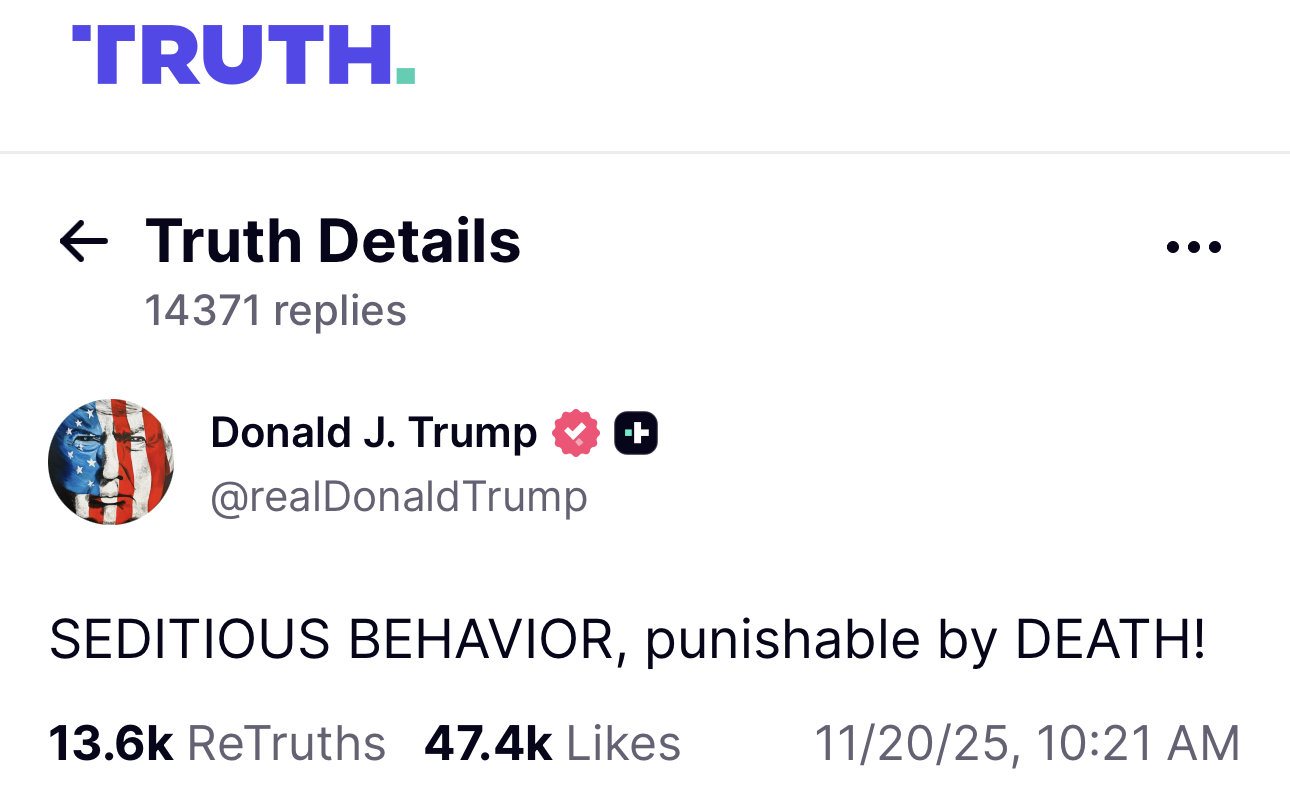
I think you run into a significant problem if you did this, given your tribal affiliation. You seem pretty comfortable smearing all left-of-center people with the extreme positions of far left communists. But I think it requires way less convoluted thinking to smear all Republicans and Republican-sympathetic centrists with the public statements of their chosen leader. And that would mean that all right-of-center people believe in… suspension of due process, disregarding the Constitution and the rule of law, executing political opposition, illegal taxation, and a huge list of other authoritarian abuses.
This might seem like a controversial aside of my own, but those are all ideas taken directly from Trump actions, tweets/truths, and public speeches. And sadly, I don’t really think most of them even will be controversial. Many of the relevant actions/tweets were pretty high profile.
In general I think that this line of thinking does not work that well when applied to political tribes, though. People often tolerate a large range of dissent within a political tribe if it helps them get elected and get a few things they care about done. And I think it makes more sense to smear a group for the behavior of the leader that the group supports, vs. the behavior of a niche subgroup that the main group tolerates and occasionally appeases in order to be large/stable enough to remain a viable group.
So I’m not convinced this is a principled position of yours that you apply consistently. This seems more like a justification for you making generalizations about a tribe you dislike.
Sure. I didn’t start this topic because I personally hate the asides. If I find something boring I just won’t reply. But did you find it valuable? I argued with it… are you interested in continuing that tangent now? Or is it just going to add to a bunch of stuff you feel kinda compelled to reply to but may not have energy for?
Yeah, you did it again I think.
I’ll leave this one unanswered since you seem to have rethought it after writing it. I think you left it in to demonstrate the behavior and ask that question, not to get into an abortion argument.
labels: trying to stay focused, light editing, casual effort
Off topic but a little relevant: This was suggested to me (by algorithm) the other day:
I was surprised that I hadn’t heard about this before. I can think of reasons that TRAs would want to suppress it but hard to know (might cause some issues because they’d be appealing to biological essentialism or adjacent). Maybe I should post it to BFITF thread too for discussion there.
Yeah. It seems like there’s 2 things in mild conflict here: the asides can be ignored and are useful for providing context and exposing ideas (they’re an option if they reveal something more important / deeper), and also they’re a distraction because they’re controversial. So it feels like they are more okay the more skilled (or at least focused) your discussion partner is.
It’s one of the posts I have half a reply drafted to, which I’ve deprioritized since this thread seems more important right now.
Hmm yeah, I see what you mean.
for what it’s worth, in hindsight I don’t think I was serious enough about this topic. (Also it occurs to me now that if I wanted to argue that leftism was hostile to christianity, it’d probably be better to start with the soviet union or ccp)
Yeah I half agree. Well maybe I should fully agree but also point out that synecdoche is happening in that there definitely are some very anti-western leftists, but they’re the minority (probably). I can pull up examples if we need but it’s not relevant right now I think.
On the note of synecdoche, I should say:
It sounded like, from your conclusion, that you maybe thought that I thought synecdoche is good or something. I think it’s bad and almost always an error. The paragraph I added about when it might be okay is not meant to be a defense of using it generally, just that I could think of one kind of case where it might be okay or useful.
You’re right in that I’m not principled about it and that I do it.
I think there’s an asymmetry here in that arguing for something being wrong is different than arguing for a specific position. And I’d guess that if you wanted to entertain a specific counter position as devils advocate, you’d bring this up via like a hypothetical, or have some context indicator about some other view/group disagreeing and then presenting their arguments, or something else that implies a different framing/context to prior comments. (I’m not sure I have any basis for that guess other than vibes)
Hmm okay – it depends. If you’re arguing for a position you think is actually wrong then it seems more like the devil’s advocate kind. It can still be useful, but it feels different to arguing for something being wrong outside of anyone else’s position.
Yeah something like that (and I agree it’s false in this case and generally).
And yeah I’m not consistent with it. I have some defensive type explanations that come to mind (like that it’s about the core of an ideology or whatever) but if I apply those consistently I should be harsher on the right too, and I should be more responsible in grouping (though using labels like ‘far left’ or ‘far right’ or ‘alt right’ or whatever feel basically meaningless in today’s political vernacular).
TBH I wish there was a centrist party that didn’t push their beliefs on their constituents so much. That would have been a lot better for preventing things getting this bad. I’m not sure such a party could lead us out of this situation though.
This is one of the reasons I wanted to bring it up and discuss it. I was thinking about it in part because I’d identified it in me as well as more broadly (I think both tribes do it).
I can guess the others but what do you mean by this one?
I’m not sure exactly what you’re referring to. I am finding this discussion valuable, if that’s what you mean. I’m happy to discuss any of the tangents I’ve brought up but I also might push back on discussing and just concede if it seems irrelevant or downstream of other topics.
Yeah that’s right. I thought it would be better to show more thinking and just like explore it a bit instead of trying to do a perfect reply or whatever. Hopefully the labels helped.
This is certainly an example of such an aside, but it is a topic I find interesting so I’ll reply.
This information is not new to me. I would guess it is not new to a lot of people, especially LGBTQ people. Trans people often say that trans people have a brain that is literally, physiologically, more aligned to their gender identity than to their gender assigned at birth.
Some LGBTQ people may not want to emphasize this due to disliking biological essentialism, the same way some LGBTQ people have drifted away from the common idea that gay people are born gay. But I would guess (without looking for facts, pure guess) that these are the minority… I would guess most gay people and trans people are fine with saying they were born that way and it is due to genetics/physiology.
I find it kind of fascinating that your initial instinct is that trans rights advocates are the ones that “suppressed” this info. From my perspective they are often shouting this from the rooftops (albeit with less technical detail than this video goes into, since this guy is teaching a biology class) and then anti-trans activists say they are wrong. I do not think “TRAs” even have the power socially to suppress this info even if they wanted to, and they absolutely do not want to. You can see lots of trans people in the comments of that video appreciating the lecture.
Also, when I googled this subject, one of the first things I found was an anti-trans website calling this exact topic a myth:
Even these anti-trans people agree with me that this is a widespread claim though. Here’s the initial text on their site (the starting sentence is bold already, but I’ll add bold to one part of one other sentence for emphasis)
“I was born in the wrong body”. We commonly hear this and similar phrases to describe what it feels like to be transgender. These sound-bites roll off the tongue with ease and have been repeated so many times that it is easy to believe they are true; that the brain is indeed gendered and mismatches can occur between the brain and the body. However, there is no credible scientific evidence to support this idea.
So yeah. I think your ignorance of this idea may have more to do with you not being very well informed on the overall subject, rather than being due to anyone suppressing information.
I think this is mostly true for the irrelevant controversial asides. If your discussion partner isn’t interested in an irrelevant aside, and isn’t baited into arguing due to finding it controversial and objectionable, then they can just ignore it.
I am unsure how valuable an aside actually is in such a case. You say the asides are useful for providing context and that seems possible to me, but not necessarily true. Probably depends on the specific irrelevant asides.
I do wonder about the value of asserting the asides as factual even for irrelevant ones. One of the issues I raised isn’t just that these asides are irrelevant and create tangents. It is also that the way you often present them puts the burden on your discussion partners to do the work. You don’t typically pair your irrelevant asides with any of your reasoning or arguments. So then it’s on us to argue against assumed “standard” reasoning, or probe for clarifying details, or similar.
Again if it is an irrelevant aside then we can just choose not to engage and then avoid that burden. But if the aside is the type that is supposed to be part of your argument, where you assert a controversial fact as if it’s just a general fact, then this can be more frustrating. An example of this would be the non-irrelevant aside about the church shooting.
Yes I agree that some leftists are very anti-western. I don’t need examples.
I don’t think I would classify that as too controversial, even. Not on this forum, for sure, but also not generally. I think some of the anti-western leftists would freely agree that they don’t like the west, and if asked they would give their arguments for why the west is bad. Then there may be another subset of lefties that you consider anti-western, but they reject that label and say they are fine with the west as a concept, they just dislike XYC western countries a lot for ABC good reasons.
And then there is another subset who reject the idea that they are anti-western, say they like western civilization, and explain that they have criticisms that they hope will make western civilization or specific western countries even better. My guess is that this last group is the overwhelming majority of left-of-center people in the USA.
Thanks for clarifying, I did interpret you as seeing it more like: sometimes an error when misapplied, sometimes good and useful when applied correctly.
One tangible example of this is a few months ago in the discussion of feminism. When I was criticizing men a lot, you eventually seemed to get frustrated that I wasn’t also criticizing women. That would be an example of the sort of thing I’m talking about. I’m not sure how you would characterize that now, in terms of the distinctions above.
I don’t think I was arguing for something I thought was wrong. But my estimation of things is contextual; I might think something is kinda bad objectively but much better than alternatives, and thus I could “defend” it. The defense would be sincere, and I may not mention the stuff about it that I view as bad.
Anyway, it may be a bit complicated. We don’t need to continue this tangent.
No. It depends on their reasons. E.g. they may be indifferent because they think something is unrealistic and won’t get anywhere politically. When the situation changes, like something is imminent and gets national attention, then lots of formerly indifferent people think about it more and stop being indifferent: some become advocates and some become opponents. Since it’s possible most of them will turn out to be opponents, it’s not fair to say they think it’s good.
This happens not just with indifference but also with favor or opposition. When something becomes more important, relevant, urgent, etc., people think it over more and may switch sides. It may turn out their favor or opposition was superficial. Some people who appear to favor or oppose a policy will switch sides before the policy gets over the finish line of being implemented.
What people really value is complex and sometimes they don’t even know. What they do when something is immediately relevant and being decided tends to be a better indicator than what they said from a distance, but it’s a flawed indicator too. For example, people may say they support something because they think it’s a foregone conclusion, or they want to get along with their neighbors, or various other reasons, but if they thought stopping it was more realistic or more popular in their social circle then they’d oppose it, and their real preference, if they could choose their full situation, would be to oppose it.
Maybe this is related to the people-not-knowing-the-best-arguments idea.
It surprised me because I’ve watched/read plenty of discussion, including reactions, debates, text analysis. While I have heard the claim that their brains are literally different, I’ve never heard any evidence for it, and moreover, I think that there are contradictory brain studies too (which I will try to check now).
Thinking more about it, there are issues with finding meaningful differences, it involves arguing that men and women have biologically distinct brains in ways that affect everyday life. This might present challenges for traditional feminism if these are differences in everyday life that influence one’s affect, emotional state and expression, interpersonal relationships (eg in the workplace), etc. [Maybe controversial] I think most feminists will resist ceding any ground on principle with matters like this.
Another problem is that identifying differences doesn’t actually support the modern TRA position that trans women are women. Rather, we end up with a list of binary factors that are (or are associated with) sex phenotypes. This suggests a natural (in the mathematical sense) way of defining gender which is as a collection of binary flags (similar to the way that enums are sometimes used in C if you’re familiar). So if we have two signals for gender that typically coincide but don’t always, we can construct a table mapping all values. Note: the exact signals don’t matter, just that they can be distinct. Also I just picked gender labels to be illustrative, we can call them A/B/C/D etc but doing it like my example doubles as an example of the kind of classifications TRAs (and trans-inclusionary LGBT+) would reject.
Gender
Sex/Gamete
amygdala thing size
Woman
female/large
big amygdala thing
Man
male/small
small amygdala thing
Trans Man / Trans-identified Female
female/large
small amygdala thing
Trans Woman / Trans-identified Male
male/small
big amygdala thing
Also, this obviously conflicts with the whole non-binary thing and says non-binary is wrong, gender is not a spectrum, but yes there are more than two genders. This would be the principled opinion IMO. It also works much better than the common ideas put forward by either the left or the right. It also means we can use male/female to just mean sex again, and it maintains the etymological origin of ‘gender’, that being ‘type’ (as in a category of a common kind, eg north/south/east/west/in/out, red/green/blue, etc).
So this seems clearly superior to me (probably controversial), but it is not at all “trans affirming” (probably not controversial). It also has consequences that probably no one likes, such as simultaneously backing additional pronouns and arguing against the singular they/them usage that the left has adopted/pushed (since there’s no need for it anymore).
gpt 5.5 thinking standard; answer about brain differences
If it enabled views like what I expressed above, would they?
IME the amount of technical detail has been basically zero. Maybe that’s a me-problem though.
This might be irrelevant but why did you put this in scare quotes? Would you put TERF in quotes too? Do TRAs object to being called trans rights activists? I thought this would be fairly uncontroversial that TRA is accurate and neutral. Is it just because the out-group(s) use it?
Yeah, good point. This possibly contributes to post-by-post fatigue/overwhelmedness (each post being longer and more effort to write, assuming I want to include reasoning).
Yeah okay that makes more sense. I think part of the reason I was frustrated was that it felt like arguing with someone with no views except for selectively applied arguments/rationality. It makes more sense now and I think I’d react differently, particularly with the above context.
Yeah that’s fair. I kind of feel like this with conservatives. I think i’ve brought up that I think people should criticize their own side more. eg I like separation of church and state, am pro-choice, leaning more anti-trump (though this seems to be becoming a more popular position on the right for US politics at least), against teaching ideology in school including religion/CRT/wokeism (except in a sociological sense).
I’m also pro-capitalism but anti-corporatocracy or whatever it is that trump and other US billionaires overwhelmingly support (overwhelming if weighted by their net worth, at least), etc. I’m anti coporatism too but didn’t realize that was already a different thing. That said, I suspect lots of right-leaning people are opposed to or unhappy with current billionaires’ actions/views/behaviors/etc.
Anyway that was a bit of an aside again. Maybe not so controversial though.
Did you look for evidence? If you ask AI for evidence, can it provide some? Does not hearing about it reflect more on what influencers you follow than what is available?
How do you know what “most feminists” are like? If you’re going by online posts by feminists, that doesn’t resemble a random sample. Feminist literature also isn’t a random sample. If you’re going by quotes and clips of feminists highlighted by anti-feminists, that’s even further from a random sample.
I don’t know what evidence this is coming from. Billionaires like Trump and Musk seem pretty popular on the U.S. right.
Why would you expect e.g. an online trans rights activist to be the right person to try to explain the detailed biology behind a claim like that? Wouldn’t it make make more sense to just investigate it separately? Even if they tried to explain it, they would probably be a biased layperson trying to summarize a scientific detail they don’t fully understand to justify their ideological position. You would be right to be skeptical of them in such a case.
But e.g. if you googled trans brains biology youtube without any quotes or anything… well, for me in a fresh browser window, that video you posted was literally the first result. That was the very first thing I tried googling; I did not try a few to see if I could get that video to pop up.
Besides, even if they did not have biology behind them, or they did not know the biology, the “my brain is in the wrong body” position still makes perfectly fine sense. Most people see the brain as a biological representation of their mind, personality, feelings, etc. So in just a sort of common sense language sense, that would be a fine position for them to take anyway. People can say that and the burden is not necessarily on them to provide you the biological arguments for it.
I don’t understand what your point is here, or what you think is such a challenge for feminists.
Do you think that feminists believe that men and women have precisely identical brains? Do you think that feminists believe that men and women have exactly identical influences on their emotional state, methods of expression, relationships, or anything else?
I’m confused. Maybe I’ve misunderstood. If I haven’t, then… why do you think that?
Edit:
I guess maybe this is the key part? I agree feminists probably wouldn’t like this framing. But also, I don’t think this framing remotely follows from anything discussed so far. You seem to be implying that a difference in BNST volume could have an impact to everyday life in some significant way? Why would it?
Even if the claim is true (I have no idea if it is or not), it might only be at all relevant in daily life if you specifically have the wrong BNST volume for your biological sex. Why assume it would even be relevant for cis men or women?
End of edit.
This all seems like a huge leap to me. I think you’re rushing to a conclusion in order to maintain a comfortable method of othering trans people.
There is no reason to believe this one gland example is exclusive or conclusive. Brains are complex and generally the least well understood human organ. Maybe there are dozens of other markers for trans people we have not clearly identified yet.
Also, we can literally restructure our brains to some degree with just our thoughts. I believe in the video the guy said these were post-mortem brain studies, so generally after a lifetime of being trans. So for this specific example I don’t know if we’ve ruled out the possibility that feeling/thinking you are trans over time might change your glands. I have no idea if that is possible, plausible, impossible, etc. It wasn’t brought up in that video and my guess is it would be hard to verify/study.
I see this as an interesting fact that contributes to an overall sense that being trans is real, but you seem to be very hungry to treat it as the conclusive sign of being trans and then extrapolating out from that an entire new classification system.
You also seem really confident that this would be upsetting to trans people, which is a bit self-fulfilling because if someone who is clearly bigoted against trans people wants to push a new classification system onto trans people I think they’d be right to resist that.
Setting aside my criticisms with you making this, why would this be so inherently upsetting to trans people? The only upsetting part is insisting on using bigoted gender-critical terms for them (“trans identified female”).
But the rest of this would be uncontroversial to most trans people. Why wouldn’t it be?
Is this part of a general misunderstanding where you think most trans people don’t know that they are different from cis people and e.g. trans women sincerely think they are “female” and completely identical in every way to AFAB cis women?
It’s a weird thing that I have seen other transphobes, not just you, say. I don’t totally understand. The trans community is literally the community that popularized terms like “trans woman” and “cis woman” — they are not generally under the misapprehension that they are identical to AFAB cis women. Why would you think they would be offended by a classification system that labels them as trans women?
My guess is because trans women also like being simply called “women”. But that’s fine, that is a social role label and is totally unrelated to and unchallenged by your classification system. Woman is not generally a biological term, it’s a social one. Trans women are a subset of the larger social classification of “woman.” When you call a trans woman a woman you are not saying she isn’t a trans woman anymore, the two aren’t mutually exclusive. Maybe this is where your confusion lies? I’m not sure.
Yeah so it seems like you just really want a tidier classification system, and the ambiguity in the trans discussion bugs you. The language in this paragraph gives the impression of being relieved. Like, “oh thank god we can just use these terms the way we used to, we can go back to these etymological roots, things don’t have to be so confusing and new.”
But a lot of trans identity comes down to internal feelings, self expression, and how one navigates through social spaces in the world. None of those lend themselves well to the super clean classifications you seem to want.
Singular they/them for gender neutrality long precedes the trans issue as a major political topic and did not used to be a left/right issue. It was a standard writing suggestion. The idea that the left has adopted/pushed this is, as far as I can tell, baseless. The left (or more accurately, anyone who isn’t anti-trans) has used it because it is normal English, and the right has gotten upset about it and pretended (against all evidence) that it was some new perversion of language.
Also you may find it interesting to know: neopronouns did not used to be a left/right issue either. The right wing TCS community pushed for a gender neutral neopronoun 20+ years ago. They used “hir” and strongly recommended everyone use it when discussing their children to avoid gendering them and revealing personal details.
I think I answered these already. If you disagree let me know.
As far as I understand, the term TRA was invented by gender critical people as a term that was hostile but had plausible deniability. It intentionally evokes the same pattern as MRA, which is a rights advocacy movement that has a very poor reputation online. Maybe I’m wrong and it originated elsewhere and just was popularized in this way?
But to some degree you’re right insofar as the actual meaning of it is pretty whatever, so many trans people who aren’t aware of the mean-spirited origins do not find it offensive. And even some who are aware of the origins don’t really give a crap. But it was never intended as a neutral term.
The term TERF actually did begin as an intentionally neutral descriptive term by trans inclusive radfems who were engaging in constructive discussion with trans exclusive radfems on how to handle trans people in their radfem spaces. It became more of a negative term because the discourse between anti-trans radfems and trans people became more acrimonious, and eventually it fell away from its roots. Often people who are not remotely radical feminists still get called TERFs because of that drift.
I don’t think it’s super useful to use these terms. You may note that I have used the term “gender critical” a few times here and in other discussions, which AFAIK is the term that anti-trans activists typically prefer and use for themselves. If I am going to use a negative term, I’ll just skip the euphemistic plausible deniability type stuff and say “transphobe” when I think it fits, since it is more accurate and straightforward.
I put TRA in scare quotes because I think you use that term for biased reasons that justify scare quotes. I think you have a strong preference for using gender critical framing and language; the only reason to use the term “trans identified male” is to make sure that you are not using the trans person’s preferred terminology. It’s kind of like if a trans person was named Steve and has changed her name to Luna, so you make sure to say “Luna, who went by Steve until last year” whenever you discuss her.
Gender critical people will insist this is about accuracy, but from my perspective I think a big motivator is something more like meanness. It feels good to defiantly refuse to be nice to people who you perceive as dangerous deluded bad actors.
I’m glad it makes more sense now.
What has made you lean more anti-trump? If it’s a big discussion feel free to make a new post or something. Or decline to answer, that’s fine too.
Do you think you could write a good/accurate summary of what it looks like when schools teach each of those ideologies?
That is, specifically and distinctly:
Religion (presumably Christianity in the US & western Europe)
CRT (Assuming you mean Critical Race Theory)
Wokeism
Do you think you understand each of these well, and know which ways schools are teaching these, and why they are each bad?
Yeah I remember that. I just searched and see over 2000 TCS posts with “hir” dating back to April 1996 (the month the TCS list started)! So that’s 30 years ago now!
“Hir” was often paired with “s/he” (which is also in over 2000 posts). It was also common to use ungendered nouns like “parent” and “child” instead of “he” or “she” (and “parent’s” and “child’s” were used too).
I used “hir” in my first TCS post in 2002 and in a few dozen other posts (sometimes I only quoted it, so I don’t have an accurate count).
I don’t think “hir” is a good option because when you say it out loud (or in your head to yourself while reading) it sounds like “her”.
Is BNST volume the thing from the neurobio video? In any case, it doesn’t really matter for my point.
If it didn’t have an impact on everyday life then it’s irrelevant for trans differences, and if it does then there’s a difference. So maybe it provides grounds for eg complaints about workplaces getting worse due to feminization. This is the core problem: the more that we understand these things, the more it could undermine common lefty positions.
The more differences and better understanding, the more justification there is for “transphobia” (which is any non-trans-affirming thought, afaict), and the more that some people will think that we’ll be able to address gender dysphoria medically (which is obviously not trans affirming).
Oh and if we get noninvasive tests then someone is going to say we can use it to tell the real trans from fake trans and I don’t see that being well received.
That’s why TRAs might not want research etc. There is also an argument that conservatives might not like this either because it could legitimize some trans stuff. An example of the latter: the trans mice thing that trump/doge made a point of like a year ago. That study to me seemed like a good study on the face of it.
I agree. I’m not sure what your point is here.
(My point about binary factors wasn’t that anything particular is an important/decisive factor, just that there are such factors, or if there are that people will weaponize it)
Yes, but that’s what some conservatives have been saying (more or less). That it’s cultural and memetic. The ‘woke mind virus’ is exactly this. So if we found out scientifically that was true, it would destroy the TRA position.
Oh the post-mortem thing, I agree. It’d be useful to know if we can we detect it in babies / very young children. (Though obviously we can’t use this as a predictive test and even a predictive test has issues controlling for culture.)
Yeah, see above. It’s not about whether I think it or not, it’s just that some people will, and some TRAs have realized this (long ago, I suspect).
Sure but do you feel the same the other way? Would you defend moderate conservatives resisting the changes to language and acceptable speech being pushed by people obviously bigoted against cis people?
Because that’s the principled approach (or at least there’s a good argument to be made for it being the principled approach; that being the origin of meaning).
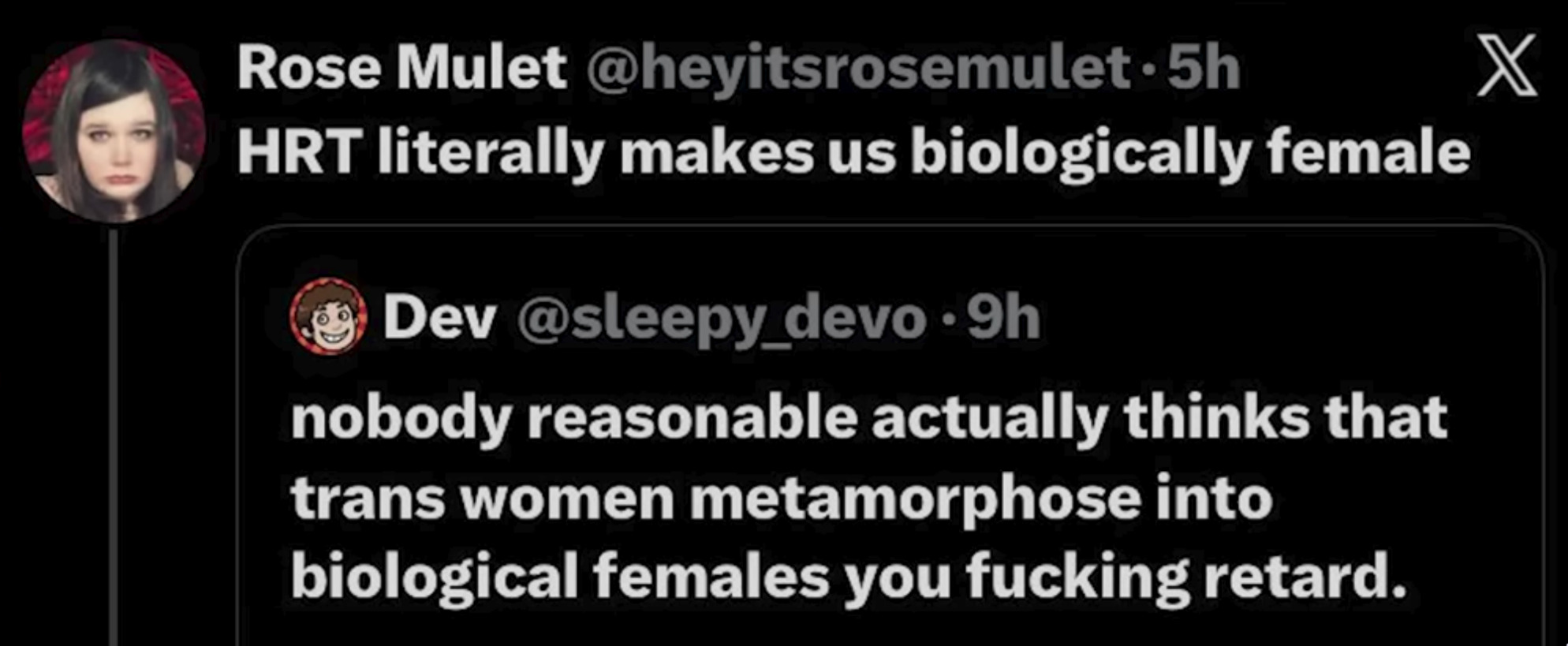
So, many trans people think that taking HRT turns you biologically into a woman. Insane, I know, but true. Majority? IDK, but as a minority they are loud.
Of course they know, and ‘completely identical in every way’ is too high a bar.
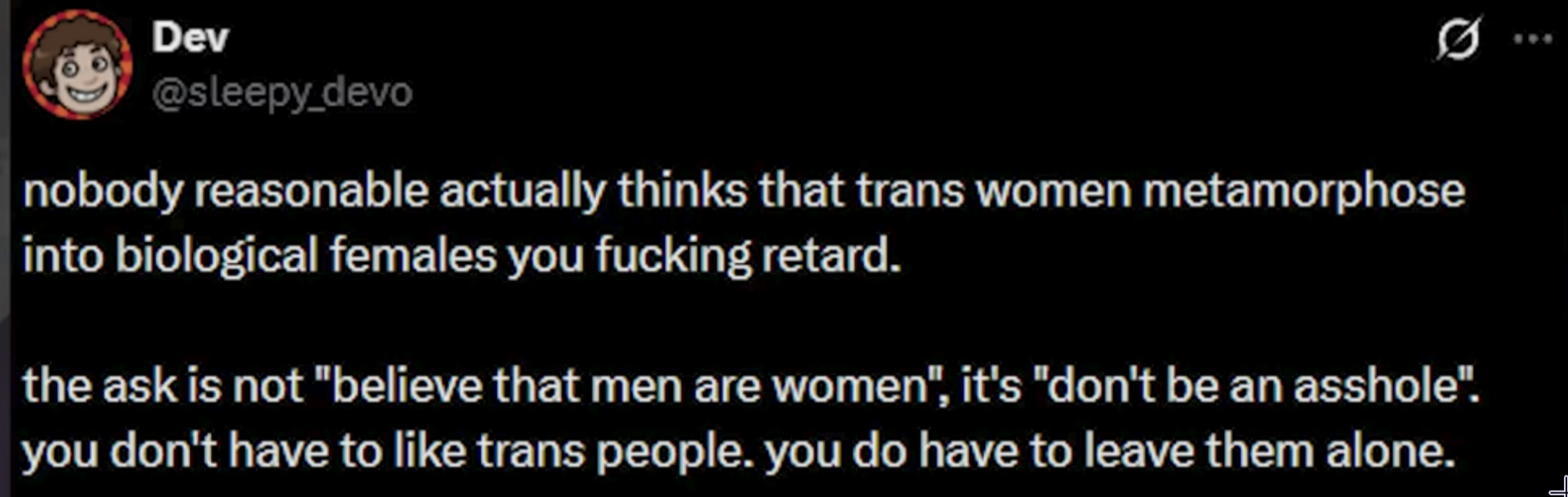
IDK if you are aware, but there was some twitter drama about this recently. It seems to me that you and I both have some similar position to Dev’s, putting aside his colorful language:
Video link is timestamped so you can see a bunch of responses to Dev’s tweet immediately after.
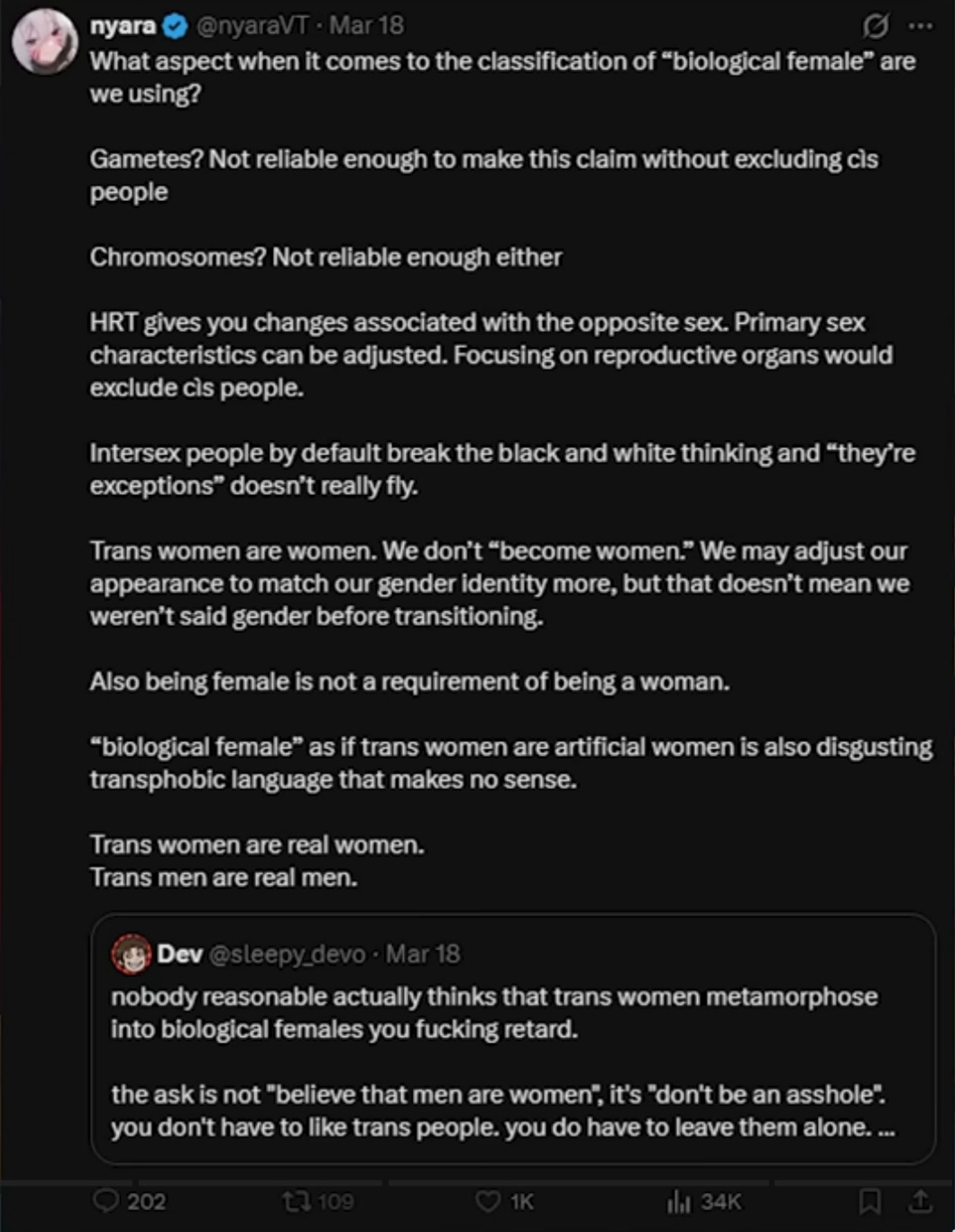
This was the response that I saw getting the most attention (and I think this is an early screenshot because others of this post I’ve seen had more likes).
The singular they/them has historically been used specifically for unspecified or unknown gender. Not for people who want to be outside the binary or whatever. eg “The customer said they wanted a bagel”. That’s fine. “John said they wanted a bagel.” Who is john talking about? Himself? A group? The customer from the previous sentence? Who knows. That was the demarcation. I remember a brief discussion in highschool english about the singular use of they, and at the time I couldn’t put my finger on why some uses felt weird, and some felt normal. I understand it now, but this idea that the contemporary (like lefties push its use today) singular ‘they’ has been used commonly is not accurate. Even wikipedia acknowledges this.
Woman is another word that has historically been used to mean an adult female human. It was clear. Now it’s a social role, too, whatever that means. To me, this seems kind of sexist (and it ignores roles like giving birth).
Anyway, it seems contradictory of you to selectively apply logic like this.
“Pushed” is a strong word. TCS had a norm of doing it for the reasons you stated, but that’s totally different to what’s being done today. They weren’t pushing it on people or forcing other people to use it (to my knowledge, at least). I remember the first time I heard someone (circa 202x) use one that I knew from TCS (can’t remember which), and it only convinced me even more about how ridiculous and performative the whole thing is.
Seems like this is the common answer on google. I’m happy to use whatever acronym if you know another.
Well GC is a position and transphobe is not .
You’re aware of the labeling-self-fulfilling-prophesy idea right? Like how it waters down the term, normalizes the ideas, and encourages people that you label to consider adopting the more extreme ideas, etc? IDK how real an effect it is, but it certainly seems like it might be real. Like did the left calling everyone nazis for a decade make it easier for nick fuentes to spew nazi shit? Anyway, just maybe something to consider. I think transphobia has increased in part due to every little thing being called transphobic.
I think both play a role (how much of each depends on the individual).
A new post at some point is probably best.
Probably not, in part because it’s done outside the syllabus (sometimes, not always), and also school isn’t something I’ve experienced recently or know that much about (meaning contemporary schooling).
I did see something from a high school math syllabus recently that included stuff about indigenous something or other (not even sure what there is to study considering a lack of written language). When you are including something like that next to calculus, I think it’s fair to say there is some external force involving itself.
Another example is teaching kids in primary school about anal sex. How common is that? IDK, and I’m not sure that anyone does, but it’s not zero, and I think it’s reasonable for parents to object to that kind of thing.
I’ve also seen (online) things like a US classroom removing US flags and putting up rainbow/trans flags; that seems pretty obviously inappropriate.
Generally no. But I’ve seen enough to know that it happens sometimes and that I don’t like it.
WRT schools teaching religion, I think that happens less these days and isn’t as much of a problem as it used to be. I included it because I’m against teaching all of them for the same reason.
This doesn’t follow at all. What if the impact is “nothing, you feel normal” unless your BNST volume is mismatched?
For it to have an impact on how trans people feel, the only impact it necessarily has is on how trans people feel. You are choosing to assume that it must have far-reaching impacts on daily life for cisgendered people for… no particular reason as far as I can tell?
Are you under the impression that trans people would not accept a medical solution to their problem, or would not want to find a medical solution to their problem? And that a medical solution to their problem would not be “trans affirming”?
This seems kind of ridiculous to me. Many trans people already seek medical solutions to their problem. They literally seek to “address gender dysphoria medically” right now, today. Why do you think that they would categorically reject future medical solutions?
Yes, I agree some people would say that, and it would be rightly considered a foolish/bigoted thing to say. Because it presupposes that there is only one possible cause of trans feelings, and therefore if we find one cause and some trans people don’t have it, we can safely invalidate their experiences and say they are fake.
This is would be like saying that we have found the cause of headaches, which is neck tension. If you have neck tension, then your headache is real. If you claim to have a headache but we can’t find neck tension, then you’re faking it.
That sounds stupid and cruel to me. If it was said about headaches, it would be stupid and cruel but possibly not bigoted (because IDK what existing demographic it is bigoted against? Maybe women, who suffer more non-tension-related migraines than men?). But when something seems stupid and cruel and explicitly targeted only against trans people, I think it is fair to call that transphobic.
Yes, of course. Right wing transphobes have a history of disliking and seeking to shut down research into transness like this. Do you think pro-trans lefties have a comparable history?
Do you agree? Your comments above seem to contradict that. Maybe you were citing the cause of trans topic as an example of what other people might say, and you agree it would be an example of foolish transphobes jumping to conclusions?
So you think trans people simultaneously hate the idea of there being a genetic cause but also hate the idea that there is not a genetic cause?
Bold added by me above. Those bolded weasel words are doing a lot of heavy lifting. I don’t think most anti-trans conservatives say that being trans is “cultural and memetic.”
Also, the “woke mind virus” is absolutely not exactly this. It is a loose term that gets applied to a wide range of topics well beyond trans people.
I think the claim that there are “changes to language and acceptable speech being pushed by people obviously bigoted against cis people” is false and kind of ridiculous. There is no appreciable faction of people bigoted against cis people. The closest you can find, which I assume is the content that you get amplified to you by right wing fearmongers and algorithms, would be isolated instances of members of a beleaguered minority lashing out at the people who routinely demean them.
They can sometimes look foolish and hostile, I agree. But they don’t have the power to push changes to language regardless; that’s done by a much broader population of people using language.
If you dropped off the last part and just said “there are changes to language and acceptable speech happening that I don’t like” then I would consider it much less ridiculous and more plausible. But also that happens all the time. Changes to language tend annoy people who feel like language should be a static thing following concrete rules. And changes to acceptable speech tend to annoy people who don’t like being told that their previous standards were harming people.
This is a red flag. When you say “many trans people think that taking HRT turns you biologically into a woman” and that this belief is “insane”, that implies they would believe that they are identical in every way to an AFAB cis women. But then you acknowledge that they know that’s not the case and is too high of a bar.
But if they know that’s too high of a bar, then they must mean something else by “biologically” or they recognize that “woman” is a social term not a biological one, or something. And then it might not be insane. Let’s read on.
Yeah so I was right to notice that red flag.
This person is rejecting the term “biological female” as a nonsense term. But they also explicitly say:
Also being female is not a requirement of being a woman.
Which implies they do in fact recognize possible distinctions. They also say “HRT gives you changes associated with the opposite sex” which implies they are using sex to refer to sex, and they are using gender to refer to gender.
I don’t think they needed to get angry about the term “biological female” — it may or may not be a bit nonsense but it is clear Dev means it as another phrasing for “cis woman” or “female sex” or whatever.
Dev is in a weird spot because he spent years cultivating a reputation for being conservative (by Canadian standards), anti-SJW, skeptical of what he saw as the extremes of feminism, transness, leftism, etc. But now he’s realized that has left him with an audience of mostly stupid, far-right bigots. So he fights his own audience a lot, but he doesn’t get much/any support from most of the lefties who he alienated. It’s unfortunate, he seems like a decent and relatively principled guy from what I’ve seen.
So that does mean I’m not surprised this person attacked Dev despite him trying to defend trans people.
You quoted me but didn’t reply. I’ll repeat it here:
Seems like the person in the screenshot agrees with this. They mention some distinctions such as sex and sex characteristics (and imply e.g. trans men start off with female sex characteristics, since HRT gives them “opposite” ones). But they clearly think that trans women are women.
Because woman is a social classification, like I said.
I don’t know what any of this has to do with what I said. But I’ll try to connect it. Here’s what I said again:
This is still correct.
To rephrase what you said: for most of history there were no people in society who wished to/were allowed to exist in society without conforming to an existing binary gender role. So the only instances where the gender neutral “they” came up were instances of unspecified/unknown gender.
But now we have people in society who wish to exist without conforming to one of the binary gender roles. These people wish for us to use “they” even after they specify their gender identity to us. That’s the part that is new.
So what “the left” is pushing is: Let’s respect these people that wish to exist in society without conforming to a binary gender role. We already have a gender neutral pronoun, so let’s just use that.
Right? So they aren’t really pushing a new linguistic thing, they’re just applying the most logical preexisting linguistic structure to a new social phenomenon. Instead of doing what the right recommends, and telling those people “fuck no, you have to conform to the binary gender roles”.
What am I missing?
Woman has always been a social role. Do you sincerely, truly think that the word “woman” has not primarily referred to a social role throughout most/all of human history? Do you really not know what “social role” means?
We can go down this tangent too if you want, but I’m not convinced it’s necessary because I’m skeptical that you’re being honest here. I think you know what social role means and why “woman” has been a social role.
“Pushed” is a strong word but “forcing” is an even stronger one.
Your belief is that “the left” is forcing people to use neopronouns? Or forcing people to use they/them?
What is your argument for this claim? It seems pretty absurd to me.
Huh?
My point was that when discussing the position, I’ll use gender critical instead of TERF, because TERF is like a euphemistic way to needle someone meanly with a bit of plausible deniability (like TRA). I don’t care to do that. And if I want to call out some specific position as bad, rather than calling it a TERF position to not-so-subtly signal I think it’s bad, I will just explicitly call it transphobic instead.
Sure, I’m aware. I do think it is plausible since lots of people are very stupid and easily swayed. I think that lots of conservatives got called nazis and then they decided that if they were being called a nazi anyway, maybe nazis aren’t that bad. I think this is a plausible partial explanation for why so much of the right wing now just openly embraces nazi rhetoric.
And I think something similar may have happened with transphobic. For example, that Dev tweet being called disgusting transphobic language. I think that’s too extreme, and I think someone who is less principled than Dev might get twisted by that sort of thing. They could decide that if they’re going to be called transphobic anyway, maybe transphobia is based and cool actually.
I do think this is a problem. In general more far left factions all share a big problem with purity testing and pushing people away who disagree a little bit. And most people do not have the wisdom or fortitude to stay out of tribes, so when they get pushed out of one tribe they often fall headfirst into the opposing tribe. So a lot of weaker-minded people who got the reply that Dev got may very well become transphobes.
I’m not sure that’s what you meant, or if you meant something similar but a bit different. To me, while this is a problem with purity testing, it is a bigger problem with the people who radicalize into terrible views because someone who they thought they were allied with was mean to them. It’s a personal failing in those people, first and foremost.
To me this reply is a big red flag. I think you are getting algorithmically radicalized by being pushed random niche content that is designed to make you angry about “wokeism”.
I think you should be better able to articulate what teaching CRT or wokeism in schools actually is before you say you are against it.
Big picture, @anonymous45 — is this discussion going how you might have hoped? Is it feeling productive to you? Overwhelming? Comfortable?
A lot of the discussion so far has come as a result of this off-topic aside, right? I’m happy to keep discussing it, but I am curious if that was your intention. Did you expect this result?
I’m not saying it has any particular impacts, though the claim that some brain related thing like this would have only one specific effect seems more of a reach to me (which you seem to agree with later on).
But ‘assume’ is exaggerating what I said in any case, I was suggesting a way that maybe it matters. Also even if it didn’t matter, if people could semi-credibly claim it matters then they might do that.
Also this part of the conversation was discussing why trans activists might not want the research done, I thought?
It contradicts ‘a woman is anyone who identifies as a woman’ and other related ideas.
It’s probably good to separate two categories: regular trans people, and radicals/activists.
I think lots of regular trans people just want to live their lives. That’s fine, and not a problem. However, these people are not writing legislation, lobbying, making content, etc.
Also, I think some medical solutions are considered more acceptable than others. Like obviously bottom surgery is a medical procedure. But if we developed a pill to resolve gender dysphoria, that would also be medical treatment. I think a lot of people would see the pill version like an attempt to ‘cure’ transgenderism or something and react negatively to it.
So that second type is what I mean by addressing it medically.
Yeah, I agree.
Yes, but it operates much more at like the academic level, or medical boards, or that kind of thing. My impression is that these areas of research have long been subject to pressure to not research certain things. So it’s not exactly the same but does have an effect on research (and if there is equivalent government action from lefties I’m not aware of it).
Yeah. With brain stuff particularly I think any kind of smoking gun is hard to establish properly. And it’s much easier to argue that detectable differences exist compared to causality. In general I’m in favor of more research.
I’m not sure why you switched to genetic particularly (environmental effects in the womb could play a role and be neither genetic nor memetic).
I think trans activists do have a bias about causality. Like if it turns out autistic girls (afab) aren’t actually more likely to be trans, just more likely to be groomed, well this would present a problem.
So in some ways, yeah I think (some) trans activists don’t want any research into causality to be done. The only acceptable path is to take them at their word.
Sure, I overstated the woke mind virus thing; it’s a bigger idea but it does encapsulate some of the cultural/memetic ideas.
I’m not sure what most conservatives think. That’s part of why I hedged. But some conservatives think it’s cultural.
Lots of people use phrasing like ‘straight white men’ or similar in a clearly prejudiced way; so I’d argue there is prejudice against cis men at least and that it’s not like a sub-1% opinion. (cis straight) women sometimes get a pass, and sometimes don’t.
And we do see laws re language being pushed, like misgendering/pronoun related laws, or ‘antidiscrimination’ laws disallowing separation based on sex and instead requiring it to be based on the new ideas of gender (at the exclusion of prior definitions, of course), including reinterpreting the wording of old laws with new definitions. Do you dispute that these things are happening?
Note: the laws aren’t exclusively about pronouns (though rulings might be).
They might not have the power to do it reliably but that doesn’t mean they aren’t pushing it. The only language I know of where something like this could be pushed by your standards is french (there’s a govt dept for standardization of the language). But it can be done elsewhere by criminalizing calling trans women men, which is enforced by govt. That enforcement separates that activists from the enforcers but I don’t think that really matters if the activists are advocating it.
It also annoys people more concerned with the truth than feelings.
Anyway, I’m okay with language changing, but I don’t like people trying to force the change. You’re repeating the kind of things that are doing that, like when you talk about ‘woman’ being about a social role. That’s one of multiple definitions, and it’s only used in certain contexts. The idea that somehow ‘woman’ has always been a social role and that’s the only acceptable definition is ridiculous, but that’s how some people see it, or how they seem to treat it at least.
I think you underestimate how much cancel culture and the like changed things. If you have a small minority who are able to create disproportionate impacts, well that’s exactly the kind of social arrangement that allows these kinds of things to happen. Do you dispute that people changed their behavior and language out of fear in response to cancel culture and all that?
You are comparing ‘most’ to ‘many’, and then equating ‘completely identical in every way to AFAB cis women’ to ‘HRT turns you biologically into a woman’.
Why should I not accuse you of weasel words, selective reasoning, showing red flags, out of context comparisons, etc? (Note: I’m only asking this because you started accusing me of it. I don’t think it would be productive.)
It also implies they agree with the sex/gender binary, but do you think you could get them to say it explicitly?
Also you’re doing the thing again where you pretend the other definitions of gender don’t exist or can’t be used or whatever.
Anyway, I’ve seen lots of examples of trans people being inconsistent about this kind of thing (by which I mean the logic presented by one person at one time is inconsistent, not that what X and Y said is inconsistent).
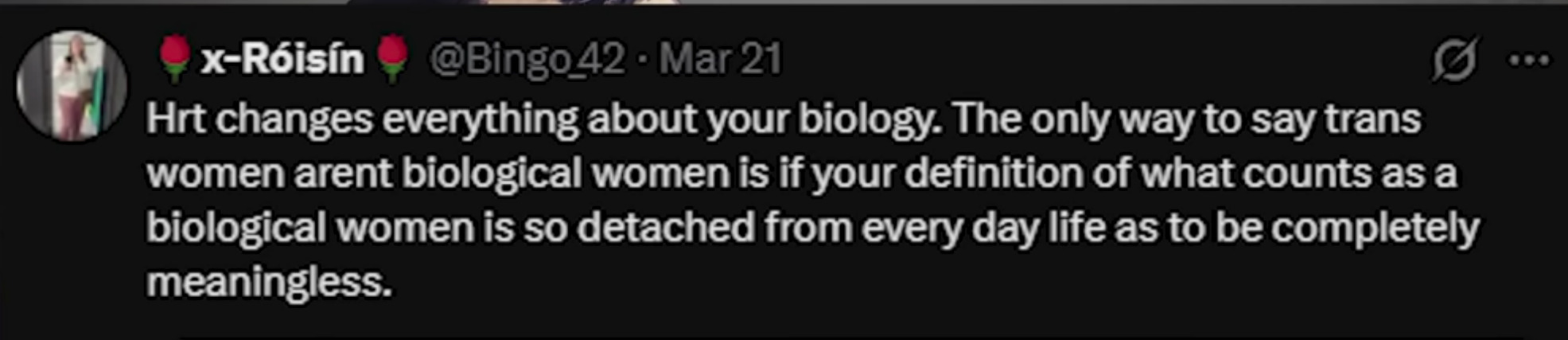
Also, although nyara’s tweet got the most attention, it was probably not the best followup to my point. if you checked dev’s video, there were a bunch like this:
Apparently it was ‘invented’ by TERFs or something (can’t remember where I heard this but was in the last 24 hours or so). I put invented in quotes cause it’s kind of an obvious term if you’re discussing gender-as-roles. But that’s why I think nyara is against it but okay with ‘cis women’, even though ‘cis’ means like ‘same side’ which only makes sense if there is a biological difference.
I watched a bit of a (recent) stream of his where he discussed falling off which he attributes to picking fights with the right. I guess that’s somewhat consistent with what you said but the order feels different. Also he does disagree with right wing creators a lot I think, like sargon. He doesn’t strike me as particularly right wing or particularly left wing. I also agree he seems reasonably principled, and he’s willing to explain his ideas a lot more than many other creators which I like, and he’s well read. Oh and he obviously isn’t afraid or unwilling to argue for what he thinks is right.
From memory he still treats the far-right as a threat. For example, one thing I saw on a recent video of his (I went and watched some after posting yesterday) was some apparently leaked DMs between some people on the right (maybe have been republicans, can’t remember) where the DM-ers said that the trans-kids angle was a foothold to like ban transgenderism all together. (Which I’m very much against, fwiw.)
Sorry it might not have been clear but I was quoting two related things and responding to both.
It’s one of multiple definitions. I don’t dispute that some people use it like that, and to understand what those people are properly saying we need to consider that as one of the definitions, however, it’s meaningless in isolation. This was an idea made up within the last century (I’m not sure when but i’d guess 60s-70s) and has entered use in some populations.
using existing words in a new way is pushing a new linguistic thing.
the new usage introduces substantial ambiguity where there was none.
commonly denying that it is new (there’s a lot of misunderstanding on both sides, like i’ve heard rightists complain about the singular use in general which is stupid, and heard leftists claim nothing has changed; though that’s similar to the change in definition of gender)
some people use it to describe everyone even when there’s no need, making the situation worse (and arguably misgendering those people since the use of they/them for a known not-they/them individual is politically charged).
ignoring the other times over the last few hundred years people have tried to introduce gender-neutral pronouns (though I guess I should say sex-neutral because those predate modern ideas about gender).
people adopting they/them in solidarity or whatever, even when they very clearly only fit one gender (both sex and role).
the fact that adopting it as part of a political movement means that it is automatically not neutral anymore (it might be sex-neutral but it certainly isn’t neutral in the way that normal words are neutral)
I think social roles were often tied to sex, but yeah of course I think that. It was used to refer to female humans. There was near universal overlap between social roles and gender sex, so i can understand why people can mistake these things, but a woman in knights armor would still be called a woman (to pick a time where the actual word ‘woman’ existed but clearly isn’t modern).
WRT ‘social role’, i have ideas but in the modern age, yeah I don’t really know what it means. In 1960 a social role of women was often like STAHM for example. But that’s not really a role anymore. Like people can do it but we also have STAHF so what’s the gendered role? Similarly, in the 60s women cooked, but now 50/50 or just personalized arrangements in general is way more common, so where’s the gendered role? This is what I mean by it seems kinda sexist, because I can only really make sense of it within the old sexist (patriarchal?) system.
Even if we consider midwifery where women females are extremely over-represented (naturally), is that a social role?
How can you talk about the social roles of males and females without being sexist and reductionist? How do you even talk about it without presupposing something immutable or quintessential about the two sexes? I would say men and women but women being defined by the social roles of women doesn’t make sense unless you acknowledge the grounding or origin of that.
Also, I don’t think that putting on a dress and cooking dinner makes you a woman, nor putting on makeup, nor having long hair, not wearing high heels, nor nurturing children. Imitating something will never make you the thing.
Part of the reason that I don’t think those things make you a woman is because women (meaning female humans) are not defined by doing those things.
Here’s a question: does the word ‘ladies’ refer to female humans or women (by your standard)? What about ‘girls’? If these are similar (gender roles), what are the collective nouns for female humans? You can argue ‘females’ if you like but I find that gross and clinical.
In highschool actually I remember thinking about how girls and women (by which i mean female humans) were referred to as ‘a female’ or ‘females’. Partly that’s because female was/is primarily an adjective to me and the noun use is just shorthand (more suitable for clinical/scientific settings, including nonhuman animals). But also it was because it felt like referring to them as like test subjects, as less than human and just an object defined by and valued for their sex organs. So I used the other words in english, deliberately: girls, women, ladies on occasion but that’s always felt a bit weird/archaic. Now though I can’t do that (well, I mean I can because 90% of usage is still people referring to gender sex). Moreover, it completely erodes ‘women in tech’ type stuff because now it refers not to female humans but to people filling a role that, in its cleanest form, contradicts the very thing that ‘women in tech’ was trying to achieve.
So please, enlighten me, what are the social roles that define women?
Please, point out where you think I’m being dishonest.
Enforcing something via law because you can’t convince people is grounds to use the word ‘force’ IMO. Threatening their jobs, livelihoods, family, freedom, etc constitutes force IMO.
I misinterpreted what you meant. I read it like you would say transphobe instead of GC. Your original statement still reads like you intend to use transphobe instead of GC, but your new explanation doesn’t.
Also FWIW I thought TERFs reclaimed the term, so like JKRowling isn’t offended if you call her a TERF (that’s my intuition at least).
Okay, we agree more than I thought then. I mentioned that effect in part responding to what I thought you were saying (replacing all GC usage with transphobe). Hopefully it makes a bit more sense in hindsight.
Maybe though I think this is a common fallback excuse and mostly a different topic (some of it is relevant but it’s also a big topic that touches a lot of other things). But a lot of my reaction has to do with my own thinking and reading. Like Orwell’s politics and the english language is an essay that had a big effect on me, and I think it’s roughly consistent with CF ideas about good writing (I haven’t done a close comparison). Orwell in general I think would agree with me about the way that ‘woman’ has been twisted as a word.
So yes algorithmic suggestions have affected me (radicalized I’d disagree with), but also I think a lot of my ideas about the left and trans issues are consistent with long-running trends in my opinions on things more broadly. And are consistent with my experiences of the left, too. I used to be (more) sympathetic to lefty ideas but IRL experiences convinced me otherwise. eg I helped organize a left-aligned protest at one point and when I thought it was done was around the time the other organizers thought it was time to get violent with the police. Obviously I didn’t really like them after that.
The “maybe” is about whether it provides grounds for a specific gendered issue, such as “feminization.” But your first sentence does not include the word maybe and I did not read it as being phrased as a maybe, I read it as definitive.
If you didn’t intend it that way, that’s fine.
I don’t think it necessarily contradicts that. It only contradicts that if you use the existence of a new medical solution to jump to extra conclusions about what that says about trans people, whether or not they are “real”, etc.
Those do not necessarily follow. Though I do agree that some people (who I would call transphobes) would make those jumps.
Radicals and activists of any type are often quite flawed. And a very common flaw is that they might take their position too far; that’s almost tautological in the case of “radical” I think.
On the other hand, radicals and activists are often the people who nudge public discourse. I think you agree with that; if anything I bet you think I am the one that seemed to disagree with that. I dunno if I agree that they are literally writing legislation very often, but they definitely push for rights and that sometimes results in legislation being written by more moderate politicians.
Since trans people have been marginalized and had their rights under assault, I see value in people fighting for those rights. But I may not always agree with the methods or arguments, especially of the most extreme radical activists. And I may not think the most extreme methods are effective, in addition to disagreeing with them on content.
None of this is unique to trans people BTW. The same statements have been true for other LGBT people, for black people (at least in the US), etc.
In general, the people who just want to live their lives and be left alone often significantly benefit from the actions of activists, though. If the activists fail, the “regular” people may not have the luxury of living their lives in peace.
When we discuss trans people as a generalized group I try to keep in mind all types of trans people. It seems like you primarily focus on the most extreme, most irrational activists that you’ve seen online.
It is worth noting that we currently do have a highly imperfect pill that cures gender dysphoria with various side effects, and you seem to view it pretty negatively. So I am not actually confident that if we developed a better one you and other gender critical people would embrace it. I think you would only embrace it if it cured gender dysphoria in a way that made you comfortable.
But I’ll imagine the new pill in question cures it in a way that conforms with gender critical preferences.
In which case, yeah, I think your guess is probably true. I think a lot of trans people (especially most of the people who have not begun transition) would absolutely take that pill. But I bet some wouldn’t want to, especially if they’ve already transitioned. And I bet some people that transitioned would have a negative view of other people taking such a pill.
I think this because we can see examples of this already: e.g. a lot of deaf people don’t like cochlear implants. This used to baffle me, and I viewed it as a terrible thing. I am more neutral about it now. I suspect you would still view that choice as condemnable, though. Maybe I’m wrong.
The reasons people make those choices are complex. Cochlear implants aren’t perfect, and can have many negative side effects. Realistically (not in a magic hypothetical), a dysphoria curing pill probably would not be perfect either, and have side effects. Also, marginalized communities are communities and develop their own subcultures over time. Many deaf people see getting a cochlear implant as choosing to abandon that community. They’re not necessarily wrong. Trans people also have their own communities and some of them would likely see such a pill in a similar way.
How familiar are you with academic practices and medical boards? What are you basing this impression on, exactly?
What is this based on? Can you give me some examples of trans activists shutting down research into causality? I am not denying it has ever happened, maybe it has and I just don’t know. But you seem to think it is a widespread issue. Is this claim falsifiable?
I am aware of the pop psych anti-trans book about autistic girls becoming trans men. But there has been plenty of research linking autism and gender dysphoria in general. There are apparent links there already (which is why I am skeptical that research into such links is being suppressed by powerful trans activists). It isn’t specific only to autistic girls. It seems like autistic people of all genders are much more likely to experience gender dysphoria than neurotypical people are. I don’t think any causality is known.
In general there are issues around this topic, such as people not being diagnosed accurately, suppressing feelings, gender biases in diagnosis or treatment, etc.
My understanding is that the number of trans men has gone up a lot recently, but it has gone up to become comparable to the number of trans women (it used to be much lower) — some people want to blame this on social contagion or grooming or whatever, but it seems like there are other possible explanations. The number of diagnosed autistic girls/women has also gone up a lot recently. Again, maybe this is due to tylenol or grooming or something, but also maybe it is due to some other cause, such as diagnostic criteria being gender biased.
I don’t think autism or gender dysphoria are perfectly understood. I’m skeptical of people making definitive claims about either topic based on the current research. But from what I am aware, the main reason research into this kind of thing gets shut down is because right wing governments (such as the current US government) hate research being done… I could stop the sentence there, but they especially dislike research into things they would rather see “eradicated,” and so they defund it.
I disagree but this will probably lead into a broader argument about bigotry and whether it makes sense to use a purely academic egalitarian standard or not.
Just to clarify…
It sounds to me like the laws you are discussing are about establishing rights for trans people. These laws are controversial, so it’s fine that if you dislike trans people and don’t think they are real and/or don’t deserve those rights, you would be against those laws. And you could even say the laws are being “pushed” since that’s what you do with laws I suppose. I broadly think these laws are good, you think they’re bad, cool, understood.
But you haven’t demonstrated at all that these laws are being “pushed” specifically by “people obviously bigoted against cis people” — you claim these people exist above, but you did not connect them to the laws at all. But originally this was a linked claim you made. The laws and changes to speech were being pushed by that group, specifically.
Can you let me know where this was done? I’m wondering if it is literally exactly as you say here, or if there is more context. I’m not too familiar offhand with laws outside the USA.
Yeah, but these two things are basically synonymous in this situation.
Do you think in the past there was nobody who was like… “What do you mean I can’t call them wetbacks? It’s a descriptive name because they crossed a river. The government literally called the big push to get rid of them Operation Wetback and now I can’t say that just because it hurts some feelings? I don’t care about feelings, I care about being truthful.”
Also a pretty famously offensive slur is directly derived from a simple skin color descriptive word (in a non-English language). So why should people stop using that just because it hurts some feelings?
“I am just a truth-teller, if you don’t like it that’s your problem” is a very standard defense whenever a bigoted person is told that their language is cruel or hurtful.
There’s something kinda funny that is loosely related to this topic IMO. This is my own potentially controversial aside: “facts don’t care about your feelings” is a rightwing/conservative catchphrase related to our current discussion, but as far as I can tell right now the right in America is overwhelmingly the tribe that is motivated entirely by feelings and not at all by facts. Hence why they e.g. run cover for bad stuff Trump says/does, because it feels good to see him trigger the libs or whatever.
I think you are the one that compared most to many. I said most, and in your direct reply you said many. Reposting:
See? Or did you mean something else? I think I just assumed you meant them to be comparable and tried not to sweat the slight change of framing.
I did think initially that “completely identical in every way to AFAB cis women” was basically comparable to “HRT turns you biologically into a woman” to you, because if you recognized the subtle distinctions then it made even less sense to me to call the claim insane.
HRT changes many biological characteristics to be in alignment to the ones that AFAB cis women have, so depending on what one means “HRT turns you biologically into a woman” it could be straightforwardly true or it could be controversial but still not “insane.”
If you think I am doing any of that stuff, feel free to mention it. I probably use weasel words sometimes; “weasel words” are like a negatively connotated type of hedging. Generally, if the hedging seems to be an attempt to obfuscate or be defensive, rather than simply clarify/constrain a claim. I definitely hedge a lot! It would not surprise me if you felt some examples of hedging were weasel words, and it might be useful to know which ones came across that way.
It implies they agree that there are approximately 2 types of sex characteristics, yeah. I do think I could get most trans people to say that explicitly, sure. A fundamental part of being trans is wanting to change your sex characteristics.
Sure, that’s plausible. People are inconsistent. Also, sometimes people can misunderstand someone else and think they’re being inconsistent when they are actually not, e.g. if they are discussing two nuanced related things that are different in subtle ways.
Okay. These are much shorter than the one you shared before, so it’s hard to judge them accurately. They might be dumb or they might be alluding to the nuanced differences the nyara tweet talked about in a less explicit way. I dunno. Would not be surprised if some of them are just dumb and overstating things because they are radicals.
Yeah I’m not overly concerned about this. I don’t mind terms like “biological woman” per se. Though I do think it is a bit conspicuous that gender critical people will consistently go through extra steps to resist using terms like “cis woman.” It makes any term they do use automatically kind of suspect, like they are contriving alternate terms in order to be performatively cruel towards trans people. So I understand why people who are more sensitive than me find that upsetting and have a bad association with any term they perceive as coming from TERFs.
I think you just misunderstood me. I probably wasn’t clear.
Right, he fights with right wing creators a lot now. He did not used to, e.g. I think he and Sargon used to mutually consider each other friends, not just allies or friendly acquaintances.
It’s not that he isn’t particularly right wing or left wing. He is a conservative leaning liberal; those are his words, and I think they’re accurate. That used to mean he fought with radical online far lefties and allied himself with a wide range of conservative-leaning people. But then conservatives went completely off the fucking rails, and he didn’t go with them. That is why he “was left with an audience of mostly stupid far right bigots” — he had alienated most farther left people already by being somewhat conservative, and now he is alienating all of the conservative people who (unlike him) stuck with their tribe and are now completely illiberal.
As far as I know his only remaining allies in online spaces are less radical left leaning liberals, which is a pretty small and often beleaguered or fracturing demographic in places like YouTube (despite being one of the two major political factions in the USA).
It’s not that he still treats the far-right as a threat. He used to not pay much attention to the far right, but now he recognizes that they are a threat. And not just a threat, but the major threat at this time. I think I somehow gave the opposite impression of what I intended before, sorry.
Okay. I would say that “woman” as a complex multi-faceted social role goes back at least as far as the beginning of recorded human history. My guess is it goes further than that, but I’m less confident about the specifics once you are talking about a period without any surviving written word or meaningful anthropological evidence.
Imagine we discover an alien species. During its reproductive cycle, this alien species encases fertilized embryos in an organic, self contained structure. Inside these structures, the embryos are protected from many typical dangers and are nourished by the organic material that was encased with them. Eventually, the embryo grows beyond the confines of the structure and breaks free as a newborn infant.
If we called those alien structures “eggs” is that pushing a new linguistic thing? It is an existing word being applied in a new way, to a new thing that did not exist when the word originated. But it is, as far as we can tell, the closest existing linguistic descriptor for what we’re seeing.
Of course in reality we call way less analogous stuff than what I just described *“*eggs,” as long as they roughly map onto some basic egg markers. Using they/them, which already served as a singular non-gendered pronoun, for a new category of people who do not want to be referred to by gendered pronouns is at least as logical as all the stuff we call “eggs.”
How so? It seems to reduce ambiguity, unless you just consider the existence of people who don’t want to be referred to by gendered pronouns to inherently introduce ambiguity. But that’s a different claim unrelated to linguistics, right?
(Note: copying just one numbered item changes the number to a bullet, in this quote and all the next ones. I am manually adding in the numbers.)
It’s a new application of an existing word, fitting the existing word’s existing use case quite closely.
I agree lots of right wing people now deny that they/them is ever singular, which is pretty odd.
So you’re saying you would prefer a neopronoun? I generally agree. I think they/them is linguistically kind of annoying/cumbersome when writing in some instances. A popular and widely adopted neopronoun would be great. Do you think trans people would generally disagree with us? I think they settled on they/them because they were trying to appease transphobes and trans-skeptical people with the path of least resistance, since they/them was already a gender neutral singular pronoun.
Not denying this may happen, but I am curious if you are thinking exclusively of people who explicitly say they are doing this? Or are you also lumping in people who you perceive to clearly fit one gender/sex/role and assuming they are doing it in solidarity?
Changing gender expression can be difficult. If you are e.g. AFAB with large breasts, then no matter what else you do you will generally be seen as obviously presenting as femme/a woman/female/etc. And if you say you want to use they/them pronouns people will probably assume you are doing it in solidarity or for political reasons or as a trend or whatever. But really it may just be that you have breasts and you have not yet or do not want to have them surgically removed.
Yeah, I agree that the politicization of pronouns is really lame. I wish politics wasn’t forced into the discussion.
I’m not sure I have the energy to try to explain social roles to you, but I’m going to try. I may make a second post to tackle this section specifically.
Do you think that a woman in knight’s armor who bound her breasts, went by a masculine name with a male honorific like “Sir” or similar, wore men’s clothes when out of armor, etc… would also still have been called a woman?
I think they would call her a man, unless/until they discovered her secondary sex characteristics such as breasts or vulva, at which point they would probably try to execute her or put her in a nunnery or something. There are a few historic cases of this.
Just to clarify, there can be multiple simultaneous social roles. There are many different roles associated with “woman” and “man” depending on context in any situation.
Many markers we have for identifying someone’s gender (or sex!) in social contexts involve conforming to various social roles.
A short list of examples: What style of clothes are they wearing? Are they wearing makeup? Do they have softer features? How long is their hair and how is it styled? Do they have facial hair? Do they have body hair? How tall are they? How are their fat deposits distributed? Do they have discernible breasts? Do they have an identifiable bulge?
These often involve, to various degrees, performing social roles associated with a gender or sex.
Yeah, many gendered roles involve sexism. They might involve sexism actively, or they may have involved sexism at some point in the history of the role.
Why would gendered roles presuppose something immutable about the sexes?
I think you are begging the question by dismissing gendered social roles as irrelevant, because you are starting with the premise that trans women aren’t women and only AFAB cis women are women.
Presumably you would go further and say you don’t think that having breasts makes you a woman, or having a vulva makes you a woman, right? Because trans women can get “fake” versions of these?
At a certain point we are left asking… what, in your estimation, does make someone a woman? Since it’s none of the normal markers or roles that have been used throughout history. Last time we discussed this I think you said something about gametes but not gametes themselves? Like they were “oriented around” a type of gamete or something? I forget the exact phrasing but I think I explained that it was a motte-and-bailey and never got any argument that it was not a motte-and-bailey. Regardless, I didn’t find it convincing.
But it’s a tough question to answer without something like that. The more gendered roles you dismiss, the more you run out of stuff to use to delineate “real” women from people who are just “imitating.”
Why would you ever need this collective noun outside of some clinical edge case?
Presumably because you find trans people distasteful and think they are faking/imitating, and you want a good word that clearly excludes them? So I guess you should just use “women” or “ladies” or whatever, and then you can clarify that you don’t consider trans-identified-males to be women?
You could just continue to do that, unless you find it important to explicitly exclude trans people. At which point, you should openly do that instead of these contortions.
How so? Unpack this a bit more.
No problem. Though I originally did say (inline notes added in bold) :
I said I would use gender critical, because it is the term gender critical people use for themselves. And then when I said if I was going to use a “negative term” then I would skip it, that is implied to be referring to the 2 terms I just spent a few paragraphs explaining why they were negative; TERF and TRA. I never implied gender critical was a negative term.
I think it makes sense.
It sounds to me like you may have gone from one form of radicalism to another after having a bad experience. Or maybe you were/are not radical, but you have a tendency to surround yourself with radicals by accident?
In my youth I was more far left and was involved in multiple protests and neither I nor any of the people I associated with got violent with police. I also did not advocate for oppressive social control. Then I became more right wing and participated in a couple of protests/events and still never got violent with police, or advocated for oppressive social control. Now I guess I’m more left again somehow, and I still don’t hang out with people who get violent or advocate for oppressive policies.
It is noteworthy to me that you were lefty before, and now have switched tribes so thoroughly. But this might make more sense to pause here and discuss (where relevant) in the politics megathread.